 How to resolve AdBlock issue?
News
- Details
- Written by: Ellen Furlong, Illinois Wesleyan University

I have discovered one positive amid the pandemic: I love working with two dogs at my feet.
As someone who studies dog cognition, I often wonder: What is Charlie learning when he stops to sniff the crisp fall air? What is Cleo thinking when she stares at me while I write? Are my dogs happy?
I’m not alone in finding myself suddenly spending more time with my pups and contemplating what’s on their minds. More people in the U.S. are working from home now than are working in the workplace, and many now share home offices with their canine companions. What’s more, many are finding their lives enriched with the addition of a new pet, as people started adopting dogs at massive rates during the pandemic.
This uptick in dog time means I have been fielding questions from new and experienced dog owners alike about their companions’ mentalities. Many questions center on the same themes I ponder: What is my dog thinking? Am I doing everything I can to ensure my pup is content?
Fortunately, research on dog cognition can help unravel what is on their minds and provide insight into what they need for psychologically fulfilling and happy lives.
Smelling superstars
Dogs are both familiar and yet fascinatingly alien. To appreciate their “otherness” all you need to do is consider their sensory world.
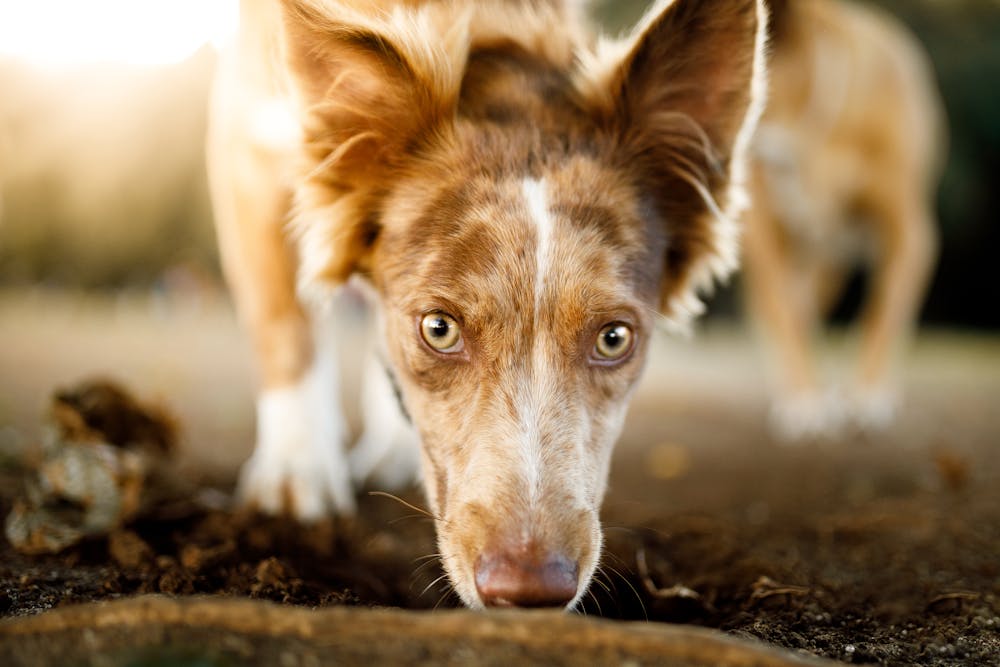
My dogs and I have very different experiences when we walk a trail. I marvel at the beautiful autumn day, but my dogs have their heads to the ground, seemingly ignoring the wonders around them.
However, they are appreciating something I can’t perceive: the scent of the fox who scampered through last night, the lingering odor of the dogs who’ve walked this way and the footsteps of my neighbor, who last wore her hiking shoes in woods my dogs have never visited.
You’ve probably heard about dogs who sniff out cancer, weapons or even coronavirus. These dogs are not special in their nose power: Your dog could do the same thing. In fact, the first dog to sniff out cancer sniffed a mole on his owner’s leg so frequently that she went to the dermatologist, where she was diagnosed with melanoma.
A dog’s sense of smell is estimated to be 10,000 to 100,000 times better than that of a human. This is due, in large part, to staggering differences in odor processing in humans and dogs.
While we have about 6 million olfactory receptors, dogs have a staggering 300 million. Their epithelium, or nasal tissue, is about 30 times larger than ours. And while people have between 12 million and 40 million olfactory neurons – specialized cells involved in transmitting odor information to the brain – dogs, depending on the breed, can have 220 million to 2 billion!
How can you even conceptualize this breathtaking difference in abilities? This disparity is like detecting one teaspoon of sugar in enough water to fill two Olympic sized swimming pools.
Now that your mind has been blown about your dog’s incredible sense of smell, you can use this information to make your dog happier by taking it on the occasional “sniffy walk” – letting it lead the way and take as much time to smell as it would like. Such walks can make dogs happier by allowing them to gain lots of information about the world around them.
The love is mutual
While there are parts of a dog’s mind that are alien, there are also parts that feel very familiar. Chances are, your dog occupies a special place in your heart. Recent research suggests your dog feels the same way about you. Your dog adores you.

Dogs attach to their owners in much the same way human infants attach to their parents. Like babies, dogs show distress when left with a stranger and rush to reunite upon their person’s return.
A recent study found that dogs that have been deprived of food and owners choose to greet their owners before eating. Further, their brain’s reward centers “light up” upon smelling their owners. And, when your eyes meet your dog’s, both your brains release oxytocin, also know as the “cuddle hormone.”
[Deep knowledge, daily. Sign up for The Conversation’s newsletter.]
All of this research shows that you can make your dog happier with just one ingredient: you. Make more eye contact to release that cuddle hormone. Touch it more – dogs like pats better than treats! Go ahead and “baby talk” to your dog – it draws the dog’s attention to you more and may strengthen your bond.
Understanding your dog’s mind can not only sate your curiosity about your companion, but can also help you ensure your pup lives a good, happy life. The more you know about your furry friends the more you can do to meet their needs.
And now I am off to gaze into Cleo’s bright blue eyes, give Charlie a belly rub, and then let them take me on a “sniffy” walk.
Ellen Furlong, Associate Professor of Psychology, Illinois Wesleyan University
This article is republished from The Conversation under a Creative Commons license. Read the original article.
- Details
- Written by: Lake County News reports
To highlight the life-threatening dangers of fatigued driving, the California Highway Patrol joins the Office of Traffic Safety, or OTS, the California Department of Transportation and the National Sleep Foundation in recognizing Drowsy Driving Prevention Week, Nov. 1 to 8, and encouraging Californians to stay alert and stay alive.
“Staying alert behind the wheel goes beyond avoiding distractions,” said CHP Commissioner Warren Stanley. “The other major contributor to driver inattention is drowsy driving. Fatigue can have a similar impairment effect as drugs or alcohol.”
According to the Centers for Disease Control and Prevention, being awake for at least 18 consecutive hours is the same as having a blood alcohol content of .05 percent. On average, in California, there are more than 6,000 crashes annually that are attributed to drowsy driving.
“If you’re feeling sleepy, you shouldn’t be driving,” OTS Director Barbara Rooney said. “When you ask yourself, ‘Am I OK to drive?’, the answer should factor in not only if you’ve been drinking or have taken drugs that impair, but also if you’ve had enough rest.”
“We should all remember that despite the pace of life, it’s vitally important to avoid driving when fatigued or without adequate rest,” said Caltrans Director Toks Omishakin. “Caltrans operates more than 85 Safety Roadside Rest Areas throughout the state, each providing a convenient place to rejuvenate before returning to the highway.”
The public can view rest area locations by visiting http://quickmap.dot.ca.gov/.
Some suggested tips to avoid drowsy driving include getting at least seven hours a day, sticking to a sleep schedule, and avoiding alcohol or medications that can cause drowsiness.
Caffeinated beverages may help in the short term, but are not a substitute for sleep or rest.
Stay alert and drive without distraction not only to protect yourself but also your passengers and other motorists.
- Details
- Written by: Elizabeth Larson
Dogs available for adoption this week include mixes of Chihuahua, German Shepherd, pit bull, Rhodesian Ridgeback and Shar Pei.
Dogs that are adopted from Lake County Animal Care and Control are either neutered or spayed, microchipped and, if old enough, given a rabies shot and county license before being released to their new owner. License fees do not apply to residents of the cities of Lakeport or Clearlake.
The following dogs at the Lake County Animal Care and Control shelter have been cleared for adoption (additional dogs on the animal control Web site not listed are still “on hold”).
Call Lake County Animal Care and Control at 707-263-0278 or visit the shelter online at http://www.co.lake.ca.us/Government/Directory/Animal_Care_And_Control.htm for information on visiting or adopting.

Male Chihuahua
This male Chihuahua has a short black and brown coat.
He has been neutered.
He’s in kennel No. 3, ID No. 13638.
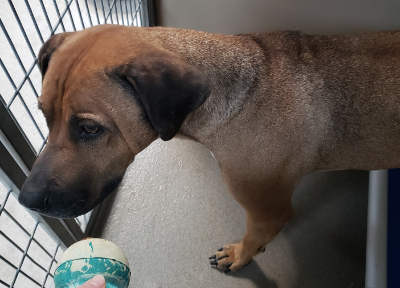
Shar Pei-Rhodesian Ridgeback
This male Shar Pei-Rhodesian Ridgeback has a short brown and black coat.
He is in kennel No. 19, ID No. 14132.
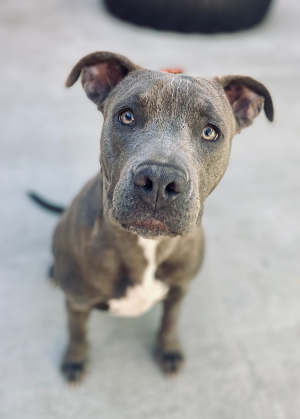
Female pit bull terrier
This female pit bull terrier has a short gray coat.
She is in kennel No. 21, ID No. 14127.

Female German Shepherd
This young female German Shepherd has a short tan coat with black markings.
She is in kennel No. 22, ID No. 14133.
Email Elizabeth Larson at
- Details
- Written by: James Mortimer, The Open University and Mahesh Anand, The Open University

The Moon was for a long time considered to be bone dry, with analyses of returned lunar samples from the Apollo missions showing only trace amounts of water. These traces were in fact believed to be due to contamination on Earth. But over the past two decades, re-analyses of lunar samples, observations by spacecraft missions, and theoretical modelling have proved this initial assessment to be wrong.
“Water” has since been detected inside the minerals in lunar rocks. Water ice has also been discovered to be mixed in with lunar dust grains in cold, permanently shadowed regions near the lunar poles.
But scientists haven’t been sure how much of this water is present as “molecular water” – made up of two parts hydrogen and one part oxygen (H2O). Now two new studies published in Nature Astronomy provide an answer, while also giving an idea of how and where to extract it.
Water and more water
The term water isn’t just used for molecular water, but also also for detections of hydrogen (H) and hydroxyl (OH). Although H and OH could be combined by astronauts to form molecular water at the lunar surface, it is important to know in what form these compounds are present initially. That’s because this will have an impact on their stability and location under lunar surface conditions, and the effort required to extract them. Molecular water, if present as water ice, would be easier to extract than hydroxyl locked in rocks.
The presence of water on the Moon is scientifically interesting; its distribution and form can help address some profound questions. For example, how did water and other volatile substances arrive at the inner Solar System in the first place? Was it produced there or brought there by asteroids or meteorites? Knowing more about the specific compound could help us find out.
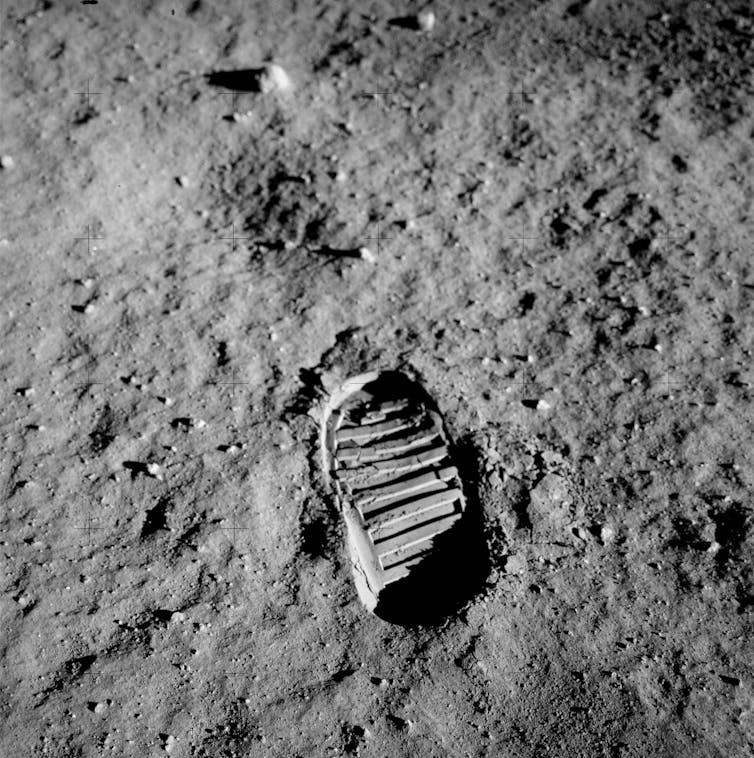
Understanding how much water is present, and its location, is also incredibly useful for planning human missions to the Moon and beyond. Water represents a key resource that can be used for life-support purposes – but it can also be split apart into its constituent elements and put to other uses. Oxygen could replenish air supplies, or be used in simple chemical reactions at the lunar surface to extract other useful resources from the regolith (soil composed of small grains). Water could also be used as rocket fuel in the form of liquid hydrogen and liquid oxygen.
This means that the Moon has great potential to become a refuelling base for space missions further into the Solar System or beyond. Its lower gravity and lack of atmosphere means it would require less fuel to launch from there than from Earth. So when space agencies talk of in-situ resource utilisation at the Moon, water is front and centre of their plans, making the new papers extremely exciting.
New research
Instruments on board various spacecraft have previously measured “reflectance spectra” (light broken down by wavelength) from the Moon. These detect light coming from a surface to measure how much energy it reflects at a specific wavelength. This will differ based on what the surface consists of. Because it has water, the Moon’s surface absorbs light at 3𝜇m wavelengths (0.000003 metres). However, absorptions at this wavelength cannot distinguish between molecular water and hydroxyl compounds.
Using the NASA/DLR Stratospheric Observatory for Infrared Astronomy (SOFIA) telescope, flown at 43,000 feet, the team behind one of the new papers observed sunlit sections of the Moon’s surface in wavelengths of 5-8𝜇m. H2O results in a characteristic peak in the spectrum at 6𝜇m, and by comparing a near-equatorial area as a baseline (thought to have almost no water) with an area near the south pole, this study reports the first unequivocal observations of molecular water under ambient conditions at the lunar surface at an abundance of 100-400 parts per million.
This is several orders of magnitude too large for most of the water to be adsorbed onto regolith grain surfaces. Instead, the authors suggest that the water they have observed must be locked up inside glass formed by tiny meteorites impacting and melting already hydrated regolith grains. Alternatively, it could be present in voids between grain boundaries, which would make it easier to extract. Where exactly this water is sited would be of extreme interest for future explorers as it would dictate the processes and energy required to extract it.
Luckily, the other paper used new theoretical models, based on temperature data and higher resolution images from the Lunar Reconnaissance Orbiter, to refine predictions of where conditions are right for molecular water to be trapped as ice.
Previous research has shown already that there are such kilometres-wide “cold traps” in permanently shadowed areas near the poles, where water ice may be present. Evidence from orbiting spacecraft, however, was inconclusive about this being molecular water or hydroxyl. The new study finds that there are also abundant small cold traps where conditions permit water ice to accumulate – on the scale of centimetres or decimetres. In fact, such traps should be hundreds to thousands of times more numerous than larger cold traps.
The team calculates that 0.1% of the total lunar surface is cold enough to trap water as ice, and that the majority of these icy cold traps are at high latitudes (> 80°). This is particularly near to the lunar south pole, narrowing down the choice of future landing sites with the highest chance of finding trapped water ice. However, it is important to realise that the two studies investigated areas at different latitudes (55°-75°S vs >80°S) and therefore cannot be compared directly.
Nevertheless, these latest discoveries further enhance our understanding of the history of water on our nearest neighbour. They will undoubtedly strengthen plans for a return to the Moon. Instruments such as the European Space Agency’s (PROSPECT payload on Luna 27) will be able to make measurements on the Moon to “ground-truth” these tantalising glimpses of the wealth of information yet to be discovered.
James Mortimer, Postdoctoral researcher in Planetary Science and Exploration, The Open University and Mahesh Anand, Professor of Planetary Science and Exploration, The Open University
This article is republished from The Conversation under a Creative Commons license. Read the original article.