How to resolve AdBlock issue?
News
- Details
- Written by: Elizabeth Larson
The National Weather Service has issued a red flag warning that covers most of California due to the winds now working their way across the state.
Red flag warnings are a factor that PG&E considers in determining whether to use public safety power shutoffs, or PSPS, to reduce fire danger.
PG&E’s shutoff, which began on Sunday afternoon, is impacting 361,000 customers in targeted portions of Alameda, Alpine, Amador, Butte, Calaveras, Colusa, Contra Costa, El Dorado, Fresno, Glenn, Humboldt, Kern, Lake, Madera, Marin, Mariposa, Mendocino, Napa, Nevada, Placer, Plumas, San Joaquin, San Mateo, Santa Clara, Santa Cruz, Shasta, Sierra, Siskiyou, Solano, Sonoma, Stanislaus, Tehama, Trinity, Tuolumne, Yolo and Yuba counties, PG&E reported.
Due to changing weather conditions, 105,000 customers who previously had been notified that their power could be turned off were removed from the shutoff’s scope, the company said.
In Lake County, 21,621 customers are included in the shutoff, including 1,572 customers in the Medical Baseline program. Earlier on Sunday, PG&E had removed about 5,000 county customers from the scope, including portions of the Northshore.
By 6 p.m. Sunday, PG&E said it had cut power to 225,000 of its customers, with another 136,000 to lose power during the course of the evening.
PG&E Senior Meteorologist Scott Strenfel said an ultra-dry air mass is washing across the state and that, as of Sunday evening, the region is entering the most critical period of the wind event.
In the North Bay hills, 53-mile-per-hour gusts have been recorded while relative humidity is at 15 percent. Gusts are forecast to be as high as 70 miles per hour, he said.
Strenfel said they believe a second round of winds could hit late Monday and into Tuesday over the region’s elevated terrain.
He said all agencies monitoring the winds – including the National Weather Service – agree that this will be the strongest event of the season, he said.
Strenfel said the forecast for the next 10 days shows no rain, but at the same time it doesn’t show a return of offshore diablo wind events. He said relative humidity is expected to begin to taper up in the coming days.
PG&E said it expects to see an all clear about midday on Monday, with plans to restore power in stages from Monday night through Tuesday night, safety permitting. Before restoring power, crews will inspect equipment for potential damage from the windstorm.
PG&E has opened seven community resource centers in Lake County, where people can get snacks and water, access wifi, charge devices and have access to ADA-accessible bathrooms. They’re open until 10 p.m. Sunday and will be open at 8 a.m. on Monday.
The centers are at the following locations:
– Clearlake Senior Community Center, 3245 Bowers Ave., Clearlake.
– Mountain High Coffee, 16295 Highway 175, Cobb.
– Scotts Valley Band of Pomo Indians Red Hills Property, 7130 Red Hills Road, Kelseyville.
– Konocti Vista Casino, 2755 Mission Rancheria Road, Lakeport.
– Twin Pine Casino and Hotel, 22223 Highway 29, Middletown.
– Community Baptist Church, 2877 State Highway 20, Nice.
– Upper Lake Middle School, 725 Old Lucerne Road.
For additional information, visit PG&E’s website.
Email Elizabeth Larson at
- Details
- Written by: Elizabeth Larson
The National Weather Service has issued a red flag warning across a large swath of Northern and Central California.
In Lake County, the red flag warning will be in effect from 11 a.m. Sunday until 5 a.m. Tuesday.
The agency also has issued a wind advisory that’s active from 5 p.m. Sunday through 11 a.m. Monday, and a freeze watch from midnight on Monday to 9 a.m. that day.
PG&E said as of early Sunday morning that shutoffs are likely, and that 26,227 Lake County customers – including 2,047 in the Medical Baseline program – are included in the potential outage area. That’s down from 31,590 county customers that initially were expected to be impacted.
The local shutoffs are tentatively scheduled to occur between 4 and 6 p.m. Sunday.
In Lakeport, where 1,228 customers are expected to be included if the shutoff occurs, city officials said they have deployed generators to critical water and wastewater facilities to ensure continued operation of these systems during the expected outage.
Customers can look up their address online to find out if their location is being monitored for the potential safety shutoff, and find the full list of affected counties, cities and communities here.
PG&E said its Emergency Operations Center, Meteorology team and Wildfire Safety Operations Center are working together and tracking the wind event.
The National Weather Service’s specific forecast for Lake County said winds are expected to be up to the mid-40s on Sunday and in the high 30s on Monday.
If PG&E goes forward with the shutoff, it said it will open seven community resources centers in Lake County. The centers will be open from 3 to 10 p.m. Sunday.
At the centers, community members will be able to get snacks and water, charge devices, use wifi, and have access to an ADA-accessible restroom and washing station.
The centers will be located at the following locations:
– Clearlake Senior Community Center, 3245 Bowers Ave., Clearlake.
– Mountain High Coffee, 16295 Highway 175, Cobb.
– Scotts Valley Band of Pomo Indians Red Hills Property, 7130 Red Hills Road, Kelseyville.
– Konocti Vista Casino, 2755 Mission Rancheria Road, Lakeport.
– Twin Pine Casino and Hotel, 22223 Highway 29, Middletown.
– Community Baptist Church, 2877 State Highway 20, Nice.
– Upper Lake Middle School, 725 Old Lucerne Road.
While there is still uncertainty regarding the strength and timing of this weather wind event, PG&E said high fire-risk conditions are expected to arrive Sunday morning and to subside Monday morning in most impacted areas, with windy conditions lingering in some regions through early Tuesday.
Once the all-clear is called, PG&E said it will begin patrol of the de-energized lines to assess whether they were damaged during the wind event.
PG&E said it will safely restore power as quickly as possible, with the goal of restoring most customers within 12 daylight hours, based on current weather conditions.
Email Elizabeth Larson at
- Details
- Written by: Kathleen Scavone

LAKE COUNTY, Calif. – I've always enjoyed observing bats appear at dusk as though by magic, while I'm relaxing on the deck at dusk.
They wing their way about the woods, silently sending out sound waves to echolocate moths, mosquitoes and more.
A bat or two has surprised me by flying out of the big shade umbrella as I unfurled it.
I wasn't able to attract bats to the bat boxes attached to trees in the yard, but plan to play host to some bats as soon as I relocate the houses at the proper ten feet above ground in an open area directed to the south-southeast, with six to seven hours of sunshine.
I draw the line at my bat appreciation when they appear to show interest in my own home, however.
While tidying up outdoors beneath the chimney I noted some bat droppings or guano. At least I think that's what it is, and I'll know for sure after I have an inspection by a professional.
By doing a bit of bat research I've learned that many bats are protected species by the California Department of Fish and Wildlife, or CDFW, due to the important role they play by consuming 50 to 100 percent of their weight in insects per night.
The CDFW's website states that, “Population declines have caused 17 of California's 24 native bat species to receive some level of state or federal protection.”
Since there are around 1,400 species of bats in the world and most are insectivorous, bats are heralded by farmers and the timber industry for their insect-suppressing abilities across the world.
Some species of bats are great at pollinating plants; in fact they are revered in Mexico where they pollinate agave, for tequila-making.
Some bats are known to aid in saving stroke victims. It turns out that there is an anti-clotting enzyme in bat saliva that can be synthesized.
Bats have supported science in other ways too, such as sonar research, advances in vaccine development and more.
Bats are mammals with a lifespan of 30 years or more. These furry critters can reach flight speeds of 60 miles per hour. Also, bats groom themselves like a cat and nurse their young – usually one 'pup' per year.
In nature, the bat's main predators are snakes, hawks, owls and raccoons. Typically bats find a snug place to roost, such as loose tree bark or tree cavities, but they may find a nice place under roof shingles, in attics or crevices in buildings to raise their pups. They can enter a crack or crevice that is less than half an inch in width!
Did you know Oct. 24 to 31 is International Bat Week? The CDFW tells us that during this time folks are invited to become “bat heroes” by informing others of the important role bats play, protect bats and their habitat, install a bat box home for bats on your property or join a citizen-science bat monitoring program.
To learn more about bats, bat box building, and learn a song called “Bats on the Brink” by Mister G a Latin GRAMMY winner, visit https://batweek.org/.
Kathleen Scavone, M.A., is a retired educator, potter, freelance writer and author of “Anderson Marsh State Historic Park: A Walking History, Prehistory, Flora, and Fauna Tour of a California State Park” and “Native Americans of Lake County.”
- Details
- Written by: Lake County News reports

NORTHERN CALIFORNIA – In addition to destroying and threatening thousands of homes and businesses, the devastating Glass Fire in Napa and Sonoma counties jeopardized the California Department of Fish and Wildlife’s Inland Chinook Salmon Program – until the Feather River Fish Hatchery in Oroville came to the rescue.
The Feather River Fish Hatchery is owned and maintained by the California Department of Water Resources, and operated by the California Department of Fish and Wildlife, or CDFW.
Each year, CDFW raises approximately 800,000 Chinook salmon smolts and fingerlings for planting and recreational fishing in large foothill and valley reservoirs from Fresno County to Trinity County.
These landlocked salmon often grow quite large and fill an ecological and recreational angling niche in these deep-water impoundments not typically occupied by other fish species.
The state record inland Chinook salmon came from Trinity Lake in 2013 weighing 20 pounds, 15 ounces. Anglers regularly catch inland Chinook salmon weighing 7 to 8 pounds at Lake Oroville and 5 to 6 pounds at Folsom Lake.
The inland Chinook salmon originate with eggs collected and spawned at the Feather River Fish Hatchery each fall from salmon returning to the Feather River. The eggs and fish are excess to the hatchery’s annual production goals.

About 1.4 million Chinook salmon eggs were collected from the Feather River Fish Hatchery in early October and designated for the Inland Chinook Salmon Program.
Ordinarily, most of these eggs are taken to CDFW’s Silverado Fisheries Base in Napa County for incubation, where they remain until the baby salmon are big enough for stocking.
The Silverado Fisheries Base suffered power outages and came under evacuation orders as a result of the Glass Fire.
In response to the emergency and with assistance from CDFW’s Inland Chinook Salmon Program staff, temporary adjustments were made at the Feather River Fish Hatchery to keep the eggs, incubate them and grow out the salmon until the Silverado Fisheries Base is once again able to accommodate the fish, likely in November.
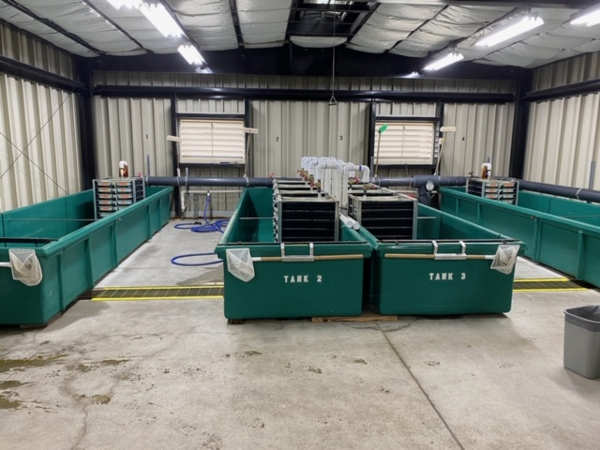
CDFW staff set up additional fish-rearing incubators in their Inland Chinook Salmon Building. That building typically only has space to hold 300,000 eggs and baby salmon destined for Lake Oroville. Thanks to the extra effort, the Feather River Hatchery is now holding 1.4 million eggs that represent the entire annual production of the state’s Inland Chinook Salmon Program.
“Understanding the inherent risk of losing an entire year’s production, CDFW staff will play a crucial role in ensuring future inland Chinook fisheries in Folsom, Oroville and eight other lakes and reservoirs,” said Kyle Murphy, a senior environmental scientist with CDFW’s Fisheries Branch. “This interagency teamwork will have long-reaching effects for thousands of anglers in central and northern California.”
Adding to the stress, the Feather River Fish Hatchery itself was ordered to evacuate for a day Oct. 15 due to a nearby fire in Oroville. Both the Oroville fire and the Glass Fire have been contained and no longer pose threats to either facility.