How to resolve AdBlock issue?
News
- Details
- Written by: Lake County News reports
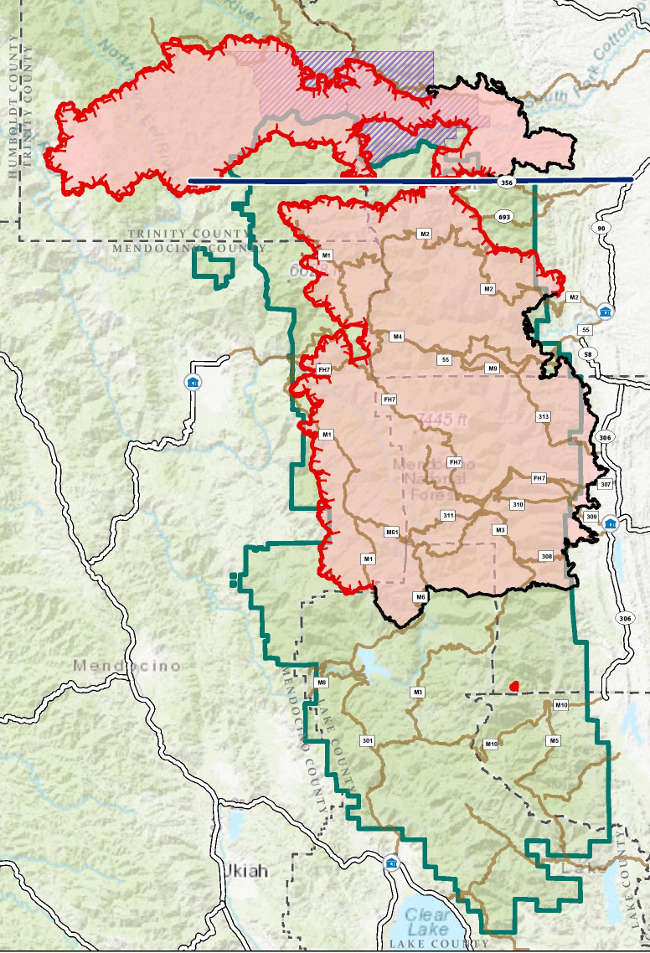
The US Forest Service said on Friday that the fires known as the August Complex – or the Doe – along with the Elkhorn, Hopkins, Willow and Vinegar were combined and are now collectively known as the August Complex.
The August Complex has grown to 875,059 acres and is listed as the largest fire in California history.
The complex will be split into three management zones: South, North and West, the Forest Service reported.
These fires have all burned together and the intent is to simplify the coordination of effort, ordering and timely release of accurate information, officials said.
The South Zone consists of the Doe Fire; the main area previously identified as the August Complex. It reached 498,202 acres and 25-percent containment on Saturday.
The August Complex will be managed under unified incident command between Great Basin Team 2-DeMasters (South Zone), California Interagency Incident Management Team 5-Young (North Zone), and Cal Fire Team 5-Parkes (West Zone).
The August Complex is burning on the Mendocino, Shasta-Trinity and Six Rivers National Forests.
Smoke cleared on parts of the fire Friday and helicopters assisted crews with water drops on hot spots around the fire. On Saturday, the Forest Service said crews continued to clear fuels and prepare around structures near Lake Pillsbury and in the communities near Eel River and Bauer Ridge.
Officials said authorization has been given to utilize a decommissioned road within the Yuki Wilderness and resources will enter the area as necessary for fire suppression. Fire resources are coordinating with Cal Fire Team 5 on the West Zone.
Evacuations are in effect in many counties, including Lake County, where Pillsbury Ranch and the entire Lake Pillsbury basin remain under a mandatory order.
For property owners who would like to talk to the Mendocino National Forest about access into their cabins, call the Forest Supervisor’s Office at 530-934-3316 from 8 a.m. to 4:30 p.m., seven days a week.
- Details
- Written by: Lake County News reports
The additional tools and resources will help ensure that residents have the information they need when making critical money decisions as they repair, rebuild, and recover following the recent fires and ongoing pandemic.
“When disaster strikes, the community comes together,” said Library Director Christopher Veach. “We want everyone to know that the library is both a welcoming convening place and a location where our families can obtain unbiased information to guide financial choices that will have lasting impact.”
Filing claims, accessing government resources, managing lump-sum payments from insurance companies, and meeting immediate expenses when income might be disrupted – these are just a few of the money challenges that residents in disaster areas must navigate.
FINRA Foundation President Gerri Walsh noted, “Many of us lack experience with these decisions. Nonetheless, we have to get it right the first time around or face long-term financial consequences. Fortunately, the library has information that can help.”
The expanded personal finance collections at the Library are made possible by a $5,000 grant from the FINRA Foundation.
For more than 15 years, the FINRA Foundation has provided funding, staff training and programs to build the capacity of public libraries to address the financial education needs of people nationwide. Much of this has been accomplished in partnership with the American Library Association through a program known as Smart investing@your library.
The FINRA Foundation is also providing the library with multimedia materials that explain the red flags of financial fraud and what people can do to be vigilant and counter the persuasion tactics that fraudsters use.
It is estimated that consumer financial fraud costs Americans more than $50 billion a year, according to FINRA Foundation research. Financial fraud is especially prevalent following major natural disasters.
Since it was established in 2005, the National Center for Disaster Fraud, which is part of the U.S. Department of Justice, has logged more than 100,000 disaster-related complaints from all 50 states. Financial fraud makes tough times all the more difficult for people recovering from the trauma inflicted by disasters.
The FINRA Foundation has issued an alert with practical guidance to help residents protect themselves from fraudulent schemes.
“Recovery follows disaster, but the path to recovery can be smooth or very bumpy,” Walsh said. “And financial fraud can be one of the biggest potholes along that road. Lake County Library has information to help people avoid the financial potholes and bring the route to recovery into sharper focus.”
The library’s website gives information about library programs, services and policies.
To speak to a library employee, call 707-263-8817.
The FINRA Foundation supports innovative research and educational projects that give Americans the knowledge, skills, and tools to make sound financial decisions throughout life.
- Details
- Written by: Elizabeth Larson
Dogs available for adoption this week include mixes of Chihuahua, husky, German Shepherd, Labrador Retriever, pit bull, pug and terrier.
Dogs that are adopted from Lake County Animal Care and Control are either neutered or spayed, microchipped and, if old enough, given a rabies shot and county license before being released to their new owner. License fees do not apply to residents of the cities of Lakeport or Clearlake.
The following dogs at the Lake County Animal Care and Control shelter have been cleared for adoption (additional dogs on the animal control Web site not listed are still “on hold”).
Call Lake County Animal Care and Control at 707-263-0278 or visit the shelter online for information on visiting or adopting.

Female Labrador Retriever
This female Labrador Retriever mix has a short black coat with white markings.
She is in kennel No. 9, ID No. 13989.
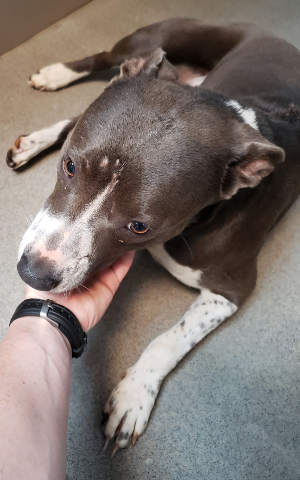
Female pit bull terrier
This female pit bull terrier has a short gray and white coat.
She is in kennel No. 18, ID No. 13990.

‘Oso’
“Oso” is a male pug-Chihuahua mix with a short tan and black coat.
He has been neutered.
He is in kennel No. 19a, ID No. 13999.

‘Little Gizmo’
“Little Gizmo” is a male Chihuahua with a short tricolor coat.
He has been neutered.
He is in kennel No. 19b, ID No. 14000.
‘Bear’
“Bear” is a male Chihuahua-pug mix with a short tan coat.
He has been neutered.
He is in kennel No. 20a, ID No. 14001.

‘Raider’
“Raider” is a male Chihuahua with a short tricolor coat.
He has been neutered.
He is in kennel No. 20b, ID No. 14002.

Male Chihuahua-terrier mix
This young male Chihuahua-terrier mix has a short tricolor coat.
He is in kennel No. 23, ID No. 14022.

‘Shiloh’
“Shiloh” is a male pit bull-chow chow mix with a short tan coat.
He is in kennel No. 24, ID No. 13992.

Female German Shepherd
This female German Shepherd has a medium-length black coat.
She has been spayed.
She is in kennel No. 28, ID No. 13995.
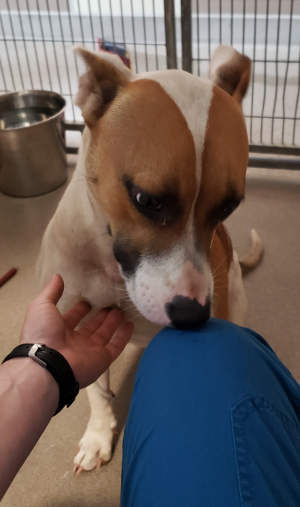
‘Lilly’
“Lilly” is a female pit bull-husky mix with a short brown and white coat.
She is in kennel No. 29, ID No. 13991.
Email Elizabeth Larson at
- Details
- Written by: NASA JET PROPULSION LABORATORY
As NASA's Mars rover Perseverance hurtles through space toward the Red Planet, the six-wheeler's twin is ready to roll here on Earth.
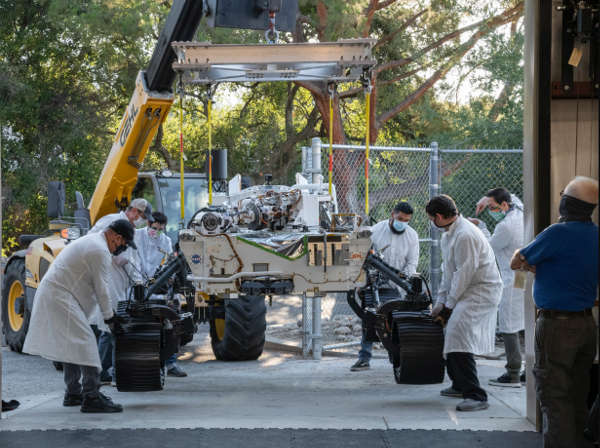
A full-scale engineering version of the Mars 2020 Perseverance rover – outfitted with wheels, cameras, and powerful computers to help it drive autonomously – has just moved into its garage home at NASA's Jet Propulsion Laboratory in Southern California.
This rover model passed its first driving test in a relatively tame warehouselike assembly room at JPL on Sept. 1.
Engineers expect to take it out next week into the Mars Yard, where a field of red dirt studded with rocks and other obstacles simulates the Red Planet's surface.
"Perseverance's mobility team can't wait to finally drive our test rover outside," said Anais Zarifian, the mobility test bed engineer at JPL. "This is the test robot that comes closest to simulating the actual mission operations Perseverance will experience on Mars – with wheels, eyes, and brains all together – so this rover is going to be especially fun to work with."
Wait, why does Perseverance need a twin?
Perseverance isn't flying to Mars with a mechanic. To avoid as many unexpected issues as possible after the rover lands on Feb. 18, 2021, the team needs this Earth-bound vehicle system test bed, or VSTB, rover to gauge how hardware and software will perform before they transmit commands up to Perseverance on Mars.
This rover model will be particularly useful for completing a full set of software tests so the team can send up patches while Perseverance is en route to Mars or after it has landed.
And just like Perseverance has a fitting name – one that captures the hard work of getting the rover on its way to Mars amid a pandemic – its twin has a name, too: OPTIMISM. While OPTIMISM is an acronym for Operational Perseverance Twin for Integration of Mechanisms and Instruments Sent to Mars, the name is also a nod to the mantra of the team that spent two years planning and assembling it.
"The Mars 2020 Perseverance test bed team's motto is 'No optimism allowed,'" said Matt Stumbo, the lead for the VSTB rover on the test bed team. "So we named the test rover OPTIMISM to remind us of the work we have to do to fully test the system. Our job is to find problems, not just hope activities will work. As we work through the issues with OPTIMISM, we gain confidence in Perseverance's capabilities and confidence in our ability to operate on Mars."
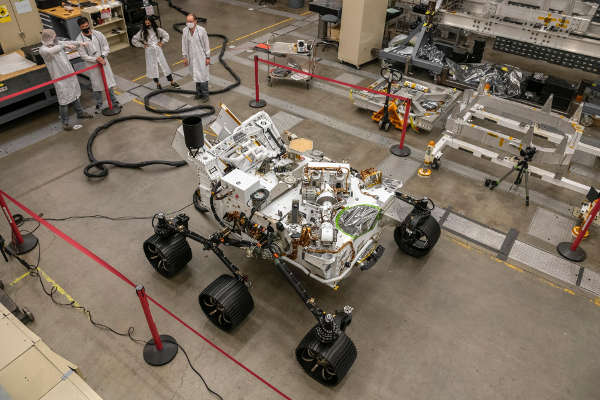
Almost identical
OPTIMISM is nearly identical to Perseverance: It is the same size, has the same mobility system and top driving speed (0.094 mph, or 0.15 kph), and features the same distinctive "head," known as the remote sensing mast.
After a second phase of building at the beginning of the new year, it will have the full suite of science instruments, cameras, and computer "brains" Perseverance has, plus its unique system for collecting rock and soil samples.
But since OPTIMISM lives at JPL, it also features some Earthly differences. For one thing, while Perseverance gets its power from a multi-mission radioisotope thermoelectric generator (a kind of nuclear battery that has reliably powered space missions since the 1960s), OPTIMISM features an umbilical cord that can be plugged in for electrical power.
That cord also provides an ethernet connection, allowing the mission team to send commands to and receive engineering data back from OPTIMISM without installing the radios Perseverance uses for communication.
And whereas Perseverance comes with a heating system to keep it warm in the frigid environment of Mars, OPTIMISM relies on a cooling system for operating in hot Southern California summers.
Welcome to the family
OPTIMISM isn't JPL's only VSTB rover. NASA's Curiosity Mars rover, which has been exploring the Red Planet since it landed in 2012, has a twin named MAGGIE (Mars Automated Giant Gizmo for Integrated Engineering). MAGGIE has been helping the Curiosity team particularly with strategies for driving across challenging terrain and drilling rocks.
OPTIMISM and MAGGIE will live side-by-side in the Mars Yard, giving JPL engineers a two-car garage for the first time.
"Missions that are operating require high-fidelity replicas of their systems for testing," Stumbo said. "The Curiosity mission has learned lessons from MAGGIE that were impossible to learn any other way. Now that we have OPTIMISM, the Perseverance mission is well equipped to learn what they need to succeed on Mars."
The Perseverance rover's astrobiology mission will search for signs of ancient microbial life. It will also characterize the planet's climate and geology, pave the way for human exploration of the Red Planet, and be the first planetary mission to collect and cache Martian rock and regolith (broken rock and dust). Subsequent missions, currently under consideration by NASA in cooperation with the European Space Agency, would send spacecraft to Mars to collect these cached samples from the surface and return them to Earth for in-depth analysis.
The Mars 2020 mission is part of a larger program that includes missions to the Moon as a way to prepare for human exploration of the Red Planet. Charged with returning astronauts to the Moon by 2024, NASA will establish a sustained human presence on and around the Moon by 2028 through NASA's Artemis lunar exploration plans.
JPL, which is managed for NASA by Caltech in Pasadena, California, built and manages operations of the Perseverance and Curiosity rovers.
Learn more about the Mars 2020 mission at https://www.nasa.gov/perseverance.