How to resolve AdBlock issue?
News
- Details
- Written by: Elizabeth Larson
On Friday, the Lake County Rodeo Association reported it had decided to cancel this year’s event, which had been set for July 10 and 11.
The association board of directors made the decision to cancel the 91st annual event after “much heartfelt discussion,” said President Adam Peters in a Friday statement.
“This decision has not come easily but with all the current restrictions in place due to the coronavirus pandemic we see no way to hold the rodeo this year,” Peters said.
Peters thanked the groups and local businesses that have made the rodeo possible over the years, including the California Cowboy Professional Rodeo Association, as well as the local barrel racing, team roping and queen competitions, and the children’s events for cutest cowpoke and mutton bustin’.
Peters said that the board believes that with a year to heal the communities from the impacts of the pandemic, the 91st annual Lake County Rodeo can be rescheduled and take place on July 9 and 10, 2021, at its usual location, the Lake County Fairgrounds in Lakeport.
“Our all-volunteer board, comprised of a variety of private residents of the county, takes great pride in bringing this community event to you every year,” Peters said.
Peters said they plan on returning with all the events connected to the rodeo – including the Saturday evening Rodeo Dance – plus great vendors in 2021.
The California Cowboy Professional Rodeo Association reported that several other rodeos have been canceled so far this season, but plans are still on for nearly 20 rodeo events between now and the association’s finals in September.
Email Elizabeth Larson at
- Details
- Written by: Elizabeth Larson
Lake County and other parts of northwest California remain under a hazardous weather watch through next week.
Forecasters said there are chances of rain during the day on Saturday, with a 100-percent chance on Saturday night.
Rainfall totals on Saturday night are estimated at between a quarter and a half an inch, and between a tenth and quarter of an inch on Sunday, according to the forecast.
Thunderstorms are possible on Sunday and Sunday night, as well as on Monday morning, with more rain expected on Monday night and into Tuesday. Conditions are then forecast to clear until Friday.
Winds of up to 14 miles per hour are forecast on Saturday and Sunday, with gusts of above 20 miles per hour on Monday.
Daytime temperatures will range from the high 50s to high 60s through Wednesday, rising into the low 70s on Thursday and Friday. Nighttime temperatures will range from the low 40 to low 50s.
Email Elizabeth Larson at
- Details
- Written by: Lake County News reports
“We continue to recommend that you follow local shelter in place orders and recreate close to home,” Mendocino National Forest Supervisor Ann Carlson said. “All visitors should practice self-sufficiency during their visit to the Mendocino National Forest. Recreating responsibly will help ensure that expanded access to recreational facilities, services, and opportunities continues. All services may not be available, so please plan accordingly.”
Responsible recreation practices include:
• Maintaining at least 6 feet distancing from others.
• Not gathering in groups and following the latest guidance from officials.
• Communicating with others as you pass, alerting users of your presence and stepping aside to let others pass.
• Packing out your trash and leaving with everything you bring in and use.
• Bringing your own water, soap, sanitizer and toilet paper.
Please check the forest website and social media pages for the most up-to-date information on what is open so that you can plan your visit. You can call the Supervisor’s Office at 530-934-3316 during regular business hours Monday through Friday, 8 a.m. to 4:30 p.m.
The following sites will open on the Mendocino National Forest beginning Saturday, May 16:
Grindstone – open:
OHV trails
Boating sites
Sacramento River Boat Launch and Day Use Area
Campgrounds
Davis Flat – OHV
Fouts – OHV
Kingsley Glade
Little Stony – OHV
Mill Creek – OHV
Mill Valley – OHV
North Fork – OHV
Old Mill – OHV
Rocky Cabin
South Fork – OHV
Sugarfoot
Sugar spring
Three Prong
Toomes Camp
Whitlock
Group campgrounds
Grey Pine – OHV
Info site/fee station
Wolf Creek Vis – OHV
Interpretive site
Firefighter memorial
Nye cabin site
Upper Lake OPEN
Pine Point Picnic Area
Covelo OPEN
Hammerhorn Lake Day Use Area and Campground
Eel River Campground
Howard Meadow CG
Howard Lake CG
Little Doe
Atchison Campground
Closed recreation sites:
Grindstone Ranger District
Camp Discovery Group Camp
Masterson Group Camp
Plaskett Meadows Campground and Day Use Area
Sycamore Grove Campground
Wells Cabin Campground
West Crockett Campground
Upper Lake Ranger District
Bear Creek Campground
Deer Valley Campground
Fuller Grove Campground
Middle Creek Campground
Navy Campground
Oak Flat Campground
Penny Pines Campground
Pine Mountain Lookout Rental Cabin
Pogie Point Campground
Sunset Campground
The following remain closed by the Ranch fire, Forest Order No. 08-20-02:
Cedar Camp
Dixie Glade
Main Letts Lake
Saddle Camp Loop
Spillway
Stirrup
Big Springs
Summit Springs Th
Various OHV trails on Upper Lake Ranger District
For more information, visit the Mendocino National Forest on the Web, Facebook or Twitter.
- Details
- Written by: NATIONAL AERONAUTICS AND SPACE ADMINISTRATION
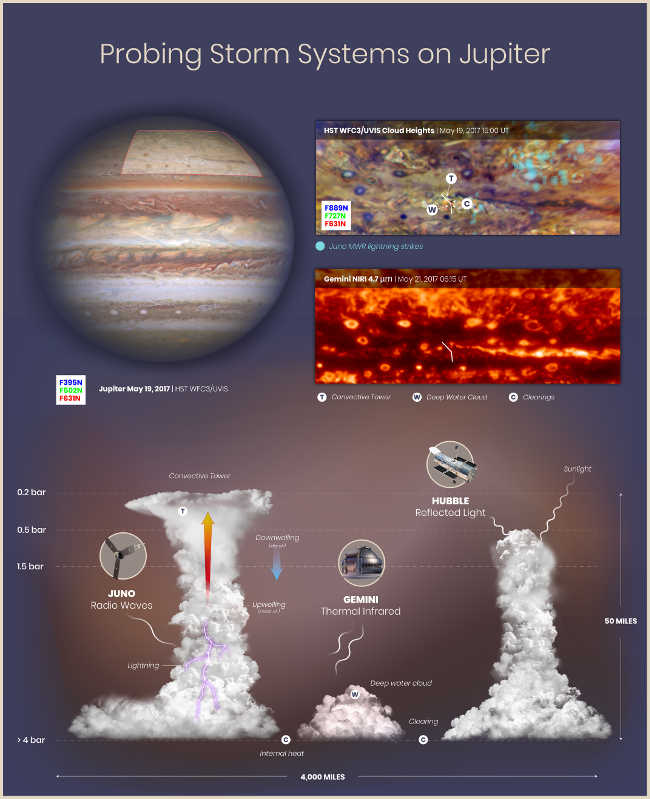
NASA's Hubble Space Telescope and the ground-based Gemini Observatory in Hawaii have teamed up with the Juno spacecraft to probe the mightiest storms in the solar system, taking place more than 500 million miles away on the giant planet Jupiter.
A team of researchers led by Michael Wong at the University of California, Berkeley, and including Amy Simon of NASA's Goddard Space Flight Center in Greenbelt, Maryland, and Imke de Pater also of UC Berkeley, are combining multiwavelength observations from Hubble and Gemini with close-up views from Juno's orbit about the monster planet, gaining new insights into turbulent weather on this distant world.
"We want to know how Jupiter's atmosphere works," said Wong. This is where the teamwork of Juno, Hubble and Gemini comes into play.
Radio 'light show'
Jupiter's constant storms are gigantic compared to those on Earth, with thunderheads reaching 40 miles from base to top — five times taller than typical thunderheads on Earth — and powerful lightning flashes up to three times more energetic than Earth's largest "superbolts."
Like lightning on Earth, Jupiter's lightning bolts act like radio transmitters, sending out radio waves as well as visible light when they flash across the sky.
Every 53 days, Juno races low over the storm systems detecting radio signals known as "sferics" and "whistlers," which can then be used to map lightning even on the day side of the planet or from deep clouds where flashes are not otherwise visible.
Coinciding with each pass, Hubble and Gemini watch from afar, capturing high-resolution global views of the planet that are key to interpreting Juno's close-up observations.
"Juno's microwave radiometer probes deep into the planet's atmosphere by detecting high-frequency radio waves that can penetrate through the thick cloud layers. The data from Hubble and Gemini can tell us how thick the clouds are and how deep we are seeing into the clouds," Simon explained.
By mapping lightning flashes detected by Juno onto optical images captured of the planet by Hubble and thermal infrared images captured at the same time by Gemini, the research team has been able to show that lightning outbreaks are associated with a three-way combination of cloud structures: deep clouds made of water, large convective towers caused by upwelling of moist air — essentially Jovian thunderheads — and clear regions presumably caused by downwelling of drier air outside the convective towers.
The Hubble data show the height of the thick clouds in the convective towers, as well as the depth of deep water clouds. The Gemini data clearly reveal the clearings in the high-level clouds where it is possible to get a glimpse down to the deep water clouds.
Wong thinks that lightning is common in a type of turbulent area known as folded filamentary regions, which suggests that moist convection is occurring in them. "These cyclonic vortices could be internal energy smokestacks, helping release internal energy through convection," he said. "It doesn't happen everywhere, but something about these cyclones seems to facilitate convection."
The ability to correlate lightning with deep water clouds also gives researchers another tool for estimating the amount of water in Jupiter's atmosphere, which is important for understanding how Jupiter and the other gas and ice giants formed, and therefore how the solar system as a whole formed.
While much has been gleaned about Jupiter from previous space missions, many of the details — including how much water is in the deep atmosphere, exactly how heat flows from the interior and what causes certain colors and patterns in the clouds — remain a mystery. The combined result provides insight into the dynamics and three-dimensional structure of the atmosphere.
Seeing a 'jack-o-lantern' red spot
With Hubble and Gemini observing Jupiter more frequently during the Juno mission, scientists are also able to study short-term changes and short-lived features like those in the Great Red Spot.
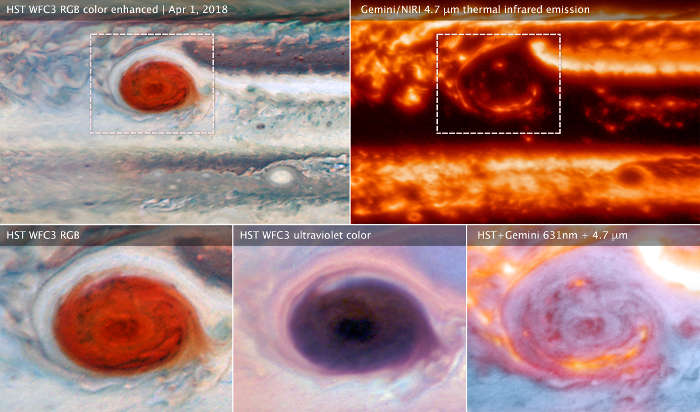
Images from Juno as well as previous missions to Jupiter revealed dark features within the Great Red Spot that appear, disappear and change shape over time. It was not clear from individual images whether these are caused by some mysterious dark-colored material within the high cloud layer, or if they are instead holes in the high clouds — windows into a deeper, darker layer below.
Now, with the ability to compare visible-light images from Hubble with thermal infrared images from Gemini captured within hours of each other, it is possible to answer the question.
Regions that are dark in visible light are very bright in infrared, indicating that they are, in fact, holes in the cloud layer.
In cloud-free regions, heat from Jupiter's interior that is emitted in the form of infrared light — otherwise blocked by high-level clouds — is free to escape into space and therefore appears bright in Gemini images.
"It's kind of like a jack-o-lantern," said Wong. "You see bright infrared light coming from cloud-free areas, but where there are clouds, it's really dark in the infrared."
Hubble and Gemini as Jovian weather trackers
The regular imaging of Jupiter by Hubble and Gemini in support of the Juno mission is proving valuable in studies of many other weather phenomena as well, including changes in wind patterns, characteristics of atmospheric waves and the circulation of various gases in the atmosphere.
Hubble and Gemini can monitor the planet as a whole, providing real-time base maps in multiple wavelengths for reference for Juno's measurements in the same way that Earth-observing weather satellites provide context for NOAA's high-flying Hurricane Hunters.
"Because we now routinely have these high-resolution views from a couple of different observatories and wavelengths, we are learning so much more about Jupiter's weather," explained Simon. "This is our equivalent of a weather satellite. We can finally start looking at weather cycles."
Because the Hubble and Gemini observations are so important for interpreting Juno data, Wong and his colleagues Simon and de Pater are making all of the processed data easily accessible to other researchers through the Mikulski Archives for Space Telescopes, or MAST, at the Space Telescope Science Institute in Baltimore, Maryland.
"What's important is that we've managed to collect this huge data set that supports the Juno mission. There are so many applications of the data set that we may not even anticipate. So, we're going to enable other people to do science without that barrier of having to figure out on their own how to process the data," Wong said.
The results were published in April 2020 in The Astrophysical Journal Supplement Series.