 How to resolve AdBlock issue?
News
- Details
- Written by: Lake County News reports
This year, due to the COVID-19 pandemic, the event is going online.
“Normally, our campus and our students would be in the midst of a multitude of celebrations as we near the end of the academic year and though we may not be able to celebrate as we normally would due to the pandemic, I want to congratulate our 2020 graduating class for their unwavering commitment to their education and tenacity to finish,” said College President Dr. Art Pimentel.
The WCC Commencement Planning Committee has been hard at work during the last month to
transition the college’s most important celebration to a virtual modality due to the ongoing COVID-19 and properly honor this year’s 344 WCC graduates.
YCCD Chancellor Douglas Houston, YCCD Trustee Susan Alves, Academic Senate President Christopher Howerton, ASWCC President Katrina Toups, and our Valedictorian Grace Matayoshi have recorded messages to the class of 2020 which will be streamed on Friday, May 15, at 6 p.m.
Community members who wish to view the ceremony can access the video on the college’s website at http://wcc.yccd.edu .
The Lake County Campus is taking the same approach and will be streaming its ceremony at the same time.
The LCC ceremony will be accessible at http://lcc.yccd.edu .
This year’s keynote address will be given by Dr. Cesar Cruz from Empowerment Homies.
Graduates were asked to submit a picture and short message that will be displayed along with their name, degree/certificate earned, transfer institution (if applicable) and honors.
“On behalf of all the Woodland Community College professional staff, faculty, and leadership, I would like to congratulate the class of 2020 and wish them the best of luck as they embark on the next phase of their education and life,” Pimentel said.
- Details
- Written by: Lake County News reports
The county of Lake reported that Verily’s Project Baseline arrived in Lake County on Wednesday and began work to operate a mobile drive-thru testing site, in collaboration with Team Rubicon USA and Lake County Health Services staff.
Lake County’s Health Services Department’s Public Health Division has been working to increase COVID-19 testing opportunities within Lake County in order to protect communities and meet the governor’s required mandates for moving through the process of reopening the local economy.
Officials reported that surveillance testing is a must in Lake County, where a quarter of the population is at risk of severe complications.
Residents can now screen their symptoms and, if eligible, make an appointment for testing at various sites around the county, using Project Baseline’s COVID-19 Testing Program online screening tool and appointment scheduling system, found at www.projectbaseline.com/COVID19 .
This program will focus first on high-risk populations. Screening and testing criteria are based on public health guidelines, which may be updated to reflect the latest guidance from public health authorities.
Project Baseline’s COVID-19 Program provides a connected solution to support individuals from screening through testing and receipt of their test results.
Verily developed the Baseline COVID-19 Program working closely with state and local government health authorities and other private health organizations, with the goal of expanding access to COVID-19 screening and testing.
Based on the COVID-19 screener and testing appointment availability, individuals will learn whether they are eligible for testing through this program, and be provided a testing location and appointment.
Eligible persons must be 18 years or older and live in Lake County.
Project Baseline can take appointments up to 48 hours in advance. Testing sites will be rotated throughout the county.
Appointments will be scheduled Monday through Friday. Results are usually returned within two to five days. Times, dates and sites will be adjusted based on community need.
To complete a screening and schedule an appointment, please visit https://www.projectbaseline.com/study/covid-19/ .
For more information on Project Baseline, please see https://www.projectbaseline.com/ .
Information regarding Team Rubicon USA can be found at https://teamrubiconusa.org/ .
For Lake County-specific Coronavirus information, visit http://health.co.lake.ca.us .
The Lake County Coronavirus Response Hub has additional valuable resources at https://lake-co-ca-coronavirus-response-lakecoca.hub.arcgis.com/ .
If you still have questions, please send an email request to
- Details
- Written by: LAKE COUNTY NEWS REPORTS
“COVID-19 has caused California and economies across the country to confront a steep and unprecedented economic crisis – facing massive job losses and revenue shortfalls,” said Gov. Newsom. “Our budget today reflects that emergency. We are proposing a budget to fund our most essential priorities – public health, public safety and public education – and to support workers and small businesses as we restart our economy. But difficult decisions lie ahead. With shared sacrifice and the resilient spirit that makes California great, I am confident we will emerge stronger from this crisis in the years ahead.”
The May Revision proposes to cancel new initiatives proposed in the governor’s budget, cancel and reduce spending included in the 2019 Budget Act, draw down reserves, borrow from special funds, temporarily increase revenues and make government more efficient.
Due to the size of the challenge, there is no responsible way to avoid reductions, Newsom said.
The budget will show that the most painful cuts will only be triggered if the federal government does not pass an aid package that helps states and local governments.
The proposal responds to the dramatic economic and revenue changes since January, when prudent fiscal management was reflected in a multi-year balanced budget plan with a $5.6 billion surplus and record reserve levels.
The rapid onset of the COVID-19 recession in California has resulted in more than 4 million unemployment claims being filed since mid-March, the unemployment rate is now projected to be 18 percent for the year, and there is a $41 billion drop in revenues compared to January’s forecast.
With a higher demand for social safety net services increasing state costs, the $54.3 billion deficit is more than three times the size of the record $16 billion set aside in the state’s Rainy Day Fund.
This recession-induced swing of nearly $60 billion in just four months underscores the necessity of additional federal funds to protect public health and safety, public education and other core government functions, as well as to support a safe and swift economic recovery.
If additional federal funds are not forthcoming, the May Revision spells out spending cuts necessary to meet the constitutional requirement for a balanced state budget.
While difficult decisions are required to close this sudden deficit as the state navigates to recovery, the May Revision is guided by principles of prudent fiscal management to protect public health, public safety, and public education; provide assistance to Californians who have been hurt the most by the pandemic; and invest in a safe and quick economic recovery.
“We are in unprecedented times. Just two months ago, we had record low unemployment numbers and a growing economy. Gov. Newsom’s revised budget reflects the difficult situation we are in – but we planned for this day. For a decade, California has been making strategic moves to put billions in our rainy day fund – and that rainy day is here,” said State Sen. Mike McGuire, whose district includes Lake County.
"This Legislature will continue to move critical legislation to protect Californians during this pandemic, as well as continue our important work on wildfire prevention and preparation, holding Pacific Gas and Electric accountable during PSPS power shutdowns, and enhancing fire services personnel. We are grateful Governor Newsom is continuing to prioritize these wildfire preparedness and prevention strategies and look forward to working with him in the months to come.
As a member of the Senate Budget and Fiscal Review Committee, Sen. McGuire continued, “I look forward to working over the next month to pass a balanced budget that works for the people of California and tackles some of our toughest challenges.”
Key priorities are summarized below.
Protecting public health, public safety, and public education
The May Revision proposes $44.9 billion in General Fund support for schools and community colleges and $6 billion in additional federal funds to supplement state funding.
To address the decline in the constitutionally-required funding for schools and community colleges resulting from the COVID-19 recession, the May Revision proposes to reallocate $2.3 billion in funds previously dedicated to paying down schools’ unfunded liability to CalSTRS and CalPERS to instead pay the school employers' retirement contributions.
It also proposes a new obligation of 1.5 percent of state appropriation limit revenues starting in 2020-21 to avoid a permanent decline in school funding that grows to $4.6 billion in additional funding for schools and community colleges by 2023-24.
The May Revision prioritizes $4.4 billion in federal funding to address learning loss and equity issues exacerbated by the COVID-19 school closures this spring.
These funds will be used by districts to run summer programs and other programs that address equity gaps that were widened during the school closures. The funds also will be used to make necessary modifications so that schools are prepared to reopen in the fall and help support parents' ability to work. The May Revision also preserves the number of state-funded child care slots and expands access to child care for first responders.
The May Revision preserves community college free tuition waivers and maintains Cal Grants for college students, including the grants for students with dependent children established last year. Many workers return to higher education and job training after losing a job; continuing this initiative will prioritize affordability and access to these programs.
Supporting Californians facing the greatest hardships
With the COVID-19 recession hitting harder on families living paycheck to paycheck, the May Revision prioritizes funding for direct payments to families, children, seniors and persons with disabilities.
It maintains the newly expanded Earned Income Tax Credit, which targets $1 billion in financial relief to working families whose annual incomes are below $30,000 – and including a $1,000 credit for those families with children under the age of 6.
It maintains grant levels for families and individuals supported by the CalWORKs and SSI/SSP programs. It prioritizes funding to maintain current eligibility for critical health care services in both Medi-Cal and the expanded subsidies offered through the Covered California marketplace for Californians with incomes between 400 percent and 600 percent of the federal poverty level.
The revision also estimates unemployment insurance benefits in 2020-21 will be $43.8 billion – 650 percent higher than the $5.8 billion estimated in the governor's budget.
The May Revision targets $3.8 billion in federal funds to protect public health and safety. It also proposes $1.3 billion to counties for public health, behavioral health, and other health and human services programs, and also proposes $450 million to cities to support homeless individuals.
State government savings and efficiency
In addition to baseline reductions in state programs, savings in employee compensation are also necessary in the absence of federal funds.
Negotiations will commence or continue with the state’s collective bargaining units to achieve reduced pay of approximately 10 percent.
The May Revision includes a provision to impose reductions if the state cannot reach an agreement.
In addition, nearly all state operations will be reduced over the next two years, and nonessential contracts, purchases and travel have already been suspended.
The COVID-19 pandemic has required an unprecedented shift to telework for state government that has allowed state managers, led by the Government Operations Agency, to rethink their business processes. This transformation will result in expanded long-term telework strategies, reconfigured office space, reduced leased space, and flexible work schedules for employees when possible.
The administration also continues working with state departments in delivering more government services online – including expansion of the Department of Motor Vehicles’ virtual office visits pilot to other departments and agencies with more face-to-face interactions with Californians.
Supporting job creation, economic recovery, and opportunity
Given the critical role of small business in California’s economy, the May Revision proposes an augmentation of $50 million for a total increase of $100 million to the small business loan guarantee program to fill gaps in available federal assistance. This increase will be leveraged to access existing private lending capacity and philanthropy to provide necessary capital to restart California small businesses.
To support innovation and the creation of new businesses, the May Revision retains January proposals to support new business creation by exempting first-year businesses from the $800 minimum franchise tax.
During this time of unprecedented unemployment, the administration will work in partnership with the Legislature to help get people back to work and support the creation of good-paying jobs. It will develop proposals and actions to support a robust and equitable recovery both in the near term and the long term.
To this end, the administration is considering options to support job creation including: assistance to help spur the recovery of small businesses and the jobs they create, support for increased housing affordability and availability, and investments in human and physical infrastructure. Any investments and actions will focus on equity, shared prosperity and long-term growth.
The governor has convened a Task Force on Business and Jobs Recovery – a diverse group of leaders from business, labor, and the non-profit sector – to develop actionable recommendations and advise the state on how the state’s economic recovery can be expedited.
Newsom said his administration is committed to additional actions, informed by the task force and other stakeholders, to support a safe, swift, equitable and environmentally-sound economic recovery.
The administration is also committed to working with colleges and universities to build on their experience with distance learning and develop a statewide educational program that will allow more students to access training and education through distance learning.
More details on the May Revision are available online at www.ebudget.ca.gov .
- Details
- Written by: Arif R. Sarwari, West Virginia University and Christopher Goode, West Virginia University
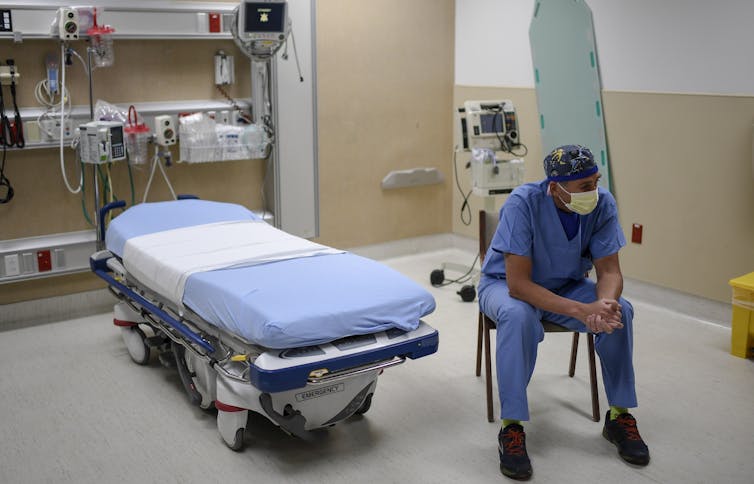
“Where have all the patients gone?” That’s what doctors in our West Virginia University hospitals began asking as the coronavirus pandemic spread.
We were prepared for a rise in COVID-19 patients, but we didn’t expect the sharp decline we saw in everyday cases. Our emergency department visits fell by half in early April, a time when we would normally see growth as flu season overlaps with an increase in trauma as the weather improves. Inpatient stays fell by nearly two-thirds during the same time period.
Did the population of a state that ranks in the bottom of most health indicators suddenly get better? Did their lung disease, heart disease and vascular disease improve?
In the emergency room, we heard the real reason: “I thought I could wait this out,” patients told us.
In hospitals across the U.S. and Europe, people fearing contracting COVID-19 have been choosing not to seek the emergency treatment they need. One survey conducted in April found that nearly a third of U.S. adults had delayed medical care or avoided seeking care because they were concerned about getting COVID-19.
A study in Spain found a 40% drop in the number of patients undergoing emergency cardiac catherization for a dangerous type of heart attack known as STEMI between the late February and mid-March. A similar study in the U.S. found a 38% drop in heart catherization for STEMI cases from January to March. Children’s vaccinations also dropped off significantly, according to the Centers for Disease Control and Prevention, raising new concerns after last year’s measles outbreak.
This has certainly been our experience as physicians and faculty at the West Virginia University School of Medicine. The patients we saw in the emergency room in April were a lot sicker, and the proportion of emergency room patients who needed hospitalization increased.
The costs of delaying emergency care
Delaying treatment for acute and chronic conditions comes at a cost, both human and financial.
A patient with appendicitis who gets treatment early will usually undergo laparoscopic surgery, using small incisions and a camera, and can go home two days later. If the same patient waits too long, however, and a pocket of infection known as an abscess forms, that means more complex surgery. We will have to insert a tube for several days to drain the abscess, and the patient will be hospitalized longer, in addition to going on antibiotics. In the worst case, the appendix could burst and lead to diffuse peritonitis and sepsis, a medical emergency with severe abdominal pain and low blood pressure.
Similarly, if a diabetic with a foot infection that is early in the stages of cellulitis, a painful localized skin infection, waits a week to two longer than usual, there’s a greater chance the infection has reached the bone, becoming an osteomyelitis that could require amputation.
The ultimate cost for delaying treatment can be loss of life. Data from the CDC shows the U.S. had 66,000 more deaths than expected from January through the end of April, with only about half of those linked to COVID-19.
In some cases, clinics are trying to balance the risks. For example, many clinics have delayed preventative care such as cancer screenings because of the risk of COVID-19. One U.S. study found an abrupt drop in preventative cancer screenings of between 86% and 94% through April. Treatments for cancer patients are continuing, with hospitals taking extra precautions to protect patients while their immune systems are compromised.
The hospital experience is changing
COVID-19 is not going away anytime soon, nor will heart attacks, strokes or appendicitis.
If you feel you need to see your doctor, go. If you feel you need to go to the emergency department, call 911. It’s better than the pain and costs that can come with delay.
Your experiences during hospital visits going forward will definitely be different for a while. People arriving for hospital care that doesn’t require staying overnight should expect some kind of screening process to make sure that they are not ill with COVID-19. The health care system will encourage social distancing at check-ins, as well as in the waiting rooms, and everyone will be wearing face masks.
As a patient, you might not be allowed to have visitors, but you will receive the health care that you need.
While these certainly unprecedented times have upended our care processes, they also offer patients and health care systems new opportunities.
When we talk to our patients, many of them appreciate the opportunity for virtual visits, especially those at highest risk for complications from COVID-19 infection. The ability to establish virtual urgent care as well as offer many clinical services through virtual visits is here to stay.
The past few weeks have seen very significant changes at all points of patient entry into a hospital or clinic. However, clinical medicine’s fundamental principle of primum non nocere, “first do no harm,” prevails, and we remain committed to making sure that patients that need care get it on time and do not have to delay their visits or ignore their symptoms.
[You need to understand the coronavirus pandemic, and we can help. Read The Conversation’s newsletter.]
Arif R. Sarwari, Physician, associate professor of infectious diseases, chair of Department of Medicine, West Virginia University and Christopher Goode, Emergency medicine physician, chair of Emergency Medicine, West Virginia University
This article is republished from The Conversation under a Creative Commons license. Read the original article.