How to resolve AdBlock issue?
News
Supervisors approve offering hazardous duty leave benefit to county workers, OK staff masking policy
- Details
- Written by: Elizabeth Larson
County Administrative Officer Carol Huchingson presented the proposals for hazardous duty leave and facial masking to the board in two separate discussions at its April 21 meeting.
Huchingson said she and an ad hoc committee met with all of the department heads the previous week, and they “overwhelmingly conveyed” to staff that to offer hazardous duty leave below the value of emergency paid sick leave would be a disincentive.
As a result, the ad hoc committee recommended a limited, one-time benefit of 80 hours of hazardous duty leave be made available to essential employees, equal to the 80 hours of paid time non-essential employees are receiving while sheltering in place. The leave would need to complete the required forms that would be subject to approval.
On July 30, 2021, approved employees would be able to get 40 hours of payout for the unused balance, she said.
Huchingson said that if all eligible employees took that payout, it would account for 2 percent of the work time for a year. The total cost to the county would be $916,000, of which $363,000 would be general fund costs, with the remainder to be covered by the self-funded departments.
Alternatively, Huchingson said projected costs based on what is budgeted for 2019-2020 – which she said assumed all positions are filled despite the county’s ongoing vacancy rate of above 20 percent – would total $1,080,848, of which $413,791 would be general fund, with the remainder covered by the self-funded departments.
She said staff intended to use salary savings to cover the cost and will reevaluate at midyear during the 2020-21 fiscal year budget.
Huchingson said the cost of lost productivity resulting from the emergency paid leave at 80 hours each for non-essential employees during the shelter in place order – with approximately 200 employees requesting that leave to that date – was still being determined, as the shelter in place remained active and approvals were continuing.
Supervisor Bruno Sabatier said that, from the beginning, the goal has been to support staff who are still being requested to go to work.
“I feel like this is a necessary thing to provide to our staff,” said Sabatier, getting agreement from board Chair Moke Simon.
Supervisor Rob Brown said it’s among the toughest decisions they have to make. “I don’t know the easy answer. I really don’t,” he said.
“I’m not sold on the idea that we can afford it,” said Brown, explaining that this same board may have to look at laying people off rather than just cutting positions due to the economic issues related to the pandemic. “We’ll see who’s really essential at that point.”
Brown said the impacts of the pandemic are going to hit the county hard due to the ripple effect, referring to a recent survey that showed 28 local businesses are closed and may not reopen.
He said he had a hard time committing to almost $1 million in extra costs, not because it’s not for a good purpose but because he doesn’t believe they have the money.
Sabatier said they could cover it without even tapping into the county’s rainy day fund. He mentioned the money used to put into reserves from the sale last year of the Lucerne Hotel – which Huchingson had pushed because she said the county needed the money – and said the county had the money to cover the expense. He added it wouldn’t cause the county to have to cut positions.
Brown replied that he didn’t say, nor imply, that this issue alone was going to break the county. He said it’s a small portion of what is going to hit the county.
The other board members expressed their comfort with going forward with the potential additional expenditure.
Public Services Director Lars Ewing raised to the board his concern that the policy only covers permanent employees, not the county’s extra-help employees. He said he has more than a dozen extra help employees working in essential capacities.
Huchingson told the board that she’s had repeated conversations with Ewing about the topic. “It’s not forgotten,” she said, explaining that they were working on permanent employees at that point.
Sheriff Brian Martin said the issue was a direct response to what the federal government did weeks earlier when mandating two weeks of leave.
The board approved the leave policy 4-1, with Brown voting no, and gave Huchingson the authority to meet and confer with employee union groups.
New masking policy approved
The board followed that discussion by another in which it approved a temporary policy requiring county employees to wear face masks when working in public at county facilities.
“The policy is a very simple one,” said Huchingson.
With Public Health Officer Dr. Gary Pace having issued guidance on April 13 in which he strongly urged masking in public, Huchingson said the proposed policy was for county employees to wear masks in county facilities when they are working with the public. Masks will be provided to employees by the county. The policy remains in effect until the board ends it.
“This is a great lead-by-example type situation,” said Sabatier.
Huchingson said touchless hand sanitizer also has been placed in the courthouse.
Supervisor Tina Scott asked if they had masks. Huchingson said they have some expired N95 masks and other departments are in the process of acquiring new ones.
Huchingson said employees can wear whatever type of mask they want, they just have to cover their mouth and nose.
Ewing said his department has a process in place for getting masks as part of ordering cleaning supplies.
The board approved the masking policy 5-0.
Email Elizabeth Larson at
- Details
- Written by: Lake County News reports
“I want to thank Colorado and Nevada for joining the Western States Pact,” said California Governor Newsom. “COVID-19 doesn’t follow state or national boundaries, and it will take every level of government, working together to get the upper hand on this virus.”
“Coloradans are working together to slow the spread of COVID-19 and have important information to share with and to gain from other states. I’m thrilled Colorado is joining the Western States Pact,” said Gov. Polis. “There’s no silver bullet that will solve this pandemic until there is a cure so we must have a multifaceted and bold approach in order to slow the spread of the virus, to keep our people safe and help our economy rebound.”
“I’m honored to have the State of Nevada join the Western States Pact and believe the sharing of critical information and best practices on how to mitigate the spread, protect the health and safety of our residents, and reopen responsibly will be invaluable as we chart our paths forward,” said Gov. Sisolak. “Millions of visitors from our fellow Western states travel to Nevada every year as a premier tourism destination, and this partnership will be vital to our immediate recovery and long-term economic comeback.”
Gov. Newsom, Oregon Governor Kate Brown and Washington Governor Jay Inslee recently announced they would be working together under a shared vision for gradually modifying their states’ stay at home orders and fighting COVID-19.
They listed three shared principles as foundational to the agreement:
– Our residents’ health comes first. As home to nearly one in five Americans and gateway to the rest of the world, the West Coast has an outsized stake in controlling and ultimately defeating COVID-19.
– Health outcomes and science – not politics – will guide these decisions. Modifications to our states’ stay at home orders must be made based off our understanding of the total health impacts of COVID-19, including the direct impact of the disease on our communities; the health impact of measures introduced to control the spread in communities – particularly felt by those already experiencing social disadvantage prior to COVID-19; and our health care systems’ ability to ensure care for those who may become sick with COVID-19 and other conditions. This effort will be guided by data. We need to see a decline in the rate of spread of the virus before large-scale reopening, and we will be working in coordination to identify the best metrics to guide this.
– Our states will only be effective by working together. Each state will work with its local leaders and communities within its borders to understand what’s happening on the ground and adhere to our agreed-upon approach.
As part of the Western States Pact, the governors commit to working together toward the following four goals:
– Protecting vulnerable populations at risk for severe disease if infected. This includes a concerted effort to prevent and fight outbreaks in nursing homes and other long-term care facilities.
– Ensuring an ability to care for those who may become sick with COVID-19 and other conditions. This will require adequate hospital surge capacity and supplies of personal protective equipment.
– Mitigating the non-direct COVID-19 health impacts, particularly on disadvantaged communities.
Protecting the general public by ensuring any successful lifting of interventions includes the development of a system for testing, tracking and isolating. The states will work together to share best practices.
- Details
- Written by: Lake County News reports

KELSEYVILLE, Calif. – Lake County Sheriff’s deputies arrested three local residents on Friday in connection to burglaries in Kelseyville and Lucerne.
Chelsea Leann Berry, 27, of Lakeport, Jason Donavon Harlan, 27, of Nice, and Monica Nicole Wright, 26, of Clearlake, were taken into custody on Friday morning, said Lt. Corey Paulich.
At 10:40 a.m. Friday Lake County Sheriff’s deputies were dispatched to a residence on Peninsula Drive in Kelseyville for a reported burglary, Paulich said.
Paulich said a witness reported seeing three subjects enter a residence and leave with a bag of items in a white Dodge with a damaged trunk.
While responding, the deputies saw a vehicle matching the description given by the witness driving on Soda Bay Road towards Lakeport. Paulich said the deputies conducted a vehicle stop at the Fast and Easy Market in Lakeport.
The deputies identified the three people in the vehicle as Berry, Harlan and Wright, and also recognized them as the individuals who had been captured on surveillance video committing a separate burglary earlier in the morning in Lucerne, Paulich said.
He said the deputies saw a suitcase in the vehicle that had a luggage tag with the address to the residence that had been burglarized on Peninsula Drive.
A records check showed Wright had an outstanding misdemeanor arrest warrant and Harlan was on felony probation for possession of stolen property, Paulich said.
Paulich said the three were interviewed about the burglaries. Berry and Wright admitted to participating in both burglaries, while Harlan denied being involved and said he had just been recently picked up by Berry.
Items from the Peninsula Drive and Lucerne burglary were located in the Dodge. The items were later identified by the owners and returned, Paulich said.
The deputies also located methamphetamine and heroin inside the vehicle. Paulich said Berry was in possession of methamphetamine and Wright was found to be in possession of heroin during the booking process.
All three were transported to the Lake County Jail where they were booked, Paulich said.
Paulich said Berry was booked for burglary during a state of emergency, possession of stolen property, conspiracy, possession of a controlled substance and possession of drug paraphernalia; Wright for burglary during a state of emergency, possession of stolen property, conspiracy and bringing a controlled substance into a correctional facility; and Harlan for burglary during a state of emergency, possession of stolen property, conspiracy and violation of probation.
Berry and Wright’s bail is set at $50,000 each and Harlan is on a no-bail hold for violation of his probation, Paulich said, adding that all three remained in custody on Monday.
- Details
- Written by: LAKE COUNTY NEWS REPORTS
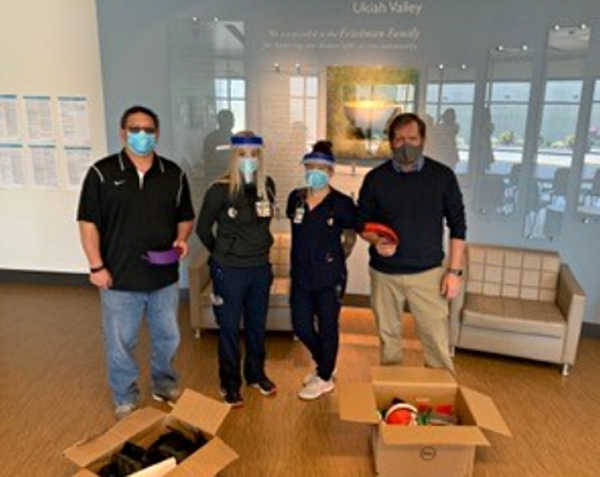
NORTH COAST, Calif. – On Wednesday, Mendocino College Career Education instructors provided Adventist Health with 250 3D printed face shields to use during the COVID-19 pandemic.
In March, the college also delivered 240 N95 masks, and another 5,000 – including ear loop surgical, face shield, and N95 – were given directly from the Mendocino College Nursing Department.
“This is Mendocino College Career Education instructors and students in action, making a difference by responding to the immediate medical equipment needs of our community and our region,” said Dean of Career Education Dennis Aseltyne.
“We have been touched by the outpouring of support from our community for healthcare workers on the front lines. At a time when usual supply chain channels are disrupted, the team from Mendocino College has found a way to address a great need and help keep our staff safe through their creativity. This demonstrates that one does not have to be a front line healthcare
worker to help our community during this challenging time and that everyone can step up and find a way to help,” said Jason Wells, president for Adventist Health in Mendocino County, which operates Adventist Health Howard Memorial and Adventist Health Ukiah Valley.

Theatre Arts/Technical Director Steve Decker and Computer Science instructor David Pai have been running up to five different 3D printers daily for the past several weeks preparing the masks. Between the five machines, approximately 25 masks can be made daily.
Decker and Pai admit that due to the new technology, the machines require a lot of handholding, which can result in slower production at times.
“In times of crisis, we want to leverage technology to provide solutions to problems,” Pai said. “This was one way that we could leverage our 3D printing technology at the college to support our front-line medical workers in this crazy time.”
The type of 3D printing is called fuse deposition modeling, or FDM. FDM is a type of printing that melts the material and pushes it out a small nozzle where material is needed that cools to make the new part. It is much like a hot glue gun, but more controlled and produces little fumes.

The material used is called polylactic acid and is a biodegradable thermoplastic made from plant-based sources such as sugar cane.
“These masks are vital to our first responders on the frontline. It's been great seeing how a new emerging technology can help out,” said Decker.
The college offers a course in 3D Design and Printing (CSC175), where students learn not only the intricacies of FDM printing but also how to design their own parts for printing.
In addition to FDM printing, students also gain experience using a stereolithography printer.

The 3D print lab is available to all students who have previously completed CSC175.
Theatre Arts instructor and professional costume designer Kathy Dingman-Katz has also been busy making free masks for the community and filling requests as they come in.
Two of her former costume construction students are also supplying local nurses with masks.
For more information about Career Education programs at Mendocino College, visit www.mendocino.edu/ce .