 How to resolve AdBlock issue?
News
- Details
- Written by: Lake County News reports
“The California Highway Patrol is honored to be a part of the distribution of these protective face coverings for truck drivers,” CHP Commissioner Warren Stanley said. “The Department recognizes the essential task these drivers are providing to keep critical goods and supplies available.”
“The Department of Transportation’s Federal Motor Carrier Safety Administration worked closely with the Federal Emergency Management Agency and trucking stakeholders to coordinate and ship 800,000 protective masks to State Motor Carrier Safety Assistance Program law enforcement agencies throughout the country for distribution to truckers all over the country,” said Collin B. Mooney, executive director of the Commercial Vehicle Safety Alliance.
State and local partners, in conjunction with the Federal Motor Carrier Safety Administration, continue to assist in the distribution of the masks in order to ensure that the masks are supplied directly to truckers who maintain the nation’s supply chain during this crisis, Mooney said.
“The agency is appreciative of FEMA for supplying these masks, and for our state partners who have worked together to ensure they reach America’s truck drivers,” Mooney said.
The CHP will distribute the face coverings to its 17 commercial vehicle enforcement facilities in each of its eight field divisions throughout the state based on known truck volume.
Truck drivers will be provided coverings at the front counter of the enforcement facilities and during other contacts by departmental commercial vehicle personnel.
To find the locations of CHP Commercial Vehicle Enforcement Facilities by CHP Division, go to https://www.chp.ca.gov/find-an-office , scroll down and click on a specific geographic Division or call 1-800-TELL-CHP (1-800-835-5247).
The mission of the CHP is to provide the highest level of safety, service, and security.
- Details
- Written by: NASA/GODDARD SPACE FLIGHT CENTER

These two Hubble Space Telescope images of comet C/2019 Y4 (ATLAS), taken on April 20 and 23, 2020, provide the sharpest views yet of the breakup of the fragile comet.
Hubble identified about 30 fragments on April 20, and 25 pieces on April 23. They are all enveloped in a sunlight-swept tail of cometary dust.
"Their appearance changes substantially between the two days, so much so that it's quite difficult to connect the dots," said David Jewitt, professor of planetary science and astronomy at UCLA, Los Angeles, and leader of one of two teams that photographed the doomed comet with Hubble. "I don't know whether this is because the individual pieces are flashing on and off as they reflect sunlight, acting like twinkling lights on a Christmas tree, or because different fragments appear on different days."
"This is really exciting – both because such events are super cool to watch and because they do not happen very often. Most comets that fragment are too dim to see. Events at such scale only happen once or twice a decade," said the leader of a second Hubble observing team, Quanzhi Ye, of the University of Maryland, College Park.
The results are evidence that comet fragmentation is actually fairly common, say researchers. It might even be the dominant mechanism by which the solid, icy nuclei of comets die. Because this happens quickly and unpredictably, astronomers remain largely uncertain about the cause of fragmentation.
Hubble's crisp images may yield new clues to the breakup. Hubble distinguishes pieces as small as the size of a house. Before the breakup, the entire nucleus may have been no more than the length of two football fields.
One idea is that the original nucleus spun itself into pieces because of the jet action of outgassing from sublimating ices. Because such venting is probably not evenly dispersed across the comet, it enhances the breakup. "Further analysis of the Hubble data might be able to show whether or not this mechanism is responsible," said Jewitt. "Regardless, it's quite special to get a look with Hubble at this dying comet."
The comet was discovered on Dec. 29, 2019, by the ATLAS (Asteroid Terrestrial-impact Last Alert System) robotic astronomical survey system based in Hawaii. This NASA-supported survey project for Planetary Defense operates two autonomous telescopes that look for Earth-approaching comets and asteroids.
The comet brightened quickly until mid-March, and some astronomers anticipated that it might be visible to the naked eye in May to become one of the most spectacular comets seen in the last 20 years.
However, the comet abruptly started to get dimmer instead of brighter. Astronomers speculated that the icy core may be fragmenting, or even disintegrating. ATLAS' fragmentation was confirmed by amateur astronomer Jose de Queiroz, who was able to photograph around three pieces of the comet on April 11.
The disintegrating comet was approximately 91 million miles (146 million kilometers) from Earth when the latest Hubble observations were taken. If any of it survives, the comet will make its closest approach to Earth on May 23 at a distance of about 72 million miles (116 million kilometers), and eight days later it will skirt past the Sun at 25 million miles (40 million kilometers).
The Hubble Space Telescope is a project of international cooperation between NASA and ESA (European Space Agency). NASA's Goddard Space Flight Center in Greenbelt, Maryland, manages the telescope. The Space Telescope Science Institute (STScI) in Baltimore conducts Hubble science operations. STScI is operated for NASA by the Association of Universities for Research in Astronomy in Washington, D.C.
- Details
- Written by: Lake County News reports
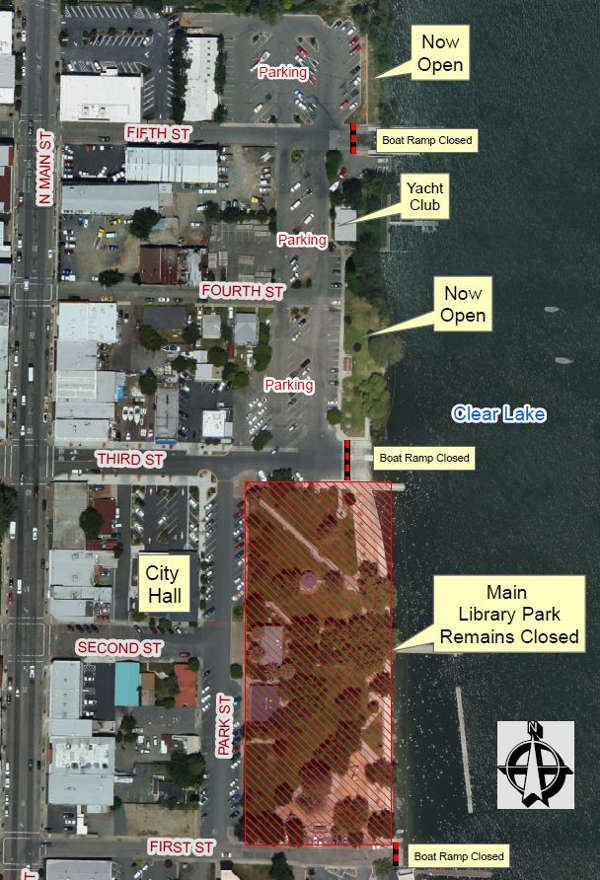
The lakefront area between Third Street and the north end of the Fifth Street parking area can now be used by the public for fishing and other outdoor recreational activities.
The main portion of Library Park between First and Third streets remains closed due to ongoing construction improvements and other factors including bathroom closures. City officials said they are working to reopen this portion of Library Park as soon as possible.
Although a portion of Library Park is reopening, social distancing and other guidelines still apply.
The city strongly encourages the following for anyone considering a visit:
– Stay at home if you are sick or do not feel well.
– Maintain at least 6 feet of distance between you and other park visitors.
– Consider bringing a cloth facial mask and wearing it when around other people.
– Prepare for limited or no bathroom access. The city of Lakeport plans to install portable toilets between Third and Fifth streets for the public’s use in the near future. The temporary portable toilets will be maintained by a private contractor and the city cannot guarantee they will be effectively sanitized. The public should be prepared to use their own hand sanitizer or other disinfectants if they use these facilities.
– Consider visiting earlier in the day so you can adjust plans if a park area is full. The city may be required to limit access if capacity is reached.
– Plan ahead. Plan to bring your own snacks, water and hand sanitizer.
– Carry your trash with you or dispose of it in the appropriate containers to help keep our staff safe and our parks litter-free.
– Overcrowding may cause this portion of Library Park to close again.
– All public boat ramps owned and maintained by the city of Lakeport remain closed per the order of the Lake County Public Health officer.
Visit the city’s COVID-19 webpage for more information related to the current virus situation: https://www.cityoflakeport.com/covid-19_updates.php .
Library Park lies along the west shore of Clear Lake in downtown Lakeport. It was established nearly 100 years ago and now includes more than three acres of land area. Owned and maintained by the City of Lakeport, it hosts numerous community events, including live music in its beautiful gazebo, which serves as the centerpiece of the park.
- Details
- Written by: Lake County News reports
Testing beginning on Tuesday, May 5, will occur in the Lakeport area, and subsequent locations around the county will be announced as they are arranged, Public Health said.
Public Health staff will see up to 50 preregistered people per day for testing in a drive-thru setting.
Sites will be open from 11 a.m. to 1 p.m. and results should be back within 48 to 72 hours.
If more than 50 people need the test on a given day, they will try to prioritize the most vulnerable.
Call 707-263-8174 to be transferred to a staff member for screening and registration. Additional information and forms will be posted on the Public Health website.
“This is a new process, and we appreciate the community’s patience as we ‘work out the kinks,’” said Public Health Officer Dr. Gary Pace. “We look forward to testing the folks that need it.”
Pace said that getting Lake County’s own test site up and running is highly significant, given the governor’s criteria for lifting shelter-in-place restrictions.
Until counties get adequate testing and contact tracing, the governor will be reluctant to loosen things up for more social and business activity.
Therefore, this new service will be a major step forward for Lake County in meeting these benchmarks, Pace said.
Pace said the value of this viral polymerase chain reaction test lies in determining if someone has the virus right now.
The antibody test, which is in the news a lot lately, is a different test that looks for previous infection, he said.
At least for the time being, no antibody testing will be available at Lake County’s mobile sites. These logistics may all change in the near future, Pace said.