 How to resolve AdBlock issue?
News
- Details
- Written by: Elizabeth Larson
LAKE COUNTY, Calif. – A new nationwide forecast estimates that the COVID-19 pandemic could peak in California in late April and end in the United States in June if strong social distancing measures continue, but that in the meantime most of the country’s states could see their health care systems stretched to the limit.
The Institute for Health Metrics and Evaluation, an independent global health research organization at the University of Washington School of Medicine, produced the new forecast.
Calling COVID-19 “an extraordinary challenge to US health and the healthcare system,” the institute – or IHME – estimates that demand for ventilators and beds in US hospital intensive care units will far exceed capacity for COVID-19 patients as early as the second week of April.
The institute’s forecast also anticipates that deaths related to the current wave of COVID-19 in the US are likely to persist into July, even if people continue to protect themselves and their communities by strongly adhering to social distancing measures and by taking other precautions advised by public health officials.
IHME’s analysis, based on observed death rates, estimates that over the next four months in the US, approximately 81,000 people will die from the virus. Estimates range between 38,000 and 162,000 US deaths.
The forecast predicts that 41 states will need more ICU beds than they currently have available and that 11 states may need to increase their ICU beds by 50 percent or more to meet patient needs before the current wave of the pandemic ends, a point which is defined as fewer than 10 deaths per day nationwide. The end of the pandemic could occur toward the end of June.
“Our estimated trajectory of COVID-19 deaths assumes continued and uninterrupted vigilance by the general public, hospital and health workers, and government agencies,” said IHME Director Dr. Christopher Murray. “The trajectory of the pandemic will change – and dramatically for the worse – if people ease up on social distancing or relax with other precautions. We encourage everyone to adhere to those precautions to help save lives.”
Nationwide, COVID-19 deaths are forecast to peak at 2,271 per day on April 15. Hospital resource use is expected to peak that same day, with more than 224,000 hospital beds needed, more than 33,000 intensive care unit beds required and more than 26,000 ventilators in use.
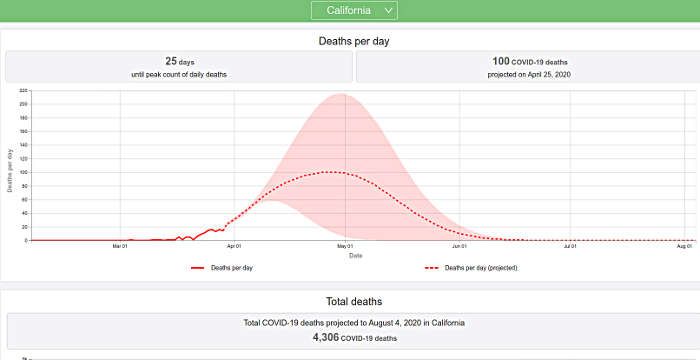
In California, where a statewide stay at home order went into effect on March 19, IHME’s forecast estimates that deaths will peak at 100 per day on April 25 and remain there for several days before beginning to decline.
The forecast states that California has a total of 26,654 beds and 1,993 available intensive care beds.
Peak resource use in California will occur on April 26, based on IHME’s forecast, with 10,468 beds needed, and 1,564 ICU beds and 1,252 ventilators required to care for patients. Peak use will persist for several days before dropping off.
Total COVID-19 deaths in California projected through Aug. 4 are estimated to reach approximately 4,306, while total deaths overall are expected to top 6,100, according to IHME’s analysis.
California’s projected number of deaths ranks the state second nationwide, with New York expected to have more than 10,200 deaths overall. Rounding out the projected top five are Texas, 5,847; New Jersey, 4,109; and Michigan, 4,061.
The forecast does not offer an estimate of how many total COVID-19 cases each state could experience, and the analysis does not look at states on a county-by-county level.
As of Sunday night, a tally of reports from public health departments across California conducted by Lake County News put the total number of confirmed COVID-19 cases in California at approximately 6,345, with deaths numbering 132. The IHME analysis had forecast eight fewer deaths in California on Sunday.
As of the latest information available through the weekend, no positive cases of COVID-19 have so far been confirmed in Lake and nearly a dozen other counties, including Alpine, Del Norte, Lassen, Mariposa, Modoc, Plumas, Sierra, Tehama and Trinity, with Tuolumne reporting a case of a nonresident with the virus being treated in that county, according to those respective counties’ public health departments.
Lake County’s public schools closed on March 16 and Lake County Public Health Officer Dr. Gary Pace issued a countywide shelter in place order that went into effect on March 19, with an additional order days later closing Clear Lake, all county waterways and lodging facilities.
In Lake County, which has a large population of both seniors and veterans, there are a total of 50 hospital beds between Adventist Health Clear Lake Hospital and Sutter Lakeside Hospital, which are both under the “critical access” designation that limits them to 25 beds each.
Dr. Pace said last week that, with state waivers, Sutter Lakeside could increase to 50 beds and Adventist to about 40. Together, the hospitals have 11 ventilators available with access to five more.
Some Bay Area counties are reported to be considering extending their own shelter in place orders.
So far, Dr. Pace has not reported if he plans on extending Lake County’s stay in place order past its initial April 10 end date.
Email Elizabeth Larson at
- Details
- Written by: Elizabeth Larson
The board will meet virtually beginning at 9 a.m. Tuesday, March 31.
The meeting can be watched live on Channel 8 and online on the county’s Facebook page or at https://countyoflake.legistar.com/Calendar.aspx . Accompanying board documents, the agenda and archived board meeting videos also are available at that link.
Because the meeting will be held virtually, members of the public are asked to submit comments on items to
This week’s board meeting is deemed a special one as the board usually does not meet the fifth Tuesday of the month.
At 9:10 a.m., the board will get the latest update on COVID-19 from Lake County Public Health Officer Dr. Gary Pace.
In an untimed item, Supervisor Rob Brown is asking the board to consider sending a letter to Gov. Gavin Newsom “suspend all legislation that has been recently introduced or been enacted over the last two years that would been seen as detrimental to many private enterprise jobs,” according to Brown’s memo to the board.
The letter, which can be seen below, asks that the governor “act swiftly to suspend all legislation that has been recently introduced or, has been enacted over the last two years that would be seen as detrimental to many private enterprise jobs. This legislation would include Assembly Bills 36, 40, 673,725, 5, 790, 882, 1332 and Senate Bills 37, 44, 135, 10, 246 and 567.”
It goes on to note, “Much of the workforce and business impacted by these legislative actions have actually been identified by the Governor as essential during this current crisis of COVID-19. Additionally, many local businesses may not qualify for benefits that are being made available to others by our Federal and State representatives.
The letter concludes, “The possibility of losing hundreds of thousands of jobs to the effects of COVID-19, is inevitable. To lose hundreds of thousands more, as a result of legislation that is under your control, is a potential disaster that is avoidable.”
In another untimed item, the board will consider recommended changes in the customary budget procedure for fiscal year 2020-21 recommended and final recommended budget, as well as proposed changes to the board’s annual meeting calendar for 2020.
Specifically, County Administrative Officer Carol Huchingson told the board in a memo for the meeting that her staff must make alternative plans for the coming fiscal year’s budget, with staffing resources “severely limited” due to COVID-19 disaster response.
“Staff met recently with the Auditor-Controller and with department heads to discuss solutions and determined that the best option will be to initiate the budget process by replicating the numbers from Adopted Budget for FY 2019/2020, as a starting point for FY 2020/2021,” Huchingson said.
Huchingson said her office, in conjunction with departments, will make minor adjustments, between April 13 and May 1.
Originally, the recommended budget hearings were calendared for June 10 and 11, with the final budget hearings set for Sept. 15, Huchingson reported.
She said that, due to the COVID-19 health emergency, staff is requesting to move those meetings to June 9 for the recommended budget hearings, with department heads to present their final budget presentations to the board on Sept. 23 and 24 during final recommended budget hearings.
The full agenda is below.
CONSENT AGENDA
5.1: Approve postponement of performance evaluations of board-appointees due to the COVID-19 crisis.
5.2: Approve the continuation of local health emergency related to the 2019 coronavirus (COVID-19) as proclaimed by the Lake County Public Health officer.
5.3: Approve the continuation of a local emergency due to the Mendocino Complex fire incident (River and Ranch fires).
5.4: Approve the continuation of a local emergency due to the Pawnee fire incident.
5.5: Approve continuation of a local emergency due to COVID-19.
5.6: Sitting as the Lake County Sanitation District Board of Directors, approve Amendment No. 1 between Lake County Sanitation District and Brelje & Race Consulting Engineers in the amount of $48,000 and a total contract amount of $405,000 for the Anderson Springs Sewer Project; and authorize the chair to sign.
5.7: Sitting as the Lake County Sanitation District Board of Directors, approve an exception to the Lake County Sewer Use Code Sec. 205, allowing APN No. 050-441-36 to remain on septic system until such time as the system is in need of repair or replacement, at which time the property owner will be required to connect to the public sewer at the owner's expense.
5.8: Request to waive 900-hour limit for extra help Field Technician II Daniella Cazares.
TIMED ITEMS
6.2, 9:06 a.m.: Consideration of continuation of a local health emergency and order prohibiting the endangerment of the community through the unsafe removal, transportation and disposal of fire debris for the Mendocino Complex fire.
6.3, 9:10 a.m.: Consideration of Update on COVID-19.
UNTIMED ITEMS
7.2: Consideration of letter to Gov. Newsom asking to suspend legislation that would affect private enterprise jobs.
7.3: (a) Consideration of recommended changes in customary budget procedure for fiscal year 2020/2021 recommended and final recommended budget; and (b) consideration of changes to the board's annual meeting calendar for 2020.
CLOSED SESSION
8.1: Public employee evaluation: Health Services director.
Email Elizabeth Larson at
Ltr_GovernorNewsom_03312020 by LakeCoNews on Scribd
- Details
- Written by: Lake County News reports
What can you do to protect your community – your family?
Lake County Public Health Officer Dr. Gary Pace, MD, MPH, wants community members to have the information they need to make the healthiest choices possible.
He also needs the community’s help. Keeping COVID-19 from gaining a foothold in Lake County is a team effort, and everyone needs to do their part.
At 6 p.m. Tuesday, March 31, Dr. Pace will host a virtual town hall meeting live on the county of Lake Facebook page.
Public officials will answer questions and provide valuable updates. Health care and other community partners will be invited to participate as well.
Please send questions to
Whether or not the panelists are able to address every question in the live meeting, the public’s input will help guide future information sharing, and community participation is appreciated.
For those who are not Facebook members, video will also be available via the county’s Granicus feed.
Mediacom subscribers can additionally access the COVID-19 Town Hall via channel 8, Lake County PEG TV.
For Lake County-focused COVID-19 information, visit the Health Services Department’s website.
If you still have questions, send an email to
- Details
- Written by: Ryan Matthew Brewer, Indiana University
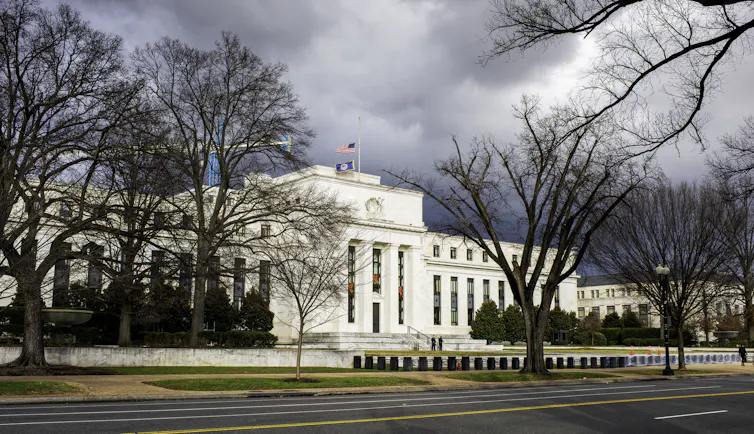
The United States Federal Reserve has committed to do everything it can to save the financial system and the American economy from collapse.
Most recently, it began an unprecedented effort to ensure banks, companies and now households have all the money they need by offering to buy unlimited amounts of securities, including bundled student loans and credit card debt. Even at the peak of the financial crisis in 2008, the Fed’s actions were much more limited in scope – as well as speed.
My colleagues and I at the Indiana Business Research Center have been studying the Fed, its actions and the economic impact for over a quarter-century. Here’s a quick primer on the U.S. central bank, how it works and what it’s doing to keep the economy from sinking into depression.
No guarantee of safety
Before Congress created the Federal Reserve System, the safety and soundness of U.S. banks was hardly a sure thing.
Bank runs – when a large number of customers withdraw their deposits simultaneously over concerns of a bank’s solvency – were common, such as during the Gilded Age from 1863 to 1907, when financial crises occurred frequently.
Yet many Americans were uncomfortable with the idea of a powerful central financial authority. Alexander Hamilton’s short-lived First Bank of the United States, which was “dominated by big banking and money interests,” did little to help to allay those concerns.
Without a central bank, it fell to private financiers like John Pierpont Morgan to avert financial crises by infusing their own capital into the economy. Recurring crises like these eventually led more people to believe that monetary policy and banking should be centralized, culminating in the 1913 Federal Reserve Act.
The act said the Fed would handle monetary policy and stimulus, keep banks safe and sound, and make sure the amount of money circulating was appropriate.
While initially successful at limiting bank runs, the Fed failed to prevent the speculative bubble that preceded the Great Depression – and the bankruptcy of nearly 10,000 banks. This led to the Glass-Steagall Act in 1933, which separated commercial and investment banking and created federal deposit insurance to prevent bank runs.
Congress more clearly delineated the Fed’s purpose in 1977, when it passed the Federal Reserve Reform Act and established what became known as the “dual mandate” of maximum employment and stable prices.
It continues to perform other functions in line with its founding purpose, such as identifying and neutralizing risks to the economy, protecting consumers and promoting the soundness of the financial system and individual institutions.
The Fed’s two key tools
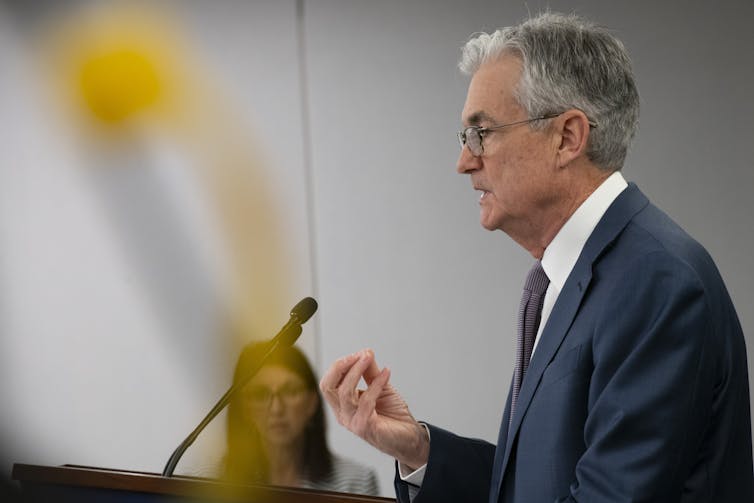
The Fed consists of a group of seven economists – collectively known as the Board of Governors – who have two key tools to affect monetary policy. The Board of Governors uses 12 regional banks of the Federal Reserve System to perform banking services.
The most well-known tool is the Fed’s ability to set short-term interest rates. When it lowers rates, the Fed aims to reduce borrowing costs for companies and consumers to encourage more lending and investment, thus stimulating the economy. It raises rates primarily when the economy is strong, when it wants to keep a lid on inflation.
The other key tool is its ability to buy and sell debt securities in open-market operations.
The Fed used this tool for the first time in 1923 ostensibly to stem a recession. By buying Treasury securities from private sellers, it was able to pump more money into the banking system, ensuring there was enough cheap credit for borrowers.
The Fed reimagined this powerful tool during the 2008 financial crisis, when it began a program of “quantitative easing” to buy longer-term, riskier debt. At the program’s peak in 2015, the Fed had accrued over US$4.5 trillion in both safe and riskier debt on its balance sheet.
The Fed’s plan to save the US
Financial markets have been in a panic since late February, when they began to reflect anxiety about the economic impact of the new coronavirus.
Since then, the Fed has engaged in a variety of actions to keep financial markets working and calm investors, including backstopping the commercial paper market and supporting money market funds.
It has also been using its two tools in more traditional ways.
The Fed used its first tool in dramatic fashion recently when it cut rates twice, first by half a percentage point and then by a full point, bringing its target rate to basically zero. Barring negative rates, there’s very little it can do to further stimulate the economy this way.
So it turned to its second tool and committed to essentially buy as many securities as necessary to stave off mass layoffs, debt defaults, bankruptcies and depression. This includes buying bundles of investment-grade corporate bonds, student loans and credit card debt for the first time.
As a result, the Fed’s balance sheet, which had fallen below $4 trillion last year, has now swelled to a new record of $4.7 trillion – and could double in size before it’s done, based on the new lending authority it’s being granted by the federal bailout.
Time will tell if this – alongside the $2 trillion in fiscal stimulus Congress is injecting – will be enough.
[Our newsletter explains what’s going on with the coronavirus pandemic. Subscribe now.]
Ryan Matthew Brewer, Associate Professor of Finance, Indiana University
This article is republished from The Conversation under a Creative Commons license. Read the original article.