How to resolve AdBlock issue?
LAKE COUNTY, Calif. – Over the objections and concerns of other local governments and special districts, the county of Lake is moving forward with attempting to recover an estimated $2.1 million in overpayments from tax defaulted property sales.
The Board of Supervisors most recently discussed the matter at its Feb. 24 meeting, when it delved into the complexity of tax law, tax defaulted property sales, undervalued lots and what is called a “negative apportionment.”
Auditor-Controller/Clerk Jenavive Herrington led the presentation to the board on the item, with help from Treasurer-Tax Collector Patrick Sullivan and Assessor-Recorder Richard Ford.
A list of reimbursement totals provided by Herrington has the county needing to pay back to the Auditor-Controller’s Office $864,815.70, followed next by the Lake County Fire Protection District, which owes $311,345.88, and the city of Clearlake, which owes $216,969.61. Others that owe funds include school and water districts, Lake County Vector Control and the Redbud Health District.
Herrington’s report explained that the county needs to “claw back” approximately $2,138,558.88 paid to school and fire districts and the cities over the past several years due to deficit tax defaulted land sales. She told the board that amount was the result of 257 deficit property sales.
Such land sales result when property owners fail to pay property taxes over the course of several years, eventually going to tax sale.
In recent years, after the city of Clearlake brought litigation over tax sales being delayed, the county has returned to the practice of more regularly holding the tax sales to recoup back taxes. Those sales often include the Northshore’s paper subdivision lots, some of which haven’t had property taxes paid on them in decades.
Herrington said the county’s software system limitations “allowed for erroneous distribution of funds that had not been collected.”
The actions discussed at the February meeting were the result of ongoing planning and conversations, taken up previously at the board’s Dec. 9 meeting, when Herrington presented a three year repayment plan for the various taxing jurisdictions and agencies impacted by the overpayment from the tax defaulted land sales.
Herrington’s plan at the time of the December meeting was to align the repayments with the two largest annual distributions from the Teeter Plan, which occur in April and December.
The Teeter Plan, which was put into effect in 1949, is a way for California’s counties to allocate delinquent property tax revenues based on what is billed but not yet collected through advancing money to the taxing jurisdictions, such as the schools and special districts.
“What’s happened has been unprecedented,” Herrington told the board in December. “Would we have communicated this sooner if we could have? Absolutely.”
She added, “It’s unprecedented, the situation, and then the amount of work to come up with the final numbers to then share.”
Supervisor Bruno Sabatier asked if there was a statute of limitations for attempting to recover the overpayments. County staff told him during the discussion that state law appeared to give them no choice but to get the money back.
Herrington said the Teeter Plan is designed to help agencies with their budgets. “To help them, we just give it to them all up front so that they can do their operations, and then we recover and so it’s a cycle.”
Part of the solution is a low value ordinance for some properties, which the county has been considering but which was withdrawn in February. The city of Clearlake in particular raised issues with it.
Herrington said such an ordinance is one aspect of addressing the problem. “I am definitely motivated to figure out how to fix this.”
She told the board that usually all of the money is recovered all at once. “But this has been a longtime county problem,” and one that she believed the county created. So she wanted to propose repayment begin in the 2026-27 tax year so she can give the impacted agencies advanced notice.
Treasurer-Tax Collector Patrick Sullivan said at that point that, related to the clawback, under state law, “That is a mandatory duty. The county has to recover those funds.”
If there is a statute of limitations, that would be a crisis for our property tax system. “If the answer is, we can’t do this, that has implications across everything that we do,” he said.
Sullivan said he doesn’t expect this situation to happen again in the future the same way. The underlying basis for the errors are the mass deficit sales which resulted from recent litigation — brought by the city of Clearlake to compel overdue tax sales — in which the state controller found that the county had to offer the low value parcels despite the fiscal impact.
Before that litigation, the Board of Supervisors issued directives not to sell the lower value lots. However, once that changed, they had to be put up for sale, when there wasn’t enough regular revenue to offset the cost, Sullivan said.
Because there was a mass catchup of property sales, “It hit all at once,” he said.
Herrington said she met with the city of Clearlake, and the fire districts, who understood the situation. “We did the best we could to mitigate the budgetary impacts.”
At that meeting, there was no input from the other agencies impacted and the board directed Herrington to come back with a letter and memo to send to the impacted agencies.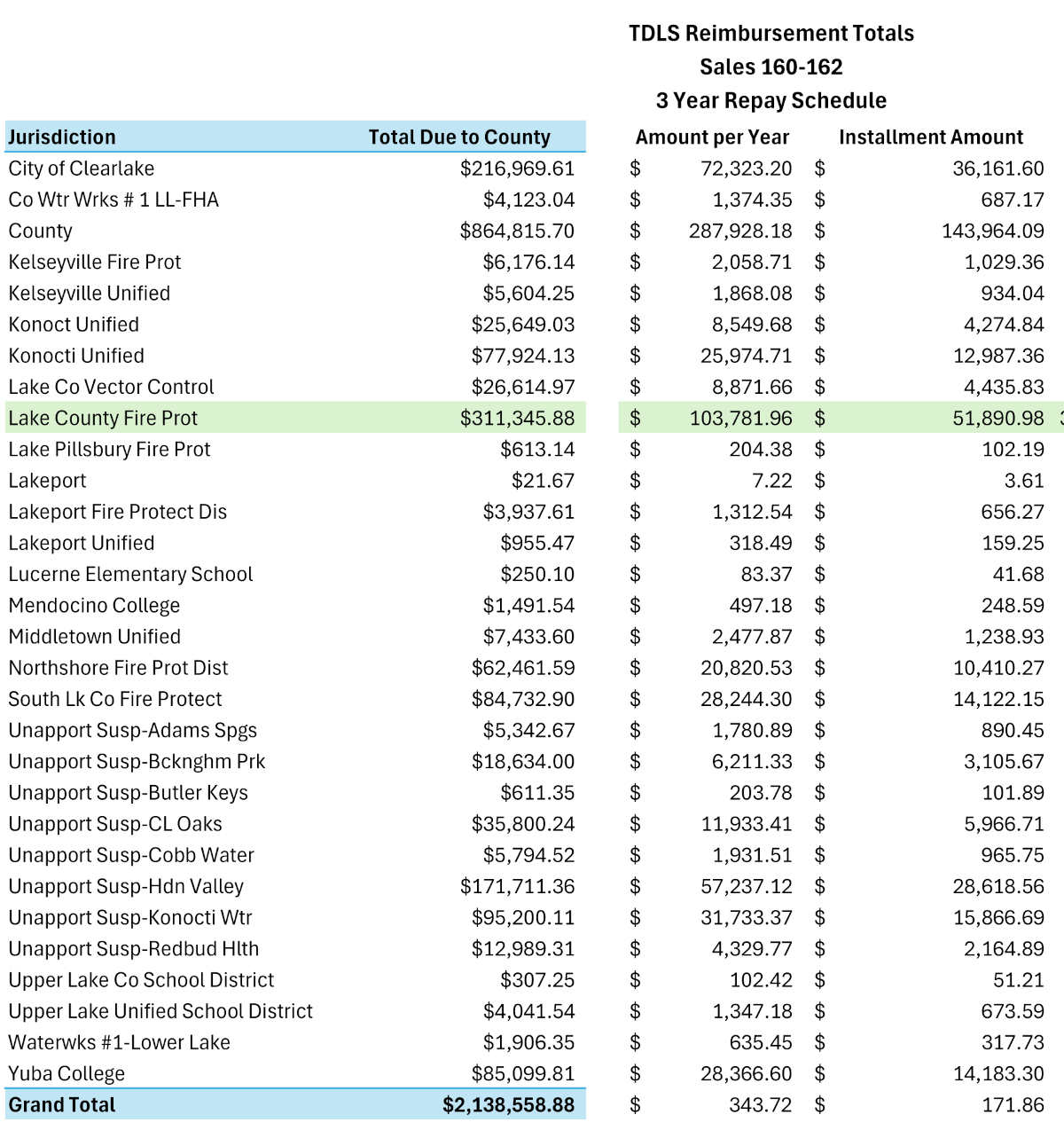
Agencies, city of Clearlake weigh in on situation
While the December meeting saw only county staff discussing the matter, several of the impacted agencies had representatives go before the board on Feb. 24 to voice their concerns.
Sullivan rejoined the discussion, explaining that when the county sets up a tax sale, “The way our software works is that upon completion of the sale, it shows that the property was redeemed if there was a bidder, but the amount of taxes owed can vastly exceed the actual sale price.”
For some properties with large amounts of penalties and interest — often the low value lots — they’re difficult to sell and the prices are dropped. That, Sullivan said, results in a deficit sale.
The county’s software “isn't really able to understand the concept of the deficit sale,” Sullivan said, and the situation is made more complicated by the fact that Lake is one of the last seven or so counties that doesn’t have a low value ordinance to address these deficit situations.
He said the auditor’s office has to make manual revisions, and if that isn't done before an apportionment, the software system wants to push that money out to the affected agencies.
During public comment, the board heard about the potential for major impacts on small districts.
Frank Costner, general manger of the Konocti County Water District, said having to pay back $95,200.11 over three years will severely impact them district.
“Why wasn't the district informed sooner? It seems like this is something you guys been talking about for a little bit,” he said, adding it would have been appropriate to let them know.
“And how could we be sure that this is not going to happen again?” Costner asked.
Clearlake City Manager Alan Flora said he’d heard a number of things that the city disagrees with in the discussion.
He said he believed the most important thing that should be raised is a communication failure about the matter. “It's been raised a couple of times, but the way we all found out about this, you know, I think really is just unacceptable.”
“The problem here is the county has a software that cannot calculate a deficit sale. And I don't understand how that's OK,” Flora said.
He added, “There has to be a way to calculate this, instead of giving us the money and then years later, withholding our Teeter funds, our regular distribution.”
Flora said the city also had found out that the county already had withheld $306,000 from its Teeter distribution, “which I don't think was legal or appropriate.”
Based on a presentation from the previous auditor-controller, Flora said the county’s Tax Losses Reserve Fund is to handle deficit sale issues.
Flora also submitted a letter to the county in which he pointed to a county resolution that opted to exclude assessments and direct charges from the Teeter Plan, leading to the clawback. “If direct charges were never subject to Teeter, then the County's decision to advance 100% on those charges was a policy choice — not an error subject to clawback under Revenue and Taxation Code Section 4707,” he said.
He said Section 4707 doesn’t authorize the clawback action, and that the city should not be faulted for its litigation to compel the long-overdue tax sales, as the action “simply forced the correction of the previous Tax Collector’s long-standing refusal to comply with state law.”
Dianna Mann, general manager of the Clearlake Oaks County Water District, said she only found out about the matter through Flora.
While the $35,000 the district owes may not sound like much, “We are so small and we depend on every penny. When we make a mistake, we eat that mistake, we don't go back to our customers and say, Oh, sorry we forgot to bill you for the five years now you owe us X amount of dollars.” She added that the county needs to be more responsible for its mistakes.
Jim Burton, chair of the Northshore Fire Protection District Board, said the amount of money the county wants to reclaim from the district — approximately $62,461.59 on Herrington’s list — is a down payment on a fire truck.
Both Sullivan and Flord said new software won’t fix the problem, which is unique to Lake County.
Herrington said there is a module for their software for tax sales that doesn’t work. “But because this is such a rare problem, we don't have a lot of county support to force them to make it work,” adding, “We're kind of alone in this.”
She said she just received another 36 deficit properties to assess. “I do believe that this will still be a problem for the future. We learned a lot through the process. I believe we'll be able to do them a little faster, but it's the volume is what it comes down to.”
Herrington said her office isn’t staffed to do the number of deficit calculations.
Sullivan pointed out that there are another 3,500 properties valued under $5,000 that are eligible for auction. “I would anticipate that all of those, if we were to list them with the intent to sell them, would have to be sold at a steep discount,” resulting in still more deficit sales, he said.
Herrington told the board that if the county doesn’t come up with another solution, she will be asking for more staffing “to make sure the work can be done timely while keeping up with our other deadlines.”
Board Chair Brad Rasmussen said he doesn’t want the situation to happen again, and that the county needs to figure it out. “I don't want to be here next year when we paid out more than we should have.”
Flora, who returned to the microphone, pressed Herrington on the $306,048.10 the county already had withheld from the city, before concluding the city owned another $216,000. Herrington offered a complicated explanation for the action, referencing the Teeter Plan.
“I just hope there's a way to have a productive discussion about this at some point,” Flora said, walking away from the microphone.
The board reached a consensus to have Herrington rework the payment plan to stretch from three years to five years and send out communications to the impacted agencies.
Email Elizabeth Larson at elarson@lakeconews.com. Follow her on Twitter, @ERLarson, and on Bluesky, @erlarson.bsky.social. Find Lake County News on the following platforms: Facebook, @LakeCoNews; X, @LakeCoNews; Threads, @lakeconews, and on Bluesky, @lakeconews.bsky.social.