How to resolve AdBlock issue?
LAKE COUNTY, Calif. – Newly disclosed financial challenges within Lake County Special Districts have drawn public scrutiny to the department at the same time as it faces criticism over a massive sewage spill two months ago.
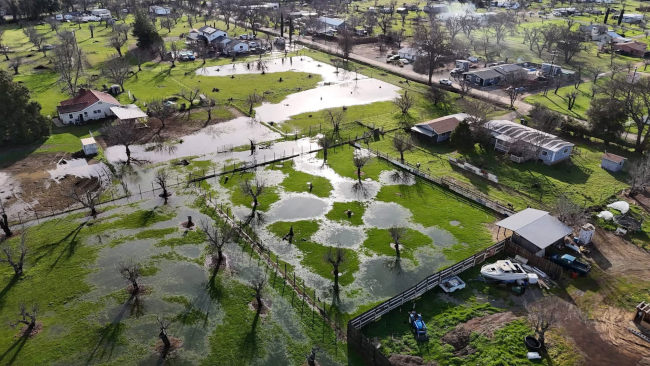
Special Districts, which oversees water and wastewater systems serving more than 40,000 people in Lake County, has repeatedly come under the spotlight during recent public meetings, particularly after the Jan. 11 Robin Lane sewer spill, when a rupture of a county-managed force main released approximately 2.9 million gallons of raw sewage, contaminating water wells and the underlying aquifer.
The department’s financial challenges – including claims of unpaid invoices, depleted reserves following the spill and unclear midyear budgeting – have come to light, reflecting broader management issues.
Yet the department is seeking additional revenue: it has requested millions in state grants and is bringing a proposal to the Board of Supervisors today for sweeping service fee increases that would affect Lake County ratepayers in two service areas including the spill area.
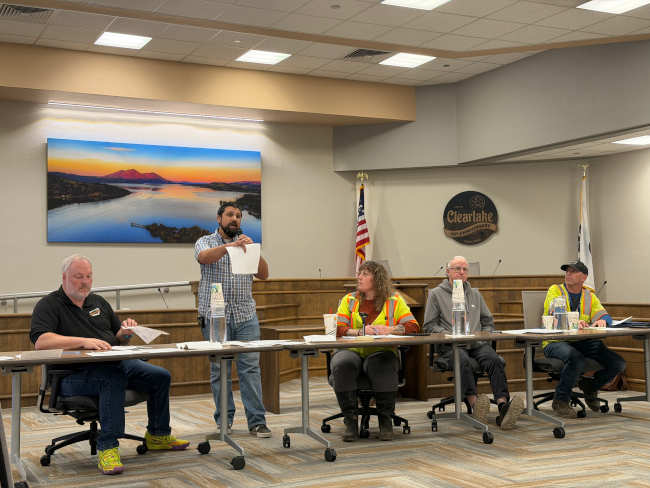
On March 3, Clearlake City Manager Alan Flora told the Board of Supervisors that the Special Districts owes the city $882,058.77 in unpaid invoices.
The invoices, Flora said, are tied to the city’s road improvement projects, which required work to raise or lower utilities such as valve boxes and maintenance holes to match new road surfaces. Because the city does not control those facilities, Flora told the board, the city believes it is the Special Districts’ responsibility to cover the costs.
“This has happened with no hitches for a number of years prior to this,” Flora said. But after four invoices sent in 2024 remained unpaid for a year, the city began assessing interest and penalties in November 2025. Special Districts has since paid only part of those invoices, Flora said.
“I would hope that this is not the expectation of this board to treat anyone or another government agency in this manner,” Flora said. ”This is my last attempt to resolve this issue before escalation.”
Ongoing disputes between the county and the city of Clearlake
The invoice dispute is among a list of issues contributing to continued tension between Special Districts and the city of Clearlake.
During his comments to the board, Flora also raised a separate dispute, saying Special Districts was putting up “roadblocks” to the city’s $60 million affordable housing project. Flora said the issue was believed to have been resolved during an Oct. 23 meeting last year with Special Districts Administrator Robin Borre and Supervisor Helen Owen.
“It was agreed to in writing,” he told the board, adding that he recently learned from the developer that it’s not resolved. “Now we’re scrambling to try and make sure the project can stay on track.”
The October meeting was held behind closed doors, with all parties agreeing to be recorded, according to Flora. The recording and meeting minutes obtained by Lake County News show 12 disputed items between the city of Clearlake and the Special Districts, including both issues Flora raised at the March 3 board meeting.
Lake County News reached out to the county for comment on the unpaid invoice amount, the reason for nonpayment, and Flora’s full statement at the board meeting.
County staff responded that discussions between the two agencies are “ongoing” and that efforts toward resolution are continuing “in good faith,” according to an email from Chief Deputy County Administrative Officer Matthew Rothstein, a county spokesperson.
“The County values our relationship with the city, and we are committed to resolving disputes, as they arise,” the email said, adding that there are “differences of perspective” between the two agencies.
The county did not provide documentation or answer questions about the unpaid invoices.
Flora told Lake County News in a text message on March 11 that he did have a meeting with County Administrative Officer Susan Parker regarding issues related to Special Districts after he spoke at the board meeting.
Flora said he was able to “stress the need for improved communication and coordination over the invoices and other outstanding items,” although an immediate resolution wasn’t reached at that meeting.
“If productive discussions were happening around sewer system challenges, the need to share comments at the Board of Supervisors meeting would not be necessary,” Flora said in the same text message.
Flora has also publicly voiced his concerns over Special Districts’ handling of the sewer spill multiple times.
At the first town hall meeting addressing affected residents, Flora said the response by Lake County Special Districts and the sanitation district it runs had been both frustrating and disappointing in a lot of ways.
At a city council meeting, he said spill-related data released by the Special Districts deserves "scrutiny."
Special Districts’ financial status remains uncertain
The department’s financial picture remains murky more than two months after the Robin Lane sewer spill. With reserves depleted and midyear budget reporting incomplete, questions persist about Special Districts’ overall management and transparency.
Ten days after the sewer spill, Borre told the Board of Supervisors, “We are out of money; we've depleted our reserves in that district,” during the Jan. 21 meeting.
At that meeting, the board approved a $750,000 county budget resolution for the department to purchase and fill water tanks for households left without safe water due to raw sewage contamination.
On Feb. 11, the board unanimously approved adding an additional $1 million to support recovery. At that meeting, Supervisor Bruno Sabatier, whose district includes the spill area, also requested to make expenses transparent to the public.
While Borre admitted the sewer spill exhausted the department’s reserve for the Southeast Regional Wastewater System, Special Districts did not report on its sewer spill-related finance and budget adjustments to the county at the midyear budget review.
At the March 3 board meeting, when the supervisors also conducted the midyear budget adjustment workshop, Sabatier said he specifically looked into the Special Districts’ budget.
“Feel like that's not the most up-to-date reserves,” Sabatier said. “And it still has a whole bunch of money.”
Out of confusion, Sabatier then asked: “Is it just that we've encumbered the cost but we have not paid out the cost, or because there was a lot more in the reserves there than I had anticipated to see when looking that over?”
Borre said the department intentionally did not include any expenditures on the sewer spill for the midyear budget meeting. “We want to bring that back as a completely transparent item,” she told the board. “So when we accrue all those costs and we know exactly what they are, we will bring that back as a stand-alone item.”
Sabatier asked for a timeline. “We’re still receiving some invoices,” Borre said. “So I would expect in the next month or so.”
Sabatier asked Deputy Administrative Officer Casey Moreno if there are any current concerns or budget areas the Board of Supervisors should be aware of, given that there is no red-flag system in place.
“We don’t really have any concerns that anybody is going to run out of money right now,” Moreno said.
But she also said the County Administrative Office historically has not been tracking any department’s cash account. “It has always been the responsibility of the department to monitor that as they pay their bills.”
“We are watching a few different departments,” she said, adding that Special Districts is one of those being monitored because of the sewer spill.
While acknowledging a lack of knowledge in departments’ cash status, flagging a few departments financially impacted by the sewer spill, Moreno said, “There's nothing that is screaming to us that there's going to be an issue.”
The board approved the midyear budget without full details.
Special Districts seeking revenue
While Special Districts’ true financial standing remains unclear, the department has been actively seeking additional income, applying for millions in state grants and proposing sweeping service fee increases – all while unresolved financial and operational issues persist.
On Feb. 24, the Board of Supervisors unanimously approved the inclusion of a $2.1 million state grant application for the Southeast Regional Wastewater System, which encompasses the spill area. It’s operated by the Lake County Sanitation District, or Lacosan, and overseen by Special Districts.
Borre said the funding would cover the gravity sewer lines cleaning and video surveillance of the entire 90 miles gravity system and portions of the 10-mine force main system.
During public comment of this meeting, Flora told the board that in 2019, “Pretty much the entire system was CCTV,” he said, referring to closed-circuit camera monitoring. “My understanding is very little operation and maintenance efforts happened as a result of that.”
Flora read out a list of 2024 State Water Board violations on the Southeast Regional system, including its lack of formal operating procedures, failure to review CCTV footage or systematically maintain air relief valves, and reliance on historical knowledge instead of a computerized maintenance management system.
“I just want to let the board know that getting the camera footage itself is something that Special Districts has had for a number of years and hasn't acted upon,” Flora said. “So I'd encourage you to make sure that this time that happens.”
Borre said the new camera system would automatically upload footage into the system and identify the problem areas. But the existing camera system – which along with a new van cost nearly half a million dollars, according to Flora – would require the operator to “be doing nothing but cameraing the lines for the next probably three years,” Borre said.
“So this funding would allow us to basically get caught up on that and then start identifying our priority areas,” Borre said.
As residents in the spill area are still struggling to have clean water, financial disputes remain unresolved and the department’s true budgetary position remains unclear.
Today at 1:30 p.m., Special Districts is bringing a proposal to increase sewer rates over the next five years in the Lands End/South Lakeport Sewer and Southeast Regional systems.
The fee studies propose an increase across 17 fee types in both areas, from single family residential to the splash pad – another disputed area between the city of Clearlake and the Special Districts.
In a Facebook group for residents affected by the spill, “Robin Ln sewage spill & contamination,” Cassandra Hulbert, who lives on Robin Lane near the ruptured force main, wrote under a post regarding the new fee proposal: “Not surprising but nonetheless maddening.”
Lingzi Chen is a staff reporter at Lake County News and a 2024-2026 California Local News Fellow. Email her at lchen@lakeconews.com.