 How to resolve AdBlock issue?
Governor commits to restarting state’s ZEV rebate program if federal tax credit is eliminated
California has surpassed 2 million zero-emission vehicles, or ZEV, sold, reaffirming California’s status as the country’s leader in clean vehicles.This milestone comes a little over two years after California eclipsed the 1 million ZEV sales mark.
To ensure the state’s continued progress, Gov. Gavin Newsom on Monday announced that if the incoming Trump Administration eliminates a federal ZEV tax credit, he will propose creating a new version of the state’s successful Clean Vehicle Rebate Program, which was phased out in 2023.
During its lifetime, the CVRP funded more than 594,000 vehicles and saved more than 456 million gallons of fuel.
The proposed California rebates, which would include changes to promote innovation and competition in the ZEV market, could come from the Greenhouse Gas Reduction Fund, which is funded by polluters under the state’s cap-and-trade program.
"Consumers continue to prove the skeptics wrong — zero-emission vehicles are here to stay,” said Newsom. “We will intervene if the Trump Administration eliminates the federal tax credit, doubling down on our commitment to clean air and green jobs in California. We’re not turning back on a clean transportation future — we’re going to make it more affordable for people to drive vehicles that don’t pollute."
In the third quarter of 2024, Californians purchased 115,897 ZEVs, representing 26.4% of all new vehicle sales in the state. With more electric vehicles, or EVs, including plug-in hybrids, on the road every day, consumers are benefitting from the state’s work to build a bigger, better and more reliable charging network.
The nation’s leader in ZEV vehicles and infrastructure
California’s support for clean cars is unmatched. With the rise in EV and plug-in hybrid demand, the state is committed to rapidly deploying funds to develop and ensure an accessible, reliable and easy-to-use charging network. In 2024, the state has doubled down on improving the network:
150,000 public or shared private electric vehicle chargers have been installed throughout California, plus over 500,000 at-home chargers.
Awarded over $32 million in federal funds to install, operate and maintain 458 direct-current fast chargers along interstates and highways across the state thanks to the first round of funding President Biden’s Infrastructure Investment and Jobs Act. California was recently approved to spend another $81.7 million in federal funding next year.
Thousands of dollars in grants and rebates available for low-income Californians. Learn more at ClimateAction.ca.gov or ElectricForAll.org.
The work doesn’t stop with electric, hydrogen, and plug-in hybrid vehicles — the state has been hard at work to cut emissions in the freight sector and in school districts. Recent efforts include:
• $102 million to install charging stations and hydrogen fueling stations for zero-emissions trucks along Interstate 5 and other key freight corridors.
• $500 million to put another 1,000 ZEV school buses on the road.
Under President George W. Bush, the first federal EV tax credit was introduced through the U.S. Energy Policy Act of 2005.
Building a bigger, better charging network
State agencies are working to speed up charger deployment, cut through red tape, establish guidelines, plan for the expected increased grid demand, and efficiently electrify charging stations through local utilities.
This includes:
• Gathering better data on EV charger counts.
• Prioritizing shovel-ready projects for both state and federal incentives.
• Developing the Zero-Emission Vehicle Infrastructure Plan (ZIP), a comprehensive plan that lays out the overall strategy to meet California’s ZEV goals.
• Establishing reliability standards.
• Updating transportation energy forecasts.
California is spending billions to speed ZEV infrastructure deployment, tear down barriers, and deploy infrastructure in hard-to-reach and low-income areas. 30.3% of new ZEVs sold in the U.S. are sold in California, according to the California Air Resources Board.
California’s strategy for a clean transportation transition
Newsom’s office said this is a major milestone on California’s path to a clean transportation future.
In addition to advancing ZEVs, the Newsom Administration said it is prioritizing clean fuel production, public transit and rail infrastructure enhancements, and a cleaner, smarter electric grid to help power it all.
As California works toward this clean transportation future, the state is also advancing efforts to prevent gasoline price spikes.
Annual Lake County burn ban lifted
LAKE COUNTY, Calif. — The annual Lake County Burn Ban has ended for 2024.It was lifted as of 9 a.m. Friday, Nov. 22, with Cal Fire’s declaration that fire season hazardous conditions have abated, fire season requirements have been lifted, and Cal Fire is transiting to winter preparedness.
Burn permits are required for all outdoor burning in the Lake County Air Basin. Residential and agricultural burn permits can be obtained online at www.lcaqmd.net or by appointment at the district office.
A smoke management plan burn permit is required for multi-day burns, overnight burns, standing vegetation burns, whole tree or vine removal, burns over 20 acres in one day, and any other burn where significant smoke impacts may occur or sensitive receptors may be impacted.
A smoke management plan can be obtained at the Lake County Air Quality Management District office, call 707-263-7000 to make an appointment. Bring a map showing the burn location (https://gispublic.co.lake.ca.us/portal/home/), burn site coordinates (GPS locations), parcel number or address, acres to be burned, and details of vegetation to be burned.
A fee is required for all burn permits, payable at the time the permit is issued. Smoke Management Plans, Agricultural burn permits and Residential burn permits are $34. In person payments may be made by cash, check, or money order. Online permit payment is by credit card only.
Only clean dry vegetation that was grown on the property may be burned. Residential burn permits require a one acre or larger lot of record, a burn location that is at least 100 feet from all neighbors, and at least 30 feet from any structure in order to qualify. Read your burn permit carefully and follow all the conditions.
Please be considerate of your neighbors. A permit does not allow you to create health problems for others. You can be liable for health care costs, fines, and other costs resulting from your burning.
Consider composting or using the vegetative waste pickup provided with your waste collection service as an alternative to burning leaves. Lake County’s joint fire agencies and air quality management district’s open burning program has incorporated both fire safety and air quality management since 1987.
Attendance rates improve across Lake County schools
LAKE COUNTY, Calif. — There’s good news when it comes to student attendance in Lake County schools.
The California Department of Education has released the 2024 California School Dashboard, providing educators and families with insights into school and district progress.
An initial dashboard review shows that schools across Lake County have increased student attendance rates, a key factor linked to academic success.
“Getting into the habit of daily attendance is more important now than ever. When students improve their attendance rates, they improve their academic prospects and chances for graduating,” said Lake County Superintendent of Schools Brock Falkenberg.
Data for the 2023/24 school year highlights reductions in average days missed by students in every Lake County district is as follows:
• Lucerne Elementary: Reduced from 16.6 to 14.0 (15.7% improvement).
• Konocti Unified: Reduced from 24.5 to 21.8 (11.0% improvement).
• Middletown Unified: Reduced from 15.9 to 14.3 (10.1% improvement).
• Upper Lake Unified: Reduced from 18.2 to 16.2 (10.1% improvement).
• Lakeport Unified: Reduced from 18.4 to 17.4 (5.4% improvement).
• Kelseyville Unified: Reduced from 15.2 to 14.7 (3.3% improvement).
The most dramatic improvements came from Konocti Unified and Lucerne Elementary, with reductions of 2.7 and 2.6 days, respectively.
These improvements reflect a collective effort to tackle chronic absenteeism, which is defined as missing two or more days of school per month, excused or unexcused.
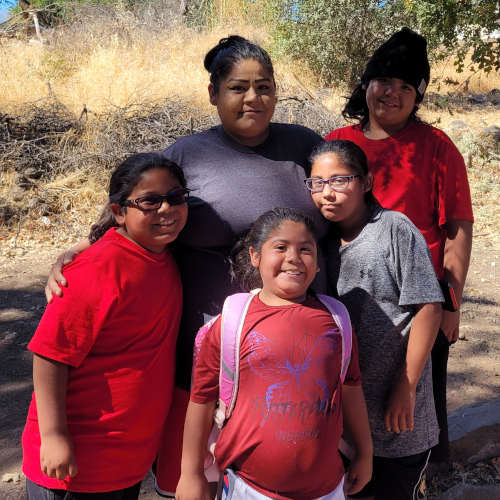
Amid these encouraging trends, the Garcia family from Konocti Unified School District stands out.
Facing significant challenges, the family initially reported an average attendance rate of just 25 percent.
With the dedicated support of the Healthy Start Attendance Team, the family achieved a remarkable turnaround, increasing their attendance rate to 82 percent.
This success story illustrates how targeted support and commitment to student well-being can create transformative change.
The Healthy Start Attendance Team was able to help improve attendance due to the Communities for School Success program, a partnership between the Lake County Office of Education and local school districts.
Funded by the California Department of Education, the initiative is led by Roxanne Morris, attendance supervisor for Healthy Start, who oversees a team of youth advocates.
“The program focuses on addressing barriers to consistent attendance, providing families with resources, and fostering a sense of belonging for every student,” Morris said. “I am proud of the Attendance staff and the work they have done to help Lake County students return to school.”
By working collaboratively with families, educators, and community partners, the Communities for School Success program is creating lasting change and brighter futures for Lake County students.
The release of the 2024 California School Dashboard and the progress in attendance underscore Lake County’s dedication to fostering academic success and community engagement.
For more information on the Dashboard, the Communities for School Success program, or other LCOE initiatives, visit https://www.lakecoe.org/.
Adventist Health Clear Lake medical office in Lucerne to close; services to be reallocated
LUCERNE, Calif. — Adventist Health Clear Lake reported that it is closing its Lucerne medical office.Hospital officials said in a written statement that the decision is “part of a strategic effort to reallocate resources to areas of higher demand, ensuring the community receives the best possible care in the most impactful locations.”
The Lucerne office will officially close on Dec. 31.
“At Adventist Health Clear Lake, our mission is to provide compassionate, high-quality care for everyone we serve,” said Adventist Health Clear Lake Administrator Chuck Kassis. “This decision allows us to strengthen services in key areas, optimizing resources to benefit the greatest number of patients in our community.”
Adventist Health Clear Lake opened the medical office in Lucerne — the former Lucerne Community Clinic at 6300 East Highway 20 in Lucerne — in the spring of 2019 after acquiring it from Dr. Robert Gardner.
The decision to close the Lucerne office “follows an in-depth review of service demands and patient needs across Lake County. By concentrating resources in locations where there is higher patient volume, Adventist Health Clear Lake aims to enhance access and improve service capacity for residents,” hospital officials said.
Adventist Health Clear Lake said patients affected by the closure will be provided “with support to transition their care seamlessly to nearby Adventist Health Clear Lake facilities,” which include options in Lakeport, Kelseyville and Clearlake.
The Adventist Health Clear Lakes patient services team can assist with answering questions about care continuity or finding a new provider, officials said.
Email Elizabeth Larson at




