How to resolve AdBlock issue?
Forecast calls for rain to continue until middle of next week
LAKE COUNTY, Calif. — An atmospheric river is continuing to dump large amounts of precipitation across the North Coast this week, with several more days of wet and windy weather in the forecast.Lake County experienced steady rain and winds on Wednesday.
Rainfall totals in inches for the 24-hour period ending at 2:30 a.m. Thursday:
— Hidden Valley Lake: 2.33.
— Indian Valley Reservoir: 0.75.
— Kelseyville: 1.21.
— Knoxville Creek: 2.03.
— Lake Pillsbury: 2.96.
— Lyons Valley: 1.07.
— Upper Lake: 1.27.
— Whispering Pines: 2.60.
The National Weather Service’s flood watch for Lake County will remain in place through Friday evening.
Gusty winds also are forecast to continue through Thursday night “as a surface cyclone brushes the area,” that National Weather Service reported.
Pacific Gas and Electric Co., which mobilized crews ahead of the storm, reported that at one point on Wednesday 104 customers had been out of power due to the storm. By early Thursday, all but 16 customers had their power restored.
The Lake County forecast calls for rain to continue through Wednesday, with close to another 7 inches of rain possible through Sunday.
Daytime highs through Wednesday will range from the low to mid 50s, with nighttime conditions into the low 40s.
Email Elizabeth Larson at
Newly detected invasive golden mussels pose potential threat to Clear Lake, Lake County waterways and infrastructure
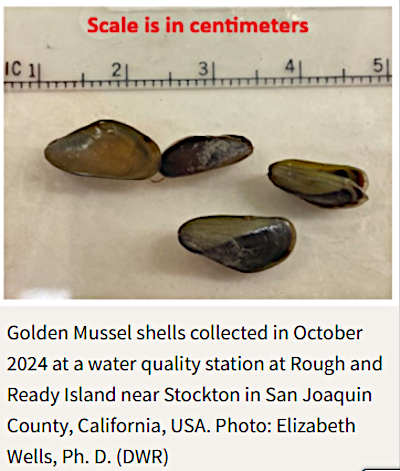
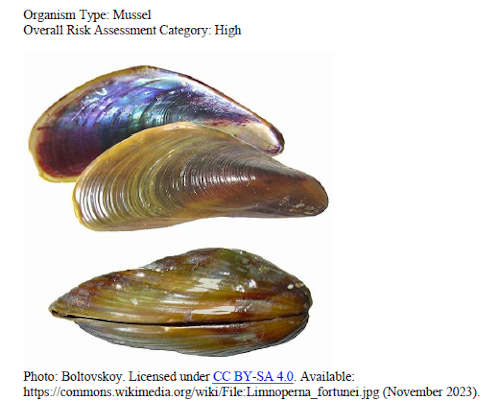
LAKE COUNTY, Calif. — A newly detected invasive mussel is posing a potential threat to Lake County’s water bodies.
The Lake County Water Resources Department, and Watershed Protection District urge residents and visitors to Clear Lake, and other Lake County water bodies, to be aware and on the lookout for invasive golden mussels (Limnoperna fortunei).
The newly detected invasive mussel (freshwater bivalve) found in several locations in the Port of Stockton and in the Sacramento-San Joaquin Delta region.
On Oct. 17, the California Department of Water Resources reported finding attached, adult mussels at a sample site location in the Port of Stockton.
Mussel specimens were sent to UC Davis Genomic Variation Laboratory and confirmed to be golden mussels, originally from China and Southeast Asia; the species had not previously been detected in North America.
Water Resource managers are concerned. While similar in appearance, biology and potential ecosystem effects to quagga and zebra mussels (the current focus of invasive mussel prevention programs in Lake County), golden mussels pose an even greater threat.
“Golden mussels have been found in soft surfaces [e.g., fine silt and sediments] and attached to hard surfaces. Adult mussels are mobile and have been observed to move freely within a waterbody,” notes California Department of Fish and Wildlife Regional Biologist, Angie Montalvo, who observes Clear Lake on behalf of the State agency. “[Golden Mussels] have a much wider tolerance threshold than Quagga-Zebra mussels. This discovery is serious.”
Much like quagga and zebra mussels, golden mussels, if established in Clear Lake or other Lake County water bodies, pose a significant threat to water conveyance systems, infrastructure, and water quality.
Effects golden mussels would have on sport fisheries, like bass, crappie, and catfish, native fisheries and wildlife species, like the Clear Lake Hitch and Clark’s and Western Grebes (which feed and forage in shallow lake areas on green algae), and plants whose populations can become heavily disrupted when invasive mussels establish, are not fully known.
Golden mussels were likely introduced to California by a ship traveling from an international port. Lake County water managers are concerned they may mobilize further from the Delta (likewise a popular California sport fishery) to Lake County overland on a visiting boat.
Therefore, the Lake County Water Resources Department is reminding the public, both residents and visiting boaters, to get their boat screened by trained and certified boat screeners and inspectors (the Lake County Invasive Mussel Prevention Program) whenever coming back to the county from Delta region or waters.
In addition to routine screenings, some boats may be inspected or required to undergo decontamination beyond what has been typical in Lake County. Please be patient and understanding with staff and certified screeners and vendors.
County water officials ask that boaters always remember to “clean, drain, dry” whenever moving a boat between water bodies — every time.
Visit www.nomussels.com for more information on the Lake County Mussel Prevention Program. To learn more about Lake County’s efforts to plan for an invasive mussel rapid response, visit https://www.clearlakemusselprevention.org/.
The California Department of Fish and Wildlife are also encouraging boaters and water users to visit their new website, “California’s Invaders: Golden Mussel,” to learn more about this dangerous newly detected invasive species: https://wildlife.ca.gov/Conservation/Invasives/Species/Golden-Mussel.
If you think you visually observe a golden, quagga or zebra mussel, please contact the Water Resources Department at 707-263-2344 or email at
Padilla, Murkowski introduce bipartisan bill to establish atmospheric river forecasting program
A bipartisan effort is seeking to create an important new weather forecasting program.On Wednesday, U.S. Senators Alex Padilla (D-Calif.), chair of the Senate Environment and Public Works Subcommittee on Fisheries, Water, and Wildlife, and Lisa Murkowski (R-Alaska) introduced bipartisan legislation that will reduce flood risks and bolster emergency preparedness by improving atmospheric river forecasting to more precisely predict the timing and location of these storms.
The Improving Atmospheric River Forecasts Act would require the National Oceanic and Atmospheric Administration, or NOAA, to establish a forecast improvement program within the National Weather Service.
The legislation was introduced as the first significant atmospheric rivers of the season made landfall in the Pacific Northwest and along the Gulf Coast.
Atmospheric rivers, often described as “rivers in the sky” that are hundreds of miles wide and can carry water vapor equivalent to multiple Mississippi Rivers, cause more than 80 percent of flood damage across the West.
Climate change will only make these storms increasingly catastrophic: by 2090, atmospheric rivers are expected to cost $2.3 to $3.2 billion in annual damages and increase in width by nearly 25 percent.
Over 50 atmospheric rivers made landfall across the West Coast during the 2024 water year, from Oct. 1, 2023 to Sept. 30, 2024.
“For the past several years, California communities have witnessed firsthand the ongoing threat of destructive flooding caused by intense and frequent atmospheric river storms,” said Sen. Padilla. “California scientists have led the way in improving our understanding of these storms, and this bipartisan bill will strengthen forecasts to both reduce flood risks and bolster our water supply and drought resilience.”
“It was one year ago today that the community of Wrangell was devastated by the loss of six people, including three children, due to landslide. Ketchikan also experienced a deadly landslide just months ago. Haines and Sitka have also lost friends, family, and property due to massive landslides. With greater frequency, we are seeing that atmospheric rivers instill dangerous climate conditions that pose deadly threats to Alaskan communities,” said Sen. Murkowski. “While there are numerous atmospheric river observatories in the Lower 48, none are in Alaska. This bill ensures that all states along the West coast, including Alaska, have at least one atmospheric river observatory. Along with improved modeling, data collection, and risk communication, this legislation will help protect our communities and ultimately save lives across Alaska.”
“Atmospheric rivers are responsible for 30-50% of annual precipitation along the western U.S. and cause the majority of the flooding, with more than $1 billion in annual average flood damage in the western 11 states,” said Marty Ralph, founding director of the Center for Western Weather and Water Extremes at UC San Diego’s Scripps Institution of Oceanography. “The introduction of this act is critically important to advance forecasts of atmospheric rivers to enable more flexible and resilient water management, improved warning around flooding, safer transportation, and overall improvements to public safety. It will also enable reservoir operators to safely implement Forecast-Informed Reservoir Operations (FIRO) to save additional water after a storm for the dry summer, or release it if an AR storm is predicted in the next few days.”
Specifically, the Improving Atmospheric River Forecasts Act would direct NOAA to establish a standalone atmospheric river forecast improvement program that would:
• Develop accurate, effective, and actionable storm forecasts and warnings in collaboration with public and private partners across the weather enterprise;
• Evaluate innovative observation tools and emerging technologies to improve atmospheric river analysis, modeling, forecasts, and warnings;
• Authorize NOAA to procure equipment, aircraft, and personnel contracts to fully monitor atmospheric river events each winter; and
• Improve atmospheric river hazard communication.
‘Responders Ahead!’: Statewide call to action during Crash Responder Safety Week
Caltrans, the California Highway Patrol, the Office of Traffic Safety and the Department of Motor Vehicles joined together this week as part of Crash Responder Safety Week to remind drivers to move over when safe to do so and slow down near traffic incidents and work zones to prevent serious injuries and deaths on California’s roadways.
California’s Move Over law requires drivers to move over a lane when safe to do so, and slow down when approaching stopped emergency or maintenance vehicles.
This week recognizes that the public’s health, safety, and well-being are often dependent on the commitment of first responders to conduct invaluable and often life-saving operations on the side of our roads. When first responders report to an incident, that is a work zone.
According to the National Safety Council, 891 people were killed and 37,701 were injured in work zone crashes in 2022 across the country.
During the same period, more than 10,000 work-zone crashes occurred on California roadways, resulting in 117 fatalities and more than 4,500 injuries.
While all 50 states have "Move Over" laws to protect roadway workers, one-third of the public are not aware of the law.
“Safety is our top priority,” said Caltrans Director Tony Tavares. “We are asking drivers that when near work zones, please slow down, pay attention and move over when you see flashing responder lights. There’s no excuse to speed and drive recklessly. Make the conscious decision to protect yourself, loved ones, fellow travelers and vulnerable highway workers.”
“Every day, our officers and first responders put their lives on the line to protect and serve our communities,” said CHP Commissioner Sean Duryee. “Crash Responder Safety Week reminds drivers everywhere of the vital importance of moving over, slowing down and staying alert when approaching emergency scenes. Together, we can save lives and ensure that those who serve on California’s roadways make it home safely.”
“Keeping all road users safe is a priority for the DMV,” said DMV Director Steve Gordon. “That is why we do what we do to ensure all drivers know the rules of the road before we license them.”
Each year, first responders are struck by passing motorists, often while aiding motorists and clearing roadway incidents, resulting in serious injury or death.
Traffic-related incidents are the leading cause of death for on-duty law enforcement officers, firefighters, emergency medical services personnel, maintenance workers and tow/recovery professionals. Many of these incidents can be prevented if motorists follow the law.
For more information on the campaign, visit http://beworkzonealert.com/.