How to resolve AdBlock issue?
New curfew bell monument to be dedicated Oct. 23
LAKEPORT, Calif. — The effort to preserve a piece of unique Lakeport history will be celebrated this week.
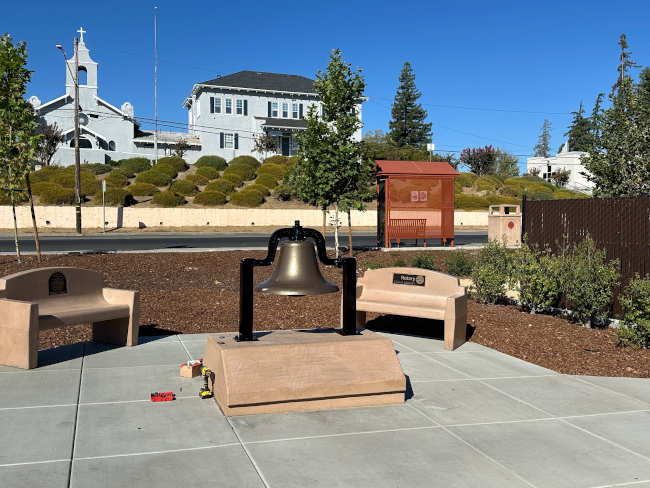
The Lakeport curfew bell is at the heart of a new monument to be dedicated at Xabatin Park in a “Rotary After Dark” event planned for 5:30 to 7:30 p.m. Wednesday, Oct. 23.
The project, a collaboration between the city of Lakeport and the Lakeport Rotary, focused on taking the historic Lakeport “curfew” — or “hooligan” — bell, which had sat in storage for many years, and placing it at the center of a new monument at the park, which opened a year ago this month.
The bell once was used to alert children to return home for the night.
During the June meeting in which the Lakeport City Council gave its final approval on the project, Lakeport Public Works Director Ron Ladd credited Public Works Superintendent Jim Kennedy for finding the bell sitting in storage on the Lake County Fairgrounds property.
Mark Lipps, a local businessman and Rotary District 5130 Area governor who took the club’s lead on the project during his term as president that ended earlier this year, reported that the bell has been installed at the park.
He said the bell originally was installed downtown just after the historic Lakeport courthouse was built in the 1870s.
“This has been a Lakeport Rotary labor of love for the last year,” he told fellow Rotarians in an email update on the bell project.
The Rotary reported that the bell display, commemorative plaque and accompanying benches are located near the parking lot and the bathrooms.
The monument’s completion comes as the Lakeport Rotary itself is planning to celebrate its 100th anniversary in 2025.
“This club is a part of the history and legacy of this community. I am excited that our club plans to continue telling the stories of ‘days gone by’ in celebrating our 100th Anniversary. Stay tuned for those details. We will continue the sweat equity in leaving more footprints around town for today and upcoming generations,” Lipps reported in his email update.
The community is encouraged to attend the Wednesday celebration.
Email Elizabeth Larson at
USDA invests $46 million in efforts to address food and nutrition security; Tribal Health among awardees
LAKE COUNTY, Calif. — The U.S. Department of Agriculture has announced an investment of more than $46 million in projects aimed to tackle food and nutrition insecurity in underserved communities, as well as support healthy diets by providing access to fruits and vegetables for eligible families.These funds support efforts across the USDA National Institute of Food and Agriculture’s Community Food Projects Competitive Grants Program and Gus Schumacher Nutrition Incentive Program.
Among the grantees in this round of funding is Lake County Tribal Health and its Food as Medicine Program.
The program will receive $480,440 through the Produce Prescription, which awarded $5.2 million to 11 awardees.
The USDA said these projects will demonstrate and evaluate the impact of fresh fruit and vegetable prescriptions.
The goals of the Produce Prescription Program are to increase purchase and consumption of fruits and vegetables, reduce individual and household food insecurity, and reduce healthcare use and associated costs.
Tribal Health did not immediately respond to a request for comment about its project.
“Healthy, safe, and affordable food is essential for a strong start for children and a healthy life for all of us,” said Deputy Secretary of Agriculture Xochitl Torres Small. “Through these investments, the Biden Harris Administration is investing in healthy food options for people no matter where they live and supporting stronger local and regional food systems.”
The investment provides funding to 20 CFPCGP projects , which bring together stakeholders from distinct parts of the food system and fosters understanding of national food security trends and how they might work together to improve local food systems.
This investment is expected to catalyze small production agriculture, increase food access in low-income communities, increase community engagement in planning for food security solutions, and bridge gaps in local foods systems.
Named in honor of the former USDA Under Secretary of Agriculture for Farm and Foreign Agricultural Services (1997 to 2001) Gus Schumacher, GusNIP grant programs include Nutrition Incentives and Produce Prescriptions. By bringing together stakeholders from various parts of the food and healthcare systems, GusNIP projects help foster understanding to improve the health and nutrition of participating households, facilitate growth in underrepresented communities and geographies, and aggregate data to identify and improve best practices on a broad scale.
Fourteen awardees are receiving GusNIP Nutrition Incentive funding totaling $36.3 million. These projects increase the purchase of fruits and vegetables by providing incentives at the point of purchase among income-eligible households participating in the USDA Supplemental Nutrition Assistance Program and Nutrition Assistance Program Block Grants. The awards include Pilot Projects, Standard Projects and Largescale Projects.
These investments answer the call to the White House Challenge to End Hunger and Build Healthy Communities, which is an extension of the National Strategy on Hunger, Nutrition, and Health that aims to end hunger and increase healthy eating.
California deploys largest service corps in the nation, connecting and supporting communities across the state
On Monday, Gov. Gavin Newsom announced the start of an ambitious new service year for the California Service Corps, with 10,000 service members expected to provide over five million service hours in 2025.“As we launch this new service year with the nation’s largest service corps, we reaffirm that service to others is the highest form of civic duty. These paid opportunities embody the best of California’s values — a commitment to each other, mutual understanding, and the belief that when we lift others, we all rise together,” Newsom said.
California leads the way in national service
In 2025, California Service Corps programs will be over 10,000 members strong and will help communities by:
• Tutoring and mentoring K-12 students.
• Supporting communities experiencing and recovering from disasters.
• Combating food insecurity and connecting vulnerable people to resources and services.
• Taking climate action — planting trees, preventing wildfires, and installing solar panels.
California Service Corps programs include:
• #CaliforniansForAll College Corps.
• Youth Service Corps.
• California Climate Action Corps.
• AmeriCorps California.
“Service members have stepped up to bridge divides and help their communities by serving in the California Service Corps,” said California Chief Service Officer Josh Fryday. “These members are the state’s future leaders, and we need their energy and enthusiasm to address our greatest challenges.”
California Service Corps members gain skills and experience while effecting positive change in their communities. Members receive living stipends, and many can receive up to $10,000 toward higher education after completing their service to be used for college, trade school or to pay back student loans.
To learn more about applying to the California Climate Action Corps, Youth Service Corps and AmeriCorps California, visit www.CAServiceCorps.com.
CHP offering Start Smart Program to curb teen driving fatalities
The California Highway Patrol has received a grant to fund the Start Smart program, a traffic safety initiative designed to educate and empower teen drivers, ages 15-19, and their guardians.The free, two-hour Start Smart class helps newly licensed teens navigate the risks of driving while highlighting the essential role of guardian involvement in traffic safety.
Led by an experienced CHP public information officer, the class covers topics such as crash prevention, safe driving habits, consequences of risky behavior, guardian responsibilities, and legal liabilities.
The program requires a guardian’s participation because it recognizes their influence on teen driving habits.
Through Start Smart, guardians learn how to support their teens, enforce safe driving practices, and understand the laws affecting young drivers.
“The Start Smart program allows us to take proactive steps in protecting our youngest drivers by equipping them and their parents or guardians with the knowledge and tools needed to navigate the road safely,” said CHP Commissioner Duryee. “Educating new drivers on responsible habits today will help prevent tragedies tomorrow, and we’re proud to be able to offer a program that prioritizes the safety and well-being of our communities.”
To register to attend an upcoming Start Smart class, contact your local CHP office. More information about Start Smart and California’s provisional driver licensing law is available on the free CHP Start Smart App.
Available for download in the Apple app store or Google Play, this app provides users with access to the Department of Motor Vehicles’ California Driver’s Handbook and a trip logger to track driving time as teens prepare to obtain their driver's license.
Additional information about the Start Smart program and the mobile app can be found on the CHP’s website.
Funding for this program was provided by a grant from the California Office of Traffic Safety through the National Highway Traffic Safety Administration.