How to resolve AdBlock issue?
Refresh this page
Lake County News,California
  • Home
    • Registration Form
  • News
    • Education
    • Veterans
    • Community
      • Obituaries
      • Letters
      • Commentary
    • Police Logs
    • Business
    • Recreation
    • Health
    • Religion
    • Legals
    • Arts & Life
    • Regional
  • Calendar
  • Contact us
    • FAQs
    • Phones, E-Mail
    • Subscribe
  • Advertise Here
  • Login
How to resolve AdBlock issue?
Refresh this page

News

Wind advisory in effect until midday Monday

LAKE COUNTY, Calif. — Lake County is starting off the week under a wind advisory.

On Sunday night, the National Weather Service issued the advisory, which took effect at 2 a.m. and will remain in place until noon on Monday.

Forecasters said north winds of between 25 to 35 miles per hour were expected, with gusts of up to 60 miles per hour, especially from the northeast.

The National Weather service said wind gusts will be particularly strong along windward ridges, especially those bordering Colusa, Napa and Glenn counties.

True to the forecast, heavy winds were recorded along the Northshore before 3 a.m., causing windows to rattle.

Email Elizabeth Larson at This email address is being protected from spambots. You need JavaScript enabled to view it.. Follow her on Twitter, @ERLarson, and on Bluesky, @erlarson.bsky.social. Find Lake County News on the following platforms: Facebook, @LakeCoNews; X, @LakeCoNews; Threads, @lakeconews, and on Bluesky, @lakeconews.bsky.social.

Purrfect Pals: This week’s cats and kittens

LAKE COUNTY, Calif. — Lake County Animal Care and Control has little cats and big cats ready to meet their new families.

The kittens and cats at the shelter that are shown on this page have been cleared for adoption.

Call Lake County Animal Care and Control at 707-263-0278 or visit the shelter online for information on visiting or adopting.

The shelter is located at 4949 Helbush in Lakeport.

Email Elizabeth Larson at This email address is being protected from spambots. You need JavaScript enabled to view it.. Follow her on Twitter, @ERLarson, and on Bluesky, @erlarson.bsky.social. Find Lake County News on the following platforms: Facebook, @LakeCoNews; X, @LakeCoNews; Threads, @lakeconews, and on Bluesky, @lakeconews.bsky.social.


A#8's preview photo
A#8


A#49a's preview photo
A#49a
A#49b's preview photo
A#49b


A#16's preview photo
A#16

A#96's preview photo
A#96


A#2's preview photo
A#2


Lake County firefighters respond to Southern California fires

LAKE COUNTY, Calif. — As devastating fires continue to rage in Southern California, firefighters from Lake County have joined the effort to stop them.

Cal Fire said Saturday night that four fires are actively burning in Los Angeles and Ventura counties.

They include the Palisades Fire, at 23,654 acres and 11% containment; the Eaton Fire, 14,117 acres, 15% containment; the Kenneth Fire, 1,052 acres, 90% containment; and the Hurst fire, 799 acres, 76% containment.

Combined, the fires have burned thousands of homes, killed an estimated 16 people and led to the evacuations of nearly 200,000 residents.

With Southern California firefighting resources stretched to the maximum, the call has gone out across the state, the nation and to neighboring countries for assistance.

Cal Fire reported that it is receiving assistance from several states — Arizona, Colorado, Idaho, Nevada, New Mexico, Oregon, Texas, Utah, Washington — and from Canada and Mexico.

Lake County Fire Protection District Chief Willie Sapeta responded to assist on Thursday. At 4:30 a.m. that morning he was assigned to the Eaton fire, according to a fire district Facebook post.

Chief Sapeta, a fire service veteran who has fought Lake County’s most devastating wildland fires, is working in the Altadena community as a strike team leader, Lake County Fire reported.

“Immediately upon arriving he reported an immense amount of support from the LA community to all first responders,” the district said in its Facebook post, which was accompanied by a picture of Sapeta and a restaurant staffer who delivered breakfast burritos to the firefighters to thank them for their service.

On Saturday morning, more Lake County firefighters headed south.

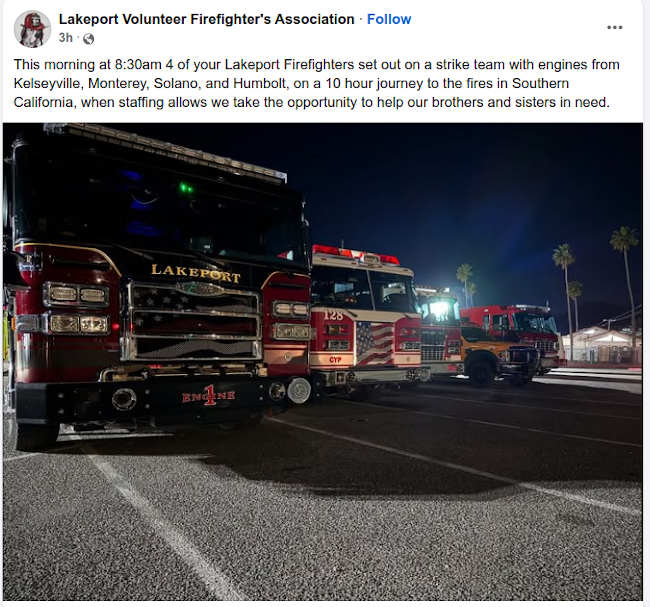
The Lakeport Volunteer Firefighters Association posted on Facebook on the evening of Saturday, Jan. 11, 2025, about its members heading to Southern California.

The Lakeport Volunteer Firefighter's Association said four Lakeport Fire firefighters set out on at 8:30 a.m. as part of a strike team with engines from Kelseyville, along with personnel from Monterey, Solano and Humboldt counties, on a 10-hour journey to the fires in Southern California.

The association noted, “When staffing allows we take the opportunity to help our brothers and sisters in need.”

On Saturday evening, the Governor’s Office said California's historic deployment of resources to Southern California is being augmented with even more support in anticipation of another round of severe fire weather expected starting Monday through Wednesday.

“The assets will join the ongoing firefight and preposition at strategic locations throughout Southern California to be ready for any new fire starts,” the Governor’s Office reported.

The Governor’s Office said the additional resources being sent to the fires brought the total on Saturday to more than 14,000 personnel, including firefighters, guard service members, highway patrol officers and transportation teams to support the ongoing firefight.

The personnel include 1,680 California National Guard servicemembers after Gov. Gavin Newsom doubled the number of deployed earlier on Saturday.

In addition, these response efforts include more than 1,700 pieces of firefighting apparatus that are in place or on the way, including 1,350 engines, 80 aircraft, 150 dozers and 160 water tenders to aid in putting out the fires, the Governor’s Office reported.

“Even as we pivot to recovery for the thousands of Californians impacted by the devastating Los Angeles hurricane-force firestorms, we’re ready for another round of severe fire weather. Hour by hour, we are surging more people and more firefighting equipment to Southern California. Californians should stay informed and stay ready,” Newsom said.

Newsom proclaimed a state of emergency on Tuesday and has issued two executive orders to support communities affected by the ongoing fires.

On Wednesday, President Biden quickly approved Gov. Newsom’s request for a Presidential Major Disaster Declaration to support ongoing response efforts.

The state also received continued federal assistance to combat the Hurst, Eaton and Palisades fires.

Cal Fire said 2025 is starting out as a particularly challenging year for fire.

For the first 11 days of this year, there have been 101 wildland fires that have burned 40,198 acres statewide in Cal Fire’s jurisdiction.

For comparison, during the first 11 days of 2024 there were 39 fires that had burned two acres. The five-year average for that start-of-year timeframe shows 46 fires and 13 acres.

Email Elizabeth Larson at This email address is being protected from spambots. You need JavaScript enabled to view it.. Follow her on Twitter, @ERLarson, and on Bluesky, @erlarson.bsky.social. Find Lake County News on the following platforms: Facebook, @LakeCoNews; X, @LakeCoNews; Threads, @lakeconews, and on Bluesky, @lakeconews.bsky.social.

CHP reports on major injury motorcycle crash

LAKE COUNTY, Calif. — The California Highway Patrol has offered additional details on a major injury motorcycle crash that occurred on Thursday night in Nice.

The wreck between a pickup and a motorcycle sent the motorcycle rider to the hospital, as Lake County News has reported.

The crash occurred just after 6 p.m. Thursday on Highway 20 at Keeling Avenue near the Dollar General in Nice.

Sgt. Joel Skeen of the CHP’s Clear Lake Area office said Gregory Cox was driving a Dodge Ram pickup that collided with a Harley Davidson Dyna Glide motorcycle ridden by Karl Pentz.

Pentz was flown to an out-of-county trauma center for treatment, based on radio traffic and the CHP’s online crash reports.

Skeen said neither drugs nor appear to be factors in the crash.

Email Elizabeth Larson at This email address is being protected from spambots. You need JavaScript enabled to view it.. Follow her on Twitter, @ERLarson, and on Bluesky, @erlarson.bsky.social. Find Lake County News on the following platforms: Facebook, @LakeCoNews; X, @LakeCoNews; Threads, @lakeconews, and on Bluesky, @lakeconews.bsky.social.

Helping Paws: New terriers and shepherds

LAKE COUNTY, Calif. — Lake County Animal Care and Control has several new unique dogs needing homes this week.

The dogs available for adoption this week include mixes of Australian shepherd, border collie, boxer, Cardigan Welsh corgi, cattle dog, Chihuahua, German shepherd, German shorthaired pointer, husky, Labrador Retriever, Patterdell terrier, pit bull terrier and terrier.

Dogs that are adopted from Lake County Animal Care and Control are either neutered or spayed, microchipped and, if old enough, given a rabies shot and county license before being released to their new owner. License fees do not apply to residents of the cities of Lakeport or Clearlake.

Those dogs and the others shown on this page at the Lake County Animal Care and Control shelter have been cleared for adoption.

Call Lake County Animal Care and Control at 707-263-0278 or visit the shelter online for information on visiting or adopting.

The shelter is located at 4949 Helbush in Lakeport.

Email Elizabeth Larson at This email address is being protected from spambots. You need JavaScript enabled to view it.. Follow her on Twitter, @ERLarson, and on Bluesky, @erlarson.bsky.social. Find Lake County News on the following platforms: Facebook, @LakeCoNews; X, @LakeCoNews; Threads, @lakeconews, and on Bluesky, @lakeconews.bsky.social.


Pixie's preview photo
Pixie

Junior's preview photo
Junior

Hector's preview photo
Hector

 
Emma's preview photo
Emma

Kennel#10's preview photo
Kennel#10

Scooby's preview photo
Scooby

Kennel#21's preview photo
Kennel#21

Tilly's preview photo
Tilly

Kennel#8's preview photo
Kennel#8

Kennel#29's preview photo
Kennel#29


Kennel#28b's preview photo
Kennel#28b

Mazie's preview photo
Mazie

Cocoa's preview photo
Cocoa

Button's preview photo
Button

Peanut's preview photo
Peanut

Nugget's preview photo
Nugget

Lucky's preview photo
Lucky

Tanner's preview photo
Tanner

Rose's preview photo
Rose

Churro's preview photo
Churro

Kennel#6's preview photo
Kennel#6

Kennel#30's preview photo
Kennel#30

Kennel#19's preview photo
Kennel#19

Kennel#32's preview photo
Kennel#32


Kennel#24's preview photo
Kennel#24

Kennel#4's preview photo
Kennel#4

Kennel#25(Frank)'s preview photo
Kennel#25(Frank)

Trees ‘remember’ wetter times − never having known abundant rain could buffer today’s young forests against climate change


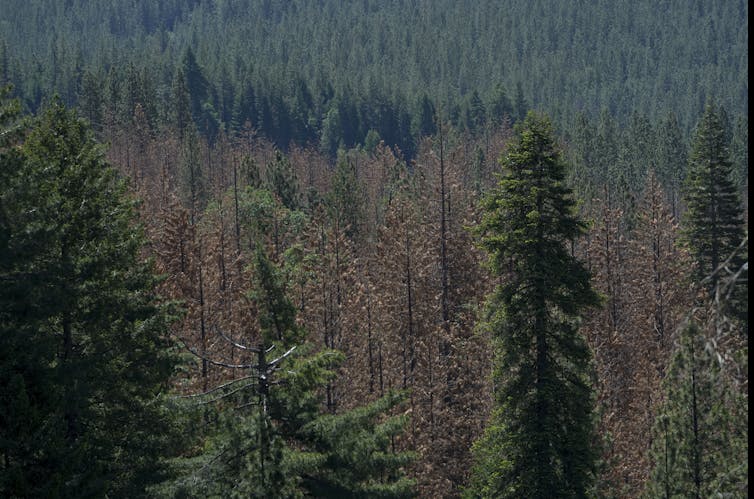
Trees killed by drought and an outbreak of bark beetles in California’s Tahoe National Forest in 2023. AP Photo/Godofredo A. Vásquez

What does the future hold for forests in a warmer, drier world? Over the past 25 years, trees have been dying due to effects of climate change around the world. In Africa, Asia, North America, South America and Europe, drought stress amplified by heat is killing trees that have survived for centuries.

Old trees may have grown through entire millennia that were wetter than the past 20 years. We are scientists who study forest dynamics, plant ecology and plant physiology. In a recent study, we found that trees can remember times when water was plentiful and that this memory continues to shape their growth for many years after wet phases end.

This research makes us optimistic that young trees of today, which have never known 20th-century rainfall, have not shaped their structure around water abundance and thus may be better equipped to survive in a chronically dry world.

Maps showing projected water deficits due to climate change by the mid-20th century across the U.S.
Climatic water deficit is a shortfall of water necessary to fully supply plants’ needs. If those needs are met, the deficit is zero. A higher number indicates drier conditions. Climate change will increase plants’ water needs, intensifying climatic water deficits in many areas. U.S. National Climate Assessment, 2023, CC BY-ND

What if we water the forest?

This study built on nearly 20 years of forest research in response to early warning signs of forest loss in the 1990s in the dry Rhône River Valley of the Swiss Alps. At that time, scientists observed that Scots pine trees that had stood for around 100 years were declining and dying. They wondered whether drought or other climate factors were driving this loss.

To tackle this question, researchers at the Swiss Federal Institute for Forest, Snow and Landscape Research designed an ecological experiment. To understand the impacts of drought, they would irrigate a mature forest, doubling natural summertime rainfall, and then compare how these water-rich trees fared in comparison with those receiving only natural precipitation.

The Pfynwald experiment, launched in 2003, has shown that trees survived at higher rates in irrigated plots. After 17 years of irrigation, the team found that irrigation didn’t just help trees survive dry phases – it also increased their growth rates.

Tree physiologist Leonie Schönbeck conducts research at Pfynwald, a natural reserve in southern Switzerland, to learn how trees take up and store energy and use their reserves to recover from drought.

Legacy effects are forests’ memories

Trees experiencing drought alter their leaves, wood and roots in ways that prime them for continued dry conditions. Wood under drought might have smaller cells that are less vulnerable to future damage, and roots might increase relative to leaf area. These structural changes persist after the drought has passed and continue to influence the tree’s growth and ability to tolerate stress for many years.

Known as “legacy effects,” these lingering post-drought impacts represent an ecological memory of past climatic conditions at the tree and forest level. Knowing that trees hold a persistent memory of past dry phases, researchers wondered whether they might also show structural changes in response to past wet periods.

Eleven years after summertime irrigation started in Pfynwald, scientists stopped irrigating half of each plot in 2013 to address this question. The formerly irrigated trees, which at this point were about 120 years old, had experienced a lasting period of irrigation – but now those times of plenty were over.

Would the trees remember? A decade later, we found out.

Trees, trains and particle accelerators

On an early March morning in 2023, two of us (Alana Chin and Marcus Schaub) met at Pfynwald to collect very fresh leaf and twig samples so that we and colleagues could look inside to search for signs of lasting effects of past water richness.

At the site, we climbed canopy access towers to collect newly grown treetop leaves and twigs from control trees that had never been irrigated; trees that had been irrigated every summer since 2003; and formerly irrigated trees that had not received irrigation water since 2013.

We took our samples to the Swiss Light Source, an intensely powerful synchrotron – a type of particle accelerator that produces the world’s most intense beams of light. This facility is the home of the TOMCAT, an extremely high-resolution X-ray that allowed us to look inside our leaves and twigs without disturbing their structure.

Scanning our samples took all night, but when we stumbled out of the building, we had images capturing every cell in exquisite detail.


The memory of water

We found that the new leaves of once-irrigated trees were different from both continually watered trees and never-watered control trees. Leaves carry out photosynthesis that fuels a tree’s survival and growth. Inside them, we could see the legacy of past water abundance, written in the size, shape and arrangement of cells.

Reading this cellular signature, we observed that, at the expense of structures promoting productivity, formerly irrigated trees showed every sign of chronic water stress – even more so than never-irrigated trees. In their anatomy, we saw why these trees that had it easy for 11 wet years were now growing slowly.

Every cell in a leaf comes with a trade-off. Trees must balance investments in rapid photosynthesis with others that promote leaf survival. Rather than building the cells used to harvest sunlight and ship sugar to the rest of the tree, leaves on the trees that had been irrigated showed every indication of drought stress we could think to measure.

After receiving extra water for an 11-year stretch and then losing it, the trees were producing new, tiny leaves that invested mostly in their own survival. The leaves were structured to protect themselves from insects and drought and to store water reserves. Compared with leaves on trees that had never known irrigation, these looked as though they were in the middle of the drought of the century.

While this memory of water might seem negative, it likely once helped trees “learn” from past conditions to survive in variable environments. The formerly irrigated trees did not know that humans had played a trick on them. Like trees experiencing climate change, they had no way of knowing that the water was not coming back.

Laser scan of a leaf showing structural changes in response to water stress
A leaf cross section from a formerly irrigated Scots pine tree. In contrast to leaves of trees that have never experienced irrigation, trees that have lost abundant water place more emphasis on features such as water storage (black cells in the center) and protection (large resin ducts that look like holes ringing the leaf) than on the cells needed to produce energy for tree growth (spotted cells). Alana Chin, CC BY-ND

When trees experience a drought event, recovery can mean reaching a “new normal” state, in which they are prepared to survive the next drought, with smaller, less vulnerable cells and increased energy reserves to ‘save up’ for future dry periods. They may have deeper roots or a smaller pool of leaves to support, helping them prepare for an unstable environment.

We wanted to know whether the same was true of trees that had experienced water abundance. Were they waiting in distress for the water to return?

Hard times may make tough trees

In some temperate forests, like the ones we studied in Switzerland, old trees once knew levels of water abundance that now are gone, thanks to climate change. That past abundance may have locked into place structural and epigenetic changes in the trees that are mismatched to today’s drier world. If this is true, then some of today’s devastating global tree mortality events may be, in part, due to the legacy effects of past water abundance.

In most of the world’s temperate forests, however, the current cohort of young forest trees – those sprouting in the past 15 to 20 years – has managed to establish itself under conditions that once would have been considered chronic drought. Those young trees, which have survived an endless dry period, will form the forests of the future.

In all, our observations in Pfynwald have provided us some room for hope that young trees currently taking their place in many forests worldwide may be better prepared to cope with the world as humans have shaped it. Climate shifts in recent decades have primed them for hard times, without the lingering memory of water.The Conversation

Alana Chin, Assistant Professor of Plant Physiology, Cal Poly Humboldt ; Janneke Hille Ris Lambers, Professor of Environmental Systems Science, Swiss Federal Institute of Technology Zurich, and Marcus Schaub, Group Leader, Forest Dynamics and Ecophysiology, Swiss Federal Institute for Forest, Snow and Landscape Research (WSL)

This article is republished from The Conversation under a Creative Commons license. Read the original article.

  • 320
  • 321
  • 322
  • 323
  • 324
  • 325
  • 326
  • 327
  • 328
  • 329

Community

  • Sheriff’s Activities League and Clearlake Bassmasters offer youth fishing clinic

  • City Nature Challenge takes place April 24 to 27

Public Safety

  • Lakeport Police logs: Wednesday, Feb. 11

  • Lakeport Police logs: Tuesday, Feb. 10

Education

  • Ramos measure requiring school officer training in use of anti-opioid drug moves forward

  • Lake County Chapter of CWA announces annual scholarships 

Health

  • California ranks 24th in America’s Health Rankings Annual Report from United Health Foundation

  • Healthy blood donors especially vital during active flu season

Business

  • Employment law summit takes place March 9

  • Two Lake County Mediacom employees earn company’s top service awards

Obituaries

  • Terry Knight

  • Ellen Thomas

Opinion & Letters

  • Who should pay for AI’s power? Not California ratepayers

  • Crandell: Supporting nephew for reelection in supervisorial race

Veterans

  • State honors fallen chief warrant officer killed in conflict in Iran

  • CalVet and CSU Long Beach team up to improve data collection related to veteran suicides

Recreation

  • April Audubon program will show how volunteers can help monitor local osprey nests

  • First guided nature walk of spring at Anderson Marsh State Historic Park April 11

  • Second Saturday guided nature walks continue at Anderson Marsh State Historic Park

  • Wet weather trail closure in effect on Upper Lake Ranger District

Religion

  • Kelseyville Presbyterian Church plans Easter service

  • Easter ‘Sonrise’ Service returns to Xabatin Community Park

Arts & Life

  • ‘CIA’ delves into the shadowy world of an espionage thriller

  • ‘War Machine’ shifts the battlefield into uncharted territory

Government & Politics

  • Lake County Democratic Central Committee endorses Falkenberg

  • Crandell launches reelection campaign plans March 15 event

Legals

  • April 23 hearing on Lake Coco Farms Major Use Permit

  • NOTICE OF 30-DAY PUBLIC COMMENT PERIOD & NOTICE OF PUBLIC HEARING

How to resolve AdBlock issue?
Refresh this page