How to resolve AdBlock issue?
Refresh this page
Lake County News,California
  • Home
    • Registration Form
  • News
    • Education
    • Veterans
    • Community
      • Obituaries
      • Letters
      • Commentary
    • Police Logs
    • Business
    • Recreation
    • Health
    • Religion
    • Legals
    • Arts & Life
    • Regional
  • Calendar
  • Contact us
    • FAQs
    • Phones, E-Mail
    • Subscribe
  • Advertise Here
  • Login
How to resolve AdBlock issue?
Refresh this page

News

What does 2025 hold for interest rates, inflation and the American consumer?


Brian Blank is a finance scholar and Fed watcher who researches how companies navigate downturns and make financial decisions, as well as how markets process information. Brandy Hadley is a finance professor who leads a student-managed investment fund and studies corporate decision-making and incentives. Together, they’re also the resident economic oracles at The Conversation U.S., and their forecast for 2024 held up notably well. Here, they explain what to expect from 2025.

New year, new questions

Heading into 2024, we said the U.S. economy would likely continue growing, in spite of pundits’ forecast that a recession would strike. The past year showcased strong economic growth, moderating inflation, and efficiency gains, leading most economists and the financial press to stop expecting a downturn.

But what economists call “soft landings” – when an economy slows just enough to curb inflation, but not enough to cause a recession – are only soft until they aren’t.

As we turn to 2025, we’re optimistic the economy will keep growing. But that’s not without some caveats. Here are the key questions and risks we’re watching as the U.S. rings in the new year.

The Federal Reserve and interest rates

Some people expected a downturn in 2022 – and again in 2023 and 2024 – due to the Federal Reserve’s hawkish interest-rate decisions. The Fed raised rates rapidly in 2022 and held them high throughout 2023 and much of 2024. But in the last four months of 2024, the Fed slashed rates three times – most recently on Dec. 18.

While the recent rate cuts mark a strategic shift, the pace of future cuts is expected to slow in 2024, as Fed Chair Jerome Powell suggested at the December meeting of the Federal Open Market Committee. Markets have expected this change of pace for some time, but some economists remain concerned about heightened risks of an economic slowdown.

When Fed policymakers set short-term interest rates, they consider whether inflation and unemployment are too high or low, which affects whether they should stimulate the economy or pump the brakes. The interest rate that neither stimulates nor restricts economic activity, often referred to as R* or the neutral rate, is unknown, which makes the Fed’s job challenging.

However, the terminal rate – which is where Fed policymakers expect rates will settle in for the long run – is now at 3%, which is the highest since 2016. This has led futures markets to wonder if a hiking cycle may be coming into focus, while others ask if the era of low rates is over.

Inflation and economic uncertainty

This shift in the Federal Reserve’s approach underscores a key uncertainty for 2025: While some economists are concerned the recent uptick in unemployment may continue, others worry about sticky inflation. The Fed’s challenge will be striking the right balance — continuing to support economic activity while ensuring inflation, currently hovering around 2.4%, doesn’t reignite.

We do anticipate that interest rates will stay elevated amid slowing inflation, which remains above the Fed’s 2% target rate. Still, we’re optimistic this high-rate environment won’t weigh too heavily on consumers and the economy.

While gross domestic product growth for the third quarter was revised up to 3.1% and the fourth quarter is projected to grow similarly quickly, in 2025 it could finally show signs of slowing from its recent pace. However, we expect it to continue to exceed consensus forecasts of 2.2% and longer-run expectations of 2%.

Fiscal policy, tariffs and tax cuts: risks or tailwinds?

While inflation has declined from 9.1% in June 2022 to less than 3%, the Federal Reserve’s 2% target remains elusive.

Amid this backdrop, several new risks loom on the horizon. Key among them are potential tariff increases, which could disrupt trade, push up the prices of goods and even strengthen the U.S. dollar.

The average effective U.S. tariff rate is 2%, but even a fivefold increase to 10% could escalate trade tensions, create economic challenges and complicate inflation forecasts. Consider that, historically, every 1% increase in tariff rates has resulted in a 0.1% higher annual inflation rate, on average.

Still, we hope tariffs serve as more of a negotiating tactic for the incoming administration than an actual policy proposal.

Tariffs are just one of several proposals from the incoming Trump administration that present further uncertainty. Stricter immigration policies could create labor shortages and increase prices, while government spending cuts could weigh down economic growth.

Tax cuts – a likely policy focus – may offset some risk and spur growth, especially if coupled with productivity-enhancing investments. However, tax cuts may also result in a growing budget deficit, which is another risk to the longer-term economic outlook.

Count us as two financial economists hoping only certain inflation measures fall slower than expected, and everyone’s expectations for future inflation remain low. If so, the Federal Reserve should be able to look beyond short-term changes in inflation and focus on metrics that are more useful for predicting long-term inflation.

Consumer behavior and the job market

Labor markets have softened but remain resilient.

Hiring rates are normalizing, while layoffs and unemployment – 4.2%, up from 3.7% at the start of 2024 – remain low despite edging up. The U.S. economy could remain resilient into 2025, with continued growth in real incomes bolstering purchasing power. This income growth has supported consumer sentiment and reduced inequality, since low-income households have seen the greatest benefits.

However, elevated debt balances, given increased consumer spending, suggest some Americans are under financial stress even though income growth has outpaced increases in consumer debt.

While a higher unemployment rate is a concern, this risk to date appears limited, potentially due to labor hoarding – which is when employers are afraid to let go of employees they no longer require due to the difficulty in hiring new workers. Higher unemployment is also an issue the Fed has the tools to address – if it must.

This leaves us cautiously optimistic that resilient consumers will continue to retain jobs, supporting their growing purchasing power.

Equities and financial markets

The outlook for 2025 remains promising, with continued economic growth driven by resilient consumer spending, steadying labor markets, and less restrictive monetary policy.

Yet current price targets for stocks are at historic highs for a post-rally period, which is surprising and may offer reasons for caution. Higher-for-longer interest rates could put pressure on corporate debt levels and rate-sensitive sectors, such as housing and utilities.

Corporate earnings, however, remain strong, buoyed by cost savings and productivity gains. Stock performance may be subdued, but underperforming or discounted stocks could rebound, presenting opportunities for gains in 2025.

Artificial intelligence provides a bright spot, leading to recent outperformance in the tech-heavy NASDAQ and related investments. And onshoring continues to provide growth opportunities for companies reshaping supply chains to meet domestic demand.

To be fair, uncertainty persists, and economists know forecasting is for the weather. That’s why investors should always remain well-diversified.

But with inflation closer to the Fed’s target and wages rising faster than inflation, we’re optimistic that continued economic growth will pave the way for a financially positive year ahead.

Here’s hoping we get even more right about 2025 than we did this past year.The Conversation

D. Brian Blank, Associate Professor of Finance, Mississippi State University and Brandy Hadley, Associate Professor of Finance and Distinguished Scholar of Applied Investments, Appalachian State University

This article is republished from The Conversation under a Creative Commons license. Read the original article.
New round of atmospheric river storms expected to bring heavy rain, winds

LAKE COUNTY, Calif. — The National Weather Service said another round of atmospheric river storms is expected to bring heavy rain and winds through the weekend.

The parade of storms, which began Christmas night, is forecast to continue through Sunday.

Although the forecast says that “none of the individual storms look particularly strong,” there will be very little break in between them, which the National Weather Service said will increase the potential for flooding.

During that time, the National Weather Service’s forecast expects Clearlake to get over 2 inches of rain; Cobb nearly 4 inches; Middletown, 3 inches; Lakeport, nearly 2.7 inches; and Upper Lake, 3.2 inches.

Between Thursday and Saturday, the storms are predicted to bring winds with gusts of over 20 miles per hour.

Temperatures during that time frame are expected to range from the low 40s to low 50s at night, with daytime temperatures forecast to push close to 60 degrees.

On Monday, forecasters expect a brief break in the rain before chances of rain return to the forecast on Tuesday.

Email Elizabeth Larson at This email address is being protected from spambots. You need JavaScript enabled to view it.. Follow her on Twitter, @ERLarson, and on Bluesky, @erlarson.bsky.social. Find Lake County News on the following platforms: Facebook, @LakeCoNews; X, @LakeCoNews; Threads, @lakeconews, and on Bluesky, @lakeconews.bsky.social.

Little Hoover Commission releases biennial report

The Little Hoover Commission has released 13 reports in the 2023-24 biennium, according to a new report summarizing the work of the independent, nonpartisan watchdog agency.

The new report, “Advocating for Change, 2023-24,” also notes that 15 bills supported by the commission to implement its recommendations were passed by the Legislature and signed by the governor.

The studies released by the commission during the past two years touch upon a wide array of policy areas, including how the state cares for those with developmental disabilities, efforts to divert organic materials out of landfills, the impact of the aging of the state's population, the California Environmental Quality Act, the state's response to retail theft, the homeowners insurance market, and the use of artificial intelligence in state government.

The state also released several reports examining how well its past recommendations had been implemented, including with regard to intimate partner violence, human trafficking for purposes of labor exploitation, and the state's Medi-Cal Dental Program.

Each report follows an extensive hearing and study process by the commission and its staff, including testimony from a variety of affected groups, a review of existing research, and in some cases original data-gathering by staff.

"Our commission searches for ways to make state government work better for Californians," said commission Chairman Pedro Nava. "By focusing on the facts and digging deep, we offer practical solutions to the problems facing our state."

After making recommendations for policy change, the commission supports actions, including legislation, that implement its recommendations.

The new report outlines commission-supported bills signed into law this biennium on topics including the developmental disabilities system, labor trafficking, intimate partner violence, open-meetings laws, organic waste disposal, and customer-centric government.

The commission includes nine public members and four sitting members of the Legislature, who are appointed by a combination of the governor and legislative leadership.

By law, no one political party may control more than five of the nine public seats.

The commission is charged in statute with making reform recommendations that foster "economy, efficiency and improved service."

Covered California reports hitting record enrollment

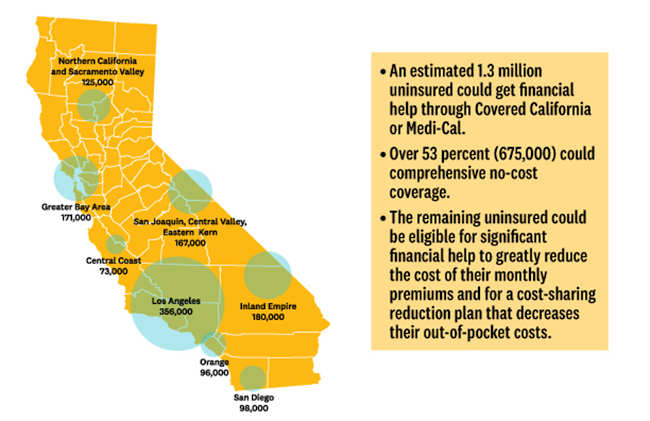
Figure 1: Nearly 1.3 Million Uninsured Californians Are Eligible for Financial Help


Covered California has surpassed 1.8 million enrollees, reaching its record-high enrollment with over a week until the first open enrollment deadline on Dec. 31.

During this open enrollment, 143,686 Californians have signed up for 2025 coverage as of Dec. 14, marking a 3 percent increase over the same period last year.

Another 1,647,162 Californians have renewed their coverage so far, a 4 percent increase over the same period last year.

“We have a record 1.8 million Californians already enrolled for 2025 coverage, but history teaches us the next week will be our busiest for new sign ups,” Covered California Executive Director Jessica Altman said. “We want to make sure every uninsured Californian understands that the most financial assistance ever offered through the Affordable Care Act is available here in California for 2025. Now is the time to take advantage of this financial assistance to start the New Year with affordable, name-brand health coverage and peace of mind for you and your family.”

With the first open-enrollment deadline of Dec. 31 quickly approaching, Covered California is urging consumers to sign up now so they can have their health care coverage for all of 2025, beginning on Jan. 1. Open enrollment will end on Jan. 31.

Nearly half of the new enrollees have come from four Southern California (Los Angeles, Orange, Riverside and San Bernardino) counties with 68,095 sign-ups.

Also, nearly 39,000 new enrollees identified as Latino, while nearly 28,000 Asian Americans have signed up for coverage so far.

Over 33,000 White Californians and over 4,000 Black Californians have enrolled, and over 28,000 Californians did not disclose their Race/Ethnicity.

Despite the continued progress, the latest data from the California Simulation of Insurance Markets, or CalSIM, a model created by the UCLA Center for Health Policy Research, shows that there are nearly 1.3 million uninsured Californians who either qualify for subsidies through Covered California (591,000) or are eligible for Medi-Cal coverage (675,000), and they reside all over the state.

California’s cost-sharing reduction program highlights assistance

In 2025, Covered California is offering more financial help for Californians than ever before.

Building on the existing federal subsidies to help pay for health insurance premiums, Covered California is enhancing its cost-sharing reduction program that reduces the cost of accessing health care for consumers by lowering out-of-pocket costs when they seek medical care, including eliminating deductibles in all three Silver cost-sharing reduction plans.

The cost-sharing reduction program for out-of-pocket costs is available to all Californians with incomes above 200 percent of the federal poverty level (which is $30,120 for a single person and $62,400 for a family of four), while those under 200 percent of the federal poverty level will continue to have access to higher levels of benefits.

In 2024, nearly 800,000 existing Covered California enrollees are taking advantage of this program, and over 100,000 of our new enrollees have qualified for these cost savings and richer benefits for 2025. That means nearly 1.1 million enrollees have already enrolled in enhanced Silver plans for 2025.

Nearly 90 percent of Covered California’s enrollees receive financial help. Two-thirds of those enrollees are eligible for health insurance for $10 or less per month, and nearly half could get a comprehensive Silver plan for that price.

Signing up for coverage is easy

Consumers can learn more about their options by visiting CoveredCA.com, where they can easily find out if they qualify for financial help and see the coverage options in their area.

Those interested in learning more about their coverage options can also:

• Get free and confidential assistance over the phone, in a variety of languages, from one of more than 14,000 certified agents and community-based organizations throughout the state that provide free, confidential help in whatever language or dialect consumers prefer.
• Have a certified enroller call them and help them for free.
• Use Covered California’s online calculator tool.
• Call Covered California at 800-300-1506.

Californians who forgo health coverage will be subject to a tax penalty administered by the State Franchise Tax Board. The penalty for not having coverage the entire year will be at least $900 per adult and $450 per dependent child under 18 in the household.

A family of four that goes uninsured for the whole year would face a penalty of at least $2,700.

Why there’s no place like home for the holidays


While Christmas playlists often include cheesy favorites like “Rockin Around the Christmas Tree” and “I Saw Mommy Kissing Santa Claus,” there are also a handful of wistful tracks that go a little bit deeper.

Listen closely to “I’ll be Home for Christmas” or “White Christmas,” and you’ll hear a deep yearning for home, and sorrow at having to spend the holidays somewhere else.

Strip away the cursory Christmas rituals – the TV specials, the lights, the gifts, the music – and what remains is home. It is the beating heart of the holiday, and its importance reflects our primal need to have a meaningful relationship with a setting – a place that transcends the boundary between the self and the physical world.

Can you love a place like a person?

Most of us can probably name at least one place we feel an emotional connection to. But you probably don’t realize just how much a place can influence your sense of who you are, or how essential it is for your psychological well-being.

Psychologists even possess an entire vocabulary for the affectionate bonds between people and places: There’s “topophilia,” “rootedness” and “attachment to place,” which are all used to describe the feelings of comfort and security that bind us to a place.

Your fondness for a place – whether it’s the house where you lived your whole life, or the fields and woods where you played as a child – can even mimic the affection you feel for other people.

Studies have shown that a forced relocation can elicit heartbreak and distress every bit as intense as the loss of a loved one. Another study found that if you feel a strong attachment to your town or city, you’ll be more satisfied with your house and you’ll also be less anxious about your future.

Gusztáv Magyar Mannheimer’s ‘Factory Site at the Outskirts of Budapest’ (1893). Hungarian National Gallery

Our physical surroundings play an important role in creating meaning and organization in our lives; much of how we view our lives and what we have become depends on where we’ve lived, and the experiences we’ve had there.

So it’s no surprise that architecture professor Kim Dovey, who has studied the concept of home and the experience of homelessness, confirmed that where we live is closely tied to our sense of who we are.

An anchor of order and comfort

At the same time, the concept of home can be slippery.

One of the first questions we ask when we meet someone new is “Where are you from?” But we seldom pause to consider how complicated that question is. Does it mean where you currently live? Where you were born? Where you grew up?

Environmental psychologists have long understood that the word “home” clearly connotes more than just a house. It encompasses people, places, objects and memories.

So what or where, exactly, do people consider “home”?

A 2008 Pew study asked people to identify “the place in your heart you consider to be home.” Twenty-six percent reported that home was where they were born or raised; only 22 percent said that it was where they currently lived. Eighteen percent identified home as the place that they had lived the longest, and 15 percent felt that it was where most of their extended family had come from.

Matsumoto Shunsuke’s ‘Suburban Landscape’ (1938). Wikimedia Commons

But if you look at different cultures across time, a common thread emerges.

No matter where they come from, people tend to think about home as a central place that represents order, a counterbalance to the chaos that exists elsewhere. This might explain why, when asked to draw a picture of “where you live,” children and adolescents around the world invariably place their house in the center of the sheet of paper. In short, it’s what everything else revolves around.

Anthropologists Charles Hart and Arnold Pilling lived among the the Tiwi People of Bathurst Island off the coast of Northern Australia during the 1920s. They noted that the Tiwi thought their island was the only habitable place in the world; to them, everywhere else was the “land of the dead.”

The Zuni of the American Southwest, meanwhile, have long viewed the house as a living thing. It’s where they raise their kids and communicate with spirits, and there’s an annual ritual – called the Shalako – in which homes are blessed and consecrated as part of the year-end winter solstice celebration.

The ceremony strengthens bonds to the community, to the family (including dead ancestors), and to the spirits and gods by dramatizing the connection each party has to the home.

During the holidays, we might not officially bless our home like the Zuni. But our holiday traditions probably sound familiar: eating with family, exchanging gifts, catching up with old friends and visiting old haunts. These homecoming rituals affirm and renew a person’s place in the family and often are a key way to strengthen the family’s social fabric.

Home, therefore, is a predictable and secure place where you feel in control and properly oriented in space and time; it is a bridge between your past and your present, an enduring tether to your family and friends.

It is a place where, as the poet Robert Frost aptly wrote, “when you have to go there, they have to take you in.”The Conversation

Frank T. McAndrew, Cornelia H. Dudley Professor of Psychology, Knox College

This article is republished from The Conversation under a Creative Commons license. Read the original article.

Anderson Marsh State Historic Park to hold New Year’s Day hikes

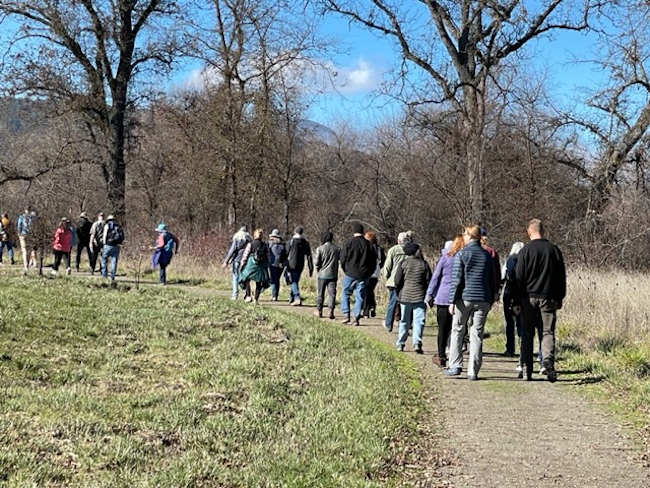
Hikers on the Cache Creek Nature Trail during last year’s New Year’s Day hike at Anderson Marsh State Historic Park in Lower Lake, California. Photo credit: Roberta Lyons.

LOWER LAKE, Calif. – Anderson Marsh State Historic Park will again offer free, community hikes beginning at noon on New Year’s Day.

The hikes are part of America's State Parks First Day Hikes program. The nationwide First Day Hikes program offers individuals and families an opportunity to begin the New Year by taking a healthy hike on Jan. 1 at a state park close to home.

Participants can choose between two routes this year. The first hike will be a leisurely trip to the end of the Dawa Qanoq’ana trail. Formerly known as the McVicar trail, “Dawa Qanoq’ana” means “south way in front of me” in the Pomo language.

This hike will go from the parking lot to the shores of Clear Lake across from Indian Island. This is a round-trip of about 7½ miles of mainly flat terrain, with the first about 0.3 miles being accessible.

This hike should take about three hours, depending on how many times we stop to admire what we see along the way.

The second shorter hike covers a three and a half mile loop over the Cache Creek, Marsh and Ridge trails, with the first about 0.5 miles being accessible. This hike should take between two and two and a half hours.

The New Year’s Day hikes will be led by State Parks volunteers associated with the Anderson Marsh Interpretive Association, or AMIA.

“The event offers a wonderful opportunity to begin the New Year right by getting outside, enjoying nature and welcoming the New Year with friends and family on Jan. 1,” said Henry Bornstein, an AMIA board member who is one of this year’s hike leaders.

Hikers will experience grasslands, oak woodlands, willow and cottonwood riparian habitats, and the tule marsh habitat of the Anderson Marsh Natural Preserve, and may encounter a variety of migrating and resident birds and other wildlife.

Both hikes begin at noon at the park off Highway 53, between Lower Lake and Clearlake.

Children of all ages are welcome when accompanied by an adult. Hikers should bring water and snacks, binoculars if they have them, and a hat for protection against the weather. Sturdy shoes that can handle a little mud are recommended.

Participants on both hikes are welcome to walk part way and make an early return at their own pace.

No dogs are allowed on these trails, which pass through the Anderson Marsh Natural Preserve.

Heavy rain will cancel the walks.

For further information, the public is asked to contact AMIA at 707-995-2658 or This email address is being protected from spambots. You need JavaScript enabled to view it..
  • 332
  • 333
  • 334
  • 335
  • 336
  • 337
  • 338
  • 339
  • 340
  • 341

Community

  • Sheriff’s Activities League and Clearlake Bassmasters offer youth fishing clinic

  • City Nature Challenge takes place April 24 to 27

Public Safety

  • Lakeport Police logs: Wednesday, Feb. 11

  • Lakeport Police logs: Tuesday, Feb. 10

Education

  • Ramos measure requiring school officer training in use of anti-opioid drug moves forward

  • Lake County Chapter of CWA announces annual scholarships 

Health

  • California ranks 24th in America’s Health Rankings Annual Report from United Health Foundation

  • Healthy blood donors especially vital during active flu season

Business

  • Employment law summit takes place March 9

  • Two Lake County Mediacom employees earn company’s top service awards

Obituaries

  • Terry Knight

  • Ellen Thomas

Opinion & Letters

  • Who should pay for AI’s power? Not California ratepayers

  • Crandell: Supporting nephew for reelection in supervisorial race

Veterans

  • State honors fallen chief warrant officer killed in conflict in Iran

  • CalVet and CSU Long Beach team up to improve data collection related to veteran suicides

Recreation

  • April Audubon program will show how volunteers can help monitor local osprey nests

  • First guided nature walk of spring at Anderson Marsh State Historic Park April 11

  • Second Saturday guided nature walks continue at Anderson Marsh State Historic Park

  • Wet weather trail closure in effect on Upper Lake Ranger District

Religion

  • Kelseyville Presbyterian Church plans Easter service

  • Easter ‘Sonrise’ Service returns to Xabatin Community Park

Arts & Life

  • ‘CIA’ delves into the shadowy world of an espionage thriller

  • ‘War Machine’ shifts the battlefield into uncharted territory

Government & Politics

  • Lake County Democratic Central Committee endorses Falkenberg

  • Crandell launches reelection campaign plans March 15 event

Legals

  • April 23 hearing on Lake Coco Farms Major Use Permit

  • NOTICE OF 30-DAY PUBLIC COMMENT PERIOD & NOTICE OF PUBLIC HEARING

How to resolve AdBlock issue?
Refresh this page