 How to resolve AdBlock issue?
 Lakeport Police logs: Saturday, Jan. 10
Saturday, Jan. 10, 2026
00:00 EXTRA PATROL 2601100001
Occurred at Lake County Law Library on 3D....

LAKEPORT, Calif. – The Lakeport City Council this week will discuss city projects including an application for a trail grant and get an update on restructuring of unfunded retirement liabilities.
The council will meet beginning at 6 p.m. Tuesday, Aug. 18, in the council chambers at Lakeport City Hall, 225 Park St.
Among the first orders of business will be the introduction of new city employees including Utilities Superintendent Paul Harris and Forrest Stogner, water operations supervisor.
Also on Tuesday the council will hold a public hearing to adopt the proposed resolution updating the program guidelines for the Community Development Block Grant Business Assistance Loan Program.
In council business, Public Works Director Mark Brannigan will take to the council the award of the contract with Synagro for the US Department of Agriculture-funded oxidation ponds sludge removal project for the City of Lakeport Municipal Sewer District.
Special Projects Coordinator Richard Knoll will present a resolution approving the application for grant funds from the Recreational Trails Program for the construction of the Forbes Street Trail within the Westside Community Park.
In other business, Finance Director Dan Buffalo will present an update to the council on restructuring a portion of the city's unfunded accrued actuarial liability under the California Public Employees’ Retirement System, and a proposed selection of an alternative plan of restructuring.
On the meeting's consent agenda – items considered noncontroversial and usually accepted as a slate on one vote – are ordinances; minutes from the July 21 regular council meeting; the Aug. 6 warrant register; Application No. 2015-018 with staff recommendations for the annual Lake County Fair Parade on Sept. 3; Application No. 2015-019 with staff recommendations for the Sponsoring Survivorship walk/run on Oct. 3; Application No. 2015-020 with staff recommendations for the Catfish Derby to be held by the Lakeport Yacht Club Aug. 28 to 30; adopt a resolution authorizing the city manager to execute project certifications with the California Department of Transportation or the Federal Highway Administration; adoption of a resolution to adopt a new records retention schedule and authorizing destruction of certain city and rescinding Resolution 2428 (2011); adopt a resolution opposing AB 113, a proposed bill that reverses and revises key provisions of the redevelopment dissolution laws offered to local agencies; adopt a resolution urging the state to provide new sustainable funding for state and local transportation infrastructure as part of the League of California Cities Fix Our Roads campaign.
Email Elizabeth Larson at
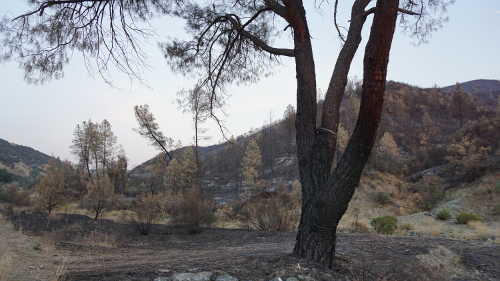
LAKE COUNTY, Calif. – While the Rocky fire was fully contained late last week, the work to make sure the fire is completely out is still taking place.
The fire was 100-percent contained on Friday after burning 69,438 acres, as Lake County News has reported.
It began on July 29 east of Lower Lake and, over the next 17 days threatened thousands of home and caused evacuations, burned about 100 structures and eventually burned north of Highway 20, east of Clearlake Oaks.
The fire's perimeter also spread into the new Berryessa Snow Mountain National Monument, crossed into Colusa and Yolo counties, and triggered the closure of the Cache Creek Natural Area.
Cal Fire Battalion Chief Scott McLean, who has been the lead spokesman for the agency on the Rocky fire, said total suppression costs are still being calculated on the incident.
Congressmen John Garamendi and Mike Thompson reported earlier this month that the Federal Emergency Management Agency approved the state of California’s request for a Fire Management Assistance Grant declaration. The grant will cover 75 percent of the fire's suppression costs.
Meanwhile, McLean said that while the fire is contained, that doesn't mean it's fully out.
“There's no flame,” he said, and officials are satisfied that the fire lines are secure and that there are no issues 200 to 300 feet inside of any of the lines.
Making sure it's out is the work of firefighters who will remain on the lines in the days to come, according to McLean.
“We are going to be in patrol mode,” he said.
Much of the patrol work with be done primarily on the ground, with occasional flyovers of the fire area, McLean said.
“They are going to be patrolling that for a few weeks to come, just to make sure that it’s to bed,” he said.
McLean said there also is fire suppression repair work under way to remove the impacts of the firefighting effort.
He said that includes installing water bars for erosion control, repairing fences and fixing dozer lines.
McLean said investigators still haven't released their findings as to the fire's cause.
“They're still working on it,” he said.
As for the effort to help the fire's victims, the county of Lake – through a partnership with the Volunteer Center of Sonoma County – continues to offer a call number for community members impacted by the Rocky fire.
The Fire Help Line at 800-325-9604 is staffed around the clock, offers referrals for services and collects information to help the county with its damage assessment.
A virtual recovery assistance center also is available online at www.LakeCountyLAC.com ; those without Internet access are encouraged to visit one of the county's libraries, where they can use computers and access the Web for free.
The Board of Supervisors last week determined that it wanted to implement a comprehensive debris cleanup program that would be overseen and funded by the state.
The county is waiting for final confirmation from the California Office of Emergency Services that it will receive between $4 million and $5 million in funding to cover the program.
On Tuesday the board will further discuss the debris removal program and the grant application process.
To the south of the Rocky fire, work is still actively under way to contain the Jerusalem fire, which has burned more than 25,000 acres since it began on Aug. 9. It is expected to be fully contained on Friday.
Email Elizabeth Larson at
LAKE COUNTY, Calif. – The Lake County Office of Emergency Services is encouraging community members impacted by the Rocky and Jerusalem fires to take advantage of resources that are being offered to assist them.
County officials said they are committed to the recovery for those who had homes or structures burned in the Rocky or Jerusalem fires.
Residents with destroyed or damaged structures from the fires are asked to please call the Fire Help Line at 800-325-9604 and give information for the completion of a damage assessment.
The telephone assessment will be forwarded to the Lake County Recovery Unit to aid in planning of the recovery process.
“I am proud to say that Lake County residents are resilient and we, at the County and Lake County OES, pledge our assistance through this recovery process,” said Lake County Administrative Officer and Director of Emergency Services Matt Perry.
Recovery is a multi-agency, multi-jurisdictional effort. The safety of Lake County residents and the environment is top priority.
To that end, Lake County OES and its many partners are focused on the development of a thorough and comprehensive debris removal plan.
To access potential funding sources to aid in the cleanup and debris removal for the Rocky fire, the plan requires Board of Supervisors approval.
The plan currently is scheduled for consideration at the Board of Supervisors' meeting on Tuesday, Aug. 18.
The Fire Help Line is staffed 24/7 thanks to a partnership with the Volunteer Center of Sonoma County, and also provides referrals for services and information about current fire status.
A virtual recovery assistance center is available online at www.LakeCountyLAC.com .
If you do not have Internet access, you may access the Web site from any computer at the Lake County Libraries for free.
LAKEPORT, Calif. – During a special Tuesday afternoon meeting, the Board of Supervisors took the first steps in putting into place the framework to guide the county's recovery from the devastation wrought over the past two weeks by the Rocky fire.
The board met for nearly 70 minutes before an audience of about 40 county and state officials, all of them involved in the process of responding to the fire, which has burned nearly 70,000 acres since it began east of Lower Lake on the afternoon of July 29.
Cal Fire has reported that the fire burned 43 residences and 53 outbuildings, and damaged an additional eight structures, figures that county officials said appear to be low based on their investigation.
By the end of the meeting, the board voted unanimously to approve several actions proposed by county staff regarding issues ranging from a debris cleanup plan to adjusting the upcoming fiscal year's recommended budget to help cover some of the anticipated costs.
County Administrative Officer Matt Perry told the board that the county's Emergency Operations Center identified some of the key issues he was bringing to the supervisors.
On Thursday, he submitted a request to the Governor's Office of Emergency Services for funding under the California Disaster Assistance Act to help the county cover costs incurred in responding to, and recovering from, the Rocky fire.
He said on Tuesday afternoon that he was still waiting for final approval of the request, noting that the policies the board was set to discuss would hinge on whether or not that funding is received.
The total funding the county could receive is between $4 million and $5 million, according to statements during the meeting.
Perry also noted that a federal Fire Management Assistance Grant Program has been awarded that will cover 75 percent of the costs to fight the fire.
Options for cleaning up
One of the key considerations Perry presented to the board was for a debris management plan for the fire-damaged areas, including private property.
With the burned buildings and debris possibly containing hazardous materials – including asbestos and heavy metals – Perry said there needs to be a plan to properly dispose of the materials in order to protect public safety.
He said disposal of the materials is a concern due to the possibility of people transporting them improperly or illegally dumping them, which could expose more people to the hazards.
As such, he presented the board with two options: to either leave the cleanup to property owners with regulatory oversight provided by the county; or the more comprehensive, safest and expensive option, to have the clean up performed by specialized contractors managed by the state's Cal Recycle agency and Lake County Environmental Health and Building and Safety Divisions on behalf of property owners.
In the case of selecting the second option, Perry said it would be paid for completely through the California Disaster Assistance Act.
While the second option had the highest cost, Perry said it also came with the highest assurance of protection to property owners and the community at large.
Supervisor Rob Brown asked about the number of insured homes among those destroyed. Perry explained that the Lake County Location Assistance Center is collecting the information. “A lot of them appear to be unpermitted.”
A requirement to get the state funding is the declaration of a local health emergency, which county Health Officer Dr. Karen Tait prepared.
Tait said the burned debris is considered hazardous waste due to the presence of asbestos and heavy metals. The sheer number of buildings involved, she added, is enough to elevate the situation to a higher level of concern for the entire community.
She said of the proposed proclamation, “This would pave the way to request the assistance that is needed to intervene quickly,” adding that time is of the essence.
Tait explained that private property owners can opt out of the state-funded debris disposal program that was proposed, but the state would still require them to meet program standards.
“There's a lot of technical issues involved with doing this well,” Tait said of the cleanup process.
In addition to concerns about ash and the hazardous materials it might contain, Tait said rain and runoff could cause heavy metals from the debris to enter the watershed.
Supervisor Jeff Smith suggested the county needed to be just as concerned about runoff as the other issues with the hazardous materials – especially if the forecast for heavy winter rains holds true. “This has got to be done quickly,” he said of the cleanup.
At the same time, Smith said, “We have to be real cognizant of the folks who have lost everything,” and give them a chance to visit their properties to recover what they want before cleanups begin, although Health Services Director Jim Brown cautioned that going through burned remains was a potential health hazard.
Perry also brought up the idea of waiving building permits for rebuilding the permitted structures that the fire destroyed, adding that it should only be available for a limited period of between six and 12 months or “some reasonable period of time.”
Supervisor Jim Comstock said his home, built in 1918, didn't have a building permit, but it was on the tax roll. Perry replied that his memo to the board on the policy decisions included a way to address such properties where original construction predated building permit requirements.
Brown raised issues with waiving permit fees that would have to be covered by insurance companies. “Basically, we're letting the insurance companies off their responsibility.”
Community Development Department staffer Audrey Knight went over the findings of teams of county staffers who went into the burned areas in the Double Eagle Ranch subdivision east of Clearlake Oaks and the Morgan Valley area near Lower Lake to do damage assessments over the weekend.
She reported that, altogether, they red-tagged 91 sites, with 18 more properties still to be posted.
The teams found 40 single family dwellings and nine mobile homes were destroyed, of which 5 to 10 percent had building permits or were built before such permits were approved, according to county staff estimates, she said.
Any building before 1980 is generally going to have asbestos issues, Knight explained.
Approximately 61 outbuildings were destroyed, of which county staff estimated 10 to 20 percent of them were living environments.
The properties where county staff posted notices included areas where there were hazards found – including propane and other fuel tanks used for off-the-grid living that are leaking – whether areas were completely burned or not, Knight said.
She showed pictures of extensive debris fields – burned homes and smaller structures, burned vehicles and piles of metal and other items.
Knight said the county teams also have found 17 documented sites that may or may not have been covered by Cal Fire's damage assessment. Staff is continuing to post notices for hazards and work on summarizing assessed values.
She said field reports noted that 100-foot clearances of vegetation around residences had saved some buildings from burning.
Seeking funding
Regarding the state funding, “We've heard very encouraging words that that funding will be obtained, we just haven't received confirmation of it,” said Perry.
As to questions Board Chair Anthony Farrington had about how quickly such funding would be made available, Sean Smith, Cal OES Disaster Assistance Programs specialist, said the state can advance funds rather than making reimbursement payments in order to expedite the assistance.
Last year, the city of Weed – which was devastated by a fire that tore through it – received funding in less than 15 days, Smith said.
The county of Lake had received state funds for the damage due to severe early December storms. “You guys have far surpassed any cost you had in the December storms,” Smith said.
While Smith – like Perry – had hoped to have final confirmation of the state grant award by the Tuesday meeting, “I would expect it in the next few days,” Smith said of the approval.
Smith said the $4 million to $5 million that is being sought for the debris removal plan also would be matched with a 10-percent administrative allowance to cover county staff costs.
Farrington asked about how much of the overall grant could be advanced. Smith said as much as the county needed. He said Weed had received 50 percent up front. The funds can be expedited, he said, due to public safety concerns.
Social Services Director Carol Huchingson also gave the board a working draft report on a temporary shelter plan for displaced residents.
She said six households went to the local assistance center on Monday, most wanting help with debris removal and cleanup. Huchingson said the assistance center and the county's assistance hotline are still gathering data, but overall the number of residents seeking help so far has been relatively small, which she said would be consistent with the damage assessment.
Next orders of business will be to establish a longterm care committee, as well as a committee to oversee funds that are being collected for the recovery effort by local organizations and agencies such as Mendo Lake Credit Union and North Coast Opportunities, all of which will be asked to pool the money they receive into one fund, Huchingson said.
As of Tuesday afternoon, Huchingson said $10,000 had been raised by Mendo Lake Credit Union.
Huchingson also proposed offering housing assistance vouchers and looking for other ways to help displaced residents. “The numbers are not huge,” she said of those seeking help. “They appear to be manageable set of numbers.”
The board voted to approve the option for a state-funded and managed cleanup – contingent on state funding; approved Tait's local emergency proclamation; directed staff to work on a policy regarding waiving building permit fees to rebuild destroyed structures; gave Huchingson consensus to move forward on her draft temporary housing plan; and approved a resolution establishing a disaster response and recovery fund with a budget amendment of $250,000 that was moved from contingencies to place into the fund to cover county staff and sheriff's operations.
The supervisors are expected to continue their discussion of various aspects of the recovery at next week's meeting.
Email Elizabeth Larson at
Saturday, Jan. 10, 2026
00:00 EXTRA PATROL 2601100001
Occurred at Lake County Law Library on 3D....
Friday, Jan. 9, 2026
00:00 EXTRA PATROL 2601090001
Occurred at Lake County Law Library on 3D....