 How to resolve AdBlock issue?
 Lakeport Police logs: Saturday, Jan. 10
Saturday, Jan. 10, 2026
00:00 EXTRA PATROL 2601100001
Occurred at Lake County Law Library on 3D....


LAKEPORT, Calif. – Decades ago, in the face of war, many young men – still teenagers – left their homes, families and schools to head to the battlefield.
In the process, some of those young soldiers didn't get the chance to receive their high school diplomas and, instead, simply moved on with life once they returned home from the war.
During a Wednesday afternoon ceremony, the Lake County Office of Education gave some of those men their long-overdue diplomas and thanks for their service as part of the annual “Operation Recognition.”
It's the second year that the Lake County Office of Education has presented the diplomas for veterans through the program.
Last year, three vets were honored. This year, the number doubled to six, with one of the diplomas awarded posthumously.
“This is a thrill,” said Lake County Board of Education Chair Dr. Mark Cooper.
Shelly Mascari, the Office of Education's spokeswoman, sang the national anthem and Superintendent of Schools-elect Brock Falkenberg welcomed the group.
Of the six men honored, two were in attendance: Thomas J. Moore, who served in World War II from 1943 to 1944; and Donald “Bill” Merriman, who served in Vietnam from 1958 to 1964.
One of the honorees, Richard Charles Engle, who served in the Korean War from 1951 to 1955, received his diploma posthumously.
The three other honorees who did not attend included Darrel James Bittle, Vietnam War, 1969 to 1971; Brian Patrick McKinnie, Vietnam War, 1972 to 1978; and William Sam Sereni, Korean War, 1950 to 1951.
To be eligible for their diplomas under the Operation Recognition program, the men had to show proof of military service and honorable discharge, must have been attending high school at the time of enlistment and they – or surviving next-of-kin – had to be current or former Lake County residents.
“I'd like to thank you for your service and your sacrifice,” Falkenberg said.
Supervisor Jim Comstock, who served in the US Navy during Vietnam, also lauded the men for their willingness to serve their country.
“This is a very special day,” said Comstock.
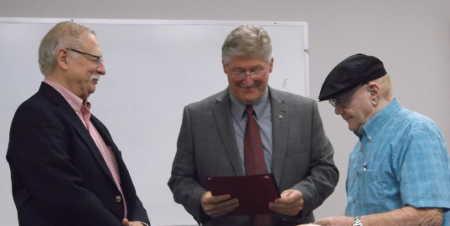
When Merriman and Moore were asked to come forward, both received from Superintendent of Schools Wally Holbrook not just a diploma but other honors, including certificates of recognition from the California State Legislature signed by Assemblywoman Mariko Yamada and special recognition certificates from the US House of Representatives signed by Congressman Mike Thompson.

Both men were delighted with the recognition, and thanked the Office of Education for the honors.
“He's so thrilled,” said daughter Pam Moore Hershey, who was at her father's side along with sisters Trena Pauly and Marilyn Marchetti.
Moore, who turned 87 on Tuesday, found out about the diploma over the weekend.
“We surprised him with it Saturday night,” said Hershey.
She and her sisters dressed her father up in cap and grown and gave him the news. They said he was determined to come to the ceremony.
Moore, an Indiana native, said he entered the Army at age 15, lying about his age. He was assigned to the 29th Infantry Division.
Marchetti said her father was a fast runner and so was used as a scout.
When his father reported to Army officials that Moore was underage, Moore was shipped home until he turned 16, and then returned to service in Europe.
In the interim, he missed the D-Day invasion in June 1944, during which his comrades in the 29th Division were amongst the first wave of Allied troops to land at Omaha Beach, sustaining massive losses.
He would later come home from the service, raised four daughters and one son in the Bay Area, and worked in management at Lockheed.
Merriman, 73, went into the military at age 17, when he was a junior in high school in Fremont, and would serve eight years in Vietnam.
He received his GED while in the service, but when he came back home, Merriman didn't return to school. “I should have, but I didn't.”
Instead, he came to Lake County, eventually became a contractor and served on the Lake County Board of Supervisors, representing District 5, from 1993 to 2001.
“Lake County is my home. I truly love it here,” he said.
He remains active in the community, including the American Legion Post 109 in Kelseyville.
For more information about the program, call the Lake County Office of Education at 707-262-4100.
Email Elizabeth Larson at

LAKEPORT, Calif. – Community members gathered at Lakeport City Hall on Wednesday evening to share ideas about how the Carnegie Library can be used and preserved in the future.
About two dozen people took part in the two-hour-and 40-minute “visioning workshop” hosted by the city of Lakeport and San Francisco-based Garavaglia Architecture.
The firm, which has experience dealing with historic buildings, was hired earlier this year and tasked with doing a feasibility study for new and best uses for the 96-year-old building.
The study – which is to cost no more than $10,000 – is funded half by a $5,000 grant won by the Lakeport Main Street Association and another $5,000 contributed by the city.
Preservation architect Mike Garavaglia and Jacqui Hogans, an architectural conservator, led the discussion after introductions by City Manager Margaret Silveira and city economic development consultant Wilda Shock.
Silveira said of the building, “It's a great asset to our community.”
In May, Garavaglia's team visited the city, met with city officials and gave the building a thorough inspection as a first step to the study. He explained that the visioning workshop was the next step, which will lead to a summary report that will be presented to the council in July.
“It's a very simple contract but a very powerful process,” he said.
Hogans gave a brief overview of the history of the building, which opened in 1918 and was operated as a library until 1985, at which point it was turned over the city. It's been used by the University of California and for city offices and storage. It was added to the National Register of Historic Places in 2008.
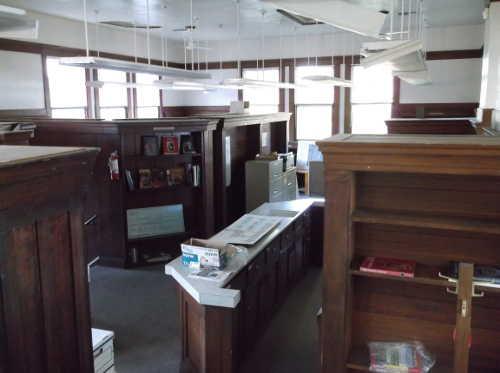
Hogans said the study is looking at “character defining features” of the building and will assess what are the highest priorities to keep.
For a building approaching its centennial, it's in excellent condition, Hogans said.
On the exterior, there are some minor concrete cracks and spalls, and deterioration of the wood windows and trim – which she said is completely understandable due to the building's age and proximity to the lake.
The building's roof was replaced in 1997 and no exterior leaks have been reported. The building's shell also is in excellent shape, she said.
The building's interior features wood shelving and the original circulation desk, all of which are in excellent condition. Hogans said those are considered character defining features.
There are two areas where the interior ceiling plaster has fallen away in chunks, which Hogans said may have been due to inadequate preparation when it was originally applied.
She said overall the building's systems are adequate for potential uses. However, the first floor bathrooms – one for men, one for women – would need to be renovated based on how the building will be used.
The building has a total of 3,000 square feet, equally split between the two floors, she said.
Garavaglia said site conditions are prone to flooding. The area was most recently flooded in 1998.
Other considerations include the need to make the building compliant with the Americans with Disabilities Act, with a lift or elevator needed.
The community's pride in the building, it was noted, is one of its benefits. Garavaglia also pointed out that the library sits in the heart of the community, and so what uses eventually are housed there will be of more interest than the average storefront.
Garavaglia said he designs around context, and that this project will require “a specialized kind of remodeling.”
The building is symmetrical, which is common for Carnegie Libraries. Its windows are an important character dynamic and are in good shape for their age, he said.
Garavaglia said he's not suggesting full window replacement; instead, he said weather stripping, minor repair, making sure the windows work properly, and use of natural ventilation, screens and curtains would help deal with temperature.
While he wants to preserve the “libraryness” of the building, “Most of these buildings are not fragile,” said Garavaglia, explaining that historical buildings tend to be robust and can change. “We don't want to be too timid.”
During a brainstorming session with the community members in attendance, perceptions of the building were recorded. Participants identified the library as a gathering place and a gateway to the lake, a retreat from Main Street and a place of childhood memories.
Suggested uses included an educational and research facility; an event space, rental venue or gallery; a wine center; television station; lake and heritage center; and cafe space.
The participants broke up into four small groups and then went over ideas, presenting their suggestions along with maps that showed their drawn-in design improvements.
Among the proposals were a large deck area to be added to the back of the building, along with an elevator and new entry points; a remodeled interior; and improved exterior lighting.
To achieve the needed remodeling, it was proposed that the city could explore public-private partnerships, either renting the library out to a private organization or a nonprofit, with the idea that the building would be available to the public – for events, cafe space, or a learning and historical center – and that its use would generate revenue.
Garavaglia said they will take the information from the group, work it into a summary and include it in the presentation to the Lakeport City Council in mid-July.

Considerations for remodeling the building
During the Wednesday discussion, Garavaglia noted that, because the Carnegie Library is on the National Register of Historic Places, renovation has to follow the Secretary of the Interior Standards for Rehabilitation, which are 10 guidelines set up by the National Park Service, Garavaglia said.
The specific guidelines were not discussed during the meeting, but they are presented below to show some of the considerations that must be taken into account in modernizing the library.
The guidelines below are published on the National Park Service Web site, http://www.nps.gov/tps/standards/rehabilitation/rehab/stand.htm .
1. A property shall be used for its historic purpose or be placed in a new use that requires minimal change to the defining characteristics of the building and its site and environment.
2. The historic character of a property shall be retained and preserved. The removal of historic materials or alteration of features and spaces that characterize a property shall be avoided.
3. Each property shall be recognized as a physical record of its time, place, and use. Changes that create a false sense of historical development, such as adding conjectural features or architectural elements from other buildings, shall not be undertaken.
4. Most properties change over time; those changes that have acquired historic significance in their own right shall be retained and preserved.
5. Distinctive features, finishes, and construction techniques or examples of craftsmanship that characterize a property shall be preserved.
6. Deteriorated historic features shall be repaired rather than replaced. Where the severity of deterioration requires replacement of a distinctive feature, the new feature shall match the old in design, color, texture, and other visual qualities and, where possible, materials. Replacement of missing features shall be substantiated by documentary, physical, or pictorial evidence.
7. Chemical or physical treatments, such as sandblasting, that cause damage to historic materials shall not be used. The surface cleaning of structures, if appropriate, shall be undertaken using the gentlest means possible.
8. Significant archeological resources affected by a project shall be protected and preserved. If such resources must be disturbed, mitigation measures shall be undertaken.
9. New additions, exterior alterations, or related new construction shall not destroy historic materials that characterize the property. The new work shall be differentiated from the old and shall be compatible with the massing, size, scale, and architectural features to protect the historic integrity of the property and its environment.
10. New additions and adjacent or related new construction shall be undertaken in such a manner that if removed in the future, the essential form and integrity of the historic property and its environment would be unimpaired.
Email Elizabeth Larson at
LAKEPORT, Calif. – The Lakeport City Council had a busy Tuesday night meeting, honoring a local man who helped a police officer, meeting the city's new fire chief, approving the new fiscal year budget and hiring a consultant to assist in an aspect of the general plan update.
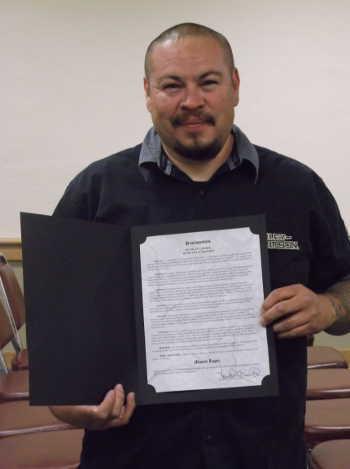
At the start of the meeting, Mayor Kenny Parlet presented a proclamation to Mauro Lopez, thanking him for assisting Lakeport Police Officer Joe Eastham on May 23.
Eastham had been attempting to arrest 40-year-old Joseph Dexter Taylor of Lucerne when Taylor began to resist arrest. Lopez came to Eastham's aid and helped subdue Taylor.
Parlet, Lakeport Police Chief Brad Rasmussen and Eastham all shook Lopez's hand and thanked him for his assistance.
Retiring Lakeport Fire Chief Ken Wells also went before the council on Tuesday to present to them his successor, Doug Hutchison, whose first day on the job was June 10.
Wells said he had taken Hutchison around to meet city staff on Tuesday and planned to meet with county officials on Wednesday.
Among Tuesday's business items was a public hearing regarding an ordinance to establish new speed limits on Parallel Drive.
City Engineer Scott Harter took to the council the results of a supplemental engineering and traffic study needed because of the Mendocino College Lake Center, the construction of which hadn't been completed when the previous study was performed in 2011.
The study proposed three speed zones: 45 miles per hour from the junction at Highway 175 to Chester Lane (north of the Mendocino College driveway); 50 miles per hour north of Chester Lane to 1,850 feet north of Todd Road; 35 miles per hour from 1,850 feet north of Todd Road to Lakeport Boulevard and from Lakeport Boulevard to the end of improvements north of Craig Avenue.
There was no public input and the council approved the speed zone study ordinance 5-0.
Finance Director Dan Buffalo presented a proposal to establish an after-hours and on-call user fee of $126 for water and sewer services.
City offices are closed on Fridays as a cost-cutting measure, and Councilman Tom Engstrom noted, “I would hope we're not going to charge people $126 on a Friday.”
If it was a nonworking Friday, they would be charged, Buffalo said.
“I can't support that,” said Engstrom.
Engstrom said the service needed to be available during normal working hours – 8 a.m. to 5 p.m., Monday through Friday.
“How often is this happening?” asked Councilwoman Stacey Mattina.
Buffalo said the city's Public Works Department doesn't keep track of the calls, but estimated it happens about four times a month. Typical calls are vacation home owners who forget to have water services turned on ahead of their arrival.
The council agreed with Engstrom that the language needed to be amended, and Engstrom moved to approve and adopt the resolution establishing the fee for requests outside of 8 a.m. to 5 p.m., Monday through Friday. The motion was approved 5-0.
In other business, city Special Projects Coordinator Richard Knoll gave the council a status report on the Lakeport Planning Commission's work on the review, update and amendment to the city's general plan.
The commission has spent several months holding public hearings and workshops, going over the document's language and refining suggestions in order to complete the initial phase of its focused general plan update project, he said.
Among the commission's recommendations is the hiring of De Novo Planning Consultants – the firm currently working on the city's housing element update – to conduct a supplemental environmental impact report on the general plan, Knoll said, with the contract cost not to exceed $29,265. He said De Novo was the only firm to submit a proposal to do the EIR work.
While an EIR addendum could cost less, around $22,000, it would only look at changes that were not substantial. However, Knoll said a supplemental EIR is more like an actual EIR and puts the city in a better position to defend itself if there are any challenges over the document.
A full EIR, Knoll said, could cost between $120,000 to $150,000 to complete.
Parlet praised the commission for its work, saying it did a great job, and Knoll agreed.
“And they're not done yet,” said Knoll, pointing out that the commission will be part of the upcoming environmental review process.
The council unanimously accepted the commission's status report and the recommendation to hire De Novo Planning Group for the supplemental EIR.
Regarding the 2014-15 budget, Buffalo presented the final review of the document to the council, with city revenues totaling $15.73 million and total expenditures of $18.78 million.
After some final questions from council members about various funds and other minor details, the document was approved unanimously.
City Manager Margaret Silveira commended Buffalo for his work on the budget, which he has crafted and improved over the last three years. Buffalo said a lot of the work is done in tandem with city departments.
The council also approved the purchase – not to exceed $14,000 – of an emergency generator for the city's tank site facility; approved a resolution supporting the renewal of the Sonoma/Mendocino/Lake Recycling Market Development Zone; and approved the delegate and alternates for the fall League of California Cities conference.
Email Elizabeth Larson at
LAKEPORT, Calif. – The Board of Supervisors on Tuesday voted to put on the November ballot a medical marijuana cultivation initiative put forward by an advocacy group that would challenge a county ordinance that went to a referendum June 3.
The board voted 3-2 to place the Emerald Unity Coalition's “Medical Marijuana Control Act” before voters in the fall, with Supervisor Rob Brown and Supervisor Jim Comstock voting no.
The supervisors did not support the option of accepting the act outright as a county ordinance, without changes.
Among its key provisions, the act allows four marijuana plants per parcel on properties of under an acre; limits collective gardens to 48 plants on rural properties of five acres or more; requires fully fenced and locked garden areas; creates a medical marijuana enforcement division in the Community Development Department and establishes a medical marijuana enforcement officer position; and charges a per-plant fee on any collective growing more than 13 plants.
While the board majority agreed to place the act on the ballot, they also wanted county agencies including the County Counsel's Office, Lake County Sheriff's Office, Community Development Department and the County Administrative Office to report back on possible impacts from the initiative, including the ability to attract and retain business, impact on law enforcement and concerns about the act's legality.
Regarding the latter, board members raised issues with the act's language, specifically, that it states that county law enforcement won't be able to enforce federal law regarding marijuana and that the county won't accept federal funds for marijuana eradication.
There also is the question of whether the fees to be collected from collective grows would be an issue with federal authorities, who shut down a program in Mendocino County that charged fees on plants.
Still in play is Measure N, a county ordinance passed to govern marijuana cultivation last December which local groups – including the Emerald Unity Coalition – gathered signatures to push to referendum.
Preliminary ballot results show that Measure N passed with a 5.2-percent margin. However, the election results will not be final until July 1, according to Registrar of Voters Diane Fridley.
Board members raise concerns
Fridley presented to the board her certification of the initiative, which needed 2,115 signatures to qualify.
The Emerald Unity Coalition in May had submitted 3,505 signatures. Out of those, Fridley's office checked 3,066, finding 934 insufficient and 2,132 sufficient.
Supervisor Anthony Farrington said he had no issue with placing the act on the ballot but raised concerns about legality, and referenced a successful recent effort to challenge senior mobile home park rent control initiatives in the city of Lakeport and in the county on the basis of whether they were constitutional.
In March Judge Richard Martin found the city and county measures weren't constitutional and ordered them removed from the ballots.
Brown accused the Medical Marijuana Control Act's proponents of “lying to everybody” in order to get the signatures they needed to qualify for the ballot.
“This is absolute nonsense that this thing is even before us right now,” he said.
Brown pointed out how the act dictates that the medical marijuana enforcement officer position be added to the Community Development Department, and that the hiring process must include a public hearing and a board vote, rather than allowing the Community Development Department director to do the hiring.
In addition, Brown pointed to language in the act that he said eliminates the ability of local law enforcement to enforce federal law and prevents the county from taking federal funds for marijuana-related enforcement.
He said he didn't think the act was legal or constitutional.
“The whole thing's a fraud,” Brown said.
Board Chair Denise Rushing asked Brown if he was saying there should be a legal challenge, and Brown said yes.
Comstock said he also had issues with the signatures gatherers' methods, recounting how one tried to entice him to sign, telling him that if he did it would help get the county's roads fixed.
Brown also agreed that the county needed to find out if the act can be challenged legally.
“It appears that there is a certain group that is never going to be satisfied, no matter what,” Brown said.
“Which is their right,” Rushing replied.
Considering options
Daniel McLean – who along with Clearlake City Council member Jeri Spittler and Adelia Klein-Leonard is a proponent of the Medical Marijuana Control Act – told the board that the act's wording is meant to prevent use of federal funding to prosecute people who are in conformance with state marijuana law.
He referred to the “Cole memo,” which the act's supporters have drawn on to support their proposal.
The August 2013 memorandum from Deputy US Attorney General James Cole suggested that “jurisdictions that have enacted laws legalizing marijuana in some form and that have also implemented strong and effective regulatory and enforcement systems to control the cultivation, distribution, sale, and possession of marijuana, conduct in compliance with those laws and regulations” are less likely to threaten federal priorities such as revenue going to cartels, marijuana trafficking and violence.
The memo also notes, “Even in jurisdictions with strong and effective regulatory systems, evidence that particular conduct threatens federal priorities will subject that person or entity to federal enforcement action, based on the circumstances.”
McLean said the Emerald Unity Coalition is seeking a compromise with the act. He said they relied on a number of outside experts, including Oakland-based attorney James Anthony, as well as a former Sebastopol mayor and an expert on environmental stewardship. He said they also held workshops and reached out to local organizations.
“People are going to continue to cultivate cannabis one way or he other,” McLean said.
He estimated that the act could easily generate up to $100,000 in the first year and more than $1 million in years ahead to fund enforcement.
He said that just because the fee system didn't work in Mendocino County didn't mean it would work elsewhere.
McLean asserted that the act was the county's best hope in settling the ongoing struggle over medical marijuana. He acknowledged that allowing grows in neighborhoods was an issue, with the act to allow up to four plants per parcel.
Community Development Director Rick Coel addressed inaccuracies that he said were being circulated about Measure N, specifically, that it prevents all outdoor cultivation. Rather, he said it requires large grows be located on ag lands.
Regarding the proposed initiative, “As it's drafted, the enforcement provisions aren't workable,” Coel said.
Based on the language, the supervisors can approve only one marijuana enforcement officer. “Where are you going to find the person to do that job?” Coel asked, noting that there are a host of problems with the proposal.
Results still pending on another initiative effort
County Counsel Anita Grant said during the discussion that there is a possibility that minor adjustments could be made to Measure N, as there is “prevalent legal theory” that what originates with the board – as Measure N did as a county ordinance – can be amended, while initiatives can't be, except by another ballot measure sent to the voters.
Supervisor Jeff Smith was concerned about the flexibility of the initiative's setback rules, which he interpreted as allowing someone to grow anywhere they wanted on a property, which would once again cause issues in neighborhoods.
It was noted during the discussion that Fridley's office is still verifying signatures for yet another marijuana cultivation initiative proposal, this time from Lucerne residents Ron and Conrad Kiczenski, also submitted in May.
“The Freedom to Garden Human Rights Restoration Act of 2014” exempts “an individual's home gardening efforts or abilities” from any limiting county permits or county ordinances, allowing for unlimited numbers of any kinds of plant to be grown and offering no recourse outside of mediation unless complaints are “related to a specific medically verifiable toxic health risk.”
The Emerald Unity Coalition has said the Kiczenskis' initiative conflicts with the Medical Marijuana Control Act.
Rushing said she wanted to know about the Medical Marijuana Control Act's enforceability, and if it is consistent with the county general plan and other laws, such as the grading ordinance.
Comstock added that it's also important to know if there is an issue with federal law.
Smith said the information gathered from county staff about local impacts can be presented to voters this fall.
McLean, addressing concerns over how many enforcement officers can be hired, said it's not capped at one, and that they could create 10 positions if they are needed.
He then referred back to Mendocino County's fee program, which federal officials pushed that county to shut down.
“They had to stop at one point,” Brown said. “That means we can't start.”
Farrington moved to place the initiative on the November ballot, asking staff to do objective fact finding. The vote was 3-2.
Email Elizabeth Larson at
Saturday, Jan. 10, 2026
00:00 EXTRA PATROL 2601100001
Occurred at Lake County Law Library on 3D....
Friday, Jan. 9, 2026
00:00 EXTRA PATROL 2601090001
Occurred at Lake County Law Library on 3D....