 How to resolve AdBlock issue?
News
The $11.1 billion legislative package takes on a laundry list of critical state water issues, from sustainability of the Bay Delta to water storage, drought relief and regional water supply, and reportedly includes establishing a statewide target to reduce urban per capita water use by 10 percent by 2015 and 20 percent by 2020.
The part of the legislation that may affect Lake County the most relates to the Bay Delta. Clear Lake drains into Cache Creek which, in turn drains into the delta, which is a critical source of water for urban an agricultural interests in the south.
On Oct. 11 Gov. Arnold Schwarzenegger called a special legislative session to address the state's water crisis, saying that it was damaging the state's economy – particularly in the agricultural and building sectors.
The state's water system now serves 38 million residents, more than twice the 16 million for which it originally was built, Schwarzenegger's office reported.
Package elements include SB 7x 1, which establishes oversight agencies for delta governance and planning; SB 7x 7, which sets 20 percent water conservation by 2020; SB 7x 6, pertaining to groundwater elevation management; SB 7 x8, which provides for investments in delta levee repair and ecosystem restoration, storage facilities, water recycling and watershed protection, and authorizes the use of $546 million from Proposition 84; and the water bond, SB 7x 2, which places the overall $11.1 million package on the November 2010 statewide general election ballot.
Out of the session resulted a water package scheduled to go before voters in November 2010. Earlier this month Schwarzenegger called it “an historic achievement.”
But that sentiment isn't shared by North Coast Assemblyman Wes Chesbro (D-Arcata), who voted against the package.
On Wednesday Chesbro issued a statement in which he called the legislation “a wolf in sheep's clothing.”
Chesbro said he strongly supports removing the Klamath dams, but added, “Funding removal of the Klamath dams while at the same time threatening the flows in the Trinity River is a fool’s bargain. We need to find a way to fund dam removal that doesn’t put the Trinity and our other North Coast rivers at risk.”
He explained that $3 billion is included in the bond, SB 7x 2, to fund water storage projects to the south.
Chesbro said those projects will increase pressure for diversion of more Northern California river water, and he asserted that the Trinity River is at greatest risk, because of existing dams and pipelines to the Sacramento River. That, in turn, increases the pressure on the Klamath fisheries.
“This would be a general obligation bond, which means they want to take our water and then make us help pay for it,” said Chesbro.
He said this would be the first time California has issued a general obligation bond for water development projects, Previously, such projects were paid for with revenue bonds, which means those who benefit from the water pay for it.
It's the big water users in the south who would reap the most benefits, said Chesbro.
In addition, he said more than $2 billion in pork was added to the package to get the votes of Southern California legislators. In turn, $100 million proposed for Northern California coastal salmonid restoration projects was cut in half, he said.
Chesbro said groups such as the Regional Council of Rural Counties and the Pacific Coast Federation of Fishermen’s Associations oppose the bond and the whole water package. He said Northern California tribes have expressed strong skepticism of the legislation.
“This is the wrong time for California to take on billions more in debt. We are in the midst of the worst economic crisis since the Great Depression,” he said.
Chesbro cited a Legislative Analyst’s Office prediction that the state is facing several years of multibillion-dollar deficits, and issued warning that the state’s bond debt service will consume an “unprecedented” 10 percent of the general fund – or about $600 million a year – if the measure passes.
Like Chesbro, North Coast Sen. Patricia Wiggins (D-Santa Rosa) criticized the water bond, which she voted against, although she voted for other pieces of legislation in the bill.
In a statement issued late last week, Wiggins said she voted against SB 7x 2 – which places the $11.1 million bond on the ballot Nov. 2, 2010 – for several reasons, among them her concern that the projects the bill might fund projects including a peripheral canal, and dams and dam expansions.
“I have been strongly supportive of efforts to remove the dams on the Klamath River, which have wreaked havoc on salmon fisheries and other ecosystems downstream,” Wiggins said. “While this bond would include $250 million to help take down those dams, I don't believe the financing should come at the expense of new dams that would harm communities in other parts of the state.”
Wiggins also called the bond “fiscally irresponsible,” coming at a time when the state is facing more budget deficits and, as a result, more cuts in the coming year. “That money should be spent directly on education, health care and other essential services, not debt payments,” she said.
She offered support for the rest of the package, which she said was brought about by an “unprecedented coalition” of groups – business, environmental, industry and utilities. Wiggins said all of the package's elements are based on years of scientific studies and recommendations from the Delta Vision Blue Ribbon Commission and the Delta Vision Committee.
The Governor's Office offered the following breakdown of the $11.1 billion water package's expenditures:
– Drought relief: $455 million for drought relief projects, disadvantaged communities, small community wastewater treatment improvements and safe drinking water revolving fund.
– Regional water supply: $1.4 billion for integrated regional water management projects up and down the state and for local and regional conveyance projects.
– Delta sustainability: $2.25 billion for projects that support delta sustainability options – levees, water quality, infrastructure and to help restore the ecosystem of the Delta.
– Water storage: $3 billion for public benefits associated with water storage projects that improve state water system operations, are cost effective, and provide net improvement in ecosystem and water quality conditions.
– Watershed conservation: $1.7 billion for ecosystem and watershed protection and restoration projects in 21 watersheds including coastal protection, wildlife refuge enhancement, fuel treatment and forest restoration, fish passage improvement and dam removal.
– Groundwater cleanup and protection: $1 billion for groundwater protection and cleanup.
– Water recycling and water conservation: $1.25 billion for water recycling and advanced treatment technology projects as well as water conservation and water use efficiency projects.
E-mail Elizabeth Larson at

Lake County Health Services said that 9,000 doses have arrived in Lake County so far, and another 9,000 individual doses are expected in multiple shipments over the next two months.
So far, the H1N1 influenza has been the cause of one local man's death, as Lake County News has reported.
Lake County Health Officer Dr. Karen Tait said vaccinations for community members will continue to take place through a combination of local clinics, pharmacies and doctor’s offices as well as vaccination clinics targeting the highest risk groups, health officials reported.
“While we are happy to see this vaccine, it is not arriving in sufficient quantities at a given time to allow us to schedule mass vaccination clinics, which we had hoped to be doing before the end of the calendar year,” said Tait.
Instead, Tait recommended continuing the current strategy of working with local health providers to administer the vaccinations.
“By partnering with local health providers, we can continuously push this vaccine out to the public and can concentrate on first reaching those at highest risk for medical complications,” she said. “We are also able to vaccinate those who may expose patients, young babies, and others who are vulnerable to
complications.”
The priority groups recommended for vaccination earliest include pregnant women, household contacts and caregivers for children younger than 6 months of age, health care and emergency medical services personnel, all people from 6 months through 24 years of age, and individuals aged 25 through 64 years who have health conditions associated with higher risk of medical complications from influenza.
One of the most challenging messages to get across is that persons 65 and over – usually one of the main targets for seasonal influenza vaccination – should plan on waiting until after these five target groups have been vaccinated, Tait reported.
The exception, according to Tait, would be for persons over 65 years old who fit into one of the defined groups, such as those who care for young infants. The risk for H1N1 infection in persons age 65 or older is less than the risk for younger age groups.
Lake County Health Services reported that it is using its limited vaccine supplies to vaccinate people who fall into the target groups, including those who may otherwise have limited access to health services.
The Public Health division does not yet have sufficient vaccine to accommodate “all comers,” but will accept referrals of eligible individuals whose own doctors are unable to provide the vaccine, Tait reported.
In this case, the referral to Public Health should be made by the doctor’s office or clinic. Dr. Tait pointed out that everyone needs to have a “medical home” with a local health care provider, so this is an opportunity to get established with a local doctor.
Although influenza illness continues to be widespread throughout the county and the state, there are indications that it may be starting to taper off, Tait said. The trend will be clearer over the coming
weeks.
“Even if flu activity does subside, we could experience additional waves of H1N1 over the coming months as well as the appearance of seasonal influenza strains later in the year,” Tait said. “However, I do feel optimistic that we are coping well with this pandemic and that we may have seen the worst. Of course, time will tell.”
The public should still continue to practice good hand hygiene, respiratory etiquette (covering coughs and sneezes), and regular cleaning of frequently touched environmental surfaces, health officials said.
Vaccination against H1N1 influenza is recommended, as additional vaccine becomes available, regardless of when it arrives. Checking periodically with health providers for vaccine is recommended, yet patience is also needed as long as vaccine production lags behind demand, according to the health department.
For more information about H1N1, visit www.cdph.ca.gov/HealthInfo/discond/Pages/SwineInfluenza.aspx , www.cdc.gov/H1N1FLU/ , www.flu.gov/ .
Follow Lake County News on Twitter at http://twitter.com/LakeCoNews and on Facebook at http://www.facebook.com/pages/Lake-County-News/143156775604?ref=mf .
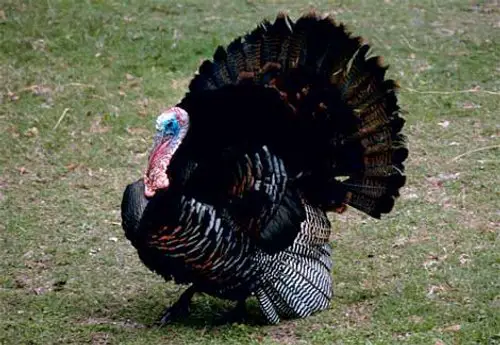
Indigenous to the Americas, the wild turkey is a majestic, fast-running bird more of interest to bird watchers and hunters than butchers.
The wild turkey was domesticated around 10 BC to 10 A D by the Aztecs. They ate its meat and used its feathers for ornamental purposes during their annual turkey festival. They were known to trade about 1,000 birds daily in their markets. When the conquistadors arrived in the Americas, turkey had become the staple meat of Mayans, Aztecs, Incas and other indigenous peoples.
In the wild the bird is fast (up to 40 kilometer per hour top speed), and its eyesight and hearing are sharp. Some say the bird is unattractive looking, but the male has an iridescent plumage that is fine to look at when he “displays” the ruffled feathers.
The bird sports a fanlike tail, bare head and bright beard. They gobble with a distinctive sound that can be heard a mile and a half away. During the day wild turkeys forage for seeds, berries, buds and grubs (even a little snake, frog or salamander may be on its menu), and at night they fly into trees to roost. An adult wild turkey can weigh as much as 20 pounds and they can live to be 6 to 9 years old.
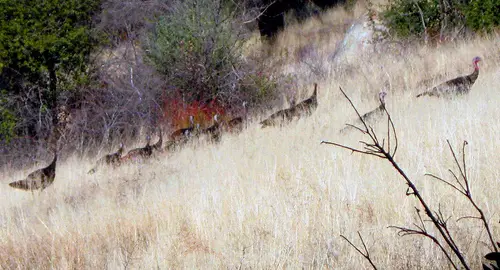
The females will lay four to 17 eggs, and feed their chicks for a few days after they hatch and the males take no role in the raising of the young. That is why you will often see mother/child flocks that can number in the dozens.
Benjamin Franklin would have preferred that the wild turkey be the national bird of the US instead of the bald eagle.
Writing to his daughter he stated: “For my own part I wish the Bald Eagle had not been chosen the representative of our Country. For the truth the Turkey is in comparison a much more respectable bird, and withal a true original Native of America ... He is besides, though a little vain & silly, a Bird of Courage, and would not hesitate to attack a Grenadier of the British Guards who should presume to invade his Farm Yard with a red coat on.”
The wild turkey was wiped out in the United States by overhunting coupled with the disappearance of their preferred woodland habitat in the early 20th century.
They will typically forage on forest floors, but can also be found in grasslands and swamps. You can see them foraging in open areas around Davis and Woodland, in the farm lands and around Cache Creek, and throughout Lake County. Feeding on nuts, seeds, fruits, insects, and salamanders they can be both beneficial and a pest to the gardener or farmer and to the declining salamander population.
In the 1940s, reintroduction programs of the wild bird took place and the birds were relocated to areas where populations had been decimated but woodlands were recovering. The program was so successful the birds now live in areas where they may not have occurred when Europeans first reached the Americas. Today, flocks can be found in Hawaii, Europe and New Zealand.
Now occupying about 18 percent of our state they are a highly valued upland game bird as well as a great bird to watch.
If you have the birds around your home or farm it is best to resist feeding them or approaching them. Trouble can begin as a flock of wild turkeys can cause great damage to a garden and if they lose their natural fear of humans they could become dangerously aggressive during breeding season.
If you have a problem with wild turkeys contact your local Department of Fish and Game office or visit www.dfg.ca.gov/regulations .
Mayan royal feasts included turkey wrapped in corn tortillas. Heat a corn tortilla until soft; add warm shredded turkey, a bit if avocado and if you are as courageous as the wild turkey a bit of habanera chili. Roll up and enjoy with steamed wild rice and fresh tomatoes.
For a more adventurous use of your leftover turkey you might try this tamale recipe called “Pibikutz, adapted from a recipe in the Diario Yucatan the Merida Yucatan newspaper, October 1996.
Traditionally prepared during the festival of Hanal Pixan, which has since become the Day of the Dead in the Maya area, this dish has a symbolic process of "burying" the tamale in a pit and then "resurrecting" as it corresponds with the ancient Maya idea of burying the dead before their transition into the afterlife.
4 cups turkey broth
6 2/3 cups corn masa harina
1/3 cup solid turkey fat or butter
6 2/3 cups shredded cooked turkey (for a vegetarian version substitute thinly sliced “ToFurkey”)
1 teaspoon achiote
Salt, to taste
1 cup tomato
1 large onion
2 sprigs of epazote (parsley is a close substitute)
habanera chile, to taste
about 12-15 corn husks
Boil the broth with half a teaspoon of achiote or parsley, a dash of salt and a little bit of the masa harina for thickening. This will be part of the "kol" that bathes the interior of the tamales.
Mix the corn masa with the turkey fat, salt and achiote to make a dough. This forms the filling that will cover the shredded turkey meat. Put some of this corn dough on top of a corn husk. Make a hollow in the dough. Layer this hollow with the turkey and bathe with the broth, alternating with onion, tomato, chile and epazote. Finally, put a covering of corn dough on top.
Wrap everything with corn husks and then bake for an hour and a half at 375 degrees. Or, for the traditional method, bury the pibikutz in a firewood and rock pit, and let cook for eight hours. Truly a “wild” treat!
Debra Chase is the executive director of Tuleyome, a local nonprofit working to protect both our wild heritage and our agricultural heritage for future generations. She's also the chef/owner of UnCooked Creations, a raw vegan/vegetarian professional chef service. She and her husband Dave reside on their farm in Colusa County. Visit Tuleyome online at www.tuleyome.org .
Follow Lake County News on Twitter at http://twitter.com/LakeCoNews and on Facebook at http://www.facebook.com/pages/Lake-County-News/143156775604?ref=mf .
The holidays are a time of food, fun and festivities; but they are also a time to be extra cautious as thousands of home fires are caused from cooking equipment during the holidays.
One of the most dangerous pieces of equipment can be a turkey fryer. A common problem is that people misjudge the amount of oil needed, not allowing room for the turkey to be placed inside.
But even when the oil is at the right level, a partially frozen turkey can cause hot oil to spew a jet of fire. Any contact between hot oil and nonmetallic materials could lead to serious damage.
Fires have occurred when turkey fryers were used in a garage or barn or under eaves to keep the appliance out of the rain. Follow all manufactures instructions and insure that children are not in the area.
“Safe cooking this Thanksgiving can mean the difference between a great gathering with family and friends or visitors from the fire department sharing in your gathering because of a cooking emergency,” said acting State Fire Marshal Tonya Hoover.
Cal Fire and the Office of the State Fire Marshal, along with the National Fire Prevention Association (NFPA), are urging cooks to “stand by their pan” to prevent fires.
“It only takes seconds for an unattended meal to turn into a dangerous and damaging fire,” stated Hoover.
To help reduce the chance of fire and injuries associated with holiday cooking, follow these safety tips:
Stay in the kitchen when you are frying, grilling, or broiling food. Never leave cooking food unattended.
If you leave the kitchen for even a short period time, turn off the stove.
Cooking food should always be supervised by an adult.
Turkey fryers should always be used outdoors a safe distance from buildings and other material that can burn. Never use on wooden decks or in garages.
Children should not be permitted near a turkey fryer since hot oil can cause serious burn injuries.
Provide a level surface that is free of ignitable materials when using turkey fryers.
Make sure a fire extinguisher is handy at all times. Never use water to put out a grease fire.
Use well-insulated potholders or oven mitts when touching pot or lid handles.
For more information on fire safety, visit our website at www.fire.ca.gov .
A Chevy van hit the bear on Highway 29 near Hofacker Lane outside of Lower Lake shortly before 8:30 p.m., according the California Highway Patrol.
CHP Officer Steve Tanguay said the van was traveling southbound on Highway 29 when the bear ran out into the roadway, and the driver couldn't stop the vehicle, which struck and killed the animal.
Tanguay said the van driver wasn't injured and declined a report.
The CHP said that the incident was reported to California Department of Fish and Game, but Warden Loren Freeman said they don't usually respond to dead bears, which are picked up by Caltrans or, if it's on a local roadway, the county roads department.
While it's not a violation to accidentally hit wildlife with a vehicle, “They can't take the animal with them,” he said.
Fish and Game usually responds when mountain lions and elk are hit, because people are likely to try to take some part of those animals, Freeman said.
Freeman said an elk was last hit in the county about a month ago near Clearlake Oaks.
E-mail Elizabeth Larson at
Education
Health
Business
Obituaries
Opinion & Letters
Veterans
Recreation
Religion
Arts & Life
Government & Politics