How to resolve AdBlock issue?
News
Schwarzenegger's office said that the bipartisan budget package takes the necessary steps to reduce spending, bring in new revenue, improve the business climate and create jobs, and make government more efficient.
First District Assemblymember Wesley Chesbro (D-Arcata) voted for the package, which he called “a compromise of deep cuts and revenue increases that required both sides of the aisle to make concessions.”
Said Chesbro, “The cuts we made are the most severe in the history of California budgets. All Californians will be asked to make sacrifices, either in the form of service cuts or paying a little more in taxes to return our state to solvency. If we had not acted on this solution now – if we had waited any longer – the pain for all Californians would have been worse.”
Chesbro said he doesn't like taxes, or cutting spending on education and other vital programs. “But the Legislature had to act now,” he said, explaining that failure to act would have jeopardized California’s eligibility for federal economic stimulus funds. Thousands more Californians employed in the public and private sector would have lost their jobs as one project after another was shut down, he added.
On Friday Schwarzenegger used his line item veto authority to cut $958 million from the 2009-10 budget's general fund.
Those line item cuts include at least a 10-percent reduction to most of the constitutional offices; replacing general fund appropriations with federal funds that the state otherwise would not receive for higher education; and, finding additional savings within the California Department of Corrections and Rehabilitation.
Other features of the budget include a strengthening of the rainy-day fund, opening up of primary elections and elimination of legislative pay raises during deficit years.
“We have achieved a great victory for California today,” Schwarzenegger said. “By staying focused on what was best for the people of our state and not the special interests, we were able to come together and solve our $42 billion deficit and also find meaningful and lasting solutions to our broken budget system.”
Despite having to make some tough decision, the state is “back on the best path forward,” said Schwarzenegger. “We will continue to work with our most important partners – the people of our great state – to ensure we never again face the kind of catastrophic budget scenario we experienced this year.”
The budget includes $14.9 billion in spending reductions, Schwarzenegger's office reported.
The reduction from most constitutional officers’ budgets, which resulted from the line item veto, will achieve $47 million in savings, according to the governor.
He added that the cut to the constitutional officers' budgets reflects equity among all executive branch agencies for the state employee compensation reductions within the budget through furloughs, elimination of positions, overtime reform and reducing paid state holidays. The constitutional officers will have the flexibility to implement the savings within their own offices.
Higher education will receive federal funding to replace general fund monies in the amount of $255 million each to the University of California and California State University systems. Additional savings of $400 million will come from California Department of Corrections and Rehabilitation through continued reforms and other cost saving measures that will not jeopardize public safety.
The budget includes temporary revenue increases totaling $12.5 billion through a one-cent increase in the state sales tax, an increase in the vehicle license fee to one percent and an increase in the personal income tax that federal stimulus funding will likely help offset. The vehicle license fee will also include an additional ongoing 0.15 percent increase that will be dedicated to local law enforcement programs. Additionally, the state will bring in revenue through modernizing the state lottery and bringing in $5 billion in 2009-10 that will offset the need for additional tax increases or program cuts.
Chesbro said the budget package he voted for will have a far less negative impact on the First Assembly District than what the governor had originally proposed.
He said the Legislature saved the rural sheriffs program and greatly reduced the impacts of deferred payments to county services. They also saved the California Conservation Corps., minimized cuts to education spending and made sure schools will be repaid in the future. Schools also received greater flexibility in how they spend state funds, and cuts to health and human services were limited.
Without the budget solution, Chesbro said veterans would have been among those to suffer first and most severely. “The state was in real jeopardy of losing federal funds needed to care for those who served in the armed forces and fought for our freedom.”
Chesbro said the budget sought to keep the state's workforce intact. The vast services those workers provide includes everything from ensuring environmental protections, to building transportation projects, to helping people file unemployment claims, to fighting wildfires.
The governor said he fought hard to include needed economic stimulus to help create jobs and boost the state's economy at the same time as the budget asks Californians to pay more in taxes while reducing their services.
The budget includes incentives and gives a competitive edge to companies that are creating jobs for Californians and to encourage companies to expand in and relocate to California. Also, a “new hire” tax incentive will target small businesses that create new California jobs in the coming two years – when we need them most, officials reported.
The package also provides for more public-private partnerships and design build authority to create more jobs and build projects quicker and more cost-effectively for the taxpayer. As well as, incentives to lure television and movie production back to California.
Other budget highlights include flexibility for categorical education funding allow local schools and districts to use it as they see best fit to serve children and keep more money in the classroom. And the state will move forward this year to reorganize its IT functions to save an estimated $1.5 billion over the first five years and creates a new streamlined, cabinet-level office for the state’s energy-related functions helping California focus on energy stability and eliminating redundancy.
Schwarzenegger's office reported that one item of importance to the governor – that was highlighted among his campaign promises – was that the rainy-day fund, or the budget stabilization account, will be increased and reformed making budget spending more predictable and stable.
Additionally, through the budget package, Californians will have the opportunity to enact true reforms for the state including open primaries to provide more moderate candidates and eliminating pay raises for elected officials when California is spending more money than it is taking in.
The structural changes to put California back on track will go before voters. Schwarzenegger said he intends to form a partnership with the people to pass these ballot initiatives.
{mos_sb_discuss:3}
THIS STORY HAS BEEN UPDATED; THE US GEOLOGICAL SURVEY HAS UPGRADED THIS QUAKE FROM 3.3 TO 3.7 MAGNITUDE.
THE GEYSERS – A 3.7-magnitude earthquake hit The Geysers area early Friday morning.
The quake occurred at 2:29 a.m., and was centered one mile north of The Geysers, five miles west southwest of Cobb and seven miles west northwest of Anderson Springs, according to the US Geological Survey.
The US Geological Survey report noted that the quake was recorded at a depth of 1.4 miles.
Residents of Kelseyville and Cobb reported feeling the quake, which also was felt as far away as El Cerrito and San Francisco, according to the US Geological Survey's shake reports.
The last earthquake measuring 3.0 or above reported in Lake County occurred on Jan. 22, measured 3.0 on the Richter scale and was centered one mile northwest of The Geysers, as Lake County News has reported.
E-mail Elizabeth Larson at
{mos_sb_discuss:2}

MIDDLETOWN – Earth-friendly technologies and sustainable ways of supporting energy and business were a theme in Lake County on Thursday.
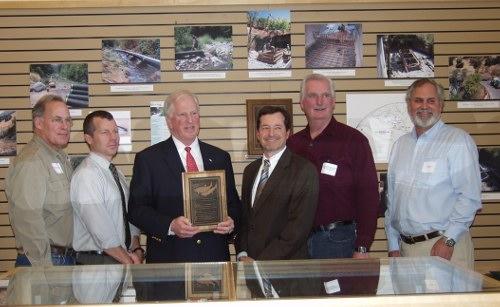
In the morning, Congressman Mike Thompson was on hand for the dedication of the county's solar array near Lakeport. Then, on Thursday afternoon, he made the trip to the Calpine Visitors Center, where he was honored by Calpine, which named a new fish ladder on Big Sulfur Creek in his honor.
Supervisors Jim Comstock and Jeff Smith, as well as state and federal officials, were on hand for the presentation at the Calpine Visitors Center.
The Big Sulfur Creek fish passage project is a joint project between Calpine, the National Oceanic and Atmospheric Administration's (NOAA) National Marine Fisheries Service and the California Department of Fish and Game.
Completed last October, the fish ladder was shaped to create stable streaming flow conditions along its margins at moderate to high water levels. It includes ladder steps designed to provide juvenile fish passage at lower flows, and allows upstream fish migration over a wider range of stream flows compared to traditional fish ladders.
Calpine spent six years working on the project, beginning in 2001, said Calpine Senior Vice President Mike Rogers.
“This really is an exceptional example of sustainability,” said Rogers, who added that it's an example of industry and government coming together on an important project.
The company had been meeting with officials from state Fish and Game when the subject of Russian River steelhead came up, Rogers said. The fish were having trouble migrating through a part of the river.
Specifically, a road crossing on The Geysers property, consisting of a triple concrete box culvert, was found to be a partial barrier to fish migrating upstream, according to a Calpine report.
So began what would be years of what Rogers called “formidable tasks” – from studying the stream to designing a project, getting complex permits and diverting the stretch of river while the fish ladder was constructed, said Rogers.
The end result was unobstructed, year-around access to the largest suitable spawning and rearing habitat on Big Sulfur Creek – one of the largest tributaries to the Russian River – above the confluence with Squaw Creek, according to Calpine.
Officials explained that steelhead trout spawn from December through April in coarse gravel areas of small streams and tributaries where cool, well-oxygenated water is available year-round.
David White of NOAA explained that the steelhead is a threatened species, and Big Sulfur Creek is a unique habitat. The fish ladder maximizes the amount of habitat available in the river, he said.
To underline the project's importance, White explained that the Russian River's steelhead runs were estimated to have 65,000 fish in the 1970s. In recent years, that number has plummeted to between 3,000 and 6,000 steelhead.
The reduction in habitat and dewatering of stream tributaries were devastating the steelhead population, White said.
But there's hope that the steelhead – which is very sensitive to environmental conditions – will come back. White said two adult steelhead were found at the project site, along with close to 2,400 juveniles. They also found 1,000 yellow-legged frog tadpoles, two California giant salamanders and about 1,000 red-legged salamander larvae.
The creek is home to a very rich assembly of California native fishes, said White.
Rogers paid tribute to Thompson, who was on the short list of candidates considered to lead the federal Department of the Interior.
Thompson lauded the work of the NOAA scientists, who he said are doing good scientific work for the government.
He said fish are an environmental canary in the mine shaft.
“If the fish aren't living where they're supposed to be living, something is wrong,” said Thompson.
Thompson recalled that he and Calpine go back a long way.
While he was in the state Legislature in the 1990s, the effort got under way to put in place Lake County's effluent pipeline to The Geysers – where the treated wastewater is injected into the steamfields to help generate geothermal power.
Thompson was elected to Congress in 1998 and when he got to Washington, DC, he started working on the pipeline issue. It was placed in a bill but the Army Corps of Engineers said it would not allow the project even if the bill was approved.
“I was up against the wall,” said Thompson.
He said he received a call from a White House staffer asking if he was still going to support the bill in which the pipeline was included, and Thompson said no.
A short time later he got a call from the President Bill Clinton asking why he was changing his vote.
Thompson said he told Clinton about Lake County's pipeline and the problems he was having with the Army Corps of Engineers.
“It is so, so wonderful when you're needed,” said Thompson, recalling how the problem was suddenly solved and the pipeline was allowed to go forward.
“Renewable energy is so important to us and our future,” Thompson said.
He said he hopes to see the steelhead numbers recover after a 90-percent drop in fish numbers since the 1960s.
For the First Congressional District, steelhead and salmon are a big part of the economy, heritage and culture, Thompson said.
A trip had been planned to go to the fish ladder, but Calpine officials said concerns about a rock slide on the road preempted the trip. Instead, visitors were taken up to see The Geysers site.
E-mail Elizabeth Larson at

{mos_sb_discuss:3}
Gov. Arnold Schwarzenegger congratulated legislators for passing the budget package to address the state's $42 billion budget deficit.
“I am extremely proud of the members of the legislature, both Republicans and Democrats, who had the courage to stand up and put the needs of Californians first,” he said. “Rather than approaching this unprecedented crisis with gimmicks and temporary solutions, we took the difficult but responsible steps to address our entire $42 billion budget deficit and pass historic bipartisan reform measures.”
Schwarzenegger said it's a “difficult” budget, but, he added, “we have turned this crisis into an opportunity to make real, lasting reforms for California.”
State Sen. Patricia Wiggins, who represents Lake County in the state Senate, said the budget will help the state address its budget with a view toward the future.
“This budget, which includes spending cuts, revenue increases and borrowing, is not a pretty budget, but it’s a necessary budget,” she said. “It’s a budget which spreads the burden across the people and businesses of this state, but it’s also a budget which includes economic stimulus and government reforms.”
Wiggins said the budget addresses the state's short-term deficit problem while paving the way for long-term solutions such as economic growth and job creation.
“And if we receive our fair share of economic stimulus funds from the federal government, we will be able to reduce some of the borrowing and spending cuts, and lower some of the taxes, that we approved earlier today,” she said.
The budget deal makes moot a lawsuit filed against State Controller John Chiang last Friday by numerous counties – Lake among them – in reaction to Chiang's announcement that he would begin withholding payments to counties due to the state's budget crisis, as Lake County News has reported.
Chiang said the move was necessary because there wasn't enough cash left in the state's bank account to pay all of its bills. He stated that he was forced to delay $3.3 billion in payments to local governments, state contractors and taxpayers this month.
Chiang said Thursday that the long-overdue budget deal won't immediately fill the state's treasury.
“The Department of Finance has promised to provide us within a week with the data we will need to update our cash flow analyses and determine how to manage the state’s payments through the end of the fiscal year,” he said. “Once this budget plan provides the needed cash in the treasury, my office will work around the clock to get delayed payments out the door.”
County Chief Administrative Office Kelly Cox said local officials are still trying to figure out how the budget ultimately will affect local jurisdictions.
Paul McIntosh, executive director of the California State Association of Counties, told Lake County News on Thursday that 37 bills – that, stacked up, were about 1 foot thick – made up the budget package.
One of the biggest areas of concern was a proposal that arose during the budget negotiations that called for delaying payments for mental health, CalWorks and several other benefits program services to counties for a period of seven months, as Lake County News has reported.
“That is not in this budget package,” said McIntosh.
There may, however, be some payment deferrals in June and July, he added.
“It's much more amenable language to counties than was originally proposed,” said McIntosh.
There also are plans for a May 19 special election, which will feature six different propositions related to the budget. McIntosh said those propositions include proposals to divert monies from Proposition 10, which imposed a cigarette tax, and Proposition 63, a mental health services fund measure; a spending cap; and a proposition that would look at the state lottery.
The special election is estimated to cost counties $80 million, said McIntosh. Counties are asking for language to be included in the legislation so they will be reimbursed for the costs of the election, as they were last year's February presidential primary.
McIntosh said the budget includes cuts in health and human services, particularly to program recipients, and some county administration cost reductions.
“We're grateful that the Legislature has solved this issue,” McIntosh said.
Although the Legislature doesn't have the power on its own to change the budget process, McIntosh said there is a building recognition that the process is “absolutely ridiculous.”
He said a petition is circulating to change the vote percentage needed to pass a budget from the two-thirds currently required to 55 percent.
McIntosh said counties and the state have a dysfunctional relationship that goes back 30 years, to the passage of Proposition 13.
Proposition 13 shifted total fiscal responsibility to the state, and removed a great deal of power from Boards of Supervisors when it comes to deciding how funds are spent. McIntosh said that, as a result of Proposition 13, only about 10 percent of county budgets are now discretionary.
As for the calls from some people that a constitutional convention is in order, McIntosh said to be careful what you wish for. The concern, he said, is that some interests might try to take over that process.
E-mail Elizabeth Larson at
{mos_sb_discuss:3}
The board met Feb. 11 for their annual strategic planning event to gather input on the direction for the district, according to district Superintendent Korby Olson.
With the long range forecast for the budget looking bleak, ways to save money while still providing high quality learning dominated the discussion, Olson said.
Olson said the school site councils from all of the schools and some other individuals were invited to attend the meeting and look at several key areas including, school configuration, fiscal solvency, educational options, student learning, technology projects and facilities.
The topic of school configuration was a discussion focus. Olson said ideas ranged from closing schools to grade reconfiguration to maximize resources. The fate of Cobb Elementary and Minnie Cannon Elementary were both discussed as the group grappled with the expense of operating small schools.
Olson said no decisions were made at the meeting, but the sentiment was clear that other options for decreasing costs should be considered before closing schools.
Cobb has been among the highest performing schools in the region and the top performer in Lake County since the Academic Performance Index was introduced, Olson said. A new school facility for Minnie Cannon is in the planning stages, so closing either school is no longer being considered.
Another topic of note was a discussion of increasing the Middletown High School graduation requirements to align with the requirements for admission to the University of California and California State University systems. Olson said several other districts in the state have made this move to assure that all students who graduate have the option to attend a university.
The board looked at other cost saving and revenue generating ideas, including charging a fee for bus transportation. Olson said the board has considered charging fees for bus rides in the past, but felt that they had not had enough input from parents on the topic to consider this option.
In other action, newly appointed Board member Lynette Carrillo took the oath of office.
Olson said the planning meeting took the place of the regular business meeting, so a board meeting was scheduled for Feb. 25 in the Middletown multi-use room at 7 p.m. Middletown Unified School District is located at 20932 Big Canyon Road. For more information call the district at 987-4100 or visit www.middletownusd.org.
{mos_sb_discuss:2}
The California Highway Patrol reported that 19-year-old Ricardo Medina was arrested following the crash, which occurred at 10 a.m. Sunday, Feb. 15.
Medina was driving his 1991 Red Chevy Blazer westbound on Highway 20 east of Mitchell Road in Clearlake Oaks, while 57-year-old Pamela Joseph of Clearlake Oaks was driving her 1994 green Ford Explorer eastbound on Highway 20, the CHP reported.
The CHP report said Medina was unable to negotiate a right curve in the road and crossed into the eastbound lane and struck Joseph’s vehicle head-on.
Both vehicles sustained major damage and came to rest blocking the westbound lane, according to the CHP.
Joseph sustained major non-life threatening injuries while Medina only sustained minor injuries. The CHP said both parties were taken to Sutter Lakeside Hospital by Northshore Fire Protection District ambulance.
Medina is suspected to have been under the influence of alcohol and marijuana at the time of collision and was booked into the Lake County Jail after being released from the hospital, the CHP reported.
CHP Officer Joseph Wind is investigating the incident.
{mos_sb_discuss:2}