How to resolve AdBlock issue?
News
“We have to adapt the way we work and plan in order to manage the impacts and challenges that California and our entire planet face from climate change,” Governor Schwarzenegger said in a written statement. “Given the serious threat of sea level rise to California’s water supply, population and our economy, it’s critically important that we make sure the state is prepared when heavy rains cause flooding and the potential for sea level rise increases in future years.”
There are four key actions in the executive order including:
Initiate California’s first statewide climate change adaptation strategy that will assess the state’s expected climate change impacts, identify where California is most vulnerable and recommend climate adaptation policies by early 2009;
Request the National Academy of Science establish an expert panel to report on sea level rise impacts in California to inform state planning and development efforts;
Issue interim guidance to state agencies for how to plan for sea level rise in designated coastal and floodplain areas for new projects; and
Initiate a report on critical existing and planned infrastructure projects vulnerable to sea level rise.
One key benefit that the executive order will facilitate is California’s first comprehensive climate adaptation strategy. This effort will improve coordination within state government and adapt the way work so that better planning can more effectively address climate impacts to human health, the environment, the state’s water supply and the economy.
The order also provides consistency and clarity to state agencies on how to address sea level rise in current planning efforts, reducing time and resources unnecessarily spent on developing different policies using different scientific information.
The executive order and its actions carry on the governor’s environmental leadership by continuing to address climate change adaptation in coordination with our climate change mitigation policies as outlined in AB 32. The states of Washington and Oregon, as well as Canada and Mexico, along with several global institutions have expressed interest in coordinating our climate change adaptation policies as outlined in this order.
California’s Energy Commission, the California Ocean Protection Council and Caltrans are conducting numerous scientific studies on the impact of climate change, including new sea level rise impact projections that are being used to develop the state’s climate change adaptation strategy.
Full text of executive order:
EXECUTIVE ORDER S-13-08
by the Governor of the State of California
WHEREAS climate change in California during the next century is expected to shift precipitation patterns, accelerate sea level rise and increase temperatures, thereby posing a serious threat to California’s economy, to the health and welfare of its population and to its natural resources; and
WHEREAS California is a leader in mitigating and reducing its greenhouse gas emissions with the 2006 Global Warming Solutions Act (Assembly Bill 32), the Low Carbon Fuel Standard (Executive Order S-01-07), the 2008 Senate Bill 375 and the Renewable Portfolio Standard; and
WHEREAS these efforts, coupled with others around the world, will slow, but not stop all long-term climate impacts to California; and
WHEREAS California must begin now to adapt and build our resiliency to coming climate changes through a thoughtful and sensible approach with local, regional, state and federal government using the best available science; and
WHEREAS there is a need for statewide consistency in planning for sea level rise; and
WHEREAS California’s water supply and coastal resources, including valuable natural habitat areas, are particularly vulnerable to sea level rise over the next century and could suffer devastating consequences if adaptive measures are not taken; and
WHEREAS the country’s longest continuously operating gauge of sea level, at Fort Point in San Francisco Bay, recorded a seven-inch rise in sea level over the 20th century thereby demonstrating the vulnerability of infrastructure and resources within the Bay; and
WHEREAS global sea level rise for the next century is projected to rise faster than historical levels with the Intergovernmental Panel on Climate Change predicting that global sea levels will rise by between seven to 23 inches this century and some experts predicting even higher rises; and
WHEREAS while climate models predicting global sea level rise are generally understood and improving, less information is available for sea level rise projections specific to California that accounts for California’s topography, coastal erosion rates, varying land subsidence levels and tidal variations; and
WHEREAS billions of dollars in state funding for infrastructure and resource management projects are currently being encumbered in areas that are potentially vulnerable to future sea level rise; and
WHEREAS safety, maintenance and operational efforts on existing infrastructure projects are critical to public safety and the economy of the state; and
WHEREAS the longer that California delays planning and adapting to sea level rise the more expensive and difficult adaptation will be; and
WHEREAS the California Resources Agency is a member of the California Climate Action Team and is leading efforts to develop and implement policy solutions related to climate change adaptation regarding current and projected effects of climate change; and
WHEREAS the Department of Water Resources (DWR) is responsible for managing the state’s water resources to benefit the people of California, and to protect, restore and enhance the natural and human environments; and
WHEREAS California’s coastal management agencies such as the California Coastal Commission, the California Ocean Protection Council (OPC) and California State Parks are charged with managing and protecting the ocean and coastal resources of the state; and
WHEREAS the California Energy Commission’s (CEC) Public Interest Energy Research Program has funded research on climate change since 2001 including funding the development of preliminary sea level rise projections for the San Francisco Bay area by the Scripps Institution of Oceanography/University of California at San Diego.
NOW, THEREFORE, I, ARNOLD SCHWARZENEGGER, Governor of the State of California, by virtue of the power vested in me by the Constitution and statutes of the State of California, do hereby order effective immediately:
1. The California Resources Agency, in cooperation with DWR, CEC, California’s coastal management agencies, and the OPC, shall request that the National Academy of Sciences (NAS) convene an independent panel to complete the first California Sea Level Rise Assessment Report and initiate, within 60 days after the signing of this Order, an independent sea level rise science and policy committee made up of state, national and international experts.
2. By March 31, 2009, the OPC, DWR and the CEC, in coordination with other state agencies, shall hold a public workshop to gather policy-relevant information specific to California for use in preparing the Sea Level Rise Assessment Report and to raise state awareness of sea level rise impacts.
3. The California Resources Agency shall request that the final Sea Level Rise Assessment Report be completed as soon as possible but no later than December 1, 2010. The final Sea Level Rise Assessment Report will advise how California should plan for future sea level rise. The report should include: (1) relative sea level rise projections specific to California, taking into account issues such as coastal erosion rates, tidal impacts, El Niño and La Niña events, storm surge and land subsidence rates; (2) the range of uncertainty in selected sea level rise projections; (3) a synthesis of existing information on projected sea level rise impacts to state infrastructure (such as roads, public facilities and beaches), natural areas, and coastal and marine ecosystems; and (4) a discussion of future research needs regarding sea level rise for California.
4. The OPC shall work with DWR, the CEC, California’s coastal management agencies and the State Water Resources Control Board to conduct a review of the NAS assessment every two years or as necessary.
5. I direct that, prior to release of the final Sea Level Rise Assessment Report from the NAS, all state agencies within my administration that are planning construction projects in areas vulnerable to future sea level rise shall, for the purposes of planning, consider a range of sea level rise scenarios for the years 2050 and 2100 in order to assess project vulnerability and, to the extent feasible, reduce expected risks and increase resiliency to sea level rise. However, all projects that have filed a Notice of Preparation, and/or are programmed for construction funding the next five years, or are routine maintenance projects as of the date of this Order may, but are not required to, account for these planning guidelines. Sea level rise estimates should also be used in conjunction with appropriate local information regarding local uplift and subsidence, coastal erosion rates, predicted higher high water levels, storm surge and storm wave data.
6. The Business, Transportation, and Housing Agency shall work with the California Resources Agency and the Governor’s Office of Planning and Research (OPR) to prepare a report within 90 days of release of this Order to assess vulnerability of transportation systems to sea level rise that will include provisions for investment critical to safety, maintenance and operational improvements of the system and economy of the state.
7. By June 30, 2009, the California Resources Agency, through the Climate Action Team, shall coordinate with local, regional, state and federal public and private entities to develop a state Climate Adaptation Strategy. The strategy will summarize the best known science on climate change impacts to California (led by CEC’s PIER program), assess California’s vulnerability to the identified impacts and then outline solutions that can be implemented within and across state agencies to promote resiliency. A water adaptation strategy will be coordinated by DWR with input from the State Water Resources Control Board, an ocean and coastal resources adaptation strategy will be coordinated by the OPC, an infrastructure adaptation strategy will be coordinated by the California Department of Transportation, a biodiversity adaptation strategy will be jointly coordinated by the California Department of Fish and Game and California State Parks, a working landscapes adaptation strategy will be jointly coordinated by the California Department of Forestry and Fire Protection and the California Department of Food and Agriculture, and a public health adaptation strategy will be jointly coordinated by the California Department of Public Health and the California Air Resources Board, all as part of the larger strategy. This strategy will be facilitated through the Climate Action Team and will be coordinated with California's climate change mitigation efforts.
8. By May 30, 2009, OPR, in cooperation with the California Resources Agency, shall provide state land-use planning guidance related to sea level rise and other climate change impacts.
This Order is not intended to, and does not, create any rights or benefits, substantive or procedural, enforceable at law or in equity, against the State of California, its agencies, departments, entities, officers, employees, or any other person.
I FURTHER DIRECT that as soon as hereafter possible, this Order shall be filed with the Office of the Secretary of State and that widespread publicity and notice be given to this Order.
IN WITNESS WHEREOF I have hereunto set my hand and caused the Great Seal of the State of California to be affixed this 14th day of November 2008.
________________________________
Arnold Schwarzenegger
Governor of California
ATTEST:
________________________________
Debra Bowen
Secretary of State
{mos_sb_discuss:3}
The California Department of Transportation suggests drivers follow the following tips for driving in deer country.
Be particularly attentive between sunset and midnight, during the hours shortly before and after sunrise, and in foggy conditions. Most deer-vehicle collisions occur during those times.
Drive carefully in areas known to have high deer populations. Places where roads divide agricultural fields or streams from forestland are particularly dangerous.
If you see a deer, slow down. Others are probably nearby.
Use high-beam headlights when there is no oncoming traffic. The high beams can reflect off their eyes and warn you of their presence.
If a deer is in your lane, brake firmly but stay in the lane. The most serious crashes occur when drivers swerve.
Don't rely on deer whistles, deer fences, or reflectors to deter deer.
Wear seat belts.
If your car strikes a deer, don't touch the animal. If the deer is blocking the highway, call 911.
These tips are used with permission from the National Park Service.
{mos_sb_discuss:2}
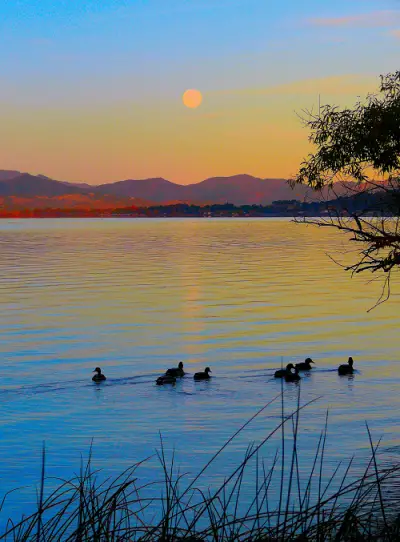
Photographer Ron Keas of Lucerne captured the full moon setting at 7 a.m. on Thursday. The shot was taken from Lucerne.
This new study comes in the wake of a salmon population crash which resulted in the state and federal government closing the commercial salmon fishing season off the coast of California and part of Oregon this spring.
Data gathered from the study will help agencies better manage the Bay-Delta ecosystem while enhancing habitat for salmon and other protected species and providing a scientific foundation for water policy, ecosystem and salmon fishery decision makers.
“Ultimately, with the data collected from this study, we hope to find ways to improve Delta water quality and water supply reliability for the State Water Project while protecting the salmon out-migrant population,” said Jim Wilde, DWR Senior Engineer coordinating the study for DWR.
Over the course of the study, scientists will release 6,000 tagged juvenile salmon into the Sacramento River to track their migration to the ocean.
Released salmon are implanted with acoustic transmitters that allow scientists to monitor their movements at junctions of waterways and throughout the Delta.
The transmitters are uniquely programmed for immediate detection and identification by an array of unmanned, robotic boats and electronic gear.
The high-tech experiment continues for the next three months between Sacramento and Pittsburg and will gather data on route selection and survival of the Sacramento River winter run of juvenile salmon.
Every year thousands of juvenile Chinook salmon migrate out of streams in the Central Valley and move through the Sacramento-San Joaquin Delta on their way to the Pacific Ocean. How young salmon move through the Delta, however, is not well understood.
“This is an evolving story. We don’t have the answers, but we are using the latest science and technology to find them,” said USGS hydrologist Jon Burau, one of the study’s lead scientists. “This is an example of interagency cooperation across many scientific disciplines and offices. Scientists will be putting in thousands of hours over the next few months to understand how juvenile salmon migrate through the Delta.”
Collected data will be used to develop management tools capable of estimating how current operations and potential new projects may impact out-migrating juvenile salmon.
The field experiment will involve many scientific disciplines and the use of emerging technologies in fisheries science and hydrodynamic measurement.
Clear Lake also is connected to the Bay-Delta, which it empties into via Cache and Putah creeks, and the Yolo Bypass in the Sacramento Valley.
{mos_sb_discuss:2}
THIS STORY HAS BEEN UPDATED.
HIDDEN VALLEY LAKE – Following a day of searching, the second suspect in an early morning break-in on Noble Ranch Road was captured by officials late Thursday.
Malcolm Safa Brown, 40, of Santa Rosa was arrested shortly after 5 p.m. after one of two victims from the morning break-in and assault identified him, according to officials at the scene.
Earlier in the afternoon, Charles William Burk, 30, was arrested when deputies found him under the exterior deck of a residence in the 19000 block of Stonegate Drive of Hidden Valley Lake. He had been spotted running into the home's garage; 10 minutes later, the homeowner reported a water bowl was in an odd position in front of a small access door under their deck, and Burk was taken into custody.
The two men are alleged to have broken into a home on Noble Ranch Road at approximately 7:20 a.m., where they assaulted the residents before fleeing in a white pickup, according to Capt. James Bauman of the Lake County Sheriff's Office.
The two men in the pickup collided with a sheriff's patrol car before abandoning their vehicle on Spruce Grove Road South and fleeing into Hidden Valley Lake on foot, said Bauman.
Bauman said the sheriff's office sent out a phone alert to residents in a three-mile perimeter of where the men were believed to be, in the Greenridge and Stonegate communities. However, many area residents reported to Lake County News that they did not receive the notice.
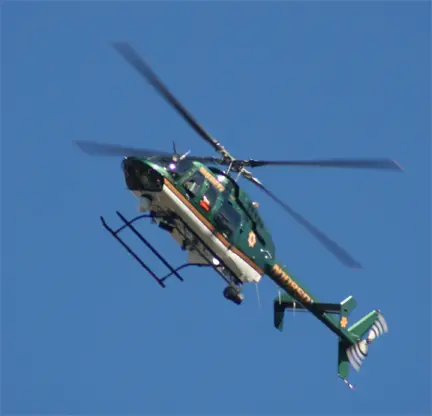
The Sonoma County Sheriff's Office's Henry 1 helicopter assisted with the search from the air for a few hours during the middle of the morning while local sheriff's investigators and deputies combed the area for the men. Area schools also kept children on campuses longer in order to keep them safe while the search went on.
Burk was arrested shortly after 2 p.m. not long after deputies spotted him on foot in the Greenridge area and stopped him for questioning. He attempted to flee behind some nearby residences and was arrested following a house-to-house search, said Bauman.
At about 4:30 p.m. Bauman told Lake County News that the sheriff's office was suspending the search for the second suspect, who hadn't yet been identified.
However, as sheriff's personnel were leaving leave Hidden Valley Lake, Hidden Valley Security was reporting receiving calls about a shirtless male with buzz cut hair running down Foothill Road just after 4 p.m., according to reports at the scene.
Deputies returned to Hidden Valley Lake, where a California Highway Patrol officer had detained Brown at Highway 29 and Arabian Lane.
One of the victims of the morning assault was brought to the scene, where she identified Brown as one of the men who had broken into her home earlier that morning.
Burk, who has addresses in both Clearlake Oaks and Santa Rosa, is listed as a cement mason on his booking sheet, which was posted late Thursday. Bauman confirmed that Burk had previous contact with local law enforcement but did not give specifics.
He is facing a battery of felony charges, including attempted murder, attempted robbery, assault with a deadly weapon (that is not a firearm) on a peace officer, assault with a firearm, another charge of assault with a deadly weapon that is not a firearm and first degree burglary. Bail is set at $575,000.
Brown, a carpenter, is charged with four felony counts – attempted murder, attempted robbery, assault with a deadly weapon that's not a firearm and first-degree burglary, with bail set at $535,000.
Both Burk and Brown are scheduled to appear in court on Nov. 17, according to their booking sheets.
Harold LaBonte and Aimee Gonsalves contributed to this report.
E-mail Elizabeth Larson at
{mos_sb_discuss:2}
Charles William Burk, 30, was arrested in Hidden Valley Lake just after 2 p.m. Thursday after he attempted to flee from deputies who had stopped him for questioning, reported Capt. James Bauman of the Lake County Sheriff's Office.
Burk, who has addresses in both Santa Rosa and Clearlake Oaks, is believed to have been one of two men who broke into a Noble Ranch Road home shortly before 7:30 a.m., where they allegedly assaulted two occupants of the home, according to Bauman.
Burk and his accomplice, who remains at large and who has not been identified, then fled in a white pickup which collided with a sheriff's patrol car, Bauman said. The two suspects then abandoned their vehicle on Spruce Grove Road South and fled on foot into Hidden Valley Lake.
Much of the day's search, according to Hidden Valley Lake and sheriff's officials, had focused on the Greenridge and Stonegate sections of the community.
Burk was located, said Bauman, while deputies were in the process of clearing some houses in the Greenridge area.
Bauman said two deputies began to question Burk, who took off on foot behind some nearby residences.
“They conducted a house-to-house search,” said Bauman.
Burk was found under an exterior deck of a home on Coyle Springs Road and arrested, Bauman said.
The sheriff's office has had some previous contact with Burk, but Bauman did not specify what those contacts may have been about.
Bauman said the sheriff's office was preparing to issue another Citywatch phone alert to community residents to let them know of Burk's capture.
There is currently not an active search under way for the second man, whom Burk has so far not provided information about, according to Bauman.
The Hidden Valley Lake community has been on alert since two residents of Park Point Court were robbed at gunpoint in their home on the night of Oct. 28, as Lake County News has reported.
The suspect in that robbery, a white male adult wearing a ski mask and dressed from head to toe in black, remains at large.
Is that robbery connected to the break-in and assault Thursday morning?
“We have no reason to believe that they are,” Bauman said.
E-mail Elizabeth Larson at
{mos_sb_discuss:2}