How to resolve AdBlock issue?
News
In January, Thompson told Lake County News he was endorsing Clinton's historic presidential bid, citing her strength on issues important to the First Congressional District, such as agriculture and the environment.
However, he had said at the time that he felt either Clinton or Obama would make “a great president.”
A statement issued from Thompson's Washington, D.C. office Saturday afternoon said the congressman was giving his support to the presumptive Democratic nominee.
“Sen. Obama’s nomination is an historic achievement for our country,” Thompson said in the written statement. “As I said from the beginning, this process would be finished long before the convention. I will do everything in my power to help make him our nation’s next president.”
Thompson called Obama “an electrifying candidate who ran a flawless campaign.”
“He has struck a vibrant chord with the American people and motivated millions of new voters to make their voices heard,” Thompson said. “From improving access to health care to protecting our environment to rebuilding our economy to ending the war in Iraq, I strongly support Senator Obama’s vision for America and believe it is directly aligned with the needs of our Congressional District.”
Thompson has had occasion to work with Obama; the two of them partnered to present legislation in both the House and Senate last year to bring home US troops from Iraq and institute an international diplomatic strategy for peace, as Lake County News reported last year.
“I look forward to working on many more important initiatives once he’s elected president of the United States,” Thompson said.
Thompson praised Clinton, who he called “a powerful leader who also energizes and inspires voters.”
He added, “I know she’ll continue her tireless efforts and help us elect Sen. Obama, change the direction of our nation, end the war, and restore our standing around the world.”
Thompson is one of more than 60 superdelegates representing California, about half of which had declared their support for Clinton this spring.
E-mail Elizabeth Larson at
{mos_sb_discuss:3{
Marinara started out being the most confusing sauce. There are so many versions, all with different lists of ingredients, which made it hard for me to figure out what made marinara, well, marinara.
After a bit of studying I found that, literally translated, a marinara is a tomato-based sauce that contains seafood, sometimes clams but more typically anchovies. The “Mari” in Marinara means marine, but its history can be traced to a light sauce created by fisherman that could be made on board a boat quickly, since the availability of wood at sea was scarce and fires on a ship were hazardous so the fisherman would want them burning long.
Characteristically, in addition to the anchovies, a marinara also contains tomatoes, onions, garlic, olive oil and spices. It’s only in America that we have distorted marinara into a nondescript, one-size-fits-all spaghetti sauce.
Ragu essentially means “Italian meat sauce,” so almost all spaghetti sauces in America are ragus. Tucco is the Tuscan name for a ragu, and Sugo, loosely translated to “sauce” or “juice”, is typically called a “light” tomato sauce with onions, garlic, and basil.
The problem with finding the true name of Italian sauces is that every Italian immigrant family called sauces something different, depending on the region they came from or just their own family influences.
It’s like asking an American, “What are the ingredients in barbecue?” Texans will start with “Beef with a tomato-based sauce,” while North Carolinians will begin with, “Pork and a vinegar-based sauce.”
Kansas City residents will just confuse the issue more. So many recipes may say “Ragu ala Bolognese,” but “Sugo ala Bolognese” or “Salsa ala Bolognese” would still be correct.
A Bolognese sauce originates from the landlocked Bologne (pronounced bo-LOHN) region of Italy which is not far from Parma (where the cheese Parmesan comes from). Their recipes favor beef or veal as the meat in their ragu, with the inclusion of tomatoes and wine. So a meat sauce from this area would be called “Ragu ala bolognese” (Rah-GOO AH-la bo-lohn-AYHS).
Naples is a seaside city of Italy, and they are credited for being the first Italians to actually eat and cook with tomatoes. Originally in Europe, tomatoes were grown only for ornamental value and as a curiosity, since they are related to the deadly nightshade plant and they were considered poisonous. A famine in the seventeenth century was enough to push people over the edge and attempt to eat the deadly tomato. That was the birth of the tomato into Italian cuisine.
The people of Naples tend to prefer pear-shaped tomato varieties because they are sweeter and less acidic. “Neapolitan gravy” is a basic tomato sauce from Naples that they use as a base to build on. They tend to favor pork in their ragus. On the other hand, brains, chicken, duck, duck liver, kidneys, sweetbreads (culinary code for “thyroid glands”), and rabbit can all found in various sauces throughout Italy.
Pasta ala Puttanesca is a dish with an intense tomato sauce that allegedly originated with the prostitutes of Naples. The name translates to “Harlots’ pasta” or “Pasta in the style of whores.” Wow! Who thought a food column could turn so blue? Many stories claim the origin of the sauce but the two most believable go like this ...
Brothels were called “closed houses” because by law the shutters were required to stay closed at all times to keep from offending the neighbors but the strong smell of the sauce was the lure for customers to enter their establishment. Now I may not be Italian but luring a potential customer with tomato sauce and feeding him pasta doesn’t sound like a brothel priority so the story that I find more believable is ...
At the end of the evening as the restaurants were shutting down, local streetwalkers would go begging for any leftovers before the restaurant was locked up for the night. The restaurant owners would throw any remaining tomato sauce, olives, capers, anchovies and hot peppers (the five classic ingredients that signify it as a puttanesca sauce) into a pot, pour it over some pasta and serve it to the unfortunate girls before going home. That story sounds a little more plausible to me. (My wife just told me that she, understanding Italian men better than I do, thinks the first version is more likely. “The way to a man’s heart, or wallet, is through his stomach.” OK, we agree to disagree.)
Arrabbiata sauce is traditionally served over penne pasta but spaghetti is sometimes also used “All’arrabbiata” translates to “angry style” since it is a very piquant and spicy sauce. The unique thing about Arrabbiata is that it is classically NOT served with meat in it.
Vodka sauce is also reserved for penne pasta and short cut pastas. A number of stories have it being created in 1970s Bologne, but some say it was invented by Frank Sinatra. What we do know is that it first appeared publicly during the 1980s and is considered part of nuova cucina, or Italian “New cuisine.”
It usually contains vodka, tomatoes, heavy cream, onions, garlic, prosciutto or ham, olives and parmesan cheese. Some early recipes contained rice, caviar, sour cream and strawberries. The meat preferred with this sauce is most frequently salmon.
Why make a sauce with vodka? Many ingredients, including tomatoes, contain flavor compounds that can only be released in the presence of alcohol. Vodka, being a “flavorless and colorless” alcohol, won’t clash with cream like wine in a sauce would.
Finally, sauce “All’Amatriciana,” or “Lovers sauce,” originates in the town of Amatrice, an agricultural area near Rome. The people from the area are so well renowned as good cooks that the Vatican prefers their cooks to come from Amatrice. With a name like Lovers Sauce, everybody wants to claim the recipe for their own, which makes the ingredients list difficult to nail down.
The known origins are that the sauce was adapted from a recipe made by shepherds, was first called La Gricia, and is always based on pork. The common components are tomatoes, guanciale (salt cured pork cheek, but pancetta is a frequent substitute), and chili peppers. Cooks in Rome include onions, but cooks in Amatrice don’t. Amatrice serves it on bucatini (spaghetti with a hole down the middle), while Rome uses rigatoni.
Now this brings me back to the sauce I am trying to create for my wife. How do I classify it? It doesn’t include anchovies so technically it’s not a marinara; no pork so it's not “All Amatriciana”; no capers or olives, so it’s not a Puttanesca; no vodka, but a hint of sour and spicy so maybe its an Arrabbiata ... That would make sense, she’s frequently angry at me! But it has meat in it so ... aw crud, this is going to take a while... Well anyway, here is the sauce recipe I created for my wife.
Salsa Arriabbiata della moglie (angry wife sauce)
Since my wife loves lavender, I wanted to create a sauce for her based around Herbs de Provence (an herb mixture that includes lavender). Sure, using fresh tomatoes and herbs is great, but for this sauce I wanted something that could be created in no time with items straight from the pantry. It can be made with your favorite ground meat (beef, pork, Italian sausage, or turkey), or the meat can be left out for a hearty vegan sauce.
1 28 oz. can of whole tomatoes
1 6 oz. can of tomato paste
1 large onion diced
2 cloves garlic
1 teaspoon Herbs de Provence
½ cup white wine
½ cup olive oil
1/8 cup sugar
1 tablespoon balsamic vinegar
Pinch red pepper flakes
Dash nutmeg
Blend everything except onions in a blender until smooth. Pour mixture into a saucepan and bring to a boil, then reduce to a simmer. Meanwhile, sauté the onions in oil until browned. Stir caramelized onions into sauce and leave on the heat for at least half an hour until sauce reduces and thickens slightly. Add browned, cooked meat at this point if desired and serve over pasta of your choice.
Ross A. Christensen is an award-winning gardener and gourmet cook. He is the author of "Sushi A to Z, The Ultimate Guide" and is currently working on a new book. He has been a public speaker for many years and enjoys being involved in the community.
{mos_sb_discuss:2}
EcoArts: Lake County Sculpture Walk, is a five-month exhibit of sculptures at the 107-acre Middletown Trailside Nature Preserve County Park, 21435 Dry Creek Cutoff/Hwy 175, in Middletown.
Works of art by local, Bay Area, and national artists, who have given their time and material to create a public art installation, will be on display from June through October.
The park is open from dawn to dusk every day and admission is free. EcoArts of Lake County also offers free docent-guided tours of the art installation to schools and youth organizations by reservation.
EcoArts of Lake County is a nonprofit organization dedicated to promoting visual art, visual art education, and ecologic stewardship to the public and visitors of Lake County.
Karen Turcotte, executive director of EcoArts of Lake County said that since the program's inception in 2003, the exhibit has developed a reputation among curators, sculptors and art lovers throughout Lake County and the Bay Area as an impressive cultural event.
Nationally renowned fiber artist Sheila O'Hara is participating in the program this year. According to Turcotte, O'Hara and her students have created a work that is both beautiful and poignant. Lake County educational groups and schools participating this year include Middletown High School, Coyote Valley Elementary, and Redwood Children's Services.
The central trail at Middletown Trailside Nature Preserve County Park has been designated for EcoArts: Lake County Sculpture Walk. This trail is approximately 3/8th mile long and meanders to a picnic area with large oaks shading half a dozen tables. Temperatures can be quite warm in the summer, so visitors are advised to dress accordingly and pack water as no water is available at the preserve. Tall, comfortable walking shoes are recommended.
For visitor information, contact the Lake County Visitor Information Center at (800) 525-3743 or www.lakecounty.com.
{mos_sb_discuss:2}
Heather Valdez, 17, died Thursday afternoon after she was stabbed near her home in the area of Austin Drive near Mullen Avenue in Clearlake.
A short time later, Clearlake Police arrested 18-year-old Gabrielle Rachel Varney, who is being held in the Lake County Jail on a murder charge.
Both girls were juniors, completing their first year at Carlé High School in Lower Lake, a model continuation school which Principal Bill MacDougall called “a place of absolute peace.”
But that peace was shattered by Valdez's death Thursday.
“There's apparently been some type of feud between them for a couple of months,” said Lt. Mike Hermann of the Clearlake Police Department said of Valdez and Varney.
Both of the teens lived in the area where the incident is alleged to have taken place, said Hermann.
Hermann said Valdez and Varney got into an altercation. Varney allegedly had a knife on her and she pulled it out during the fight. She allegedly admitted to police that she stabbed Valdez.
People in the area saw bits and pieces of the incident, said Hermann. He said no one so far has claimed to have seen Valdez being stabbed, but they saw the fight and then saw her bleeding.
More students were interviewed Friday, and Hermann estimated the investigation shouldn't take long to complete.
Konocti Unified School District Superintendent Dr. Louise Nan said a four-member district grief crisis response team was deployed on Friday morning to work with students.
“We're working through the day,” said Nan, who added that it will be “quite a process” ahead for students and staff.
MacDougall, who next month will succeed Nan as the district's superintendent, said, “This is a tragedy not only for Carlé, our school district and our community, but it's absolutely devastated two families.”
Valdez and Varney had been friends, he said. “They were girlfriends, so there was that young girl tension that came on and off, but there was nothing that was way out of the ordinary that we could see.”
He added, “If there was anything physical, I never saw it.”
Students, however, have been bringing up incidents that they say took place between the girls as they open up to teachers and peers, he said.
MacDougall said many of his 10 staffers were on their way home when they got the news Thursday afternoon. The stabbing, according to police, took place just after 2 p.m.
All of the teachers came back to the school, where they assembled in MacDougall's office. He said at 6 p.m. he put out an automated call to notify students and their families of the tragedy. The staff remained together until about 7 p.m.
He said the first focus was to stop the rumors and get out the truth to students; the next step was to facilitate healing.
The school's annual field day had been planned for Friday, but that was canceled, MacDougall said.
Instead, when students arrived for school, they filled the school's central quad area with rose petals from the school rose bushes, and the 80 students, 10 staffers and the school's custodian came together – as a family – in a big circle, instinctively holding hands, to begin the healing process, MacDougall.
They shared stories of Valdez, who was a talented artist, said MacDougall.
Varney also is a good artist, and a member of the school's cadre of designers, said MacDougall.
They then shared a prayer by St. Francis of Assisi – which includes the words, “Make me an instrument of your peace; where there is hatred, let me sow love, where there is injury, pardon ...”
The school then moved into the rest of its day, said MacDougall, with the school psychologist taking some of the teens to the county park, and other students doing “the usual Carlé thing” – playing music and moving about their activities, but the air was much more somber.
MacDougall had to go to district negotiations, and when he came back after lunch, he could see the students had begun the process of healing and working through their understanding of what happened. But they still must move through the long grieving process.
The tragedy comes less than a week before Carlé High's graduation is scheduled to take place. MacDougall said commencement ceremonies will be held as scheduled beginning at 6 p.m. Wednesday, June 11.
As a community, the imperative is to bring happiness into the lives of its children, he explained.
The sense from the Carlé community, he added, is that “we have to make sure this never happens again.”
E-mail Elizabeth Larson at
{mos_sb_discuss:2}
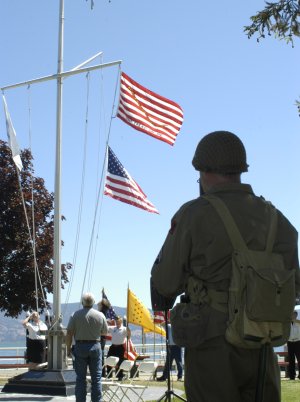
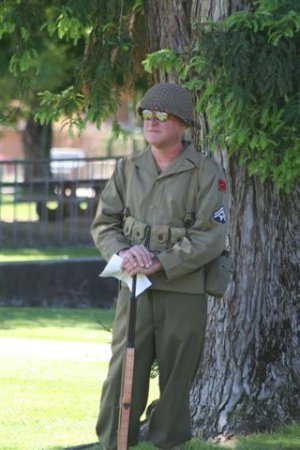
LAKEPORT – Cutting an imposing figure in his World War II-era Army uniform, Lakeport resident Bob Bartley was more than 5,000 miles and 64 years away from the beaches at Normandy, but looking at him gave a sense of what it might have been like on that frightening morning decades ago.
Bartley was at the Pearl Harbor Survivors Association's memorial mast in Library Park on Friday morning to pay respect to the soldiers who took part in the D-Day invasion.
Beginning on June 6, 1944, the invasion saw an estimated 160,000 Allied soldiers fight to gain a foothold in a Europe overwhelmed by Hitler's forces.
Bartley's green wool uniform included an ammunition belt and haversack which was many pounds short of the supply-laden, 90-pound packs US soldiers carried on their backs as they scrambled onto Omaha Beach.
The military's amphibious vehicles landed too far out in some cases, so men jumping into the sea found themselves up to their necks – or over their heads – with the packs on their backs and bullets whizzing by.
Many men drowned struggling under their packs. Accounts by survivors recount soldiers having to swim through corpses to get to land.
Bartley was a poignant figure in the short morning ceremony, meant to honor that day and what would turn out to be a masterstroke in the war – against overwhelming odds, mercurial weather and two months after hundreds of men died in Exercise Tiger, a practice run for the invasion carried out off the south coast of England near Slapton Sands.
“We're not here to celebrate it, we're here to commemorate it,” Ronnie Bogner, the master of ceremonies, explained of the D-Day anniversary event, held each year overlooking Clear Lake.
Pastor Mike Suski of Lakeport Christian Center led a prayer to bless the gathering. A native of Poland, the day had special meaning for Suski, who told the crowd that he was born in “Old Europe.”
During the ceremony, Bogner said that US casualties were highest among the US troops who landed at Normandy, because of Omaha and Utah beaches' treacherous conditions.
The American Legion, Veterans of Foreign Wars and Vietnam Veterans of America were on hand, and the colors of the US military branches were on display, as was the POW/MIA flag. On the memorial mast flew the “First Jack” (often called the “snake flag,” said Bogner, for its portrait of a snake and the words, “Don't tread on me”), the US flag and the Pearl Harbor Survivors Association flag.

Special guests seated in the audience's front row included Jim Harris of Lucerne, who was at Pearl Harbor and then D-Day three years later, aboard the destroyer USS McCook (DD 496), which helped destroy German positions used for firing on the soldiers landing on the beach. He was joined by fellow Pearl Harbor Survivor Walt Urmann, who served aboard the USS Blue; and Alice Darrow, widow of Dean Darrow, who was at Pearl Harbor aboard the USS West Virginia.
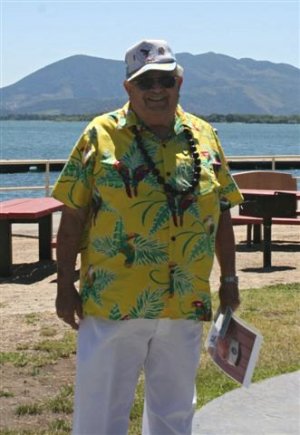
California Highway Patrol Commander Dane Hayward once again attended the ceremony, bringing with him several CHP officers, and Lakeport Police Chief Kevin Burke attended in full uniform.
Newly re-elected District 5 Supervisor Rob Brown was the guest speaker. Brown said he was born 16 years after the invasion, but was fortunate to be raised in Lake County, where veterans are valued.
He said he hopes future generations will learn to value their veterans.
Brown pointed to differences in the media coverage of World War II and the current war in Iraq. He quoted a World War II-era headline that asked, “Why doesn't Hitler quit?” Brown contrasted that with sentiment in today's media, which he said asks instead why the US doesn't quit.
“It's dependent on us to continue to support our troops,” Brown said.
He recognized efforts like Operation Tango Mike, founded by Ginny Craven – who was in attendance – for working to keep up soldiers' morale.
A bugler from the United Veterans Council's Military Funeral Honors Team played “Taps” as the US flag was lowered to half-staff for the remainder of the day in remembrance of the invasion.
E-mail Elizabeth Larson at
{mos_sb_discuss:2}
Renato Hughes, 23, will go on trial beginning Wednesday, June 11, in Martinez, District Attorney Jon Hopkins reported.
Jury selection wrapped up Friday, said Hopkins.
The minute the jury was selected, a young woman raised her hand and asked to be excused because a medical condition she has was being exacerbated by the proceedings, said Hopkins.
The judge granted the request, said Hopkins, which required he and defense attorney Stuart Hanlon to choose a new juror from among four alternates.
Opening statements are scheduled to begin Wednesday morning, said Hopkins.
He anticipates the trial wrapping up in the latter part of July.
Hughes is being tried for the murders of his two friends, Christian Foster and Rashad Williams, who were shot to death after allegedly breaking into Shannon Edmonds' Clearlake Park home on the morning of Dec. 7, 2005.
The case against Hughes alleges he and his two companions beat Edmonds, his girlfriend and her son severely as they tried to steal marijuana Edmonds claimed to have a medical prescription to use.
Edmonds reportedly shot Foster and Williams as they ran from the home, but Hughes is being tried for their deaths under the provocative act legal theory because he allegedly took part in a crime that could result in a lethal response – the shooting of his two companions.
The jury seated Friday actually is the second jury to be selected in the Hughes case.
Last Nov. 15, after a three-week jury selection in Lake County was completed and the jury seated, Judge William McKinstry, a retired Alameda County judge assigned to the case, granted Hanlon's change of venue motion. In his decision McKinstry cited the number of jurors excused for various reasons.
In January, Lake County Superior Court Judge Arthur Mann ruled the trial would move to Contra Costa after Hanlon and Hopkins mutually agreed to the venue.
E-mail Elizabeth Larson at
{mos_sb_discuss:2}