How to resolve AdBlock issue?
News
THIS STORY HAS BEEN UPDATED WITH A COMPANY RESPONSE.
CLEARLAKE OAKS – A Lower Lake woman is facing felony charges for allegedly stealing thousands of dollars from her employer.
Michelle Lynn Davis, 23, was arrested Jan. 2 by Lake County Sheriff's Detective Corey Paulich, according to jail records.
Chief Deputy District Attorney Richard Hinchcliff said a felony warrant was issued for Davis, who then turned herself in.
“She's been charged with embezzlement and with a special allegation that the amount embezzled was over $150,000,” Hinchcliff said.
Sheriff's spokesman Lt. Cecil Brown said Davis is accused of taking the money from her employer, Shannon Ranches of Clearlake Oaks.
Brown said Davis had been with Shannon Ranches, a vineyard management consulting business, for five years. The occupation listed on her booking sheet is bookkeeper.
The investigation was triggered, said Brown, when the company noticed suspicious uses of business checks and a credit card.
Hinchcliff said he couldn't discuss the specifics of the case, which is so new that it has yet to be assigned to a deputy district attorney. Davis also has not yet appeared in court for arraignment, he added.
Davis' case constitutes one of the larger embezzlement prosecutions the District Attorney's Office has dealt with recently, said Hinchcliff.
If convicted, Davis could face up to five years in prison, Hinchcliff said.
Shannon Ranches, owned by Clay and Margarita Shannon, was a precursor to the couple's Shannon Ridge Vineyards and Winery, which has won both praise and awards for its wines, produced from winegrapes grown in Clearlake Oaks.
The Shannons also have become known for their generosity to community causes. They have assisted in Clearlake Oaks improvement projects, and last month volunteered one of their trucks to transport flooring materials from Southern California to the Clearlake Skate Park so the park can be repaired and reopened.
E-mail Elizabeth Larson at
{mos_sb_discuss:2}

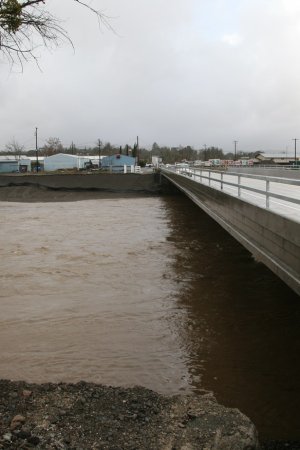
LAKE COUNTY – The worst weather predictions came true Friday, as high winds and heavy rains battered the county, with downed power lines and flooding closing roadways.
And, while in some areas waters were starting to recede and rainfall was lessening, the National Weather Service issued a blizzard warning for northern Lake County – which includes the Lake Pillsbury area – through 4 a.m. Saturday.
Weather Underground reported Friday that between Thursday and Friday morning Cobb had received 8.3 inches of rain, with just under 4 inches falling in Lower Lake, 1.92 inches in Lakeport and about six-tenths of an inch in Clearlake Oaks.
The US Geological Survey's stream gauges showed Kelsey, Cache and Putah creeks running so high they were almost off the charts.
Clear Lake also has begun to rise, according to the survey's measurements. The lake water along the Northshore Friday had turned brown due to runoff.
Wind gusts of as high as 40 miles per hours were expected in areas of the county, according to Weather Underground.
High winds and wet weather contributed to fallen power lines and trees around the county, said Lake County Roads Superintendent Steve Stangland.
Downed power lines, in turn, resulted in power outages.
Thousands of customers around the North Coast were out of power Friday, said Pacific Gas and Electric spokesperson Jana Schuering.
Shortly before 12:30 p.m. Schuering said 55,000 customers remained out of power, through 509 separate outages, in the North Coast region, which includes Lake, Sonoma and Mendocino counties.
The outages were so numerous that Schuering said she was unable to separate out just which ones were in Lake County.
In Clearlake, that city's Public Works Department reported all streets were open Friday afternoon.
The City of Lakeport's Public Works Department reported one street closure – on North Street, between Ninth and 10th – Friday afternoon, due to water. Water that had partially covered some city streets, including some close to downtown, had receded by afternoon.
County Public Works, which includes the Roads Department, is issuing county road updates every half hour because of fast-changing conditions, said Stangland. The updates can be found at the county's Web site, www.co.lake.ca.us.
“We're opening roads almost just as fast as they've been getting closed,” said Stangland.
Water had covered Lakeshore Boulevard at Lyons Creek near Lakeport, Witter Springs Road near Upper Lake and the new bridge on Perini Road at Siegler Canyon Road near Lower Lake, but Stangland said the roadways reopened once the water receded.
Road crews were working around the clock to keep on top of the situation, said Stangland. “It's going to be a continuous thing.”
In some cases where roads remained closed due to downed power lines, it was because road crews were waiting for PG&E to respond. “We won't even touch the tree if it has lines in it,”he said.
Crews hadn't had to help respond so far to accidents, Stangland said.
The California Highway Patrol reported numerous road hazards in Lake and Mendocino counties Friday, many appearing to be weather-related.
Caltrans had no road or lane closures in Lake County on Friday afternoon, said Caltrans District 1 spokesman, Phil Frisbie Jr.
“Currently, there's a lot going on in Mendocino County,” said Frisbie. “Lake County looks pretty calm right now, relatively.”
E-mail Elizabeth Larson at

{mos_sb_discuss:2}
Lake County Superior Court Judge Arthur Mann concluded that Timothy Poindexter of Kelseyville couldn't be held to answer for the case based on the evidence against him, according to statements from the District Attorney's Office and Poindexter's defense team.
“Obviously, we're very happy,” said Judy Conard, one of Poindexter's attorneys in the case.
Poindexter's lead attorney, Jamie Thistlethwaite of Santa Rosa, couldn't be reached late Thursday for comment.
The ruling followed a preliminary hearing that stretched across several days, said Deputy District Attorney Joyce Campbell.
The District Attorney's Office charged Poindexter, 48, last June, alleging that between October 2004 and June 2007 he had taken advantage of an elderly Finley couple during a real estate transaction.
Poindexter pleaded not guilty to the charges in a June 8, 2007 court appearance, as Lake County News has reported.
“The primary question was whether or not the defendant had tricked the elderly victim out of some farming equipment by saying it went along with real estate that was sold,” said Campbell.
Poindexter purchased an 18.7-acre property with a pear orchard on Finley Road East from the couple, paying $300,000, according to court documents obtained by Lake County News. Escrow on the property closed in 2005.
No Realtor was involved in the sale, according to the investigation, with Poindexter taking care of the paperwork.
Campbell said Thursday that a paragraph of the real estate contract added farm equipment valued at more than $25,000 that the couple said they had not originally agreed to include in the property sale.
The older man who sold Poindexter the property was adamant that he had not filled in the portion of the contract for the farm equipment, said Campbell. She added that the disputed paragraph had a handwritten alteration, which only was initialed by Poindexter and not the elderly seller.
In addition, the escrow officer testified in court that it was clear to her that the equipment was not included, Campbell said.
The case also had alleged that Poindexter had gained the older man's trust by visiting his home while in uniform, and while driving his CHP patrol car. “The elderly victim was indeed very impressed with him and there developed a relationship of trust,” said Campbell.
The investigative documents revealed that the men had gotten along at first, with Poindexter agreeing to allow the couple to store some of their belongings and equipment there. However, the older man alleged that his access to his belongings was blocked by Poindexter, who stacked his own property around those items.
Later, the men engaged attorneys who exchanged numerous letters either demanding the elderly couples' access to their belongings or that the couple refrain from returning to Poindexter's property.
Conard said Mann, who took an hour to finalize his ruling following the end of testimony in the hearing, provided a “very thorough” decision on the matter.
“Mr. Poindexter had a reasonable belief that the property in question does in fact belong to him,” she said, and it was a point with which she said Mann agreed.
What should be stressed, Conard added, is that Poindexter did not abuse his power in any way. “He has a claim to title.”
The case was a complex one, said Campbell, with many critical aspects to it.
She said that the elderly male victim – now in his 90s, and a World War II veteran – was “rock solid” as a witness, but on the stand he was forgetful of some details, which she suggested influenced the case's outcome.
Issues of memory and forgetfulness make elder financial abuse cases especially difficult to handle, said Campbell, who is retired but works on a part-time basis with the District Attorney's Office on cases involving seniors.
Keeping that in mind, Campbell said prosecutors work hard to make sure they can corroborate all the evidence in elder abuse cases. They thought they had done so in this case as well, she added.
Conard stated that the case ultimately should have been taken up in civil – not criminal – proceedings.
The case's turn in criminal court isn't entirely over, however.
“It is a felony so our office does have the option to refile if we feel it's the right thing to do,” said Campbell.
She added that the District Attorney's Office has not yet made a decision on whether it will pursue the case further.
Meanwhile, Poindexter's future in the CHP is still not clear.
After he was charged, the CHP placed Poindexter, a 26-year CHP veteran, on administrative leave, the CHP reported.
That's where Poindexter remains today, Fran Clader, a spokesperson for CHP's Sacramento headquarters, said Thursday. “His current status is, he's on administrative time off.”
Clader said Poindexter will remain on administrative leave “pending the completion of an internal investigation” by CHP.
She could not comment on whether Poindexter was seeking reinstatement.
Clader added that, because of the Peace Officer Bill of Rights, the CHP can't share the eventual outcome of that internal investigation.
E-mail Elizabeth Larson at
{mos_sb_discuss:2}
The state Department of Water Resources held the first of five manual snow surveys for the 2007-08 winter season on Thursday near Echo Summit off Highway 50, on the way to Lake Tahoe.
Thursday's readings showed the statewide snowpack averaging 60 percent of normal, only one percentage point above this time last year, according to Water Resources.
Electronic sensor readings show Northern Sierra snow water equivalents at 64 percent of normal for this date, Central Sierra at 53 percent and Southern Sierra at 69 percent, Water Resources reported. That's compared with 68 percent, 55 percent and 52 percent, respectively, compared to the first survey in January 2007.
Water Resources hydrologists use the readings to forecast the state's water supply in the coming year.
Although the readings show the season isn't off to a great start, Water Resources officials cautioned that it's still early, and pointed to rain, snow and wind that started arriving Thursday.
Forecasters called for the Central Valley to receive several inches of rain, while at least 5 feet of snow is expected in high Sierra elevations.
In Lake County, Thursday's rains gave area creeks a charge, with the US Geological Survey's stream gauges showing dramatic upsurges in water levels.
Arthur Hinojosa, chief of Water Resources' Hydrology Branch, said in a Thursday statement that Sierra snow levels are expected to begin at 6,000 feet and drop to below 4,000 feet through the weekend with another weaker system forecast across Northern California early next week.
“The pending storms should provide the state with a much needed helping of snow,” said Hinojosa. “We hope to get close to the January average precipitation for the Northern Sierra over the next week.”
Officials said the surveys are particularly significant this year because last year’s snowpack yielded only 30 percent of the normal water content.
Reservoirs are low, as well, with Lake Oroville holding only 35 percent of its 3.5 million acre foot capacity, 55 percent of average for this time of year, according to Water Resources.
Because less-than-normal water supply conditions exist, the initial State Water Project allocation for 2008 was placed at 25 percent of water contractors’ requested amounts, Water Resources reported.
Snowpack monitoring is coordinated by the Department of Water Resources as part of the multi-agency California Cooperative Snow Surveys Program.
Surveyors from more than 50 agencies and utilities visit hundreds of snow measurement courses in California’s mountains each month to gauge the amount of water in the snowpack.
The next survey will take place in early February, Water Resources reported.
E-mail Elizabeth Larson at
{mos_sb_discuss:2}
The California Highway Patrol reported that a single vehicle collision was reported at 2:50 p.m. on Highway 29, one mile south of Twin Pine Casino in Middletown.
The vehicle was 15 feet over the roadside, with three people trapped inside, the CHP's incident logs reported.
Cal Fire and CHP responded, with “extensive extrication” needed to get the people out of the car. Highway 29 also was reportedly closed for a time – reopening shortly before 5 p.m. -- while the crash victims were removed.
CHP Officer Adam Garcia, spokesman for the Clear Lake CHP Office, said late Thursday afternoon that he had no information on the people who were involved.
E-mail Elizabeth Larson at
{mos_sb_discuss:2}
California Attorney General Edmund G. Brown Jr. sued the United States Environmental Protection Agency (EPA) on behalf of the State of California Wednesday, saying the EPA was “wrongfully and illegally” blocking the state's landmark tailpipe greenhouse gas emissions standards.
Brown's lawsuit, filed in the U.S. Court of Appeals for the 9th Circuit, challenges the EPA's refusal to allow the state to implement its emissions law, which Brown's office reported requires that motor vehicle greenhouse gas emissions be reduced by 30 percent by 2016.
Fifteen other states or agencies have pledged to join the suit as intervenors, according to the Attorney General's Office.
Brown's office reported that cars generate 20 percent of all human-made carbon dioxide emissions in the United States, and at least 30 percent of such emissions in California.
To go into effect, California's new emissions standard required a waiver from the EPA, which the agency's administrator, Stephen Johnson, refused to grant.
In a letter to Gov. Arnold Schwarzenegger dated Dec. 19, 2007, Johnson denied California's request for the waiver.
That same day, Johnson's office released a statement in which he said new federal energy legislation would set mileage standards.
"The Bush Administration is moving forward with a clear national solution – not a confusing patchwork of state rules – to reduce America’s climate footprint from vehicles," Johnson said. "President Bush and Congress have set the bar high, and, when fully implemented, our federal fuel economy standard will achieve significant benefits by applying to all 50 states.”
Johnson's Dec. 19 statement also noted that EPA “has determined that a unified federal standard of 35 miles per gallon will deliver significant reductions in greenhouse gas emissions from cars and trucks in all 50 states, which would be more effective than a partial state-by-state approach of 33.8 miles per gallon.”
EPA reported that it held two hearings on California's waiver request and reviewed more than 100,000 written comments and thousands of pages of technical and scientific documentation received during the public comment period, which lasted from April 30 to June 15.
The agency's conclusion: Because greenhouse gases are fundamentally global in nature, EPA did not conclude that California's request met the Clean Air Act's criteria of meeting “compelling and extraordinary conditions.”
Brown shot back that the EPA's finding reversed decades of agency practice and ignored the dangerous consequences of global warming to California – including a severely reduced snowpack.
Brown also said Johnson's letter was “shocking in its incoherence and utter failure to provide legal justification for the administrator's unprecedented action.”
He added that under 1963's federal Clean Air Act, California is “expressly allowed” to impose environmental regulations that are more strict that required by the federal government because of the state's “compelling and extraordinary conditions” – which include unique topography, climate, and high number and concentration of vehicles.
The Clean Air Act also empowers the state to challenge the decision, said Brown.
Until the Dec. 19 decision, Brown reported that EPA had never turned down a request from California for a waiver, granting approximately 50 over the last 40 years for catalytic converters to leaded gasoline regulations.
Brown added that the National Academy of Sciences has reviewed the waiver system and strongly supports maintaining California's role as “a proving ground for new-emission control technologies that benefit California and the rest of the nation.”
According to Brown, 15 other states or state agencies — Massachusetts, Arizona, Connecticut, Delaware, Illinois, Maine, Maryland, New Jersey, New Mexico, New York, Oregon, Pennsylvania Department of Environmental Protection, Rhode Island, Vermont, and Washington — are joining Wednesday's lawsuit as intervenors.
California's auto emission rules have survived previous challenges.
In December, Brown's office reported that the U.S. District Court in Fresno rejected the auto industry's challenge to California's law, concluding that both California and the EPA are equally empowered to limit greenhouse gas emissions from motor vehicles
A similar effort to overthrow the law also had failed in September, according to Brown's office, when a federal court judge in Vermont ruled against an automobile industry group trying to block the state from implementing the emissions standards.
What the standards mean for Lake County
Bob Reynolds, who heads Lake County's Air Quality Management District, said that any air quality rules the state enacts are likely to fall on the district in some fashion or another.
He said many people believe the district is a county department, but it isn't. Rather, it's a state-created, regional agency which regulates stationary pollution sources – such as business and industry – and open burning, and must enforce regulations and laws imposed by the federal, state and local governments.
The emission standard, said Reynolds, “will affect us and, at the same time, it needs to affect us.”
“Global warming is very real,” he said, adding that enough scientists have signed onto the idea that the argument about its validity should be over.
The state hasn't gone into detail about how the standard will be rolled out, but Reynolds said he believes its most direct impacts on Lake County will be in the form of the fuels and new vehicles that residents will have available to them in the future.
Carbon dioxide, said Reynolds, is California's main focus when it comes to greenhouse gases. The new standard, he added, would require that new cards have reduced carbon dioxide emission, and Brown's lawsuit boils down to whether or not California can write its own carbon dioxide rules.
Air quality in California has special challenges, which Reynolds say make these heightened rules necessary.
“Our air dispersion in California is far worse than anywhere else,” he said.
In areas like California that are located east of an ocean, Reynolds said emissions don't disperse as they do in other places.
A pollutant released in California will have 10 times the air quality impact than it would in, for example, Miami, he said.
In California smoke doesn't disperse well upward because of stronger and more frequent weather inversion, which is one of the reasons for more limited burning rules, Reynolds explained.
Carbon dioxide, said Reynolds, can be especially problematic in confined spaces, where it displaces oxygen. California's dispersion issues, therefore, make the greenhouse gas more of a challenge.
Air pollution control in the United States has benefited due to California's initiatives, said Reynolds.
That, he added, is an essential argument of Brown's case against the EPA.
And although the EPA believes that California's situation doesn't justify increasing the standards, Reynolds said, “My guess is that's an argument they'll lose in court.”
E-mail Elizabeth Larson at
{mos_sb_discuss:2}