How to resolve AdBlock issue?
News

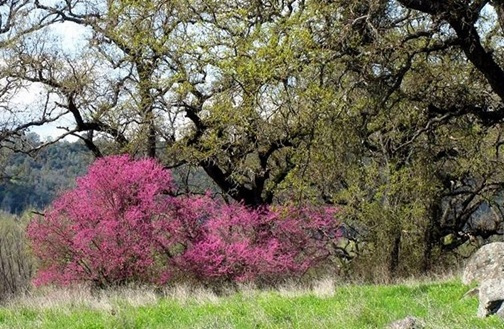
KELSEYVILLE – After weeks of final preparations, the Ely Stage Stop was moved to its new home on Sunday.
The move was originally scheduled to take place over the next week, with the house being moved in stages across Highway 29 and then through cattle pastures and oak woodland.
However a lot of prep work completed this past week apparently allowed Solares House Moving – the Bay Area firm with the contract to complete the move – to complete the move in one day.
On Thursday the house had been moved from its original location to a staging area down toward S Bar S Ranch where it would cross the highway. A trail also was cleared across the open ground to the site of a new Ely Stage Stop museum along Soda Bay Road, which will be owned by the county but run by the Lake County Historical Society.
The work day began early on Sunday, with Caltrans closing the highway at 6 a.m. and California Highway Patrol standing by.
A Pacific Gas & Electric crew worked to raise power lines to let the house – reportedly built around 1859-1860 – pass underneath.
With the lines raised and the house hooked up to a semi towing truck, the house began to move across Highway 29 and then through the fields just before 8 a.m.
Historical Society President Randy Ridgel and wife Jackie, the group's secretary, along with Board of Directors member Kevin Engle, were on hand to witness the move, recording it with both film and photography.
The house movers stopped to build a bridge over a part of Thurston Creek and continued the move in the afternoon.
Kelly Cox, the county's chief administrative officer, watched the move throughout the day. He said the house finally moved up the hill to the museum site at about 5 p.m. after a few hours of “painstakingly slow” progress. At the final push the movers used a cable to pull the house up, inch by inch, said Cox.
County Deputy Redevelopment Director Eric Seely, who was away this week and unable to be there for the move, was given an update on the progress via cell phone, said Cox.
Seely has spent several years working to make the museum project a reality. Cox said Seely was glad to hear the house had survived the move and safely arrived at its new location.
Cox said next come the foundation, roof and siding, which will be done in stages. Seely said the work will be done in stages, as funding allows.
E-mail Elizabeth Larson at
{mos_sb_discuss:2}



BARTLETT SPRINGS – This weekend, two local buildings with important connections to the county's past met very different fates.
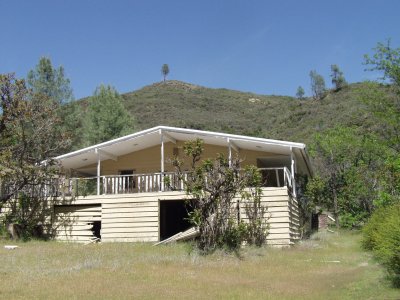
On Sunday, the Ely Stage Stop began its move to a new museum location. A day earlier, the reconstructed Bartlett Springs Resort lodge was burned to the ground.
“It's completely gone,” said Zane Gray, the resort's caretaker since 1982, of the main lodge building.
The fire was reported Saturday afternoon, said Gray. On Sunday, he went to survey the damage, which included five acres of brush land and the building.
A US Forest Service investigator is working to determine the fire's cause, Gray said. The Mendocino National Forest office in Willows couldn't be reached over the weekend for comment.
However, Gray said he believes it was arson, saying that fire officials told him Sunday that the fire appears to have started in the lodge building.
“It couldn't have started by itself,” he maintained, explaining that the propane tanks were removed several years ago, and the electricity was turned off.
“Somebody had to match it, that's all,” he said.
The lodge building that burned Saturday was located at the site of the resort's original lodge, which burned down in 1934. It was rebuilt, with that incarnation of the lodge blowing down in a windstorm in 1988, said Gray.
“I had the building all totally rebuilt in 1989,” said Gray. “It cost the company $171,000 at that time to do the upgrade on it.”
The nearby gazebo, said Gray, was spared in Saturday's fire. “The fire burned right to it but never touched it.”
Gray said he rebuilt the gazebo in 1985, installing new timbers and lumber in an attempt to put it back the way it was at the turn of the 20th century.
The Bartlett Springs Resort's history stretches back to the 1870s, after a mineral spring was discovered there by Napa resident Greene Bartlett during a camping trip, according to The Bartlett Springs Area: Past & Present, written in 2005 by Upper Lake resident Michelle Wells.
Bartlett, who suffered from rheumatism, believed in the springs' healing abilities, Wells' history reports, so he filed a claim for the 160 acres around the spring.
A resort would later be built there, Wells wrote, that included three hotels, camping areas, two stores, mineral steam baths, a bottling facility, a concert hall, stores, a doctor's office and numerous recreational activities – swimming, golf, croquet, tennis, riding, bowling and more.
A Justice of the Peace and constable even were stationed at the resort, Wells wrote, explaining, “because it was so isolated it became more like its own little town as well.”
Known by friends and neighbors as “the mayor of Bartlett Springs,” Gray, who will be 80 in September, has cared for the 1,990-acre property for the last 25 years.
A self-described “pretty tough old man,” Gray is a World War II veteran who moved to Lake County in 1978 with his wife, Frances.
During the time Gray has acted as caretaker, the resort has changed hands a few times, purchased by the French water bottling company Vittel in 1984, who later sold the property to Nestle in 1993. The Vittel bottling plant was later sold separately, and is today the home of Tulip Hill Winery in Nice.
Gray has worked hard over the years to preserve and improve the remaining resort buildings.
The resort suffered damage in the 1996 Fork Fire, said Gray. The two-week Fork Fire reportedly burned 83,000 acres in the Mendocino National Forest and on private property, destroying 11 structures.
Of those structures destroyed, one was a small second house on Gray's 12-acre property near the resort.
A member of the Northshore Fire Protection District, Gray helped fight the Fork Fire and tried to protect the resort then as well.
“We were able to save the lodge at that time and all of the buildings, except for two of the old cabins that were from the 1890s era, and I had just restored them,” he said.
In recent years, despite his care, Gray has been fighting a losing battle against vandals intent on destroying the resort buildings.
Vandalism has been going on in Bartlett Springs “nearly forever,” he said, adding, “It's picked up in the last two years.”
He's found a lot of people on the property – mostly young people, he added – and despite chasing them off the problems have continued.
A visit this reporter made to the lodge in May – granted access by Gray – revealed windows, walls bashed in, bullet holes, kicked in doors and evidence of parties, including trash and beer bottles.
There have also been bouts of arson in the area, said Gray, with a “firebug” around caught there a few years ago after setting some fires.
Gray said he notified Nestle of the building's destruction, and hasn't received word what the company might do. He said he doesn't think that they will rebuild the lodge.
Editor's note: Zane Gray is the great-uncle of Lake County News Editor Elizabeth Larson.
{mos_sb_discuss:2}

NICE – Firefighters continued their work Sunday mopping up at the scene of a 128-acre fire that was contained Saturday night.
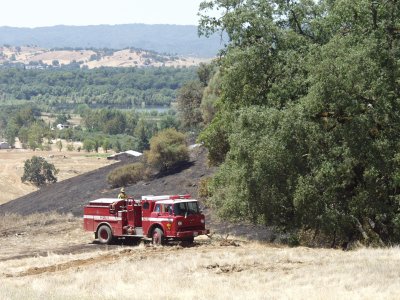
Cal Fire reported that the fire broke out behind Robinson Rancheria Saturday afternoon, quickly climbing up the hill and into steep terrain. Firefighters from Cal Fire, and Northshore and Lakeport Fire Protection Districts fought the blaze.
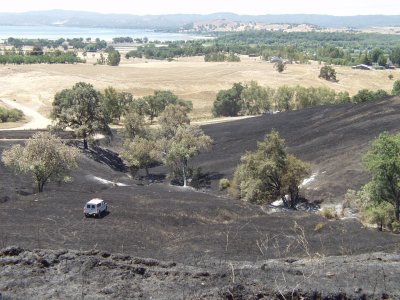
At the scene Sunday, the trail of the fire was clearly visible, making its way from behind Robinson Rancheria Bingo & Casino, traveling over the hill and back toward more steep terrain near Pyle Road.
Firefighters cut trees and dealt with remaining hot spots around the area of the fire, which left a huge blackened footprint.
Rachelle Trimmer of the Cal Fire Incident Command Center reported that 80 firefighters were on duty Sunday, including a five-engine strike team and supervisors, and a water tender.
Trimmer said one engine with four firefighters would remain at the scene overnight.
Northshore Fire District Chief Jim Robbins said the fire was the largest his agency has fought so far this fire season.
E-mail Elizabeth Larson at
{mos_sb_discuss:2}
LAKE COUNTY – Last week Lake County Sheriff's Office (LCSO) deputies and members of a recently formed task force conducted an operation to make sure convicted sex offenders are following registration requirements.
A report from LCSO Det. Mike Curran of the said that on July 23 and July 24, a sex registrant compliance and enforcement sweep was conducted by the Region II Sexual Assault Felony Enforcement (SAFE) Task Force in the City of Clearlake and south Lake County.
The Region II SAFE Task Force is funded through a grant from the Governor’s Office of Emergency Services and covers 12 counties along the North Coast from Monterey County to Del Norte County.
Approximately 130 registrants were contacted to ensure that they are in compliance with their sex registrant requirements, in particular that the registrants are residing at the address given during registration, Curran reported.
Registrants with parole and/or probation search terms were also subject to search conducted at the time of contact. Several arrests were made and additional investigations were initiated as a result of alleged registration violations.
Staffing shortages at the sheriff’s office have created a real challenge for the patrol and investigations divisions to perform brief quarterly compliance checks, reported Curran, as well as initiating investigations on registrants known to be out of compliance with their sex registration responsibilities. Periodic compliance/enforcement operations such as the one just completed will take place on both ends of Lake County.
Agents assigned to the task force coordinate with agencies within their respective counties for operations such as the one just completed in Lake County, and also assist agents within the region with operations in their own respective county, according to Curran's report.
SAFE Task Force Agents from Santa Clara County, Humboldt County, Del Norte County and Napa County participated in the operation, Curran reported.
Additional agencies involved in the operation were the Lake County Sheriff’s Department, Clearlake Police Department, Lake County Probation Department, Lake County District Attorney’s Office, Lakeport Police Department and State Parole. Curran, a Lake County SAFE Task Force agent, coordinated the operation.
Santa Clara County Sheriff Laurie Smith submitted the grant for the task force, which was approved and funded by the Governor’s Office of Emergency Service, Curran reported.
Smith’s desire to pursue a regional task force has added a seriously needed tool for law enforcement not only for her county, but for every county, especially the smaller ones covered within the grant boundaries that allows funding and staffing for sex registrant compliance/enforcement operations, according to Curran's report.
Thanks to Smith's innovative efforts, LCSO – which might otherwise not have been able to carry out such an operation due to a lack of available funding – is able to participate in this most-needed aspect of protecting the public, Curran reported.
Sheriff Rod Mitchell expressed his gratitude to Smith for including Lake County in the grant funding, and said he applauded her for her initiative and innovation.
{mos_sb_discuss:2}
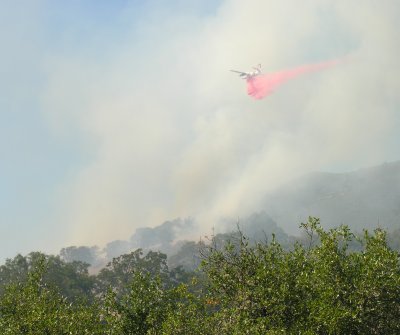
NICE – Northshore firefighters took on their largest wildland fire of the season so far, battling a Saturday afternoon blaze that burned 128 acres near Robinson Rancheria.
Suzie Blankenship, a Cal Fire fire prevention specialist, said the fire was reported at 3:45 p.m. It broke out in steep, rugged terrain behind the rancheria's playground, which is located behind the main area of the rancheria.
Witnesses at the scene said the fire then burned up into the hills toward Nice.
Northshore Fire Protection District, Cal Fire and Lakeport Fire Protection District responded to the scene, said Northshore Chief Jim Robbins. The Lake County Sheriff's Office also was at the scene to control traffic.
Blankenship said Cal Fire sent seven engines, four dozers, three fire handcrews, one air attack, five air tankers and three helicopters, along with two officers on the ground helping an incident commander organize the effort.
Another five engines from Northshore Fire responded, said Robbins, along with two four-wheel drive attack units, he and a battalion chief. Lakeport Fire also sent an engine.
Blankenship said firefighters had difficulty fighting the fire because of high-tension power lines in the area, which limited the use of air crews.
The fire was contained at 7:15 p.m., said Blankenship.
However, the fire was far from out at that point, said Robbins.
“There's still a lot of hot spots,” he said from the scene.
Because of the need to monitor the area, Robbins said crews were being ordered in overnight.
No single family dwellings were threatened, said Robbins, although a few small sheds that were buried in the remote area's brush were destroyed.
There were no injuries to area residents or firefighters, said Robbins.
Robbins said it was the biggest blaze that Northshore Fire has had to fight so far this season.
The wind helped the fire spread rapidly, said Robbins.
“We went from 20 acres to about 60, 70 acres in less than 20 minutes, it had such a good westerly wind on it,” he said.
The cause of the fire is under investigation, said Robbins. A Cal Fire official was at the fire scene Saturday evening in an effort to determine the source.
E-mail Elizabeth Larson at
{mos_sb_discuss:2}
The US Fish and Wildlife Service announced July 20 that it will reconsider eight decisions involving endangered species that were overseen by former Assistant Secretary of Fish, Wildlife and Parks Julie MacDonald.
MacDonald was a Bush appointee who joined the Department of the Interior in July 2002. She resigned April 30 following an investigation by the Department of Interior’s Inspector General that found she had used her position to violate the Endangered Species Act, rewrote scientific reports, browbeat agency scientists and colluded with industry lawyers to generate lawsuits against the Fish and Wildlife Service.
During a July 2 Congressional hearing in Vallejo, MacDonald's role in influencing environmental decisions in the Bay-Delta came to light in testimony given by Steve Thompson, manager of the U.S. Fish & Wildlife's California/Nevada Operations Office, as Lake County News previously reported.
Congressman Mike Thompson questioned Steve Thompson about if the agency had been under political pressure to change science used for decisions in the Bay-Delta, similar to how Vice President Dick Cheney used political influence in a decision last year that resulted in the death sof 70,000 salmon in the Klamath River.
Steve Thompson said MacDonald had shown interest in the agency's work on delta smelt, a seriously threatened fish that calls the Bay-Delta home.
But he said he couldn't discuss the issue further, as another Inspector General's investigation is under way into the matter.
Growing concern over the role MacDonald might have played in compromising science in the name of politics has resulted in calls for Fish and Wildlife to reconsider decisions that may have been tainted by her influence, as well as Congressional hearings on the matter.
Red-legged frog decision slated for reconsideration
The final critical habitat designation for the California red-legged frog is one of the endangered species decisions that will be re-examined because the decision was potentially tainted by MacDonald, according to the Center for Biological Diversity, one of the groups that helped bring MacDonald's actions to light.
The red-legged frog was made famous in Mark Twain's 1865 short story, “The Celebrated Jumping Frog of Calaveras County.”
The frog once ranged across most of California, according to a Fish and Wildlife report. In the late 1800s and early 1900s it was harvested excessively for food, and today only occurs in about 10 percent of its historic locations.
The frog is found in 238 streams and drainages in 23 counties statewide, including Lake County. Project documents from the county's proposed Middle Creek Ecosystem Restoration Project state that the red-legged frog is among several “special-status wildlife species” that the plan could help by creating additional wetland, riparian habitat and open space. Other county planning documents reveal that major projects must ensure that they don't impact the frogs.
In 2006 the Fish and Wildlife Service slashed the critical habitat protection for the red-legged frog by 90 percent, which the center called “a giveaway to the development industry” and which conservation groups called “a recipe for extinction of the frog.”
The service cited a biased and controversial economic analysis as justification for cutting the original designation from 4.1 million acres to 450,288 acres of critical habitat, according to the center. The final critical habitat designation excluded much of the areas the service had previously determined are necessary for the long-term survival and recovery of the frog.
The other species which will get another look from Fish and Wildlife include:
White-tailed prairie dog;
Preble’s meadow jumping mouse;
12 species of Hawaiian picture-wing flies;
Arroyo toad;
Southwestern willow flycatcher;
Canada lynx.
The Center for Biological Diversity issued a statement in which it said that, while it's glad these species will receive consideration for additional protection, but that the effort falls short of what's needed to address MacDonald's damage to endangered species protections. The center added that it appears to be more a token effort to deflect criticism.
“Fish and Wildlife’s reconsideration of eight decisions tainted by former assistant secretary Julie MacDonald is a day late and a dollar short,” said Noah Greenwald, conservation biologist with the Center for Biological Diversity. “Despite no scientific training, MacDonald interfered in dozens of scientific decisions concerning endangered species--only a full and transparent accounting of all the decisions tainted by MacDonald’s malignant influence can undue the damage she has done.”
The center said the list fails to include decisions to not list the Mexican garter snake, to potentially delist the marbled murrelet, and to sharply reduce critical habitat for the bull trout, even though regional directors of the Fish and Wildlife Service specifically requested that these decisions be reconsidered because of MacDonald’s influence.
The list also fails to include reconsideration of critical habitat for the Sacramento splittail, even though a story by the Contra Costa Times revealed that MacDonald may have illegally limited designation of habitat to avoid an 80-acre farm she owns in Dixon.
The center reported that MacDonald is known to have been involved in reversing numerous other decisions by agency scientists to protect species, including decisions over Gunnison sage grouse, Montana fluvial arctic grayling, Mexican garter snake, Southwestern bald eagle and many others. These decisions should also be reconsidered.
E-mail Elizabeth Larson at
{mos_sb_discuss:2}