How to resolve AdBlock issue?
News

LAKEPORT – An Iraq war veteran will spend another six months in jail after being convicted of felony possession of stolen property.
Derick Hughes, 21, was sentenced to a total of 280 days in jail and felony probation Monday afternoon after lengthy courtroom sentencing deliberations between prosecutor Art Grothe and defense attorney Stephen Carter.
Hughes was charged with felony possession of stolen property after being pulled over in Nice last December. During the stop, a sheriff's deputy discovered two used 10-inch by 12-inch ballistic panels from a military body armor system, a BB gun, a miniature souvenir baseball bat and a quantity of concentrated cannabis.
During the first part of testimony on Friday, Grothe attempted to cast doubt on Hughes' military service and his activities in the Marines while Carter worked to relate Hughes' behavior in Lake County to a psychological condition known as post traumatic stress disorder (PTSD). Grothe questioned Hughes about the dates and locations of his service as well as the temperature of the weather in Iraq.
Hughes developed PTSD after an explosion during a promotion ceremony in an Iraq battlefield which took the lives of 10 of his fellow soldiers, Carter said.
While on the stand, Hughes described the promotions location. “It was in the middle of an ops zone, a combat zone,” he said.
That tragic event was dramatic enough to garner the attention of ABC's Good Morning America, which interviewed a number of the survivors, including Hughes.
According to testimony during the sentencing, Hughes was diagnosed with PTSD by a Navy doctor before being discharged from the military.
Subsequently, he received an Other Than Honorable (OTH) discharge after testing positive for marijuana and methamphetamine in Twentynine Palms shortly after returning from Iraq. During the sentencing, Hughes admitted to using the drugs.
The sole defense witness, aside from Hughes himself, was Dr. Albert Kastl, the clinical and forensic neuropsychologist Carter brought in to evaluate Hughes.
Kastl, an expert witness, concluded that Hughes' behavior and attitude was consistent with that of someone affected by PTSD.
At one point Kastl told the court that Hughes had been “trained not to show weakness,” and that suspicious, defensive behavior was “highly consistent” with PTSD.
During cross examination Kastl explained that instances of PTSD were much higher in Iraq than in previous wars. In Iraq, Kastl said, as many as 20 to 30 percent of the soldiers would suffer from the affects of PTSD while in Vietnam the numbers were much lower, closer to 5 percent.
Active duty troops in Iraq currently number around 160,000, according to press accounts.
Friday's sentencing was cut short by the judge and two fire alarms which emptied the courthouse before either attorney had completed their closing arguments. The sentencing resumed Monday afternoon.
The weekend respite gave Carter sufficient time to accumulate 24 defense exhibits comprised of Hughes' discharge documents, a letter of commendation, a two-page checkout sheet reflecting that all items checked out to Hughes were returned, numerous photographs of Hughes in Iraq and a video copy of the Good Morning America show in which Hughes appeared.
Before getting to the video Judge Richard Martin silently reviewed all the exhibits for several minutes, looking over some items more than once. After he had finished reviewing the multiple exhibits, Carter presented the video and Grothe uttered his objection.
Grothe did not object to any of the exhibits except for the Good Morning America video, which he described as redundant.
During a brief give-and-take with Carter over the tape, Martin questioned Carter about how the tape might boost Hughes' credibility with the court. Carter sought to have Martin play the tape and decide for himself.
Carter argued that since Grothe had suggested on multiple occasions that Hughes was not being truthful, it helped support Hughes' claim of military service in Iraq. “It goes to weight,” Carter said.
Carter ultimately convinced Martin to review the tape before deciding whether to sustain Grothe's objection. Carter then placed a small television on the judge's desk and played the video in full view of the court.
During the first portion of the ABC video, Hughes expressed that losing his fellow soldiers was akin to losing relatives. “It's like losing a family member, that's what we lost,” Hughes said on the tape.
Judge Martin then overruled Grothe's objection and accepted the video into evidence along with the other 23 exhibits.
The two attorneys then proceeded with their closing arguments.
Carter had filed a 17b motion, which is used to request a reduction from felony to misdemeanor. He focused on Hughes' service and need for treatment. He stressed that Hughes, who had fought to establish a right to vote in Iraq, stood to lose his own right to vote in the US if found guilty of a felony.
At one point, Martin noticed two veterans in the audience, one a veteran's representative who would soon testify that Hughes would still be eligible for Veterans Administration benefits even after being OTH discharged.
Richard Hulet, a Vietnam veteran who works for the Employment Development Department as a veterans representative, took the stand.
“He's gonna be eligible for full VA treatment for post traumatic stress,” Hulet said of Hughes.
During his closing, Grothe continued to attempt to poke holes in Hughes' story by picking out conflicting details from a probation report and Kastl's testimony. Grothe told the judge he would not seek prison time.
In the end Martin told the court that he had problems with the inconsistencies in Hughes' account and denied Carter's request for the 17b reduction from felony to misdemeanor.
“This court doesn't hand out 17bs right and left,” he said. “This court is not ready to turn him loose on a 17b.”
Martin then sentenced Hughes to 280 days with credit for 90 days served, bringing his sentence to 190 days. Carter said Hughes will actually serve two-thirds of that sentence.
Martin also allowed for day-for-day credit if Hughes takes part in a residential VA treatment center. That treatment would be in lieu of jail time with the possibility of other types of treatment centers as an option.
After the sentencing, Carter expressed his satisfaction with the verdict and reported that Hughes was taking it in good spirits.
“We're very happy he didn't get a prison sentence,” Carter said. “For a guy who's been through what he has been through this isn't such a big deal.”
Carter will meet with Hughes on Wednesday at the jail to work out a strategy going forward. Hughes could potentially complete his three year probation in one year through good behavior and petitioning the court for a reduced charge.
“A year from now when I expect Derick Hughes will be successfully completing the terms of probation, our plan is to bring a motion for early termination of probation,” Carter said. “There's an open door there, we don't have to wait the full three years.”
Should Hughes successfully complete his probation, “You can bet I'll be at the courthouse,” Carter said, where he'll apply to have Hughes' felony expunged from his record.
E-mail John Jensen at

{mos_sb_discuss:2}
SANTA ROSA – A Sonoma County man whose history of drunk driving culminated in his hitting and killing a former Clearlake resident was sentenced to 15 years to life in prison last Thursday.
Joseph Elton Lynchard, 74, was driving drunk in an incident two years ago when he hit and killed bicyclist Kathryn Lynn Black, 43, according to Sonoma County District Attorney Stephan Passalacqua.
Lynchard pleaded guilty to second-degree murder in Sonoma County Superior Court Judge Lawrence Antolini's courtroom in January. On Thursday Antolini handed down the 15 years to life sentence last week.
Passalacqua, who called Black's death a “senseless tragedy,” said Lynchard had numerous previous DUI convictions by the time of the incident, which gave rise to the second-degree murder charge.
“The law permits such a charge when people like Mr. Lynchard are subjectively aware of the risk, and choose to ignore that very risk when they drive under the influence and take another’s life,” Passalacqua said in a January statement.
Black was riding her bicycle eastbound on Mark West Springs Road on the afternoon of March 28, 2005, when she pulled her bike onto the dirt shoulder of the road and appeared to be standing over her bike resting, according to a statement from Passalacqua's office.
Lynchard was driving his Ford F150 pickup home after drinking at his brother’s bar, Eddie’s, according to Passalacqua's statement. He drove onto the dirt shoulder, up and over a raised asphalt curb and struck Black from behind.
Black died at the scene, according to the original California Highway Patrol report. CHP officers reported at the time that Black's family came upon the accident shortly afterward, to find that she had been killed.
Lynchard’s blood alcohol level was determined to be 0.24 percent, three times the level permitted by California law, according to Passalacqua's office.
The criminal investigation, according to Passalacqua, determined that Lynchard had seven prior arrests for driving under the influence of alcohol, and had attended the state-mandated drunk driving course four times previously.
The Sonoma County District Attorney’s Office statement said it charged Lynchard with second-degree murder because this prior history demonstrated that Lynchard was aware of the risk, and chose to ignore it when he drove after consuming alcohol.
Deputy District Attorney William Brockley was the prosecutor assigned to the case and was assisted by District Attorney Investigators Kris Allen and Roslyn Eliaser, and Victim Advocate Miriam Gaon. California Highway Patrol Officers Steve Wyatt and Robert Mota were the lead detectives on this successful investigation.
“I hope this sentence gives the Black family some closure to aid them in the healing process,” Passalacqua said.
E-mail Elizabeth Larson at
{mos_sb_discuss:2}
THE GEYSERS – The Geysers area was hit by a 3.1 magnitude quake early Monday.
It's the third quake surpassing 3.0 in magnitude to hit the area since last Tuesday.
The US Geological Survey reported the quake occurred at 8:51 a.m. Monday, centered two miles north northwest of The Geysers and six miles west of Cobb. The quake's depth was 2.1 miles.
Three smaller earthquakes, the largest a 1.6 magnitude microearthquake, occurred in the hour following the 3.1 quake, according to the US Geological Survey.
Last Tuesday, there was a 4.4 quake one mile east southeast of The Geysers. On Sunday, a 3.4 quake occurred that was centered two miles northwest of Anderson Springs and four mile east of The Geysers.
E-mail Elizabeth Larson at
{mos_sb_discuss:2}
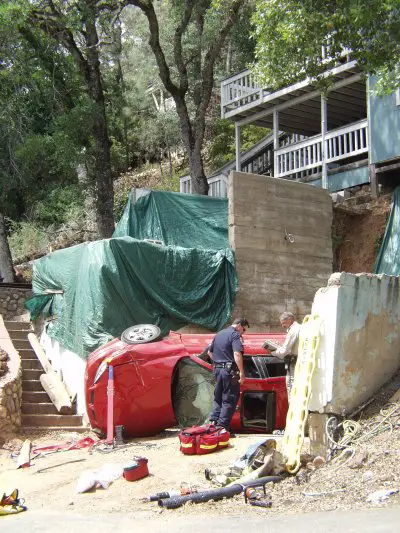
CLEARLAKE OAKS – A Clearlake Oaks woman died as the result of a single-vehicle collision Saturday afternoon.
The California Highway Patrol reported Monday that the 49-year-old woman, whose name has not yet been released pending family notification, was the driver in the crash. Two passengers traveling with her also were injured.
A report from CHP Officer Adam Garcia stated the woman was driving her 2004 Pontiac westbound along Highway 20 just east of Beryl Way at approximately 12:39 p.m. Saturday when the accident occurred.
For reasons that aren't known, the driver was unable to negotiate a curve to the left, Garcia's report stated.
Garcia reported the car went off the highway's north edge and collided with a rock retaining wall, which caused major inward crush to the vehicle's passenger compartment.
Passenger Michelle Reidle, 45, of Clearlake Oaks sustained minor injuries, according to CHP Officer Josh Dye. A third person in the vehicle, a 16-year-old girl, received major injuries, Dye reported.
All three of the vehicle's occupants were wearing their safety belts, according to Garcia's report.
E-mail Elizabeth Larson at
{mos_sb_discuss:2}
SPRING VALLEY – Fire protection, water, emergency preparedness and community identity proved to be the top issues at a Saturday town hall meeting held for the Spring Valley community.
About 50 people gathered for the afternoon meeting, hosted by District 3 Supervisor Denise Rushing, at the Spring Valley Community Center on Wolf Creek Road.
It was the fourth town hall meeting that Rushing has organized so far this year for the communities she represents throughout District 3.
During Saturday's meeting, the valley's residents made it very clear to officials that they view themselves as a unique and separate community, and not part of Clearlake Oaks.
Rushing was once again joined at the town hall meeting by county officials including county Administrative Officer Kelly Cox and Deputy Redevelopment Director Eric Seely, who gave updates on county projects. Also on hand was Northshore Fire Protection District Chief Jim Robbins.
Much like some other Northshore communities, Spring Valley is concerned about water.
Mark Dellinger, who heads up the county's Special Districts – which includes Spring Valley's Community Service Area 2 water district – couldn't attend Saturday's meeting.
However, Karen Hanson, Special Districts' administrative manager, attended and was available to answer questions about water bills and the district's budget.
Hanson said she has already compiled Special Districts' preliminary budget for the coming year. Included it in, she said, will be a way to track the money spent on special projects, such as improving the water system.
Special Districts is currently exploring several funding sources – from state to federal loans and grants – in order to improve Spring Valley's treatment plant, she said. Along with that, she said, Dellinger is looking at different treatment plant options.
In addition, Hanson reported that Special Districts has so far installed 182 new water meters in Spring Valley, with 117 more to go. She said a test of the old water meters showed inaccuracy levels of as much as 27 percent, with the meters actually underreporting usage.
Hanson reported that since 1997 the district's unbilled water costs due to those inaccuracies amounted to $350,205.
Fire and emergency preparedness were major discussion topics, with Monte Winters, the District 3 volunteer coordinator for the local Office of Emergency Services, discussing how to be prepared for emergencies in the valley.
That theme was echoed by Rushing and Robbins. In particular, concerns for fire were noted several times, with Roberts saying that fire is the valley's No. 1 expected disaster.
Preparation in dealing with fire should always be a No. 1 issue in Lake County as a whole, said Robbins.
Area residents were concerned about use of the fire rings at the Spring Valley campground during the dry summer season. Robbins explained that while burn bans are managed by the county, campfire permits are managed by a state agency, and the two aren't connected.
During his five years leading the Northshore Fire District, Robbins said he hasn't seen actual problems with actual campfires at the campground, although there have been separate issues with teens and bonfires.
When Rushing asked whether the community wanted to have the campground shut down for the summer to prevent fire issues, there was little support. The room also was split on banning campfires altogether.
In other fire-related news, Robbins said that Northshore Fire recently completed a weed abatement ordinance requiring that weeds be kept down to no more than 4 inches in height on vacant parcels and land during the summer.
The district is starting a database to track owners of vacant lots, Robbins said. If the owners don't keep down the weeds, Robbins said the district will have the weeds mowed and the owners will be billed.
Robbins also addressed the issue of how to evacuate the valley's 300 families in case of an emergency.
Citing the example of a large fire in the valley a few years ago, Robbins said New Long Valley Road -- the main path into the valley – would likely only be shut down for a few hours in such an instance. However, he said, creating an evacuation plan is still critical to the valley's residents.
Old Long Valley Road may offer another route out of the valley, said Robbins, an issue that he said needs to be further explored.
"I feel a little unsafe with you really having only one way out of here," said Robbins.
Rushing said she had Public Works Director Gerald Shaul conduct an assessment regarding access routes out of Spring Valley, as well as likely emergencies.
The two most likely emergencies, said Rushing, are fire and landslides. She said Shaul also said the bridges in the valley need to be evaluated, because some of them may not be able to hold fire trucks responding to emergencies.
A fire-related emergency, said Rushing, "may well be the most important issue in this valley, and it can happen at any time."
During an open forum for questions, residents asked Rushing about a variety of issues, including use of Lake Transit and ways to deal with ATVs.
Rushing said Lake Transit hasn't yet found a cost-effective way to offer public transportation to valley residents. She said she would pass along a suggestion from the meeting that Lake Transit provide service to the valley a few days a week so that residents can make shopping trips to nearby towns.
At Rushing's request, Spring Valley resident Helen Mitchell gave an update on a community plan to set up a Neighborhood Watch-type group called Rapid Responders to address security issues at the campground.
Mitchell said she also is working with Sheriff Rod Mitchell to deal with ATV riders who are destructive at the campground, and would like to set up a special permit process for ATV riders who obey rules.
Another town hall meeting is planned for Blue Lakes, but Rushing said no date has yet been set.
E-mail Elizabeth Larson at
{mos_sb_discuss:2}
ANDERSON SPRINGS – The Anderson Springs area has had another sizable earthquake in a week's time, with a 3.4 magnitude earthquake hitting the area Sunday.
The quake was recorded at 6:06 a.m. at a depth of 1.3 miles, according to the US Geological Survey. It was centered two miles northwest of Anderson Springs, three miles south of Cobb and four miles east of The Geysers.
The quake was immediately preceded by a 2.0 magnitude quake centered three miles west northwest of Anderson Springs.
A 4.4 magnitude quake hit near The Geysers last Tuesday.
In recent weeks, seismic activity has increased around the county, with larger quakes seen in the areas around The Geysers, as well as across the county near Lake Pillsbury.
E-mail Elizabeth Larson at
{mos_sb_discuss:2}