How to resolve AdBlock issue?
News
LAKE COUNTY – The West Lake Conservation District has won a state grant that will help it complete assessments of three of the county's major watersheds.
Greg Dills, watershed coordinator, East Lake and West Lake Conservation Districts, said the West Lake District recently received a CALFED Watershed Committee grant of funds from Proposition 50, a state water bond.
The plan, said Dills, is to produce three watershed assessments for Middle Creek, Scotts Creek and Kelsey Creek, which will inventory historical and current data collected on the watersheds.
It was tough competition, said Dills; there were 120 applicants from agencies around the state that competed in a two-phased grant application process.
The district submitted a concept paper, Dills said, which explained its plan for the three assessments.
After making it past the first round of cuts, which took the number of applications down to 60, Dills said the district wrote a full proposal. The district, he said, was eventually named one of 28 projects funded statewide.
"It's highly competitive," said Dills. "We were fortunate to have done so well."
The watershed assessments the district proposes to complete will be a management tool, said Dills, and a building block in future work.
Once those planning documents are finished, he said, the district and/or its partners can use them to approach agencies for funds to pursue the projects identified in the assessments, such as restoration or fuel load reduction.
Together, Middle and Scotts Creeks are the most significant conveyance of water to Clear Lake, said Dills. They transport 57 percent of the water and 70 percent of sediment, he added.
The third largest watershed, said Dills, is Kelsey Creek.
The watersheds each have coordinated resource management and planning groups – called CRMPs – that have been meeting about the health of the county's watersheds, he said. For many years those groups have been compiling data and doing the background work necessary for watershed improvement projects.
“We've seen a lot of land use changes going on in the watersheds in recent years," said Dills, including shifts from agricultural usage to development, which impact watersheds.
The three watershed groups for Kelsey Creek, Middle Creek, and Scotts Creek, are now jumping into the assessment process, he said, which includes going into the Department of Public Works watershed data library, which stretches back to the 1940s.
That data, he said, includes loss of habitat, water quality data, fuel load management, stream bank erosion, nonnative and invasive weeds.
Dills said they'll identity missing data and try to fill in the gaps during the new assessment project.
There are many aspects to watershed management and assessments, said Dills. So, besides CRMP members examining data, there also will be help from engineers, hydrologists and other professionals in the watershed management field to help put the assessments together, "so we have the science behind it," he added.
There's a lot of work to be done, he said, and a deadline to do it by – June 2008 for assessment completion, with the grant expiring the following June.
Simultaneously, as the assessments are going on, said Dills, the Clear Lake Basin Management Plan will be completed under the grant. When the assessments are finished, he said, they will be incorporated into that finished management plan.
The grant also offers funds to provide capacity building for the Upper Cache Creek Watershed, said Dills. "Capacity building," said Dills, is a term used in reference to providing assistance and sustainability for the watershed groups, which includes training and educational workshops for watershed group members. Providing that assistance will be a function of the Upper Cache Creek Watershed Alliance, which was formed under this grant.
A few of those workshops have already taken place, he said. One, on Jan. 27 at the Scotts Valley Women's Clubhouse, was standing-room only, he said.
Interest in the health of watersheds – which has a direct impact on water quality – is interesting more people these days, Dills said.
"Back nine years ago when I started this whole journey, doing a kickoff meeting for a watershed group was a cold sell," he said.
He added, “This many years later, we have people coming in the office asking for help starting one.”
Education about water issues, and the success of local watershed groups, has helped generate the increased interest, he said. The Scotts Creek Watershed Council, he said, has been responsible for creek cleanups and a fire break on Cow Mountain.
The Big Valley CRMP, Lower Lake Watershed Council, Middle Creek CRMP, and Nice Watershed Group also participate in cleanup events each year removing thousands of cubic yards of trash from our landscape, according to Linda Juntunen, project coordinator for the West Lake Conservation District. The active groups are involved in a variety of projects and activities besides their cleanup events.
There are now nine CRMPs in various stages of activity throughout Lake County, Dills reported, with a 10th, in Lucerne, now beginning to form.
For more information about watershed issues, CRMPs and how to get involved, call the West Lake Resource Conservation District, 263-4180.
E-mail Elizabeth Larson at
{mos_sb_discuss:2}

A nationwide information audit, conducted as a prelude to Sunshine Week, found slightly more than four in 10 of the official gatekeepers willing – if wary – to provide copies of emergency response plans, which federal law makes public.
Other local officials, however, reacted to requests with confusion, outright denials and sometimes by calling police to check out the auditors. Many weren’t sure who had the authority to release the reports, or even where the documents were located.
More than a third of public officials audited refused to provide access to their local Comprehensive Emergency Response Plan – which is mandated by the Emergency Planning and Community Right-to-Know Act of 1986 as a public document. Another 20 percent provided only partial reports.
Those denials stood in stark contrast to the experience of other auditors, many of whom were offered copies of the report in either paper or disc form; 48, or 12 percent, of the 404 communities put the reports online.
The audits were conducted in early January, when reporters, civic group members, students and other volunteers visited their Local Emergency Planning Committee, which prepares the reports outlining emergency response in the event of a chemical or hazardous material accident. The 1986 law not only says the plans are public, it also requires the local officials to advertise their availability once a year.
In all, 162 news organizations participated as requestors, along with three student newspapers and eight League of Women Voters chapters. This report is built on a database of their experiences and offers a snapshot of the difficulties citizens may face when they request public information that may be considered sensitive.
The audit is a project of the American Society of Newspaper Editors, the Coalition of Journalists for Open Government, the National Freedom of Information Coalition and the Society of Environmental Journalists for Sunshine Week 2007, March 11-17. Sunshine Week is an open government initiative spearheaded by ASNE. Entering its third year, the program encourages newspapers, broadcasters, online content producers, schools, libraries, civic groups and others to engage in discussions about the importance of protecting public access to government information and meetings. It is supported by a grant from the John S. and James L. Knight Foundation.
Overall, there were 404 audits conducted in 37 states and Puerto Rico. The emergency response plan was provided in full to 177 requestors, or 44 percent of the total. One official in Iowa told the auditor that he was delighted to see a citizen seeking the report: "We need more awareness on what to do during an incident for the safety of everyone."
Officials around the country who denied requests, however, frequently cited national security or terrorism concerns – or even, incorrectly, the USA PATRIOT Act. In fact, the law provides for separating any sensitive information the local responders gather in preparing the plans. Several auditors were told they were getting the document because they didn’t "look like terrorists." In all, 20 percent of auditors, or 82 requestors, received the plan only in part, and 36 percent, 145 requests, were denied.
In some cases, officials ran background checks on citizen auditors or sent police to follow them. The highway patrol in one state even launched an all-county alert seeking more information about one requester. In several states, officials sent e-mails to colleagues in other emergency planning agencies warning of the audit.
A handful of the officials asked for the report apparently did not understand the request and did not appear eager to help. Several also were working out of their homes or businesses, although that did not necessarily hinder disclosure.
The full report can be viewed online at http://www.sunshineweek.org/files/audit07.pdf. It includes data charts as well as recaps of auditors' experiences.
{mos_sb_discuss:6}
This story has been updated.
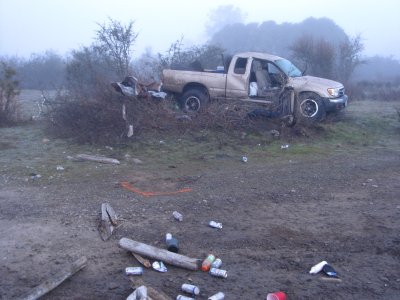
LAKE PILLSBURY – An early morning traffic collision on Sunday killed a 19-year-old Santa Rosa man, according to the California Highway Patrol.
The victim's name has not been released pending family notification.
The accident, a vehicle rollover, happened along Elk Mountain Road east of Soda Creek at 12:40 a.m., according to a CHP report released Monday.
Ryan White, 20, of Rohnert Park was driving a 2000 Toyota Tacoma westbound on Elk Mountain Road west of Oak Flats campground and three miles east of Soda Creek, the CHP reported.
With White were three passengers – one in the front, the unidentified victim, and two in the back, Erik Anderson, 23, of Santa Rosa and a 17-year-old male juvenile, also from Santa Rosa, the CHP report noted.
White rapidly accelerated in the Toyota and lost control, the CHP stated, with the rear of the vehicle skidding out from behind and rotating in a clockwise direction.
The Toyota then left the paved portion of the road and began to overturn, according to the CHP.
The right front passenger was ejected and sustained major injuries, the CHP reported. He was transported via ground ambulance to the hospital, where he later died.
Neither White nor Anderson received any injuries, the CHP said. The juvenile received minor injuries and was treated at the scene.
The CHP reported that White was arrested on suspicion of driving under the influence.
E-mail Elizabeth Larson at
{mos_sb_discuss:2}
District 3 Supervisor Denise Rushing hosted a town hall meeting for Lucerne on Feb. 17 at the Lucerne Senior Center.
As part of the gathering, Rushing asked attendees to answer a “quick survey” ranking their priorities in shaping Lucerne.
The No. 1 priority was cleaning up the town/enforcing codes and law, which was the same primary goal for Clearlake Oaks members surveyed at their town hall meeting Jan. 24, Rushing noted.
Coming in a close second in Lucerne was addressing basic infrastructure, such was water and roads. Water, in particular, has been one of the most pressing issues facing Lucerne in recent years.
The rest of the ranked items, in order, were illegal dumping and creek cleanup, revitalizing businesses, better local stores and services, face lifts for businesses and Highway 20, improving community parks and waterfront, Highway 20 traffic calming, building community identity and cohesiveness, keeping expenses low/efficient use of dollars, creek flooding and parking.
The town hall meeting helped bring attention the condition of Morrison Creek, which was the focus of a cleanup conducted by the county on Saturday.
The next town hall meeting scheduled to take place in District 3 will be in Upper Lake. The meeting will take place beginning at 5 p.m. on Thursday, March 29, in the Upper Lake High School cafeteria, 675 Clover Valley Road.
County Staff will provide updates on the community redevelopment process, flood zone and other issues and citizens will be given the opportunity to participate in an open forum discussing critical issues of concern to the Upper Lake Community.
For more information visit Rushing's Web site, www.drushing.com.
E-mail Elizabeth Larson at
LUCERNE – "I was very hungry as a kid," admits Yvonne Cox. "At a very young age, I decided if I ever made it, I would feed people."
This Tuesday, Cox will feed an entire auditorium of people for the fifth time.
Really Understanding Hunger (RU Hunger) is a program Cox developed in early February to help feed those in need in Lake County. Every Tuesday from 5 to 7 p.m. Cox opens up what she calls the "Dignity Diner" at the Lucerne Alpine Senior Center to feed people with no and low incomes.
At the Dignity Diner, Cox explains, people don't have to stand in line for a small commodity and deal with any discomfort or embarrassment. Instead, guests are invited to come in, sit down and be served.
Even children and adolescents are welcomed to come unattended. Full tables of kids and teens have been present at times, without any adults accompanying them.
The program started big and continues to increase. On the first night she opened, Feb. 13, Cox served 61 people. Two weeks ago, she served 87.
Cox described the response from her guests as being one of the most powerful feelings she has ever experienced: "When these people came in and started thanking me, it was overwhelming."
Cox puts out anywhere from $150 to $200 per week to provide food to RU Hunger, covering about 80 percent of the cost. Lakeview Market makes up the rest, donating breads and a variety of salads.
Cox has expressed gratitude and appreciation for Kenny and Deana Parlet, owners of the small-town market, for their generosity - especially after some of the large grocery stores turned her down.
In the beginning, Cox was cooking and preparing all of the food, but more and more volunteers have shown up to support the program. Cox has seen help in the kitchen from the Lucerne Alpine Senior Center chef – after his regular shift – as well as students from the junior high, who came last week on their own right after school, ready to help out. In addition, students from Cox's own dance class help serve, and each week, more and more of their family members and friends have been joining them.
The owners of Pet Acres in Upper Lake were the first to contribute food to RU Hunger's food pantry.
Even a few people who came to eat the first night returned the second night and thereafter to help serve others food.
"It's turning out better than I imagined," smiles Cox.
She says none of this would have been possible without her partner, Annie Barnes of Sunrise Foundation.
Cox advises: "Talk about your dreams out loud because you never know who's listening."
It was Barnes who overheard Cox's wish to open up a soup kitchen and who helped get the process in motion. Barnes handles the administrative side of their partnership and is currently working on funding for RU Hunger.
"The best thing in the world is having her in our corner," says Cox. "She's a wonderful, incredible woman. She made my dreams come true. I can't say much more."
Though RU Hunger targets people with no or low incomes, anyone is welcomed to come and eat. Donations are accepted for those who would like to pay to enjoy the great food, which changes each week.
Many have likened the Dignity Diner to a regular restaurant, and some have even boasted that the quality of food and service is superior – with no real waiting time and plenty of servers who are doing the job simply because they want to.
In the future, Cox wants to open four more Dignity Diners throughout the county – one per night – so that five nights a week, people are able to eat a full meal.
And a little further down the road? "I want to put Dignity Diners across the United States," she says.
The Lucerne Alpine Senior Center is located at 3985 Country Club Drive.
All types of donations are accepted for the RU Hunger program - time, labor, food, drink mixes, paper plates, to-go boxes, money, etc. To volunteer, donate, or for more information about RU Hunger, contact Yvonne Cox, (707) 274-8821.
E-mail Penny Dahl at
{mos_sb_discuss:2}
Daylight Savings Time will go into effect Sunday, when clocks are set ahead one hour at 2 a.m.
Clocks will “fall back” to Standard Time on Sunday, Nov. 4.
The California Energy Commission (CEC) reports that the National Energy Policy Act of 2005 created the extended Daylight Saving Time beginning this year.
The legislation moved the time change from the first Sunday in April to the second Sunday in March, the CEC noted. Daylight Savings also ends one week later, on the first Sunday in November rather than the last Sunday in October.
One of the potential benefits of extending Daylight Savings is an energy savings. CEC estimates that there is a savings in electricity used during the peak of the day. The "peak" electricity demand is estimated to decline by approximately 3 percent for the remainder of March, according to the CEC.
Pacific Gas & Electric spokesman David Eisenhauer said the company isn't sure yet of what energy savings that it might realize. Calculations and studies are still under way, Eisenhauer said this week.
The CEC encourages people to use the Daylight Savings time change to remember to change the batteries in home smoke detectors, and to replace an incandescent light bulb with a compact fluorescent light to save energy.
E-mail Elizabeth Larson at
{mos_sb_discuss:2}