 How to resolve AdBlock issue?
Clearlake’s Measure V Oversight Board to hold special meeting
LAKE COUNTY, Calif. — The city of Clearlake’s Measure V Oversight Board is set to hold a special meeting to consider an annual report and review upcoming projects.
The oversight board will meet at 3 p.m. Wednesday, Oct. 15, in the council chambers at Clearlake City Hall, 14050 Olympic Drive.
The agenda can be found here.
The meeting will be broadcast live on the city's YouTube channel or the Lake County PEGTV YouTube Channel.
Community members also can participate via Zoom. The pass code is 918903.
Public comments should be submitted by noon on the day of the meeting to Administrative Services Director/City Clerk Melissa Swanson at
In November 2016, Clearlake’s voters approved Measure V, a one cent sales and use tax to be used for improving the city’s roads.
Items on the agenda include the receipt and filing of the 2024 meeting minutes and review of Resolution No. 2021-18, affirming the duties of the Measure V Citizen Oversight Committee members.
The oversight board also will review the fiscal year 2024-25 Measure V revenue and expenditure report and adopt a resolution declaring its compliance with city ordinance.
Also on the agenda is a review of Measure V projects through 2031.
Email Elizabeth Larson at
Adventist pulls out of Clearlake health project amid looming Medicaid cuts

CLEARLAKE, Calif. — A flagship clinic project in Clearlake has come to a halt after Adventist Health Clear Lake withdrew, citing the potential fallout from new federal legislation that will slash Medicaid funding.
In its Oct. 2 newsletter, the city of Clearlake announced Adventist Health’s decision to withdraw due to the passage of the “One Big Beautiful Bill Act,” or OBBBA — a law signed by President Donald Trump on July 4 that proposes sweeping health care cuts across the country.
“While the full impact is still uncertain, Adventist Health expects the legislation to significantly affect health systems serving large Medi-Cal populations in rural areas,” the city’s newsletter stated.
Adventist’s decision effectively stalls the long-planned medical complex along Highway 53, a $50 million, 38,000-square-foot facility originally expected to open in 2026 and draw up to 165,000 patient visits a year, while also anchoring a major new commercial development site.
“As responsible stewards of our resources, we must carefully adjust our plans in light of these financial realities,” said Adventist Health Clear Lake Operations Executive Chuck Kassis in the newsletter. “This was not an easy decision. Adventist Health Clear Lake’s priority remains ensuring long-term stability and resilience while advancing opportunities to strengthen community health.”
While Lake County has long struggled with limited health care access, it is also among the California counties most dependent on federal funding, with over 35,000 out of its total 68,000 residents — more than half the population — relying on Medi-Cal.
The act’s staggered timeline, which experts say is politically calculated to take full effect after the 2026 midterm elections, has not stopped its ripple effects from reaching Lake County — where a major health care provider has already dropped a key capital project, turning speculation into reality.
Over the next decade, the act would reduce federal Medicaid spending by an estimated $911 billion. An additional 10 million people could become uninsured, according to an analysis by health policy research nonprofit KFF using data from the Congressional Budget Office, or CBO.
For California, the KFF projects an increase in the uninsured population by 1.2 to 1.9 million in 2034. But research from the California Budget and Policy Center suggests the impact could be even greater, with as many as 3.4 million people losing Medi-Cal coverage and the state losing $30 billion in federal funding each year.
The city’s No. 1 priority
The clinic project originated in 2023, when the Clearlake City Council voted unanimously to sell three acres of property at the former Pearce Field airport to Adventist Health at the price of $1.
The city also was reserving an additional 10 acres in case Adventist would want to expand the development, as Lake County News reported at the time.
“It’s definitely disappointing,” Clearlake City Manager Alan Flora said of Adventist’s withdrawal in a phone call with Lake County News. “It is our No. 1 priority project for the city.”
Adventist Health has invested in early-stage planning, including assessments and preliminary design, while the city of Clearlake has already spent $700,000 in environmental and entitlement processes for the entire site, including the medical building, according to Flora.
“We put a lot of work into having a wellness component as part of this site,” Flora said. “There’s a lot of paths the project could take. We really liked this one because there's a lot of healthcare needs in the community.”
Despite Adventist Health leaving the table, the city is exploring alternatives to move the project forward, Flora was quoted as saying in the newsletter.
Behind Adventist Health’s withdrawal
Adventist’s decision to withdraw was finalized in late September.
The passage of the OBBBA served as “the most significant factor” in the decision-making, according to Kim Lewis, Adventist’s marketing and communication manager, in an email to Lake County News on Monday.
After evaluating the long-term financial implications of the act, Adventist Health determined that moving forward with the project at this time “would not be fiscally responsible given the uncertainty surrounding future Medicaid funding,” Lewis said.
In his conversations with Adventist Health, Flora said the negative long-term outlook on federal funding led them to downsize capital investment.
“They're feeling like the money that they had planned to put into capital is going to be needed to backfill operations because of the reduction in Medicaid funding,” Flora said. “So that's my understanding of what's really happening here.”
“I was told this is not the only project that has been terminated,” Flora added.
Lewis did not specify which other projects have been affected but said the organization is “reassessing timelines and scopes for several projects.”
“Adventist Health is taking a careful, systemwide approach to reviewing all major capital projects in light of OBBBA and its potential to significantly alter Medicaid reimbursement across California,” she said. “The goal is to prioritize financial resilience and the continued delivery of quality care — particularly in rural communities that will be most affected by these funding reductions.”
Both Clearlake’s newsletter and Lewis’ email cited an estimated “$168 billion” reduction in California’s Medicaid funding over the next decade under the federal act, on which Adventists' decision was said to be based.
However, Lake County News was unable to verify this figure using publicly available sources, and has reached out to Flora and Lewis for clarification.
Flora said the number was provided by Adventist, and Lewis said the figure was an initial projection by the California Hospital Association, or the CHA.
“But our corporate team has since notified us that CHA has updated its analysis, with the high-end estimate now showing a potential reduction of $128 billion over the next 10 years,” Lewis said in an email on Saturday.
According to the CHA, California’s potential health care funding loss now ranges from $66 billion to $128 billion. The KFF, meanwhile, estimates a range of $112 billion to $187 billion in Medicaid funding losses for the state.

Not just about health care
For the city of Clearlake, the project is not just about health care but also about revitalizing the local economy.
“Adventist currently leases a lot of space in the city that could be used for retail,” Flora explained.
The city hopes that by consolidating those services in a new central location, it could free up existing space for retail use and stimulate commercial activity.
“It was expected to generate close to 100,000 patient visits a year,” Flora said of the original project. “So we wanted that traffic at the site, which would help support the retail.”
While the purchase agreement was approved in 2023, “the property was never actually transferred to them,” Flora said of Adventist.
The original agreement between the city and Adventist Health called for the property transfer to take place after the environmental review and entitlements were completed. Flora said the city is finalizing the environmental document and still owns the property.
The agreement also allows Adventist to “withdraw for any reason,” Flora said in an email. “There is not a financial penalty associated with the withdrawal.”
Since Adventist’s withdrawal, Flora said the city has been exploring ways to keep the health care project alive, including bringing in another developer to build the facility and lease it to Adventist, or finding a new health care provider to take it over.
Anticipated impact on Lake County
The concerns over potential impact of federal cuts on local health care are not new to Lake County.
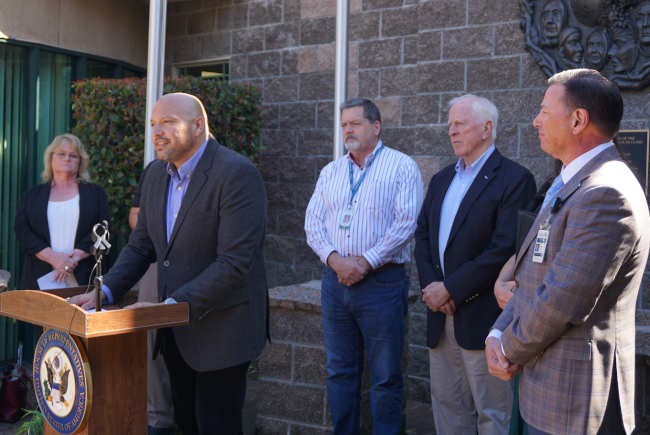
In February, Congressman Mike Thompson, Board of Supervisors Chair Eddie Crandell and five local health care leaders warned that the then-passed Republican budget resolution may jeopardize access to care and create more food insecurity in Lake County at a press conference.
“So this is not a Tribal Health or Sutter or Adventist issue — this is a Lake County issue,” said Tribal Health CEO Ernesto Padilla at the press conference. “This could be crippling.”
At that time, Padilla told Lake County News that Tribal Health receives 60 to 70% of its funding from Medi-Cal.
On the night of Saturday, Oct. 4, Lake County Health Public Health Director Anthony Arton, who was not at the February meeting alongside the other health care leaders, responded to Lake County News’ inquiry on the anticipated impact of the OBBBA on the department and the county.
While saying the impact on the department has been “minimal” so far, Arton mentioned scaling back services and reconsidering hiring priorities.
“We are scaling back the CalFresh Nutrition Education Program as funding runs out and focusing on cross training staff,” he said. “We're also prioritizing mission critical roles in our hiring process and staying in close communication with our healthcare partners both locally and at the state level.”
He added: “As Medicaid changes take effect, we are preparing to enhance community education efforts to ensure residents are informed about available resources and how to obtain care.”
When talking about the potential impact on Lake County, Flora mentioned the $50 billion set aside for rural health care in the OBBBA.
The Senate Committee of Finance statement said, “The $50 billion rural hospital fund is intended to provide immediate relief to rural hospitals while allowing facilities to establish the tools necessary to be successful in the long term.”
However, Flora was not so optimistic of how much it will benefit California.
While he believes California is likely to get some of that amount, “with the sort of game that's being played between Trump and Newsom, we may not get the share that we really should,” Flora said. “That's something everyone's trying to keep an eye on, but we just don't have any answers right now.”
Email staff reporter Lingzi Chen at
Purrfect Pals: This week’s new cats
LAKE COUNTY, Calif. — Lake County Animal Care and Control has several new cats and kittens who are ready to be adopted.
The kittens and cats at the shelter that are shown on this page have been cleared for adoption.
Call Lake County Animal Care and Control at 707-263-0278 or visit the shelter online for information on visiting or adopting.
The shelter is located at 4949 Helbush in Lakeport.
Email Elizabeth Larson at








Governor signs bipartisan package of bills reforming California’s insurer of last resort
Gov. Gavin Newsom has signed a bipartisan package of bills that will improve the state’s insurer of last resort and help Californians recover from disasters.
The action builds on years of work to combat the climate-fueled insurance crisis, which is being felt across the country and around the world.
The legislation strengthens the state’s third-party insurer of last resort, the FAIR Plan, with new financing mechanisms to more swiftly pay claims, better oversight, improved policyholder experience, and added coverage for manufactured homes.
Additionally, the California Department of Insurance will be required to consider additional home hardening measures every five years as part of its Safer from Wildfires efforts.
"The kinds of climate-fueled firestorms like we saw in January will only continue to worsen over time. That’s why we’re taking action now to continue strengthening California’s insurance market to be more resilient in the face of the climate crisis,” said Newsom.
Last month, the governor signed an executive order to expedite the state’s response to mitigate the impacts and fairly allocate the costs of natural disasters and further stabilize the insurance market and energy utility sector.
"These crucial reforms to the FAIR Plan mark a significant step forward in protecting consumers, stabilizing the market, and enhancing transparency. As we implement the largest regulatory changes in our market, the insurance company-run FAIR Plan must meet the challenge of addressing our insurance crisis," stated Insurance Commissioner Ricardo Lara. "As we tackle availability concerns and ensure that insurance companies provide consumers with policies in the traditional market as mandated by my new regulations, the FAIR Plan must offer essential support to its customers. I am grateful to Governor Newsom for his continued leadership and to the legislators who have worked on these vital issues, which will greatly benefit communities most at risk of wildfires."
The governor signed the following bills:
AB 1 by Assemblymember Damon Connolly (D-San Rafael): Residential property insurance: wildfire risk.
AB 226 by Assemblymember Lisa Calderon (D-Whittier): California FAIR Plan Association.
AB 234 by Assemblymember Lisa Calderon (D-Whittier): California FAIR Plan Association governing committee.
AB 290 Assemblymember Rebecca Bauer-Kahan (D-Orinda): California FAIR Plan Association: automatic payments.
SB 525 by Senator Brian Jones (R-San Diego): California FAIR Plan: manufactured homes.
Stabilizing California’s home insurance market
In 2023 Newsom issued an executive order urging Insurance Commissioner Lara to take swift action to address decades-old issues with the insurance market exacerbated by climate change and expand coverage options for consumers, while maintaining strong consumer protections and keeping plans affordable.
That led to the creation and swift execution of the Sustainable Insurance Strategy, a package of reforms that strengthens California’s marketplace and maintains strong consumer protections.
Newsom’s office said he has continued to support the insurance commissioner’s regulatory actions in this space, including requiring insurers that use new catastrophe modeling to write more policies in distressed areas.
The Department of Insurance recently announced it had completed a review of three forward-looking wildfire catastrophe models, a key element of implementing the Sustainable Insurance Strategy.
Home insurance rates in California — while increasing along with the national trend due to climate-related threats — continue to be lower than the national average, among the lowest in the nation, Newsom’s office reported.




