How to resolve AdBlock issue?
News
LAKE COUNTY, Calif. — Californians on Tuesday overwhelmingly approved Proposition 50 to redraw congressional boundaries.
Based on the preliminary vote count, Lake County delivered only a narrow win in favor of the measure on election day.
However, the vote count is expected to change during the official canvass, which will continue until the election is certified on Dec. 12, so how Lake County ultimately decided on the matter won’t be certain for weeks.
The passing of Proposition 50 means California will temporarily adopt new congressional district maps drawn by the Legislature, giving Democrats a better chance of winning up to five additional House seats from Republicans in the next midterm election.
For many, putting the matter on the ballot is a response to Republican gerrymandering, where President Trump urged GOP-led states to redraw their districts.
“We put Prop 50 on the ballot and voters passed it today in direct response to Texas Republicans’ choice to draw and pass a new, rigged Congressional map without input from voters,” Congressman Mike Thompson said in a statement after its passage. “That’s anti-democratic, plain and simple.”
Statewide, the preliminary count as of 2 a.m. Wednesday showed that voters approved the proposition by nearly a 2-to-1 margin: 63.8% in favor and 36.2% opposed.
Whereas in Lake County, the results were much tighter, with a difference of just 236 votes. Of all the 10,358 votes counted by Tuesday night, 51.14%, or 5,297, were in favor and 48.86% or 5,061, opposed.
These numbers include 8,732 vote-by-mail ballots received and counted by Nov. 4, and 1,630 ballots turned in to the 20 polling places around the county on the election day.
They do not include ballots turned in at the six drop boxes around the county, because those ballots require signature verification before counting.
The rest of the vote-by-mail ballots postmarked on or before Nov. 4 and received by Nov. 12 will also be counted at a later date upon receiving.
Those who showed up at polling stations on Tuesday seem to display a differing preference: out of the 1,630 votes cast, 1,010, or 61.96% voted against the proposition — against both the local and state trends.
Regardless of the final local results, however, congressional redistricting will take place.
For Lake County, it means Thompson will cease to serve most of the county except for a portion in the south.
“I love my current district, and I will continue to serve the people in our community with dedication and to work with the candidate elected to represent the First District,” Thompson said in a statement. “I am also excited and energized to work with the local leaders in our newly-formed Fourth District to serve our community and address the issues important to them.”
Final hours of election night
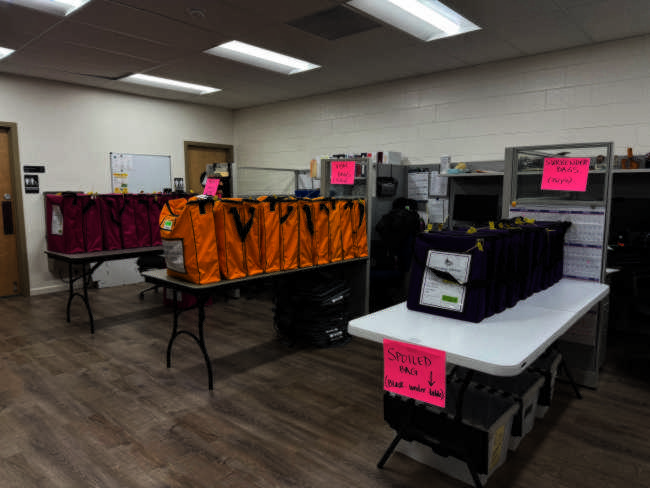
As the statewide special election unfolded amid the debate over gerrymandering, the Lake County Registrar of Voters office on Forbes Street in Lakeport carried on with a sense of order, calmness as well as some warmth.
While the office waited for vehicles delivering ballots from across the county, an unexpected visitor from the recent Halloween weekend — a black spider roughly an inch long — was spotted roaming the lobby. A young election worker took it out, declining the suggestion to kill it.
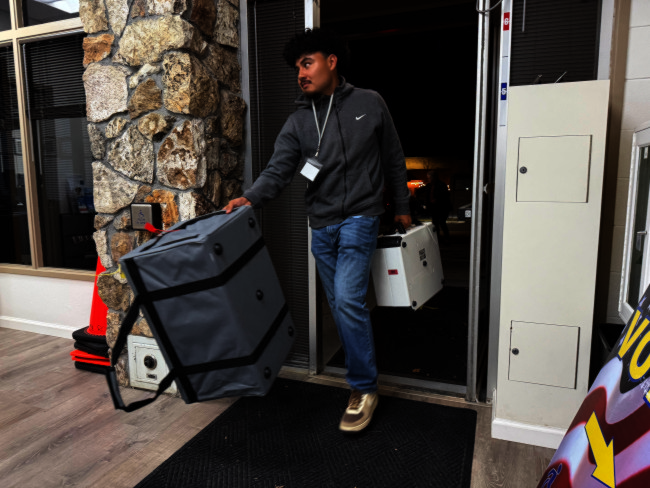
Shortly after 9 p.m., cars began arriving intermittently, with one from Upper Lake arriving first. As soon as ballots came in and were sorted, counting started at the scanning machine, with two people operating at each station.
The office grew busier and quieter as waves of ballots were delivered and poll workers departed.
For the special election, the registrar’s office deployed five permanent staff, five to six extra help personnel, and two IT staff, with supervisors Bruno Sabatier and Brad Rasmussen volunteering at the site, Registrar of Voters Maria Valadez told Lake County News.
Valadez said throughout the day that seven people stayed on the phone answering voters’ questions, from lost ballots to changed addresses, just as in past elections. At least one person was always at the counter.
Ballots were processed orderly and quickly once unloaded into the office.
“We have a great team here,” said Valadez. “We are really organized; we have to be organized.”
“Shoutout to our poll workers too because they rock,” she added.
“We were doing great. We always have a good turnout but we don’t have lines. Our counting was perfect and there’s no mistake,” Precinct 381 Inspector India Akua Mendonca, who has worked at polling stations for over 10 years, told Lake County News as she signed off at the office after delivering the ballots. “We have a great team.”
The expected storm on the night didn’t materialize, but hints were dropped that it might just come soon.
“It starts sprinkling,” Valadez announced, panning in from the parking lot as staff continued waiting for the ballots. The clock had just turned 10:30 p.m.
The night ended after the final ballot was counted at 11:25 p.m.; counting to be continued.
Email Lingzi Chen at
LAKE COUNTY, Calif. — The Board of Supervisors on Tuesday appointed a deputy county counsel to act as interim public defender.
Following a closed session discussion that began in the morning and was continued later in the late afternoon, the board appointed Senior Deputy County Counsel Carlos Torrez to fill the job temporarily.
The county reported that Torrez accepted the appointment, which took effect immediately on Tuesday, the day that outgoing Chief Public Defender Raymond Buenaventura’s tenure officially came to an end.
Buenaventura, who joined the county two years ago, was hired Oct. 14 as chief public defender by the Monterey County Board of Supervisors.
He later submitted his resignation to the county of Lake, with the supervisors accepting it in closed session last week.
Torrez received his law degree from the University of Illinois College of Law and was admitted to the State Bar of California in 2009.
He was involved with the county’s conversion from an indigent defense contract to the new statutory Public Defender’s Office, which the county said “plays a vital role in ensuring effective client representation and the responsible stewardship of public resources.”
The county’s take on the office’s effectiveness is despite ongoing concerns from county defense attorneys and criticism from judges about the performance of the public defender’s attorneys in court since the office was restarted in 2023. A previous iteration of the Public Defender’s Office was abandoned 40 years ago due to the high cost of dealing with conflicts of interest among its attorneys.
The county’s announcement on his interim appointment said Torrez brings 10 years of dedicated public service experience, including extensive work in complex litigation, management, leadership and policy development.
“During his tenure with the Office of the County Counsel, he has demonstrated unwavering professionalism, sound legal judgment, and a deep commitment to access to justice for all Lake County residents,” the county’s Monday evening announcement said.
As interim public defender, the county said Torrez will lead a team of “dedicated attorneys and professional staff,” overseeing the office’s criminal defense work including juvenile and probate/conservatorship divisions.
The county congratulated Torrez on what it called a “well deserved appointment.”
Email Elizabeth Larson at
LAKE COUNTY, Calif. — New drone technology the Lake County Sheriff’s Office is rolling out has helped its Search and Rescue team locate a lost hiker.
On Tuesday night at 7:20 p.m., Lake County Sheriff’s deputies were dispatched to the 1400 block of Big Canyon Road in Lower Lake after receiving a report of a lost hiker, the agency reported. The individual was tired and unable to make it out of the rugged terrain on their own.
When deputies arrived, they were unable to locate the hiker or determine which path they had taken. The hiker had been in the wilderness for approximately nine hours, temperatures were beginning to drop and rain was a possibility, said Lauren Berlinn, the sheriff’s spokesperson.
Berlinn said the Lake County Search and Rescue, or SAR, Team was called in to help, along with a member of the newly established Lake County Sheriff’s Office Drone Response Team.
“This search was the kind of real-world scenario the Sheriff’s Office’s new drone program was created to support,” Berlinn said in her report.
Although the program is still in its early stages, Berlinn said the operation showed just how valuable this technology can be for improving search efficiency and keeping both rescuers and community members safe.
The drone was launched in the area of the hiker’s last known location, and within a short time, the operator spotted the missing individual, Berlinn said.
With real-time guidance from the drone operator, Berlinn said two SAR members, Deputy Kaylene Strugnell and her K9 Sadie reached the hiker and safely led them out of the steep, rocky area.
“This successful rescue highlights the important role the Sheriff’s Office Drone Program will play in future operations,” Berlinn said.
She said the drone program “not only improves response capabilities and resource coordination but also increases the likelihood of saving lives.”
The program reflects the Sheriff’s Office’s ongoing commitment to leveraging modern technology in service to the Lake County community, Berlinn said.
“The Lake County Sheriff’s Office is proud of our deputies, dispatchers, search and rescue volunteers, and everyone who worked together to ensure a safe and successful outcome,” she said in her report.
COBB, Calif. – The Cal Fire Sonoma-Lake-Napa Unit announced that the Boggs Mountain Demonstration State Forest entered its annual process of winter season management at the forest starting on Nov. 1.
During this period, the forest will remain open for day use only from sunrise to sunset.
Some recreational facilities will be winterized and closed for the season.
Forest roads will be subject to temporary closure pending wet weather conditions. Off highway vehicles and off-roading are prohibited.
Staff will be committed to unit tasks including prescribed burning on the forest near roads and trails. Do not approach fires and avoid the area if sensitive to smoke.
Cal Fire reminds forest visitors to plan ahead before arriving and respect signage for public safety.
For more information, call the forest office at 707-928-4378 or visit us online at www.fire.ca.gov.
LAKE COUNTY, Calif. — Despite federal court opinions handed down on Friday ruling that billions of dollars in food benefits must be released as the government shutdown continues, Lake County Social Services said the food assistance remains delayed.
Two separate lawsuits resulted in the Friday decisionshttps://lakeconews.com/news/82991-federal-courts-rule-that-snap-benefits-must-be-released-delay-in-food-assistance-still-anticipatedthat found the funding for the Supplemental Nutrition Assistance Program, or SNAP, should be released, and that the government was statutorily required to do so.
That’s because Congress appropriated $6 billion in SNAP contingency funds for the U.S. Department of Agriculture through September 2026.
In addition, one of the decisions — resulting from a lawsuit filed by 25 states including California — found that the USDA also has discretion to use $23 billion in Section 32 funds — from an account set up 90 years ago — for SNAP.
Section 32 funds are in a permanent account, the Funds for Strengthening Markets, Income, and Supply, that’s part of a mandatory appropriation Congress created in August of 1935 to support certain agricultural commodities programs.
One of the established allocations is for domestic food assistance programs like SNAP, as well as child nutrition programs. More information is here.
Despite the orders to release the funds, on Monday the Trump administration indicated it will only pay half of the SNAP benefits for November.
Lake County Social Services Director Rachael Dillman Parsons on Monday released an update on the local situation, explaining that the benefits for CalFresh, which is California’s version of SNAP, are still delayed.
That delay will impact 24% of Lake County’s residents, or 16,320 people, who use SNAP/CalFresh, according to Social Services.
Dillman Parsons’ update explained that benefits will not be issued until USDA releases funds and instructions to states.
“If USDA releases partial funds, state systems will need to be reprogrammed,” she explained.
As a result, she said any partial CalFresh benefits released by USDA may not be issued until Mid-November.
“Your local county welfare department cannot change this,” Dillman Parsons said. “We realize these are difficult times.”
Those who need food now are urged to see the food resource list pinned to the top of the Lake County Social Services Facebook page. That list is also published below.
The Board of Supervisors will hold a discussion with Dillman Parsons, other county staff and community members about the situation during Tuesday’s board meeting.
At that time, Dillman Parsons is expected to offer some potential options to mitigating the impact on the county’s most vulnerable residents.
She also is meeting this week with local food pantries and food banks to discuss opportunities for collaboration.
Email Elizabeth Larson at
LAKE COUNTY, Calif. — Rain, fog, flooding concerns and high winds — this week’s forecast contains the fall season's first storms of note.
The National Weather Service said Monday a “significant” weather system is expected to arrive over the North Coast this week.
Rain began overnight and is expected to continue on Tuesday and Wednesday, bringing with it the potential for moderate to heavy rain, as well as the potential for some minor flooding.
At the same time, the agency has issued for Lake County a wind advisory that’s in effect from 7 p.m. Tuesday, Election Day, until noon on Wednesday, with south winds of between 20 and 30 miles per hour with gusts of up to 60 miles per hour expected. Forecasters said the highest winds will take place over higher terrain, such as ridgetops.
A flood watch also is in effect from 12 a.m. Wednesday until 10 a.m. that same day.
The Lake County forecast calls for as much as 2.25 inches of rain from Tuesday through Wednesday, with up to 3 inches in mountainous areas. Early Wednesday, there is a chance of a thunderstorm.
The forecast anticipates a break in the rain during the day on Thursday and again on Friday night, and on Saturday. Chances of rain are expected to continue through Monday.
Forecasters said there are chances of patchy fog on Thursday and Saturday mornings.
Email Elizabeth Larson at