 How to resolve AdBlock issue?
Business News
- Details
- Written by: Editor
SACRAMENTO – The Assembly Committee on Natural Resources has approved a bill (SB 697) by North Coast State Sen. Patricia Wiggins (D-Santa Rosa) to expand an existing requirement for the California Department of Transportation (Caltrans) to use compost in the state's highway landscape maintenance program.
“Requiring CalTrans to buy and use California’s compost will help create new markets and expand existing ones,” Wiggins said in her testimony before the committee this afternoon. “This bill also assists the state in reducing the amount of waste being disposed of in landfills, and assists the state in meeting the diversion requirements established by the California Integrated Waste Management Board.
“Compost is an effective erosion control and it provides the same benefits as chemical products without the dangers of polluting,” she added.
If approved by the full Assembly and signed into law by Governor Arnold Schwarzenegger, Senate Bill 697 will mark the first step toward assuring that the state is utilizing existing resources and is effectively recycling compost in an efficient and environmentally sound way.
In addition to erosion control, compost provides a savings of construction expenditures due to quicker vegetation establishment, a savings of future maintenance expenditures due to erosion avoidance, and the opportunity for Caltrans to be seen as a partner in the statewide waste reduction effort.
Compost is the product resulting from the controlled biological decomposition of organic material, and can improve soil quality and vegetation, provide erosion control, minimize storm water runoff, and conserve water.
The California Integrated Waste Management Board estimates that organic materials comprise 30% of disposed materials in landfills.
{mos_sb_discuss:2}
- Details
- Written by: Editor
Fair officials are working out the details of a partnership with the newly formed Lake County Vintner's Association to produce a display of as many locally produced wines as possible.
The display will take the place of the commercial wine competition that has been produced by the fair during the past decade.
The number of wines entered in the competition has varied widely from year to year, with as few as 75 wines entered in some years and nearly 300 wines entered in other years.
"We've sometimes had more wines from outside Lake County entered in the competition than wines produced here. We're trying to showcase the local industry through this partnership, and give our patrons a single place to see the huge variety of great wines from Lake County," said Fair CEO Richard Persons.
Competitive classes for amateur wines and beers are still being offered, with cash prizes for winners in a variety of categories.
Information about entering the amateur wine and brewing competitions can be found at the fair's Web site, www.lakecountyfair.com, in the Exhibitor Handbook, which contains information about all of the prize competitions offered at the Lake County Fair.
Fair officials hope the Lake County Vintner's Association display will grow in future years to include a wine tasting opportunity for Fair patrons.
"Wouldn't it be great to be able to attend the fair and view several hundred wines produced right here in your neighborhood, and then purchase tastes of a few wines that you've never tried before?" pondered Persons.
Wine producers interested in participating in the new Lake County Vintner's Association display can contact the fair office at 263-6181 for more information.
{mos_sb_discuss:2}
- Details
- Written by: Elizabeth Larson
LUCERNE – After 44 years in business, “Gypsy” Jim Harris has decided it's time for retirement.
Harris has announced that he's holding a retirement sale for his business, Gypsy Lure and Tackle Co. Distributors, and everything has to go.
The sale will take place from 9:30 a.m. to 4 p.m. July 3 through July 16 at 5825 Highway 20, Lucerne.
The Boy Scouts are helping Harris set up for the sale, and he said there will be an abundance of items for the devoted fisherman.
Harris, 83, is a World War II veteran who was at both the bombing of Pearl Harbor and later at the D-Day invasion, he remains active in local veterans groups and activities.
Harris was in the insurance business after he got home from the war, and after he left that business he began running a bait shop.
He first came to Lake County on a part-time basis in 1962, after meeting a county resident who told him about it. Harris said he liked Lake County because it was easy to get to the mountains or the ocean. He moved his family here permanently in 1973.
Harris' retirement sale will include all of his inventory: all types of rods and reels and rod and reel units; salt water lures; split shot, assorted sinkers in packs; flies, import, domestic, steel head salmon; import snelled hooks; all types of fillet knives; bait knives; replacement nets; B.B. swivels, snap and brass swivels; connectors; beads No. 2 through 10 and fancies; all domestic lures, nets, gaffs, fly and jig vices; and all bulk lures and components.
Harris said everything goes, “including my mistakes.”
Dealers and the public are welcome to take part in this “opportunity of a lifetime” as Gypsy Jim closes his business.
E-mail Elizabeth Larson at
{mos_sb_discuss:2}
- Details
- Written by: Editor

CLEARLAKE OAKS – Shannon Ridge Winery celebrated the grand opening of its new tasting room on Saturday and Sunday.
The event also offered the winery to show of it's newly completed demonstration “vinegarden” and picnic area. The vinegarden aims at increasing visitors’ awareness about the Lake County wine grape growing region.
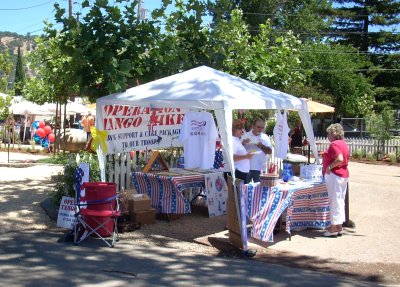
A portion of the proceeds from the grand opening event benefited Operation Tango Mike, a community group that sends care packages to U.S. troops overseas.
{mos_sb_discuss:2}