 How to resolve AdBlock issue?
Business News
- Details
- Written by: Editor
SANTA ROSA, Calif. – Redwood Empire Vineyard Management Inc. of Geyserville has agreed to pay seven farmworkers $33,548 in lost wages and offer them reinstatement to resolve an unfair labor practice complaint filed by the California Agricultural Labor Relations Board.
The complaint by the board, or ALRB, alleged that Redwood Empire Vineyard Management, or REVM, retaliated against workers by issuing written warnings and failing to rehire them because they engaged in protected activity, including a workers’ rights protest, worker marches and other activities together with the local organization North Bay Jobs with Justice.
Under the terms of the settlement agreement with the ALRB, REVM will also rescind language in their employment contracts they require employees to sign stating that those who tried to negotiate higher wages would be immediately fired.
The company additionally agreed to rescind warnings issued against two workers, and to respect the rights of farmworkers to join together and speak up to seek improvements to working conditions without retaliation.
As agreed, ALRB agents will go to REVM’s worksite to read a Notice to agricultural workers about their rights under the Agricultural Labor Relations Act, or ALRA.
This notice will be posted at the workplace for 60 days and mailed to current and former employees. ALRB Agents will also provide training to REVM supervisors about their responsibilities under the ALRA.
The ALRB enforces the Agricultural labor Relations Act, which states that “it is the policy of the State of California to encourage and protect the right of agricultural employees to full freedom of association, self-organization, and designation of representatives of their own choosing, to negotiate the terms and conditions of their employment, and to be free from the interference, restraint, or coercion of employers of labor, or their agents, in the designation of such representatives of in self-organization or in other concerted activities for the purpose of collective bargaining or other mutual aid or protection.”
The ALRB is headquartered in Sacramento and maintains field offices in Santa Rosa, Salinas, Oxnard, Visalia, and Indio.
Those wishing to access ALRB services may call any ALRB office including the Santa Rosa office at 707-527-3256, or a statewide toll-free phone number, (800) 449-3699. More information is available at www.alrb.ca.gov.
- Details
- Written by: Editor
The Employment Development Department, or EDD, just released a simpler online application for disability benefits — another step in modernizing California’s benefit programs and improving the customer experience.
"We're simplifying California’s disability application to serve our customers better," said EDD Director Nancy Farias. "We’re designing and delivering systems that are easier for everyone to understand and access."
Disability Insurance can be a complex public benefit program, with detailed eligibility requirements and required medical certifications. As a result, the application was often considered complex and confusing.
In response, EDD asked customers, employees, and advocates for ideas to make the application easier.
The new, online application includes:
- Revised instructions and questions that are easier to answer — using less technical terms.
• Help text with simple explanations right when they are needed.
• Reorganized questions to improve the overall application experience.
• Improved navigation through complex topics like the medical authorization and declaration signature pages.
• Relabeled page headings and titles to improve the customer experience.
For example, there are times when workers may want their benefits to start at a different time than when their actual disability began. But many customers said they had difficulty providing a date in response to, "Date you want your Disability Insurance claim to begin if different than the date your disability began." This prompt has been replaced with a simpler, yes-or-no question, "Do you want your claim to start on a different date?" If yes, customers are then prompted to provide a date.
EDD reorganized the application and revised the headings to guide customers through the application process and gather all information needed for application review. Some customers didn’t realize that an application for disability benefits was not complete until a medical certification, also known as Part B – Physician/Practitioner’s Certification, was submitted to the Department.
The updated online application includes more visible reminders at the beginning and end of the application process to help the customer understand this required step.
These improvements — and many others — will help EDD process applications more quickly and pay customers faster.
EDD’s commitment to enhance the way Californians engage with its programs and services is all part of EDDNext, an ongoing modernization effort to completely transform the EDD customer and employee experience.
EDDNext efforts include updating benefit applications, contact centers, the claims process, policies, procedures, and forms, to make the EDD experience easier and faster. It involves working with customer service experts, such as Amazon Web Services and Salesforce, to ensure EDDNext is forward-thinking and embraces the best technology and practices.
- Details
- Written by: California Board of Food and Agriculture
SACRAMENTO — The California State Board of Food and Agriculture will hear updates from agricultural organizations, policy experts and business groups concerning single-use plastic packaging regulations on Tuesday, June 3.
The meeting will be held from 10 a.m. to 2 p.m. at the California Department of Food and Agriculture, 1220 N St., Main Auditorium, Sacramento.
The meeting is also available via Zoom. The webinar ID is 871 2264 9005, passcode is Board2025!. The phone access passcode is 2509326576.
There will be simultaneous Spanish interpretation available via the Zoom application.
“We need to reduce plastic pollution in our environment,” said CDFA Secretary Karen Ross. “At the same time, we must consider opportunities and pathways for California’s farmers and ranchers that advance a circular economy and allows for packaging innovation that maintains quality and safety of fresh food products.”
In 2022, Gov. Gavin Newsom signed the Plastic Pollution Prevention and Packaging Producer Responsibility Act (SB 54) into law.
The act established enforceable goals to be achieved by 2032, which include 1) reducing single-use plastic packaging and food service ware by 25%; 2) recycling 65% of single-use plastic packaging and food service ware; and 3) ensuring that 100% of single-use packaging and plastic food service ware is recyclable or compostable.
Since the passage of the Act, the California Department of Resources Recycling and Recovery, or CalRecycle, has been engaged in the rulemaking process and continues public outreach.
CalRecycle is soliciting feedback on proposed changes to SB 54 regulations, with a comment deadline of June 3.
Invited speakers include Susan Robinson, Circular Action Alliance; Emily Rooney, Agricultural Council of California; Gail Delihant, Western Growers; Rick Tomlinson, California Strawberry Commission; representatives from the California Grocers Association and California Chamber of Commerce and other invited speakers. The Board will also be joined by a delegation from the Murcia Region (Spain) to discuss agricultural technology collaboration.
“As a grower, we are always concerned with costs — everything from water, labor, fertilizer and other inputs,” said President Don Cameron, California State Board of Food and Agriculture. “Packaging, whether done in the field or at the cooler, has an impact on a farm’s bottom line. I support cutting plastic pollution but underscore that it is adding more costs to producers in a difficult economic time for agriculture.”
The California State Board of Food and Agriculture advises the governor and CDFA secretary on agricultural issues and consumer needs.
The board conducts forums that bring together local, state and federal government officials; agricultural representatives; and citizens to discuss current issues and concerns to California agriculture.
- Details
- Written by: Redwood Credit Union
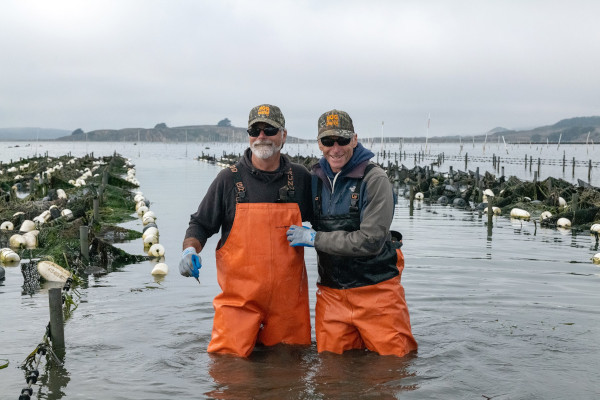
Hog Island Oyster Co. is one of the North Coast businesses being featured by Redwood Credit Union during Small Business Month. Shown here are CEO John Finger and co-founder and Vice President Terry Sawyer. Courtesy photo.
SANTA ROSA, Calif. — As Redwood Credit Union, or RCU, marks 75 years of service, it’s celebrating not just its own history but the stories of the small businesses that helped shape the community alongside it as part of Small Business Month.
One such company is Hog Island Oyster Co. Like RCU, Hog Island is deeply rooted in community — it’s celebrating its 42nd anniversary — while also focused on building strong relationships and a sustainable future.
According to Hog Island founder and CEO John Finger, growing the blue food economy — through proteins sourced from aquatic environments — contributes to a more resilient and equitable food system. To help reduce its carbon footprint, and because oysters reflect a strong “sense of place,” the company sources most of its seafood on the West Coast.
Hog Island was co-founded by Terry Sawyer, who also acts as the company’s vice president. With locations throughout the North Bay and San Francisco, the company is committed to “doing things the right way.” Part of that is choosing where they bank.
“I like the model of a credit union,” Finger said. “Where we bank has an impact. Where that money is used has an impact. It means something to us.”
Another RCU business member, who recently financed heavy equipment with an SBA loan, is Direct Line Dozer, Inc., co-owned by longtime friends Vince Herring and Kevin Fox since 2020. Fox is also licensed as a timber operator for clearing brush for fire prevention efforts, but the company’s emphasis is on fighting fire. In 2024, they worked on the Point fire near Healdsburg, the Toll fire in Calistoga, and the Park fire in Chico, the largest wildfire of California's the season.
Herring’s father and grandfather moved mobile homes for a living, so he “grew up on tractors.” In addition to helping protect communities threatened by wildfires, Herring loves the sense of camaraderie he and Fox share with their crews. “It’s us against the fire. We’ve got to work as a team.”
According to Herring — an RCU member for nearly 20 years who also has mortgage and auto loans through RCU — teamwork was also on full display during his recent loan experience with RCU. Direct Line Dozer relies on federal firefighting contracts, which account for a lot of local jobs, but in order to apply, they needed additional equipment — a second semi and an excavator. Because of a looming deadline, they were worried they would have to wait until 2026.
“It came down to the wire,” Herring said. “The loan officer said it was the fastest they had ever funded an SBA loan.”
With the quick processing, Direct Line Dozer Inc. made the deadline to file for the federal government.
“RCU cares,” Herring said. “They heard our story and wanted to help us grow. They took time to get to know our company.”
He added, “The loan process can be intimidating, but everyone at RCU goes out of their way to make you feel comfortable and find the right person to help.”
Hog Island CEO had a similar experience — he said RCU understands their mission and supports their goals with an array of products and services, such as working lines of credit, fleet vehicle lending, and potential solar energy solutions. He also appreciates RCU’s benefits for its members, such as financial counseling. He's been spreading the word to his employees — those who work hourly often see their incomes vary seasonally, so the financial counseling is a welcome perk.
“Just because you’re making more money in the middle of summer doesn't mean it's going to be that way in January,” he said. “We want to help them have the tools they need to plan for that.”
He added that he appreciates that RCU “knows who we are and cares about what we're doing. It's not just about the money.”
Though this is the month small businesses are celebrated, at RCU they’re top of mind every day, no matter how big or small. RCU proudly serves over 19,000 local businesses. The credit union is currently the #2 SBA 504 lender in the Northern California Market.
“Operating a business in Northern California presents unique opportunities and real challenges,” said Steve Ward, SVP of Business Services. “It’s important to have a local partner who wants to understand your specific situation and present options to help you meet your goals. At RCU, we are committed to listening first and tailoring solutions to meet your unique needs.”
RCU’s Business Services team prides itself on their commitment to the local business community. Over the past three years, they have significantly enhanced the products and services they provide for their business members, ensuring they have access to products and the banking technology necessary to thrive in a competitive market. They offer a full suite of lending options supporting everyday purchases up to large commercial property purchases. RCU is also a Preferred SBA Lender, which allows them to process loans more quickly and efficiently with local decision-making.