 How to resolve AdBlock issue?
Business News
- Details
- Written by: Elizabeth Larson
AB 1013 (Lowenthal) requires establishments with a Type 48 license from the California Department of Alcoholic Beverage Control (ABC) to have signage displayed in a prominent and conspicuous location, letting patrons know that drug testing kits are available to test for common date-rape drugs, often referred to as ‘roofies.’
The required signage displays a message reading, “Don’t get roofied! Drink spiking drug test kits available here. Ask a staff member for details.”
A sample sign is available on ABC’s website and can be downloaded and printed by licensees.
The new law impacts approximately 2,400 licensees across California. Type 48 licenses are issued to bars and nightclubs. The license authorizes the sale of beer, wine, and distilled spirits for consumption on the premises where sold. Minors are not allowed on the premises, and food service is not required.
Licensees will be responsible for procuring testing kits. ABC does not sell or provide kits, and does not recommend or endorse any specific company that does.
Additionally, Type 48 licensed premises must either offer the drug testing devices for sale to customers at a price not to exceed a reasonable amount based on the wholesale cost, or be given to customers free of charge. Drug testing devices could include test strips, stickers, straws or other devices that can detect the presence of controlled substances in drinks. These substances could include flunitrazepam, ketamine, and gamma hydroxybutyric acid.
License holders who do not comply with the new law could face administrative actions impacting their licenses.
- Details
- Written by: Trena Moore Pauly
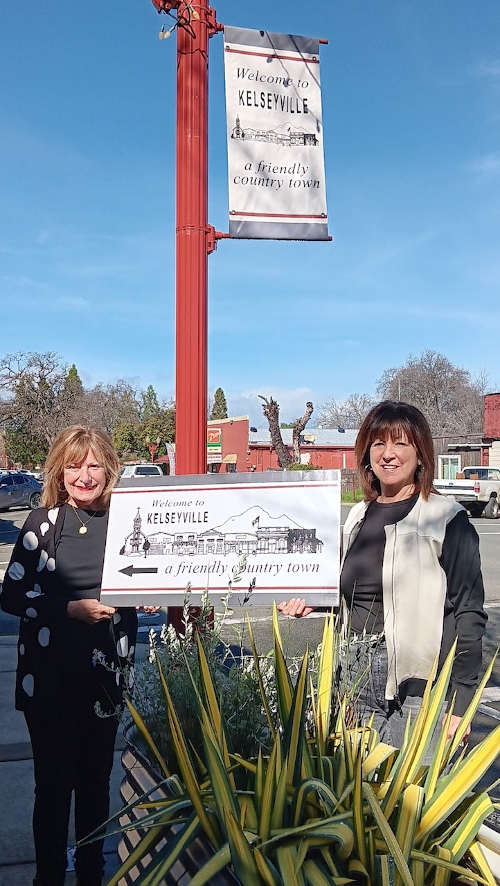
KELSEYVILLE, Calif. — The Kelseyville Pear Festival Committee, led by Cindy Bain, has generously donated over $57,000 to the Kelseyville Business Association Beautification Committee over the past three years.
The funds were a result of the Farm to Fork Dinner auction. They also donated an additional $5,000 towards the restoration of the Kelseyville Senior Center, now the Kelseyville Event Center.
“We are so grateful!” the association said in a statement on the donations.
The Beautification Committee Vision is to enhance the aesthetics and assets of downtown Kelseyville by beautification of public and private spaces.
The committee’s goal is to ensure that Kelseyville remains a safe, clean and attractive place to live and visit.
Its mission is to initiate, promote and facilitate the implementation of projects/programs designed to enhance and restore the beauty and historic character of downtown Kelseyville.
The committee’s scope is beautification efforts, pedestrian amenities and community landscaping, and its purpose is to identify, prioritize, and scope projects; assign project leads; identify available resources and/or need for contractors; and report regularly to KBA board and membership.
The monies were used for the following accomplishments:
• Restoration of the Kelseyville Event Center (senior center).
• New “Welcome to Kelseyville” lamppost banners.
• The painting of all lampposts and garbage receptacles on Main Street.
• Three additional trash receptacles on Main Street.
• Eight benches on Main Street.
• Eight planter troughs on Main Street adorned with plants.
• Event sign at old Kelseyville Lumber Yard.
• Rain bonnets for the two trash receptacles.
• New bulletin board near the Food Center.
• Two “Welcome to Kelseyville” billboards on Highway 29.
These improvements are in the works and are proposed to be accomplished spring of 2024:
• Two “SLOW” flashing solar signs, one for each end of downtown Main Street.
• Replace the reflective tape on eight crosswalks on Main Street.
• Utility vehicle, two-seater with cargo bed and trailer to be used for downtown events.
The beautification committee offered its sincere thanks to the Pear Festival Committee for its generous donations and commitment to Kelseyville.
Trena Moore Pauly writes on behalf of the Kelseyville Business Association Beautification Committee.
- Details
- Written by: Elizabeth Larson
To date, 500,518 servers and managers at more than 56,000 statewide businesses in California have been trained and certified in responsible beverage service. On average, more than 10,000 alcohol servers are certified in responsible beverage service each month.
“This has been an amazing, ongoing joint effort between the department and industry partners,” said ABC Director Joseph McCullough. “The positive engagement and participation we've seen from our licensees shows their dedication to promoting responsible alcohol service.
Assembly Bill 1221, signed into law in 2017, created the Responsible Beverage Service Training Program Act with the intention of reducing alcohol-related harm to local communities.
The bill required ABC to create a program to ensure that on-premises servers of alcoholic beverages and their managers are educated on the risks of serving alcohol and related responsible practices.
Currently, alcohol servers and their managers working in California must have a valid RBS certification from ABC to serve alcohol. If they are newly hired, they must pass an exam and be certified within 60 days of their first date of employment.
To meet the training requirement, any on-premises alcohol server or manager must register in the Responsible Beverage Service Program, or RBS, Portal, take training from an authorized RBS Training Provider, and pass the ABC Alcohol Server Certification exam within 30 days of their confirmed training.
There are currently 80 RBS training providers offering training in English, Chinese, Korean, Spanish, and Vietnamese. The exam is available in English, Chinese, Hindi, Korean, Punjabi, Spanish, Tagalog and Vietnamese.
“We are working hard to ensure all servers have access to this program,” said Megan Brewer, ABC staff services manager for the RBS Training Program. “Our goal is to ensure licensees and servers have access to training in as many languages as possible. We are constantly working to offer additional programs, especially non-English programs.”
ABC protects communities through education, prevention, and enforcement programs designed to increase compliance with California’s alcoholic beverage laws.
If you are a new alcohol server or have not yet obtained certification, please visit www.abc.ca.gov/education/rbs to learn more.
- Details
- Written by: Cal Fire
This funding supports California’s goals of conserving working forests to help protect natural landscapes threatened with conversion to other uses, promote sustainable and resilient forest practices, and encourage longterm stewardship in line with the goals of the California Wildfire and Forest Resilience Task Force.
Under this competitive grant program, Cal FIre purchases or accepts donations of conservation easements or fee titles of productive forest lands from willing sellers, to encourage long-term conservation throughout the state.
The solicitation for these grants is two-part: first, a pre-application must be submitted, which will be ranked and scored; second, successful pre-applicants will be invited to complete a full application that will be considered for funding.
The pre-application period is open from March 18 to April 16, 2024. Invitations to complete a full application will be made by May 7, with the full application period open until June 7. A field visit by Cal Fire staff to the potential project properties is required.
Additional application information including grant guidelines, eligibility requirements, and deadlines can be found on the Forest Legacy Program website. All grant work must be completed by June 30, 2028.
Funding to conserve working forests is provided through the Budget Act 2023. Administered by Cal Fire’s Forest Legacy Program, this critical funding works to ensure that forests are safeguarded for future generations while also aiding the state in meeting critical climate and carbon goals.
Protection of California’s forests through these grants ensures they continue to provide such benefits as wildlife habitat, recreation opportunities, watershed protection and open space, and supporting sustainable wood product economies.