 How to resolve AdBlock issue?
Business News
- Details
- Written by: Elizabeth Larson
“Today we put financial institutions on notice that we will hold them responsible for customers who are cheated out of their investments,” Sen. Dodd said Friday. “When incidents of abuse and exploitation happen it is unacceptable. I thank the governor for signing this much-needed law that will require insurance agents to do what’s best for their clients. If they know an annuity is a bad fit, they will not be able to sell it.”
Senate Bill 263 is the latest consumer protection proposal from Sen. Dodd. Sen. Dodd is also authoring SB 278, which would hold financial institutions accountable for not protecting seniors when they are victims of fraud.
Also last year he introduced SB 478, which would outlaw hidden fees in an array of transactions, including banking.
In his continuing effort to protect our state’s most vulnerable, Sen. Dodd’s SB 263 would require insurance producers and insurance companies to strengthen suitability standards for the sale of annuities.
The bill would ensure California meets federal and national model standards, while providing additional consumer protections.
The goal is to prevent the sale of these financial products to people who do not understand them or would not benefit from them.
The bill is sponsored by Insurance Commissioner Lara and supported by the California Commission on Aging. It won unanimous, bipartisan support in the Legislature before being signed by the governor.
“Gov. Newsom’s signing of SB 263 puts consumers’ best interests ahead of insurance company sales of annuities,” said Insurance Commissioner Ricardo Lara, who sponsored SB 263. “This new law protects California seniors by requiring all sales of annuities be based first and foremost on the facts of their individual insurance needs, financial situation and goals. I commend Sen. Dodd for authoring this commonsense consumer protection law.”
Dodd represents the Third Senate District, which includes all or portions of Napa, Solano, Yolo, Sonoma, Contra Costa and Sacramento counties.
- Details
- Written by: ATTOM
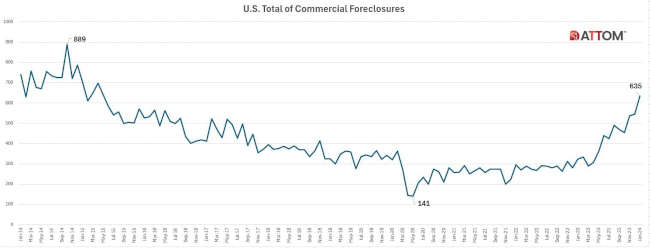
IRVINE, Calif. — ATTOM, a leading curator of land, property, and real estate data, has released a special report on U.S. commercial foreclosures.
The report reveals a significant climb in commercial foreclosures over the years, from a low of 141 in May 2020 to the current figure of 635 in January 2024. This represents a steady increase throughout the period.
A decade of data driven decisions
ATTOM's analysis began in January 2014, a time when the nation was emerging from the shadows of economic uncertainty, with commercial foreclosures at 740 nationwide. Over the next decade, ATTOM tracked fluctuations, witnessing the highest spike in October 2014 with 889 foreclosures, indicating the ongoing market corrections and adjustments.
However, the trajectory wasn't a steady incline. In the face of challenges such as the COVID-19 pandemic and changing economic policies, the market displayed remarkable adaptability. While the pandemic saw an initial rise in foreclosures, the subsequent months showed a notable stabilization as businesses adapted to new market realities.
In May 2020, the United States marked a significant low in commercial foreclosures, reaching 141 commercial foreclosures, reflecting the immediate impacts of the COVID-19 pandemic and the swift response measures that followed, including moratoriums and financial aid.
By January 2024, commercial foreclosures had surged to 635, a stark contrast to the 2020 low. The 97% year-over-year increase signals a revitalizing market that is navigating through the long-term economic shifts following a global event, adapting with resilience and strategic adjustments to new commercial realities.
“This uptick signifies not just a return to pre-pandemic activity levels but also underscores the ongoing adjustments within the commercial real estate sector as it navigates through a landscape transformed by evolving business practices and consumer behaviors,” said Rob Barber, CEO at ATTOM.
State-by-state commercial foreclosure review
California, as a bellwether state, began the decade with 209 foreclosures in January 2014. Though it experienced a decrease in the following months, the foreclosure numbers saw fluctuations reflecting the state's dynamic economic climate.
By January 2024, California had the highest number of commercial foreclosures for the month, at 181. This was a 72 percent increase from last month and a 174 percent increase from last year.
New York, Texas, New Jersey, and Florida also showed significant variance over the decade, with each state's unique economic composition influencing the foreclosure rates.
For instance, New York had a total of 59 commercial foreclosures in January 2024, a 12 percent decrease from last month and a 12 percent decrease from a year ago.
Whereas Texas saw a 17 percent increase from last month and a 143 percent increase from last year. New Jersey saw a 38 percent increase from last month and a 157 percent increase from last year.
Finally, Florida saw a 18 percent increase from last month and a 42 percent increase from last year.
- Details
- Written by: UScellular
Global Day of Unplugging is an annual awareness campaign that encourages people to take a break from technology and celebrate human connection over digital engagement.
"Our mission at UScellular is to connect people to what matters most, but there are times when the technology helping create these connections can have unintended consequences in our lives," said Sarah Pearson, area vice president at UScellular. "We encourage everyone to join us on Global Day of Unplugging to take a break and reset their relationship with technology.
It’s well-known that Americans are increasingly dependent on their smartphones for essential daily functions, entertainment, and connection, but data from a December 2023 survey commissioned by UScellular suggests that people may need a break.
According to the survey, 41% shared that they could use some time away from their phone and nearly a third of people want to take an intentional break from their phone.
Additional survey findings reveal:
• 56% of people have experienced “phubbing” or the act of being ignored by someone you are with because they are on their cellphone.
• Nearly 75% of people spend at least an hour on social media every day, with 24% spending 3-4 hours per day.
• More than half of people spend at least one hour texting every day, 63% spend at least an hour web browsing and nearly half spend at least an hour mobile gaming.
For every person who shares their participation at uscellular.com/unplugging, the company will make a donation, up to $50,000, to Unplug Collaborative, the non-profit that organizes the Global Day of Unplugging and works to make tech-free experiences meaningful and accessible to all.
Actress and producer Sarah Michelle Gellar is also lending her voice to the campaign to encourage her social media followers and consumers to participate.
To help people participate, UScellular suggests activities focused on human connection over digital engagement, including going on a hike or walking your dog, volunteering for a local non-profit, or going on a road trip with friends or family.
UScellular launched its “Built For US” campaign in February 2023 to lead the conversation around developing healthier relationships with technology. This includes a variety of programs and tools such as:
• The "Phones Down for 5 Challenge," an invitation for people to take a phone break in a way that works for them.
• US Mode, an effort to help smartphone users better utilize customizable native focus settings on their smartphones.
• In partnership with Screen Sanity, the company introduced the “Smarter Start Toolkit,” a free, downloadable kit for families looking for guidance on building better digital habits.
- Details
- Written by: U.S. Department of Agriculture and the U.S. Department of Energy
Through the Rural and Agricultural Income & Savings from Renewable Energy, or RAISE, initiative, USDA is setting an initial goal of helping 400 individual farmers deploy smaller-scale wind projects using USDA’s Rural Energy for America Program, or REAP.
This goal is only possible because of President Biden’s Inflation Reduction Act which provided more than $144 million in grant funding for underutilized technologies through the REAP program.
Additionally, DOE is announcing a total of $4 million in related funding, including $2.5 million to support the testing, certification and commercialization of the latest distributed wind technologies including for the agricultural sector, and $1.5 million to support outreach and the identification and development of new business models for farmers to save money and earn income deploying these technologies.
“Today’s announcement furthers the Biden-Harris Administration’s commitment to rebuild our nation’s economy from the middle out and bottom up by increasing income and opportunities for the small and mid-sized farmers that keep rural main streets vibrant,” USDA Secretary Tom Vilsack said on Monday. “By strengthening our longstanding partnership with DOE through the RAISE initiative, USDA is ensuring farmers and hardworking Americans everywhere have the opportunity to save money and earn income from smaller-scale, distributed renewable energy technologies. These investments will create long-lasting economic benefits for their families, businesses and communities for years to come.”
“There is a huge opportunity to power the American heartland with distributed wind resources, and President Biden’s Investing in America agenda is tapping into that potential so that all Americans can reap the benefits of the clean transition,” said U.S. Secretary of Energy Jennifer M. Granholm. “DOE is raising the bar with our partners at USDA — creating jobs, lowering costs and increasing energy independence for farmers and those in rural communities.”
Operating under an existing memorandum of understanding, USDA and DOE have a joint working group overseeing an action plan for the RAISE initiative. DOE has identified advances in certified distributed wind technology that have opened a significant market opportunity, enabling cost-effective investments for farmers and rural communities.
Initial RAISE initiative activities, focused on smaller-scale or distributed wind, are expected to include:
• USDA providing additional technical assistance to support applications for the use of the $144.75 million in grant funding from the Inflation Reduction Act for REAP underutilized technology projects, including but not limited to farmer-owned smaller-scale wind projects, small-scale hydropower, geothermal, biomass-based and other clean energy. DOE also intends to prioritize technical assistance for smaller-scale wind projects through various programs.
• DOE’s Wind Energy Technologies Office funding $1.5 million for research into and outreach on new business models for collaborations of farmers to earn income from distributed wind, including through farm associations that could administer it with fee-for service models.
• DOE’s Wind Energy Technologies Office calling for proposals for up to $2.5 million under the Distributed Wind Competitiveness Improvement Project, or CIP, which funds distributed wind technology development, testing, certification, and commercialization. CIP provides support to U.S. component suppliers and manufacturers of small- and medium-sized wind turbines. For the first time, this round of CIP funding includes a specific focus on commercialization of distributed wind turbines for the agricultural sector in support of the RAISE initiative.
• USDA and DOE hosting a joint webinar series to provide information to farmers, rural electric cooperatives, farm associations, and small-scale, distributed wind providers about our programs and how to use them to develop place-based wind projects. The first webinar in the series will launch a new National Distributed Wind Network and Resource Hub on March 14, 2024.
• USDA and DOE developing a farmers guide to distributed wind power that will include technical, economic, and geospatial analysis regarding distributed wind technologies and applications as well as ways to finance smaller-scale wind projects.
There are many small-scale underutilized technologies that farmers and rural communities can benefit from. USDA and DOE are working together through the RAISE initiative to increase education, outreach, research and technical assistance to help small and mid-sized farmers save money and earn income from underutilized technologies.
Distributed wind includes, for example, a single wind turbine to meet a farm’s energy demand and save and stabilize electricity costs. It could also include a few wind turbines across several farms to support a local electricity utility, thereby earning a revenue stream for the hosting farms.
Distributed clean energy projects can create cost savings and income for farmers and rural small businesses. They also support energy independence, local electric grid reliability, and enhance resilience by providing back up power, especially when it is paired with energy storage.
These projects also create jobs and investments in rural economies, with approximately a third of a renewable energy project value usually invested in the local communities through construction jobs and maintenance. These projects also give farmers, rural electric coops, and food companies the opportunity to address climate change.
DOE has worked with industry partners and its national labs to develop a new generation of reliable, high performing and cost-effective distributed wind technologies that are certified to national performance standards and that represent significant improvements over prior generations of distributed wind technology.
DOE works to ensure America’s security and prosperity by addressing its energy, environmental, and nuclear challenges through transformative science and technology solutions. Learn more about DOE’s efforts to advance distributed wind and sign up for the Wind Energy Technologies Office’s newsletter.
USDA Rural Development provides loans and grants to help expand economic opportunities, create jobs and improve the quality of life for millions of Americans in rural areas. This assistance supports infrastructure improvements; business development; housing; community facilities such as schools, public safety and health care; and high-speed internet access in rural, tribal and high-poverty areas. Visit the Rural Data Gateway to learn how and where these investments are impacting rural America.
To learn more, visit www.usda.gov.