
Opinion
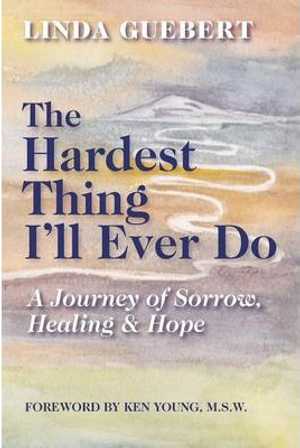
In the tradition of C.S. Lewis and Joan Didion comes another gifted writer chronicling the aftermath of the death of the beloved.
“There is a knock at the door,” she begins.
A policeman. After nine months of marriage the soulmate it took her a lifetime to find is suddenly no more. “Oh my god, oh my god.”
In “The Hardest Thing I’ll Ever Do,” Linda Guebert touches us where it hurts, exquisitely capturing the moody tides of agonizing despair and senseless hope that follow the tragedy of love lost. And who among us has not loved and lost, one way or another?
Subtitled “A Journey of Sorrow, Healing & Hope,” this stirring memoir leads us down the dead ends of denial and magical thinking; through mortuaries and memorials, old photos and the death of dreams; into the bottomless abyss of sleepless nights and wretched days; and through the labyrinth of wine, valium, bereavement groups, self-help books, massage, anti-depressants and psychotherapy – only to discover the greater healing power of friends, family, humor and kittens.
And time. Those sweet healing hands of time …
Guebert weaves this collection of deepest thoughts and feelings with pointed narratives, uncensored journal entries, the wise words of other bereaved souls, irony and humor (yes, humor), and poignant song lyrics heading each chapter.
The writing is well-crafted, well-paced and engaging – one minute searching out the meanings of life and death, the next minute raging against the ungodly unfairness of life and death, the next minute broken and sobbing on the floor.
The author gives clear and personal voice to the subtleties and complexities of a broken heart and spirit, and the long, slow process of rising from the ashes.
She guides us step-by-lonely-step through the seemingly endless purgatory of pain-filled holidays and anniversaries, leading slowly but inexorably to the resurrection of life, love and hope.
Forcing herself to stay involved with her community radio program, her teaching, her writing and the theater she loves, we watch as Guebert evolves to the bittersweet realization that she isn’t ready to die yet whether she wants to or not. That she longs to love again, someday.
And in time, one day the horror movie is over – but never the love – and a new chapter, a new storyline, begins.
Guebert’s odyssey serves as an important reminder to us that there is a gift in the heart of a wound, that the darkest hour is just before dawn, and that life goes on, carrying us along in its mysterious currents into the unknown future.
Many readers have said they “couldn’t put it down.” I read it in two sittings.
Buy this book, available at Watershed Books in Lakeport, at any Lake County library branch, or online at www.amazon.com or www.barnesandnoble.com . Take it to bed with a cup of hot cocoa, and be touched heart and soul.
“The Hardest Thing I’ll Ever Do: A Journey of Sorrow, Healing & Hope,” 2013 by Linda Guebert, paperback $19.99.
Dr. J. Holden, Ph.D., is a psychologist.
- Details
- Written by: J. Holden
As our society has changed, so have the technologies we all use everyday. Our children don’t know life without today’s technology. As we use today’s technology to enhance and improve our lives today, we must also be wary of the dangers.
Many children use the Internet and social media as their new playground. Some people spend more time online than any other activity in their life.
Although many people feel their children are safe because they are in the home and away from the dangers of the outside world, they are not. The Internet has allowed people who prey on children into your house through the Internet.
I admit having the ability to contact your children by cell phone is an incredible convenience. I am not against today’s technology, but I am concerned how this technology is used to put our children in harm's way.
As many of our children’s cell phones these days also have access to the Internet, the threat is with them much of the day. Most teenagers would consider their cell phone as there most important possession as it gives them freedom.
The Internet is full of predators. More than just people who are after your Social Security number and bank account information, the Internet is a tool used by people who want to prey on your children. Predators on the Internet are sophisticated and dangerous and many of them target your children.
It is very important for parents to talk to their children about the Internet. The Internet is an incredible learning tool and when used properly can enhance your children’s education. And yes, you need to be able to trust your children, but they must be well educated about the dangers of the Internet and social media. Just like children have been taught about stranger danger, there are many strangers online.
Some information your children post on social media Web sites like Facebook seem innocent, but do you really know who is looking at this information?
There is also a trend on social media sites being called “cyber bullying.” In these cases comments can be made which are hurtful or harassing and the problem escalates. This is a real problem which has been documented in recent national headlines where some teenagers have committed suicide over postings on social media.
There are also numerous documented cases in this country where children were communicating through the Internet with predators. Generally these predators misrepresented themselves as children and had friendships or relationships with these children. Some of these children later met with these strangers, resulting in some of them being sexually assaulted or murdered by theses predators.
Each household with children needs to discuss the dangers of the Internet. I have researched numerous Web sites that discuss this growing danger of the Internet and found www.Netsmartz.org does a very good job at educating both parents and children about these dangers. This Web site is operated by the National Center for Missing and Exploited Children (NCMEC) and I urge parents to go to the Web site and spend some time reviewing the information with their child.
The following are a few ideas from the Netsmartz Web site to assist you in keeping your children safe of the Internet.
Children use a variety of online services, and each of these services can have different safety concerns. However, there are some basic tips which you can employ no matter how your children use the Internet.
- Keep the computer in a high-traffic area of your home.
- Establish limits for which online sites children may visit and for how long.
- Remember that Internet technology can be mobile, so make sure to monitor cell phones, gaming devices and laptops.
- Surf the Internet with your children and let them show you what they like to do online.
- Know who is connecting with your children online and set rules for social networking, instant messaging, e-mailing, online gaming, and using webcams.
- Continually dialogue with your children about online safety.
Start a discussion with your child:
- What are your favorite things to do online?
- What is personal information? Why should you keep it private?
- What could you do to be safer online?
- What would you do if anyone online asked to meet you face-to-face?
- Besides me, who do you feel that you can talk to if you are in a scary or uncomfortable situation?
My hope is to keep all children safe. If you suspect a child has been victimized, contact your local jurisdiction and report it:
- Lake County Sheriff’s Office – 707-263-2690;
- Lakeport Police Department – 707-263-5491;
- Clearlake Police Department – 707-994-8251;
- NCMEC Cyber Tip Line – 1-800-843-5678.
Det. Todd Dunia works for the Lake County Sheriff’s Office, based in Lakeport, Calif.
- Details
- Written by: Todd Dunia





 How to resolve AdBlock issue?