 How to resolve AdBlock issue?
Education
- Details
- Written by: Editor
SACRAMENTO, Calif. – Van Ton-Quinlivan, vice chancellor for workforce and economic development for the California Community Colleges Chancellor’s Office, has been appointed to the U.S. Department of Labor Advisory Committee on Apprenticeship.
Ton-Quinlivan was appointed to the committee by U.S. Secretary of Labor Hilda Solis and joins 26 others on the committee representing organized labor, employers and the general public.
The committee provides advice and recommendations on the development and implementation of policies, legislation and regulations affecting apprenticeship programs that connect students and job seekers looking to learn new skills with employers looking for qualified workers.
The committee also is involved in the preparation of the U.S. workforce through employment and training programs and agrees on strategies that meet the labor demands of a global economy.
“With Vice Chancellor Van Ton-Quinlivan’s appointment we will have a strong voice within this national group advocating for higher education programs that train the workforce,” said California Community Colleges Chancellor Jack Scott. “Our community colleges continue to power the economic recovery by providing the workforce with highly trained individuals. It is through the efforts of Vice Chancellor Ton-Quinlivan and her team that we build even stronger relationships between our colleges and employers who are looking for skilled workers to expand their businesses and the economy.”
Before becoming vice chancellor of the California Community Colleges Workforce and Economic Development Division in 2011, Ton-Quinlivan spent more than 15 years in a variety of corporate leadership roles.
She most recently was director of workforce development at Pacific Gas & Electric (PG&E). While at PG&E, Ton-Quinlivan created PowerPathway, a nationally recognized best practice model program in workforce development.
“I’m proud to represent our 112 colleges and more than 2.6 million students on the apprenticeship committee,” Ton-Quinlivan said. “Apprenticeships are great ‘learn and earn’ models where individuals can acquire hands-on training while working. The combination makes them into exactly the kind of skilled workers that industry is demanding.”
The U.S. Department of Labor Advisory Committee on Apprenticeship is comprised of 27 members and includes leaders from throughout the Registered Apprenticeship system and its partners, including the U.S. Department of Labor's Employment and Training Administration, the National Association of State and Territorial Apprenticeship Directors, the National Association of Governmental Labor Officials, the U.S. Department of Commerce, the U.S. Department of Health and Human Services, the U.S. Department of Energy and the U.S. Department of Education.
To stay current on what the California Community Colleges system is doing to prepare students for the workforce, follow Vice Chancellor Ton-Quinlivan on Twitter: @WorkforceVan.
The California Community Colleges is the largest system of higher education in the nation. It is composed of 72 districts and 112 colleges serving 2.6 million students per year. Community colleges supply workforce training, basic skills courses in English and math, and prepare students for transfer to four-year colleges and universities.
- Details
- Written by: Editor
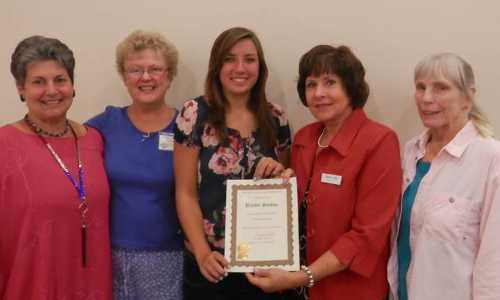
HIDDEN VALLEY LAKE, Calif. – The Hidden Valley Lake Garden Club is happy to announce that Middletown High School senior Rachel Sutton was chosen as the recipient of the 2012 HVL Garden Club scholarship.
As part of the 2012 community projects for the Hidden Valley Lake Garden Club the members chose to offer a scholarship in the amount of $500 to a graduating high school senior interested in majoring in subjects such as horticulture, floristry, natural resource management, viticulture, sustainable agriculture and agriculture production.
Half of the possible points on the evaluation related to participation and leadership in programs and activities and awards with a heavy emphasis on community service that related to the major field of study or science or the environment.
For her senior project, Sutton created a curriculum and guide for teacher-led field trips to the Boggs Ridge State Nature Trail/Cobb Mountain.
“Rachel understands that education is the key to involvement; she placed markers along the trail, providing information that coincides with the species of animals, plants and rocks,” said Therese Nelson, the mentor for Sutton’s curriculum project.
Sutton’s awards included Golden Mustang Award in chemistry May 2011 and Golden Mustang Award in US History May 2011. These awards are presented at the end of each academic year to a select few Middletown High students who exemplify high achievement in specific areas of study.
She also received the Scholar Athlete Award for all three sports – basketball, volleyball and softball, all four years of high school.
She completed the following Advanced Placement classes: AP English, AP Calculus, AP Environmental Science, and AP Spanish.
Sutton is a strong leader not only in sports, but also in the science field. She began her science interest in elementary school in the science fairs with award-winning projects in greenhouse effects, organic farming, and the importance of recycling.
“In all of her research projects Rachel incorporated how people can become involved and make a difference in their community and the world they share with others,” said Nelson, who also is science coordinator and teacher at Cobb Mountain Elementary School.
“Rachel has a natural curiosity and a desire to truly understand the processes of our world,” said her AP Environmental Science class instructor Suzanna Macedo. “These traits not only make for an excellent student, but for a valuable contributor to society.”
Sutton plans to major in environmental science at California State University at Monterey Bay. She selected this college due to its outstanding environmental science program, but also because of their internship programs with the scientific organization Monterey Bay Aquarium Research Institute.
Her career-related goal is to protect and improve the environment now and for future generations. She intends to pursue a career that will give back to the community through sustainability and conservation of natural resources.
For further information please contact Hidden Valley Lake Scholarship Committee Member Marsha Willard, 707-987-2034,
- Details
- Written by: Editor
UKIAH, Calif. – The Mendocino College Foundation is excited to announce that 32 fifth graders in Lake and Mendocino counties were adopted through the Foundation’s Adopt-A-Fifth Grader Program this year.
Since its inception, 89 fifth graders in Lake and Mendocino counties have been awarded this honor and distinction.
“More schools were adopted this year than ever before and we continue to grow this program by leaps and bounds,” announced Katie Fairbairn, executive director of the foundation.
In fact, at least one fifth grade class in every district public school in Lake and Mendocino counties was adopted this year.
According to Fairbairn, “This program is designed to motivate students at a young age to think about graduating from high school and attending college as well as forging bonds between the College and K-12 schools in Lake and Mendocino counties.”
Donors provide a $700 award per student at one of the elementary schools within our district and the Foundation then invests these funds at an average return of 7 percent per year which will grow to over $1,000 by the time the fifth grader graduates from 12th grade.
The foundation believes so strongly in this program that they guarantee the $1,000 scholarship even if the average rate of return is lower than the projected 7 percent.
The foundation awards a certificate and a check for $25 dollars to each student stating that a scholarship in the amount of $1,000 is available when the student obtains a high school diploma and enrolls for at least one full semester as a full-time student at Mendocino College.
If the student earns a high school diploma, but does not enroll at Mendocino College, $500 will be awarded to the student.
This program would not be possible without the generous support of the 2012 donors: Wade and Marylou Koeninger, George and Ruth Bradford Foundation, Claudia Smith-Hill, Willits Rotary, Mendocino College Management/Confidential, Bruce Burton, David and Christy Scollin, Mendo College Part Time Faculty, Ukiah Valley Medical Center, Ken and Brenda Hoek, Kathy Lehner, Kelseyville Rotary, Tom and Angie Herman, Mendocino College Board of Trustees, Mendocino College Classified Senate, Tommy and Ann Thornhill, Mendo Lake Credit Union, Bob and Marlys Blanc, Ed Haynes, Lynne Bruner, Bette and Katie Fairbairn in memory of Bob Fairbairn, Mendocino College Full Time Faculty, North Shore Business Association, Keeling-Barnes Family Foundation and to many anonymous donors.
Please contact the Mendocino College Foundation Office at 707-468-3164 for more information about this program.
- Details
- Written by: Editor
KELSEYVILLE, Calif. – The Taylor Observatory-Norton Planetarium will host a Lego robotics workshop on Saturday, June 30.
The workshop will be held from 1 p.m. to 4 p.m. at the observatory, 5725 Oak Hills Lane, Kelseyville.
Provide your child a foundation for learning Science, Technology, Engineering and Math (STEM) fundamentals using Lego WeDo Robots.
This workshop will introduce 6- to 11-year-old students to 21st century skill sets in a fun and team-oriented way.
Participants will have the opportunity to assemble robots using familiar Lego components, paired in teams of two humans, one robot and one laptop.
After building their robot, students will program it to perform specific tasks.
During the three-hour session, each team will build several robots to accomplish different goals.
The workshop will be conducted by Children’s Museum of Art and Science member Kinene Barzin and supported by Michael Schenck, director of technology for the Konocti Unified School District.
Registration is $15 per student and includes an afternoon snack and beverages.
Register for this event at www.lakecoe.org/calendar/details/lego_robotics_for_elementary_and_middle_school_students/2012-06-30 .
The robot kits are on loan. Therefore students will not be able to take their LEGO creations home. Hardship scholarships may be available.
For more information on scholarships, contact Bill Haddon, president of the Friends of Taylor Observatory, at 415-209-3084 or