 How to resolve AdBlock issue?
Education
- Details
- Written by: Editor
KELSEYVILLE, Calif. – The Taylor Observatory-Norton Planetarium will host a LEGO robotics workshop on Saturday, June 23.
The workshop will be held from 1 p.m. to 4 p.m. at the planetarium, 5725 Oak Hills Lane, Kelseyville.
Provide your child a foundation for learning Science, Technology, Engineering and Math (STEM) fundamentals using LEGO Mindstorms NXT.
This workshop will introduce 9- to 16-year-old students to 21st century skill sets in a fun and team-oriented way.
Students will understand structural building concepts using LEGOs, build and program Mindstorm robots to accomplish missions.
The workshop will be conducted by an award-winning robotics team from Folsom, Saiyeesh Rathish and Akshay Rathish. Michael Schenck, director of technology for the Konocti Unified School District, will be in support.
You can learn more about the team at http://phoenxtrix.org/ and http://www.gatorobytes.org/ .
Registration is $15 per student and includes an afternoon snack and beverages.
Register for this event at www.lakecoe.org/calendar/details/lego_robotics_workshop_for_kids/2012-06-23 .
The robot kits are on loan. Therefore students will not be able to take their LEGO creations home.
Hardship scholarships may be available. For more information on scholarships, contact Bill Haddon, president of the Friends of Taylor Observatory, at 415-209-3084 or
- Details
- Written by: Jade Fox

On June 2 professional chef Rosy Martin came to Carlé and showed many students how to cook a lineup of food.
The students enjoyed making pulled barbecue pork sliders, coleslaw and brownies.
The Carlé students and staff would like to thank Martin for coming to Carlé and showing many of the
students how to cook creatively.
We would like to show even more thanks as her family refused the school's request to pay for all the food. She stated that her husband donated all the food. The school truly appreciates this kindness.
Everybody at Carlé would like to thank and say goodbye to retiring staff members Verna Rogers and Scott Klynstra of the adult school.
Everybody would like to thank these staff members for all of the time they have spent dedicated to helping educate and change countless students lives. We will miss them and we hope they have a wonderful life in retirement.
Everybody at Carlé would like to say goodbye to Dennis To and Sean Duarte, who are leaving Carlé this year for other job opportunities.
Both Mr. To and Young have worked hard and served the school well and everybody will miss them.
Carlé students and staff would like to thank Donna Johnson, who donated money so a student could be able to get a yearbook.
On June 6 Carlé held its graduation in the high school's new gym. Every student who graduated received an award and some even received scholarships.
The students who graduated were Holly Brumback with First out the Door, Paul Larue with Keepin' it in the Family, Arwen King with Dances to Her Own Drummer, Emily Thompson with the Interact Award, Ashlee Ables with the Focus Award, Alyisha Bachman with Mommy and Me, Jacob Grove with Martial Arts Man, Darren Gasperoni with the Independence Award, Ashely Gravelee with the Yearbook Award, Shawna Sample with the Yearbook Award, Anthony Montalvan with the Gentleman Award, Shania Jones with the Thinker, Corissa Schoonderwoerd with Community Service, Dallas Schell the Recycle Award, Erica Woods with the Sweetheart Award, Shanika Chandler with the Renaissance Girl, Nick Paonessa with I Did It My Way, Leticia Bowman with the Perseverance Award, Raina Golden with The Blossom Award, Zachary Gray with The Fun Loving Award, Joseph Griffith with Hard Working Man, Jessica Johns with Spirit, Dylan Ward with Super Science Award, Tucker Barnett with Vogue, Jesse Green with Against All Odds, Teesha Greer with the Sunshine Award, Robert Potter with the Musician, Colton Robone with the 180 Award, Charles Tracy with the Athlete, Jorge Vieira with The Right Hand Man, Chantilly Pannell with Eyes on the Prize, Tonya Smith with The Come-Back Kid, Lacey Talley with the Biggest Heart, Monique Throop with Most Improved, Dennis Warner with The Well Rounded Award, Desiree Bauer with All Star Student, Jade Fox, Christina Green with the Free Spirit Award, Daniel Hernandez with the Media Award, Kevin Rampone with The Working Man, Kyle Scott with the Military Man, Jonathan Warren with the Trucker, Sean Foss with Future Landscaper, and Gerald Stahlman with Never Left.
Congratulations to all of these students and best of luck in their future endeavors!
This will also be my last article since I am also graduating this year, so goodbye and thank you to everybody who has been reading.
That is all for now, have a great year!
Jade Fox is graduation from Carlé Continuation High School in Lower Lake, Calif.
- Details
- Written by: Editor
UKIAH, Calif. – People arriving at the 2012 Mendocino College Nursing Graduation were greeted by laughter, big smiles and beautiful bouquets of flowers for loved ones.
What everyone didn’t know was that a wonderful surprise awaited all nineteen of the nursing graduates.
A few months earlier, Albert Beltrami of Ukiah generously agreed to provide a magnificent gift to each graduate.
The gift was a check made payable to each nurse in the amount of $400 to fund their state board examination fees.
According to Dr. Barbara French, director of Nursing at Mendocino College, “For every month a nursing candidate waits to take their state board examination, their ability to pass goes down 24 percent. It is absolutely critical that our graduates take the examination immediately following graduation, and this gift from Mr. Beltrami guarantees that they will.”
On average, once students begin the nursing program their annual income drops by over 43 percent due to the intensity of the program.
“Several students approached me prior to graduation expressing their concerns about paying for their state boards. It was hard to keep the secret but well worth it when I saw their faces as the announcement was made,” stated French.
Beltrami believes in supporting his community and has done so by creating the Albert and Patricia Beltrami Scholarship Internship for those interested in pursuing a career in local government and more recently by providing the nursing graduates with this remarkable gift.
“Al knows that a strong and vibrant community is built around having an educated and well trained workforce,” stated Katie Fairbairn, executive director of the college’s foundation.
According to Fairbairn, this unprecedented gift represents a guarantee that these 19 nursing candidates have the ability to immediately sign up for their exams and once passed begin working in our community to provide the care and compassion that embodies a nurse.
“The foundation is extremely grateful to Mr. Beltrami for his generosity and vision to create a stronger community by supporting these graduates,” stated foundation President Gary Smith.
The Mendocino College Nursing program boasts some of the highest pass rates for a community college nursing program in the State of California.
According to French, the current pass rate for Mendocino College nursing students is 96.4 percent while the statewide average is 85 percent.
Student speaker Alison Bowen told the audience in attendance that the last two years in the nursing program were both the hardest of her life and the most rewarding.
Now the real work begins, and she and her classmates can’t wait.
For more information about the Mendocino College Foundation, they can be reached at 707-467-1018 or at http://foundation.mendocino.edu/site/ .
- Details
- Written by: Editor
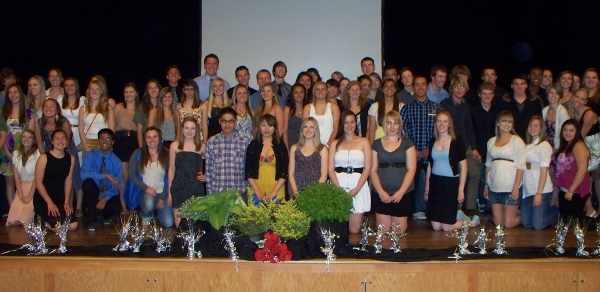
LAKE COUNTY, Calif. – The seventh annual College-Going Initiative University Admit Reception was held on May 7 at Kelseyville High School.
Each year administrators, board members, counselors and college representatives all gather to honor the graduating seniors and their families who have been accepted to a four-year college.
This year, the schools invited 94 students who have been accepted to a wide variety of schools including California State Universities Bakersfield, Cal Poly San Luis Obispo, Chico, East Bay, Humboldt, Long Beach, Maritime, Monterey Bay, Sacramento, San Diego, San Francisco, Sonoma, Stanislaus, Universities of California Davis, Irvine, Los Angeles, Merced, Santa Cruz, plus a variety of out of state and private schools including Alabama A&M University, Art Institute of Sacramento, Arts Institute of San Francisco, Ave Maria University, Baylor University, Baylor University, Brigham Young University, Cal Lutheran University, Chapman University, Dominican University, Grand Canyon University, Hartwick College, John Paul the Great Catholic University, Mills College, Missouri State University, Neumont University, Oregon State University, Pacific Union College, Simpson College, Southern Oregon University, Southern Utah University, St. Mary's College, Texas Tech University, The Master's College, West Virginia University, Westminster College, Whitman College and Willamette University.
The reception was lead by Lake County Office of Education Program Specialist Tammy Serpa, who credited past Director of the College Going-Initiative and current Mendo Lake Credit Union marketing and community development coordinator Jamie Gill for her development of the event for the last 6 years.
Following a welcome address from Superintendent of Schools Wally Holbrook, Lower Lake High Vice Principal Kevin Wickersham gave both parents and students words of advice for their upcoming adventure.
This year’s student speaker was 2011 Middletown High School student Luis Guzman. Luis is currently attending University of Arizona and was unable to make it in time for the event, but was gracious enough to make a video to show in his place describing his first year of college, dorm life, and even how he missed home.
Guests were treated to a wonderful buffet dinner prepared by Michelle Malm and her staff at Kelseyville High School, as well as lively music performed by the Kelseyville High School Jazz Band. Seating for the large group was made possible thanks to the loan of tables from Rick Malm of the CDF.
During dinner service, guests were also able to view the slide show presentation featuring each student’s career goals and special thanks to those that assisted them in achieving their college admission.
Each guest received a seedling of either a blue spruce or redwood tree from the National Arbor Foundation in keeping with the quote of the evening from Harold Taylor, “The roots of true achievement lie in the will to become the best that you can become.”
Students and parents were also treated to a free raffle of prizes that included dorm survival bags filled with items such as first aid kits, sewing kits, towels, sponges and other necessities.
Parents also were treated to raffle prizes form Konocti Vista Casino that included two one-night stays, concert tickets and a café voucher.
Thanks to the generous donations and loan of plants by Kelseyville Lumber and Mendo Mill & Lumber, students were called onto the beautifully decorated stage by their prospective colleges to receive both recognition and small gifts.
All colleges were contacted and asked to send an item from their school as a welcome to the students. Many students received something from their college such as bags, pennants, water bottles, and/or shirts.
Every student received a canvas tote from the Mendo Lake Credit Union, a financial planning workbook from the National Endowment for Financial Education and a deck of cards from Konocti Vista Casino.
Students were awarded their gift bags by Superintendent Wally Holbrook, college rep Ruben Lubers from UC Merced and college rep Daniel Zurkic of Pacific Union College.
The University Admit Reception was created seven years ago to honor the hard work and dedication of our local students and families who achieved a difficult academic goal.
The CGI department is proud of all of Lake County seniors who will be starting college in the fall and wish them a successful future as they embark on their higher education endeavors.
If you would like more information about the University Admit Reception or would like to make a donation to support next year’s event, please contact Tammy Serpa, CGI/CTE Program Specialist at 707-262-4164 or