 How to resolve AdBlock issue?
Education
- Details
- Written by: Editor
MARYSVILLE, Calif. – The Yuba Community College District (YCCD) has received a $348,000 grant to encourage students to enter the Early Childhood Education (ECE) career pathway.
The grant will run through Feb. 28, 2014, and is designed to strengthen the pipeline from elementary to post-secondary education for all students with an emphasis in the area of ECE through career awareness, additional Career Technical Education (CTE) courses, bringing community college classes to the high school campus, and providing engaging workshops and camp activities for students.
A major focus for this California Community Colleges Chancellor’s Office CTE Pathways Initiative and Community Collaborative Project is to continue the pipeline for students onto state colleges and universities and to prepare students interested in careers as credentialed teachers by formalizing feeder programs and outlining for students road maps to achieve those goals.
“This grant will enable us to not only show students that ECE is a career option at a very early age, but will also give us the resources necessary to make sure interested students matriculate through college in this field,” said Dr. Beatriz Espinoza, vice chancellor for Educational Planning and Services at YCCD.
A career exploration and peer mentoring will be implemented at the middle school level to increase peer support at school and increase excitement about attending high school.
Middle school students also will be exposed to the community college campus and instructors through field trips and the Kinders go to College event.
Partners have developed an articulated pathway between Regional Occupational Programs (ROP) Careers in Education, Community College course Preschool Teaching Practices and field experience with school age children allowing the opportunity for students to earn 6 units of college credit.
YCCD will offer an ECE course on the high school campus to help encourage awareness and interest in the ECE certificate and degree programs.
Yolo County ROP will also develop an ECE entrepreneurial camp designed to assist students in becoming childcare providers and online blended courses in ECE to reach out to rural students and out of school youth.
The goals for this grant are to prepare students for a high skill and in demand ECE workforce. In doing so the project management team will provide extensive outreach to target populations in Careers in Education and Child Development.
Yolo ROP will provide basic employment strategies such as resume writing, interviewing techniques, and receiving letters of recommendation.
Students in the ECE program will also complete an internship at a childcare facility or elementary school.
The internship is critical for students to obtain work experience in child-centered educational activities, safety and child nutrition.
For additional questions please contact Project Director Lori Perez at
The Yuba Community College District spans eight counties and nearly 4,200 square miles of territory in rural, north-central California. It has colleges in Marysville and Woodland, an educational center in Clearlake, outreach operations at Beale Air Force Base and in Williams, and will be adding an outreach facility in Sutter County as part of the Measure J facilities bond.
For more information about YCCD please visit our Web site at www.yccd.edu .
- Details
- Written by: Editor
LOWER LAKE, Calif. – Girls in grades sixth through 10th are invited to come explore nontraditional careers for females at a special event on Saturday, April 28, at Lower Lake High School.
Keynote speaker will be Dr. Venus Opal Reese from the Street to Stanford program.
Students will attend four workshops led by local women in a variety of industries.
Presenters will include attorney Jacqueline Snyder; engineer Denise Rushing of Tactical Partners; financial advisor, Jennifer Strong of Strong Financial Group; Kim Sone, a forestry professional who works for Cal Fire; Mendocino College basketball coach Jody Steliga; Mandy Feder of Lake County Publishing; Chef Julie Hoskins of Chic Le Chef; Tova Fry a robotics expert with the Society of Women Engineers; firefighter, Stephanie Cardwell of Cal Fire; Wendy Parsons of Lake County Probation; observatory/planetarium coordinator, Barbara McIntyre of Taylor Observatory; and Sherry Falge, who works on a line crew for Pacific Gas & Electric Co.
All workshops will include a hands-on activity. Lunch and light snacks will be provided as well as a variety of raffle prizes including gift cards and an iPod.
Admission is free, however advanced registration is required.
For priority registration visit www.lakecoe.org or call 707-262-4162.
This event is funded by Mendocino College and the LCOE Career Technical Education.
Lower Lake High School is located at 9430 Lake St.
- Details
- Written by: Editor
UKIAH – “Gala on the Green,” Mendocino College Foundation’s annual fundraiser to benefit Mendocino College students and programs, is scheduled for Saturday, June 23, at Campovida, 13601 Old River Road, Hopland.
Foundation board members working on details of the event are seeking sponsors.
The gala festivities include dinner, wine, auctions and music.
The event begins at 5:30 p.m., and will be preceded by an optional tour of the Campovida gardens between 4:30 p.m. and 5:30 p.m.
Proceeds from the event are used to fund scholarships for students and provide support for College programs as recommended by the administrators.
Last year’s Gala on the Green raised more than $60,000 for scholarships and educational programs.
Event and support sponsors are needed for the event, according to organizers.
Sponsorships are available at various levels. Sponsors receive tables to the event, name listings in programs and media releases, and mentions during the evening’s announcements, depending on levels of sponsorship.
Businesses, organizations and individuals interested in sponsoring the gala are urged to call the Foundation office, 707-467-1018.
Tickets for the event are $100 per person. Tables, with seating for eight people each, may be reserved for $700.
Additional information about tickets and table reservations is available on the Foundation’s Web site, http://foundation.mendocino.edu .
Campovida LLC is a “Presenting Sponsor” for the event. Use of Campovida, the setting for the annual event the last four years, is provided by owners Gary Breen and Anna Beuselinck.
“Campovida” translates to “Field of Life,” and company owners Breen and Beuselinck have revitalized the 51 acres that feature a dining pavilion, a farmhouse inn, a field house, a tasting room, 10 acres of organic vineyards, and organic gardens of more than 2,000 varieties of fresh fruit, herbs, vegetables, and ornamental and edible flowers.
Guided garden tours will be offered during the hour prior to this year’s gala festivities.
Additional sponsors for this year’s event are Mendo Lake Credit Union, the Skunk Train, TLCD Architecture, Richard Cooper, SHN Consulting and Gary Smith.
Wells Fargo Advisors has offered to sponsor the appetizers for the event while the Lake County Friends of Mendocino College is sponsoring the gala’s dessert bar.
Midstate Construction is the sponsor for the martini bar. Kit Elliott and George Husaruk have once again signed up to sponsor the live music, which is provided by Husaruk and his band.
For more information about the annual Gala on the Green or about the Mendocino College Foundation, visit the foundation’s Web site, http://foundation.mendocino.edu .
- Details
- Written by: Editor
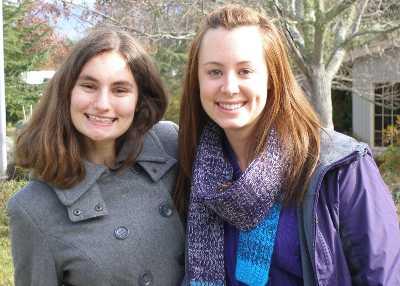
UKIAH, Calif. – Mendocino College students Christina Casella and Kathryn Dudley have a lot in common, including their work in health care facilities and interest in science classes.
In addition, the two Lake County residents are recipients of the Mendocino College Yvonne Sligh Book Awards this spring.
Pursuing a career in nursing or as a physician’s assistant, Casella currently works at St. Helena Hospital in Clearlake as an emergency medical/emergency room technician.
She is enrolled in 16 course units this semester and attends classes at the college’s main campus in Ukiah and its Lake Center in Lakeport. Her studies are focused on microbiology and biochemistry.
Casella, who earned a 4.0 grade point average in her prerequisite classes last semester, would like to continue her education at Mendocino College.
“It’s close to home and affordable,” said the student who named anatomy as her favorite class, adding that she felt challenged by the summer session course. “I learned a lot and enjoyed the instructor.”
Like Casella, Dudley is studying microbiology this semester with plans to enter Mendocino College’s Nursing Program. She will complete her coursework for an associate’s degree in natural science this spring.
Dudley also attends classes at both the Ukiah and Lakeport locations of the College. In Lakeport, she has enjoyed the political science class and she named Rick Jones as her favorite teacher.
Dudley has managed to maintain a 3.56 grade point average while attending Mendocino College.
With 17 units of courses this semester, Dudley still finds time to volunteer her services at Evergreen Healthcare nursing home in Lakeport.
“I love it,” she said, noting that she assists patients with their occupational and physical therapy routines.
The Yvonne Sligh Book Awards benefit Mendocino College students by providing vouchers to assist with book expenses.
The awards are funded by Mendocino College faculty, administration and staff, the Nebraska Book Co., College trustees, the Mendocino College Foundation and donations.
Established in 2002-03 by the foundation, the award program honors Yvonne Sligh, the late librarian who was employed at the college for 16 years.
Since its establishment, the program has grown exponentially. Students may receive the book vouchers if they are not eligible for any other financial aid and do not receive Mendocino College scholarships.
Individuals who are interested in making a donation to the Yvonne Sligh Book Award Program are asked to contact the Mendocino College Foundation at 707-467-1018.
Additional information may be obtained by calling the foundation or by visiting its Web site, http://foundation.mendocino.edu .