 How to resolve AdBlock issue?
Education
- Details
- Written by: Editor
SACRAMENTO, Calif. – The California Community Colleges Board of Governors on Monday heard regulatory changes that would make better use of state funds by preventing students from repeatedly enrolling in courses that they have already completed successfully.
The changes primarily focus on physical education, performing and visual arts classes that students had been allowed to take up to four times.
“Budget cuts have forced us to ration education, and we are currently turning away hundreds of thousands of students from our campuses that want to pursue a degree, transfer to a four-year university or get job training so they can get back into the workforce or advance in their current career,” California Community Colleges Board of Governors President Scott Himelstein said. “It doesn’t make sense for us to allow students to take the same physical education course four times on the taxpayer’s dime while we are closing our doors on those looking for a degree or seeking job skills.”
The recommended changes are intended to support the California Community Colleges Student Success Task Force goal of better aligning courses with student education plans and needs.
By not allowing students to needlessly repeat courses, colleges are able to focus course offerings directly to a student’s degree requirements.
“Restricting students’ ability to repeat state-subsidized courses in physical education and other classes will help all of us focus on the priorities of providing basic skills in English and mathematics, certificate and degree attainment and transfer preparation,” Chancellor Jack Scott said. “It used to be we could be all things to all people. Those days are gone, and now we have to focus on those with the greatest need.”
The new regulations, which were drafted with extensive input from the Academic Senate for California Community Colleges, will prohibit a student who successfully completes a class from repeating it, except under certain circumstances.
Students can repeat courses if it is required for transfer to the University of California or California State University, related to participation in intercollegiate athletics or is required for vocational or licensure reasons.
In July 2011, the board of governors adopted regulations that limited the number of times a student could repeat a class to make up for a substandard grade to three times. The new regulation changes focus on retaking classes that have already been successfully completed.
The regulation changes will go before the California Community Colleges Board of Governors for a second reading in July, and if approved then will take effect in the fall of 2013.
The California Community Colleges is the largest system of higher education in the nation composed of 72 districts and 112 colleges serving 2.6 million students per year. Community colleges supply workforce training, basic skills education and prepare students for transfer to four-year institutions. The Chancellor’s Office provides leadership, advocacy and support under the direction of the Board of Governors of the California Community Colleges.
For more information about the community colleges, please visit http://californiacommunitycolleges.cccco.edu .
- Details
- Written by: Jade Fox

On Friday, April 27, all of the students who earned silver level or higher were treated to a day of watching movies.
The students that earned the privilege were Tucker Barnett, Cody Beers, Saffron Blue, Cameron Carrillo, Chelsea Cherney, Brandon Cruz, Sabrina Farnan, Jade Fox, Junior Garcia, Ashely Gravelee, Ray Green, Jesse Harrell, Shania Jones, Anthony Montalvan, Chantilly Pannell, Marya Pantoja, Corissa Schoonderwoerd, Kyle Scott, Tonya Smith, Monique Throop, Charles Trujillo, Austin Weldon, Trevor Wilson and Erica Woods.
Many people helped with setup and running the movie. Jessie Harrell brought the movies, Pat made snacks, Derek Grace, Dylan Ward and Daniel Hernandez helped set up and run the movie, and Alan Siegel helped by over viewing the entire event, set up and clean up.
On May 3, Carlé High school had its open house. The parents were shown around the school and then took part in a site council meeting to decide next year's budget. After the meeting everybody got to enjoy a wonderful potluck dinner.
If anybody has any computers they don't want or need Siegel is looking for them. Siegel's media class works to give students computer repair skills by letting them work on broken computers, and any computers that are fixed are donated to students and their families who are in need of one. Thomas Valdez is the student who is in charge of the computer project.
This week students who came to Carlé as juniors or lower will be working on the STAR test.
The STAR test is a semi-competitive way to show how students and teachers have worked together to better themselves.
It is the hope of all the teachers for every student to try their best and do well on the test. The teachers and state would like to stress the importance of getting to school on time, eating breakfast, getting a good night's sleep and staying calm during the testing.
Teacher Siegel has been invited to go to the Palace Hotel in San Francisco on Sunday, May 6, to
attend the Software & Information Industry Association (SIIA) conference.
There he will be able to talk with the top game design companies in the country. Siegel will be a panelist during the Games and Learning Forum.
It is his hope that this will open Carlé up to beta test some new learning games.
Jade Fox is a student at Carlé Continuation High School in Lower Lake, Calif.
- Details
- Written by: Editor
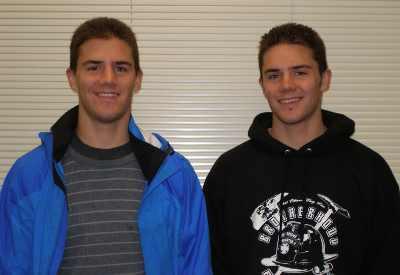
UKIAH – Twin brothers Brandon and Devin Campbell are attending Mendocino College and are recipients of the Mendocino College Yvonne Sligh Book Awards this spring.
In an interview with Mendocino College Foundation Executive Director Katie Fairbairn earlier this semester, the two said they are doing well in their second semester at the College. Devin named “Fire Combustion” as his favorite class so far while brother Brandon said the Hazmat class topped his list.
Graduates of Ukiah High School in June 2011, the Campbell twins enrolled at Mendocino College with a desire to obtain degrees in general education with an emphasis in Fire Science.
The brothers are volunteer firefighters for the city of Ukiah’s Fire Department.
Each of the young men said he wants to gain employment in a fire department once he earns his degree.
The Campbell twins are two of several Mendocino College students who have benefited from the Yvonne Sligh Book Awards.
The program provides vouchers to assist with book expenses. The awards are funded by Mendocino College faculty, administration and staff, the Nebraska Book Company, College trustees, the Mendocino College Foundation, and by a variety of other generous supporters.
Established in 2002-03 by the foundation, the award program honors Yvonne Sligh, the late librarian who was employed at the College for 16 years.
Since its establishment, the program has grown exponentially. Students may receive the book vouchers if they are not eligible for any other financial aid and do not receive Mendocino College scholarships.
Individuals who are interested in making a donation to the Yvonne Sligh Book Award Program are asked to contact the Mendocino College Foundation at 707-467-1018.
Additional information about funding opportunities may be obtained by calling the foundation or by visiting its Web site, http://foundation.mendocino.edu .
- Details
- Written by: Editor
SONOMA, Calif. – U.S. Rep. Mike Thompson (CA-1) joined by university leaders and students, on Wednesday hosted a roundtable discussion at Sonoma State University on college affordability and student loan interest rates.
If Congress does not pass legislation by July 1, seven million students across the country would see their interest rates double on need-based student loans.
During the roundtable discussion, Thompson highlighted the impact a rise in interest rates would have on students and families who must borrow to attend college.
“If interest rates for students double to 6.8 percent on July 1, more than 572,000 students across California will see their debt load increase by more than $476 million,” said Thompson. “If our nation is going to continue producing the world’s best entrepreneurs and innovators to compete in the global economy, then a college education must be an affordable option for working families. College is already costly, and our government doesn’t need to make the price tag even higher by allowing interest rates to double. Congress needs to act now to keep this from happening.”
If Congress doesn’t act, more than seven million students will incur an additional $6.3 billion in repayment costs for the 2012-13 academic school year.
That means college next year, and every additional year Congress doesn’t act, gets $1,000 more expensive for each student borrower.
In 2007, Thompson voted to pass the College Cost Reduction and Access Act which made historic investments in student aid.
The law halved interest rates on these need-based federal student loans to 3.4 percent, making them more affordable for low- and middle-income students.
Without Congressional action, the rate will jump back up to 6.8 percent on July 1.
Thompson is a co-author of legislation that would keep the interest rate on the need-based student loans at 3.4 percent.
To help make college more affordable, Thompson has also voted to increase Pell Grants to $5,550, and to create the American Opportunity Tax Credit which provides a $2,500 tuition tax credit to eligible families and students.
Thompson represents California’s 1st Congressional District, which includes the Counties of Del Norte, Humboldt, Lake, Mendocino, Sonoma, Napa, and Yolo. He is a senior member of the House Ways and Means Committee and the House Permanent Select Committee on Intelligence. Rep. Thompson is also a member of the fiscally conservative Blue Dog Coalition and sits on the bipartisan, bicameral Congressional Wine Caucus.