 How to resolve AdBlock issue?
Education
- Details
- Written by: Elizabeth Larson
Eastern New Mexico University's Greyhound Arena hosted Spring Commencement at ENMU-Portales, with 427 candidates walking across the stage for graduation on Saturday, May 14.
The spring commencement address was given by 2022 ENMU graduate Ms. Lorynn Guerrero, who was named 2022 New Mexico Teacher of the Year for her work with students at New America School in Las Cruces, New Mexico.
"The ENMU commencement ceremony is ENMU's celebration of our students and their families," said Dr. Patrice Caldwell, chancellor and president of ENMU. "The degrees we award students already changed their lives; those degrees are now their ticket to change the world. I can't wait to see what they will accomplish."
- Details
- Written by: University of Mississippi
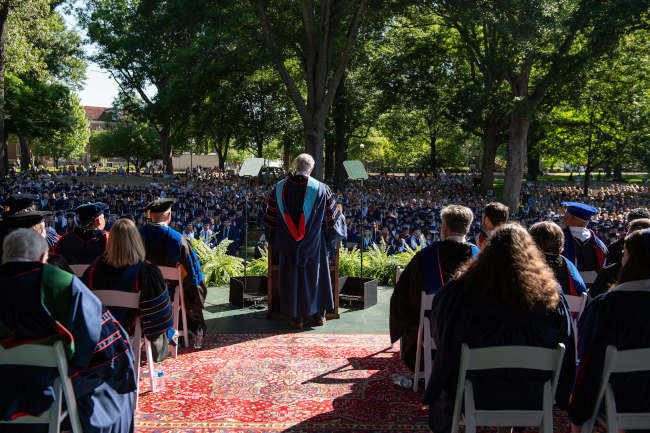
UNIVERSITY, Mississippi — Michelle Young, of Kelseyville, California, is among the more than 3,300 students who earned their degrees from the University of Mississippi in May 2022.
Young, who majored in counselor education, received a specialist in education from the Graduate School.
"Our May 2022 class of graduates are distinguished by incredible achievements, character and resilience," said Chancellor Glenn Boyce. "They accomplished so much during their years at Ole Miss, and we can't wait to see all the ways they will pursue their passions and reach their full potential on their paths to a bright future."
May 2022 graduates were invited to walk across the stage at the University of Mississippi 169th Commencement exercises, which were held by individual colleges and schools May 4 to 8. The universitywide morning convocation was held on Saturday, May 7, in the Grove, with UM alumnus Bradford Cobb, a celebrated music industry executive, giving the keynote address.
Undergraduate and graduate candidates received degrees from the College of Liberal Arts, general studies and schools of accountancy, applied sciences, business administration, education, engineering, journalism and new media, law and pharmacy.
The University of Mississippi, affectionately known as Ole Miss, is the state's flagship university.
Included in the elite group of R1: Doctoral Universities — Highest Research Activity by the Carnegie Classification, it has a long history of producing leaders in public service, academics and business.
Its 16 academic divisions include a major medical school, nationally recognized schools of accountancy, law and pharmacy, and an Honors College acclaimed for a blend of academic rigor, experiential learning and opportunities for community action.
Recognized among the nation's most beautiful, Ole Miss' main campus is in Oxford, which is routinely acknowledged as one of the country's best college towns.
- Details
- Written by: Elizabeth Larson
This program is a key component of a statewide strategy for cultivating regional economies, strengthening education-to-career pathways, and ensuring that education, vocational, and workforce programs work in partnership to provide broader access for all to education and employment opportunities.
“We’re creating new regional pipelines — K-12 schools to higher education to the workforce — for California’s students that will prepare our kids for the jobs of the future in their communities. This essential collaboration will help bridge equity gaps and provide more resources to help our students achieve their career goals right in their own communities,” said Gov. Gavin Newsom.
As communities across the state work to transform our public education system from cradle to career — scaling universal transitional kindergarten, expanding after-school programs, improving college access and affordability, and more — the regional collaboratives will serve to marshal action and promote implementation.
Along with priorities such as the Community Economic Resilience Fund and Cradle-to-Career Data System, California is building partnerships and structures to ensure policies translate to on-the-ground improvements.
“The Department of General Services is proud to be of assistance in administering this innovative program that will bring together regional partners to better serve all the learners of California, ensuring equitable pathways to meaningful careers,” said DGS Director Ana Lasso. “As the business manager of the state, DGS is excited to see the collaboration, system changes and enhancements that result from timely investment.”
The first six awards of approximately $18.1 million each, for a total of $108.6 million, will be going to the following collaboratives (summaries of each collaborative can be found on the Regional K-16 Education Collaboratives Grant Program website):
• Central San Joaquin Valley: Central San Joaquin Valley K16 Partnership (Fresno-Madera Collaborative & Tulare-Kings Collaborative). The Partnership brings together the Fresno-Madera Collaborative and Tulare-Kings College & Career Collaborative — with partners including the Fresno County Superintendent of Schools, State Center Community College District, Fresno State, and UC Merced — to develop four education to work pathways in health care, education, business management, and engineering / computing, with goals to increase the number of graduates with postsecondary degrees and certifications in these high wage disciplines, close equity gaps and economic disparities, and improve graduation rates and time-to-degree across all institutions.
• North State: North State Together (Shasta Tehama Trinity Joint Community College District). North State Together (NST) brings together partners across the region — including the Shasta-Tehama-Trinity Joint Community College District, Shasta County Office of Education, CSU Chico, and UC Davis — to expand educational access, regional support networks, and cross-sector partnerships. They plan to increase college and career readiness, create occupational pathway programs in health care and education, and streamline transitions between educational institutions and the workforce.
• Kern County: Kern Regional K16 Education Collaborative (Kern County Superintendent of Schools). The Kern K16 Regional Education Collaborative seeks to prepare students for the global economy by dismantling long-standing social and economic inequities in the region, removing barriers to student success, and improving educational outcomes. The collaborative brings together partners — including the Kern County Superintendent of Schools, Kern Community College District, CSU Bakersfield, and UC Merced — to develop pathways in health care, education, and engineering/computing with a focus on fostering inclusive institutions to better serve historically underrepresented students, streamline pathways to degrees and facilitate student transitions, and increase access to resources supporting basic, digital, and financial needs.
• Redwood Coast: Redwood Coast K16 Education Collaborative (California State Polytechnic University Humboldt). The Redwood Coast Collaborative brings together partners across the region — California State Polytechnic University Humboldt, Sonoma State University, the Humboldt County Office of Education, Redwoods Community College District, UC Davis, and ProjectAttain! — to develop a robust college-going culture in the region by building career pathways for education and health care, specifically focused on increasing participation in and completion of A-G courses and improving retention rates in higher education, especially for Native American and socioeconomically disadvantaged students in the region.
• Orange County: OC Pathways to and Through College and Career (Orange County Department of Education). OC Pathways aims to promote career and college readiness for students in the Orange County region by developing and expanding career education opportunities. This project brings together partners — the Orange County Department of Education, Rancho Santiago Community College District, CSU Fullerton, and UC Irvine — to implement high-quality programs in education, health care, business management, and engineering/computing that offer career preparation and college credit attainment by leveraging regional work partnerships, decreasing institutional barriers, providing rigorous and relevant Career Technical Education courses, and college credit opportunities for all students.
• Sacramento: Sacramento K16 Collaborative (Los Rios Community College District). The Sacramento Collaborative brings together partners throughout the region — including Los Rios Community College District, CSU Sacramento, UC Davis, and the Sacramento County Office of Education — to develop and expand career pathways for students in health care and engineering. They plan to invest in structures supporting preparation for college and transitions between educational institutions, develop a regional data sharing system, and provide targeted support to historically underserved students.
The program provides funding to enhance or create collaborative efforts between the University of California system, the California State University System, Community Colleges, K-12 School Districts, and workforce partners.
Collaboratives participating in the program commit to creating two occupational pathways from the following sectors:
• Health care;
• Education;
• Business management;
• Engineering or computing.
Collaboratives must also commit to implementing four of seven recommendations pulled from the Recovery with Equity report to promote student success. The seven recommendations are:
• Improve faculty, staff, and administrator diversity;
• Cultivate inclusive, engaging, and equity-oriented learning environment;
• Retain students through inclusive support;
• Provide high-tech, high-touch advising;
• Support college preparation and early credit;
• Subsidize internet access for eligible students;
• Improve college affordability.
The program offers two phases for application submittal with the goal to award one grant within each of the 13 Community Economic Resilience Fund or CERF regions.
The Department of General Services also intends to work with three other regions that submitted applications in this first funding phase to solicit supplemental information for a revised application with the hope to select a single, strong grantee for each region. There is also a second phase of funding available to regions that require additional time and planning to establish collaborative partners or to determine their program goals. Information about the second phase of funding can be found at Regional K-16 Education — Collaboratives Grant Program.
- Details
- Written by: Mediacom
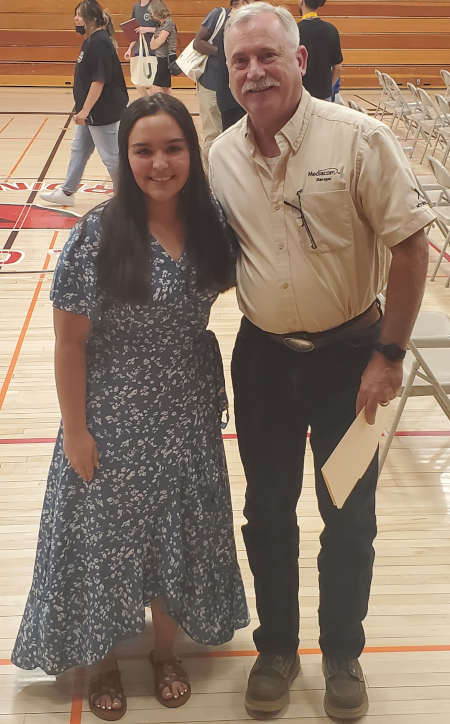
LAKEPORT, Calif. — Mediacom Communications announced the selection of Bailey Rodriguez, a senior at Clear Lake High School, as a recipient of the company’s World Class Scholarship program.
The $1,000 scholarship recognizes the Lakeport resident for excellence in leadership and academics.
“As a technology company, Mediacom understands how important it is to invest in future leaders like Bailey Rodriguez,” said Mediacom Senior Operations Director Shawn Swatosh. “I’m proud that our company supports talented local students with scholarship support. We congratulate all graduates in the Class of ‘22, and particularly acknowledge Bailey her for outstanding accomplishments.”
This year marks the 21st consecutive year Mediacom has funded World Class Scholarships for students who live in areas where the company delivers high-speed broadband and digital video services.
The company annually selects 60 graduating seniors who each receive scholarships to support their post-secondary education.
Recipients must attend an accredited two-year or four-year college, university, or technical school within the United States.