How to resolve AdBlock issue?
Education
- Details
- Written by: Editor
SACRAMENTO — State Superintendent of Public Instruction Jack O'Connell announced that the California Department of Education (CDE) has received a major federal Charter Schools Program grant through the U.S. Department of Education's Office of Innovation and Improvement.
California had applied for $300 million in federal Charter School start-up grant funds.
The U.S. Department of Education has not yet announced the amount California will receive from this competitive grant program.
“High-quality charter schools can spur innovation and provide communities more flexibility to create the kind of learning environment they want for their children,” said O'Connell. “This infusion of federal funding will give a boost to communities trying to initiate and share information about a charter school so the organizers can focus their attention on helping students succeed academically.”
California's federal charter grant application specifies that the state will use the federal funds to increase the number of high-quality charter schools in the state with stronger fiscal, governance, and academic accountability training and reporting requirements.
The funds also are intended to sustain charter schools' capacity to improve the academic achievement of students and support the dissemination of effective practices of high quality charter schools.
Preference will be given in the distribution of the funds to assist the development of high-quality charter schools located in high need communities where students attend schools in Program Improvement.
O'Connell believes high-quality charter schools that can serve as laboratories of education innovation.
A charter school is a public school that usually is created or organized by a group of teachers, parents and community leaders or by community-based organizations. A charter school may be sponsored by an existing local public school district governing board or county board of education.
Charter schools are generally exempt from most laws governing school districts, except where noted by law. In exchange for this increased flexibility, charter schools are held accountable for improving student academic achievement.
The objective is to replace rules-based governance with performance-based accountability, thereby stimulating the creativity and commitment of teachers, parents and citizens.
The federal Charter Schools Program funding is designed to help communities in the planning, program design, initial implementation, and dissemination of information on charter schools.
As the grantee, the CDE will make the funding available as subgrants on a competitive basis to developers of charter schools who have applied for a charter.
Charter schools will be able to apply for the subgrant funding once federal review of several requested waivers is complete, and the Legislature has approved a budget and the disbursement of the funds.
Once an applicant is awarded a subgrant through the CDE, the funding may be used for the planning and design of the education program for a charter school, refining the desired education results, refining methods for measuring progress toward achieving those results, and the initial implementation of the charter school.
Implementation may include informing the community about the charter school and acquiring necessary equipment, materials, and supplies.
The CDE may reserve up to 10 percent of the grant for another subgrant to share lessons learned from high-quality charter schools with a demonstrated history of success.
The purpose would be to share information about how to create and sustain high-quality, accountable schools with other public schools and charter schools.
Information on the federal Charter Schools Program may be found on the U.S. Department of Education Web site, http://www2.ed.gov/programs/charter/index.html.
- Details
- Written by: Editor
SACRAMENTO – This week California was selected as a finalist in the competition to receive up to $700 million for education reform efforts as part of phase two of the federal Race to the Top (RTTT) competition.
“I am thrilled that our efforts to push for even more progress in improving public education were recognized by the U.S. Department of Education,” said State Superintendent of Public Instruction Jack O'Connell.
“California remains in the running for the Race to the Top competition,” O'Connell said. “We now will prepare to present our reform plan before reviewers in Washington. I remain optimistic that California will be granted funding that will help us ensure that we have effective teachers in every classroom, strong leaders in every school, common core standards to improve instruction, and an effective data system to ensure that every student is being prepared for success in college or careers.”
California's Phase 2 RTTT application was built around the strong commitment and leadership of seven superintendents representing a diverse group of school districts: Clovis, Fresno, Long Beach, Los Angeles, Sacramento, Sanger and San Francisco unified school districts.
Those seven superintendents were the primary architects of California's RTTT Phase 2 plan to transform the state's education system and strengthen California's ability to prepare all students for success in college and careers.
The districts were joined by more than 300 additional local educational agencies (LEAs) that pledged their commitment to implement California's Phase 2 RTTT plan by signing binding memorandums of understanding.
The participating LEAs represent more than 1.7 million California students, a student population that is larger than the total kindergarten through twelfth grade enrollment of all but six other U.S. states. These LEAs also serve some of the neediest students in the state, as 68 percent of the students in participating districts live in poverty.
California's RTTT Phase 2 application is rooted in four key areas of reform that call for:
Refining California's rigorous state standards by adopting internationally benchmarked common core standards and aligned assessments that better prepare students for success in college and the workplace;
Recruiting, developing, and retaining effective teachers and principals and ensuring that they are helping students that need them the most;
Expanding our education data system to better measure student success in college and the workforce; and
Dramatically improving the state's persistently lowest-performing schools.
California's Phase 2 RTTT application also emphasizes the critical goal of advancing the state's students' understanding of science, technology, engineering and mathematics (STEM).
With funding from the federal government, the state plans to launch new partnerships with institutions of higher education, and strengthen and expand the delivery of STEM in California's high schools.
The plan also includes an emphasis on building a strong STEM foundation in the kindergarten through eighth grade system, an expansion of support systems, and infrastructure for the future of STEM.
Finalists of the Phase 2 grants will present their plans before a review panel in Washington, D.C. on Aug. 9. Finalists are expected to be announced in September.
Information on California's RTTT Phase 2 application may be found at http://www.caracetothetop.org.
- Details
- Written by: Editor
MARYSVILLE, Calif. – The Yuba Community College District (YCCD) Board of Trustees voted at Thursday's regular meeting to rescind layoff notices and reinstate several full-time faculty members at Yuba College.
Those reinstated include Lynette Garcia, nursing; Li-Chiuan Hsieh, political science; and Veronica Torres, drafting/engineering.
All three professors will remain at Yuba College and will continue their faculty assignments for the 2010-11 academic year starting this fall semester.
“In these tough economic times, we are all pleased to be able to bring back positions that once were scheduled for elimination,” said YCCD Chancellor Dr. Nicki Harrington.
Harrington thanked the college's faculty for stepping up to the plate and making the necessary concession to allow reinstatement of the faculty positions.
“This, along with the 11 support staff positions, will provide our students with additional courses and student services that are badly needed,” said Harrington. “We remain hopeful that the state budget will prioritize resources to support students and the communities we serve to stimulate economic recovery.”
The reinstatement of these positions was made possible due to a faculty resignation, faculty concessions in the form of a 0.8-percent salary reduction and the foregoing of a $20,000 professional development/travel and conference fund.
In addition, thanks to the deficit factor coming in lower than anticipated 11 other positions were reinstated by the board, including a custodian, a library technical assistant and a computer help desk technician, to name a few.
Furthermore, a recent grant enabled a nursing clerical assistant to be brought back and the recent resignation of the chief of police allowed for a police officer position to be reinstated.
The Yuba Community College District spans eight counties and nearly 4,200 square miles of territory in rural, north-central California. It has colleges in Marysville and Woodland, an educational center in Clearlake, and will be adding outreach facilities in Sutter and Colusa counties as part of the Measure J facilities bond.
For more information about YCCD please visit www.yccd.edu.
- Details
- Written by: Lake County News Reports
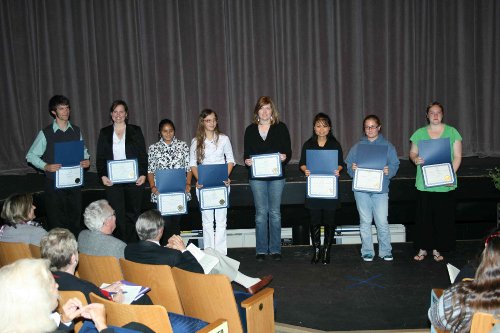
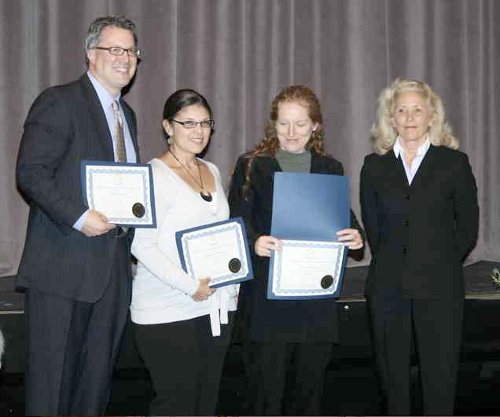
UKIAH – Mendocino College Foundation recently presented nearly $123,000 in scholarships to high school and college students planning to continue their education at Mendocino College.
Foundation board members, college trustees, faculty, and staff honored the recipients during the annual scholarships awards ceremony at the college’s Ukiah campus.
This year 85 awards were presented and included a new scholarship that was made possible by a December 2009 donation from retired school teacher Hulda Weger to the foundation.
Tommy Thornhill, chair of the foundation’s scholarship committee congratulated the recipients and concluded the ceremony by asking everyone in attendance to “give a hand to the people who pushed you here,” referring to family, friends and people in their lives who helped and encouraged them to continue their education.
Students receiving the Mendocino College Foundation Academic Excellence Scholarships in the amount of $1,500 each include Sara Adams, Amanda Andersen, Ignacio Ayala-Aguilar, Fujun Bernie, Kelley Boss, Alice Bourdykina-Jelobniouk, Darleen Castanon, Corinne Chaulk, Krisy Fletcher, Christine Hawley, Zachary Hedges, Veronica Hernandez-Clow, Alondra Herrera, Monica Jimenez-Covarrubias, Sarah Johnson, Jane Khoury, Victor Macias, Susan Madison, Ryan McCartney, Cristianne McElhenie, Barbara McKey, Daniel O’Connor, Rachana Panchal, Rachel Parmenter, Connie Patterson, Katharine Payne, Alexandro Reyes Murrillo, Silvia Sanchez, Laura Smith, Karen West, Pamla Wood and Christine Zurcher.

Recipients of the Foundation’s $1,500 Evelyn R. Foote Scholarships are Laura Alexander, Ana Alvarez-Magana, Rebekah Carlson, Monica Ceja, Shelley Christensen, Holly Cochran, Kirsty Cordell, Tarabeth Dufour, Joe Ann Dvornik, Lezlie Elmer, Ivette Fernandez, Jesus Fonseca, Nayley Garcia, April Hildbrand-Ford, Emily Houghton, Nicole Ibrahim, Tawna Jamison, Darlene Klaiber, Jonelle Sornes, Michael Teller, Rolinda Want and Rachelanne Weiss.
Additional award winners include Mariam Ballaho, the Thomas M. Evans Scholarship in the amount of $2,500; Erika Lund, the George R. Szanik Scholarship, $2,500; Rachel Reichard, the Jim Meyer Scholarship, $2,000; Natasha Jelen, the Carl J. Ehmann Scholarship, $2,000; Deidre Hallman, the Hulda and Alfred Weger Scholarship, $1,000; and Vernida Brown, the Mary Oosting Fine Arts Scholarship, $1,000.
For the Nursing Program, recipients include Iana Lima and Ashtin Salisbury, the Karen L. Atkinson Nursing Scholarship, $1,250 each; Erika Lund and Julie Pulse, the Heidi Marie Daniel Nursing Scholarship, $500 each; Anthony Burich, Jacqueline Graumann, and Barbara McKey, the Kathleen Kohn Fetzer Family Foundation Nursing Scholarship, $2,500 each.
Recipients of the Bernard Osher Foundation Scholarships, also $1,000 each, are Scott Diebold, Veva Garcia, Luz Gutierrez, Stacy Holden, and Jennifer Tovar.

Selected to receive the Directors/Trustees Annual Fund Scholarships in the amount of $1,000 each, jointly presented by Mendocino College Board of Trustees President Janet Chaniot and Mendocino College Foundation President Channing Cornell, are students Brian Cahill, Ariana Foster, Megan Gardner, Willow Karlsson-Champion, Ryan Maidrand and Janine Rose.
The foundation’s annual awards are made possible by donations and perpetual scholarship contributions.
For more information about Mendocino College Foundation and ways to contribute, call the foundation office, 707-467-1018.