How to resolve AdBlock issue?
Education
- Details
- Written by: Editor

SACRAMENTO – Joining the California Community Colleges Chancellor Jack Scott and members of the Board of Governors, former U.S. Secretary of State Condoleezza Rice gathered with education leaders, industry chiefs and students in Sacramento on Monday on the 10th anniversary of the Dr. John W. Rice Diversity and Equity Award ceremony.
All were together in support of a common goal – honoring programs and staff that demonstrate a commitment to maintaining and recognizing the important role community colleges play in providing educational opportunities to all Californians.
The annual award promotes diversity at the community colleges and is named for Rice’s late father, a former member of the Board of Governors.
The 2010 award was presented to the Taft College Transition to Independent Living Program that helps integrate disabled students into campus life and to Elaine Moore, a founder of the El Camino College Project Success program that seeks to improve academic performance and graduation rates of inner city students transitioning to college.
“I would like to congratulate the winners from Taft and El Camino College. These wonderful programs foster what my father stood for,” said Condoleezza Rice. “My father taught me that you can come from humble beginnings and do great things if you have an education. Nothing captured his imagination, passion and attention more than the California Community Colleges and the time he served as a member of the Board of Governors.”
Having been born to a Presbyterian pastor in Baton Rouge, Louisiana and living through years of segregation and the civil rights era, Dr. Rice was passionate about ensuring the California Community Colleges staff, faculty and student body reflected the diversity of California.
The award, given to individuals or programs, celebrates the profound impact Dr. Rice continues to have on the system. He served on the board from 1992 to 2000.
“Dr. Rice made it his mission to make sure every person who could achieve would get the help they needed to succeed,” said Chancellor Scott. “Today’s award winners are a testament to the fact that Dr. Rice’s ideals live on. He would be proud to see the diversity in our system. Our colleges mirror the diversity of California. After all, we are the college of the open door. ”
In addition to Rice and Scott, other speakers and special guests at the event included Dr. Rice’s widow Mrs. Clara Rice, Board of Governors President Debbie Malumed, President and CEO of the Foundation for California Community Colleges Paul Lanning, State Superintendent of Public Instruction Jack O'Connell, Sacramento Bee Publisher Cheryl Elbright Dell and Sacramento Business Journal Publisher Joanna Wessman.

Clara Rice, Dr. Rice’s widow, attended the event and warmly recalled the memory of her late husband.
“I called John my ‘gentle giant’ not only because of his size but because of his enormous passion for equity and diversity.” She went on to say, “I’m sure he’s looking down today and smiling as he sees us gathered here to celebrate these programs, people and students with his daughter and me present.”
“Community colleges give all Californians an equal opportunity,” said Board of Governors for the California Community Colleges President Debbie Malumed. “I am proud to be affiliated with the largest system of higher education in the nation. We serve people from all walks of life and make their higher education goals a reality.”
The winners included the Transition to Independent Living Program at Taft College, which exemplifies the ideas of equity and diversity through the integration of students with disabilities into campus life.
It is the only residential community college program in the state that serves students with autism and intellectual disabilities. Students come from communities throughout California with unique demographic backgrounds which also adds to the campus diversity.
The Transition to Independent Living Program has gained national and international recognition based on the successful outcomes these students have achieved upon their completion of the program.
Eighty-nine percent of the students complete the two year program and of those students, 95 percent live independently and 89 percent are employed.
The other winner was Elaine Moore, one of the founders of the Project Success program located at El Camino College.
Project Success is dedicated to increasing the academic performance and graduation rates of inner city students transitioning to college. Her dedication to equity and diversity has helped El Camino College produce higher rates of African-American students who transfer to a California State University or University of California, more than at any other California community college.
Moore succeeds by promoting student centered learning and multicultural faculty, staff and peer mentoring. She is an accomplished faculty member and community leader.
Her efforts and dedication on behalf of Project Success have produced academic and student support services partnerships that have contributed to El Camino College’s ranking as number six among the California Community Colleges that graduate African-American students with associate degrees.
The California Community Colleges is the largest system of higher education in the nation composed of 72 districts and 112 colleges serving 2.89 million students per year. The system is also the largest provider of workforce training in the nation. Nearly 25 percent of all the community college students nationwide are enrolled in a California community college.
- Details
- Written by: Lake County News Reports
LAKE COUNTY – Seventeen fifth-graders in schools throughout the Mendocino-Lake Community College District are receiving awards made possible this year by the Mendocino College Foundation’s Adopt-A-Fifth-Grader Program, College Superintendent/President Kathryn G. Lehner has announced.
Award winners were honored at the schools in ceremonies at the end of the school year. One school will announce its award recipient in August.
Thanks to the generosity of several new donors and a few repeat contributors, the number of achievement awards has increased significantly over the last couple of years, said Lehner.
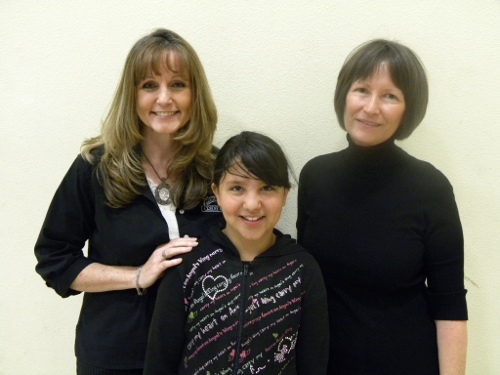
In Lakeport, student Breanna Perry of Terrace Middle School was selected for the honor, made possible by a donation from the Mendo Lake Credit Union.
Ukiah school students honored this year are Liset Escamilla, Oak Manor Elementary, donor Mendo Lake Credit Union; Jessica Garcia, Grace Hudson Elementary, donor Kathryn G. Lehner; Selena Magana Sutherland, Daniela Cocone, and Katheryn McCoy, Nokomis Elementary, donors Tommy and Ann Thornhill; Harmony Hutchins, River Oak Charter, donor Ed Haynes; Alexis Small, Yokayo Elementary, donors Donna and Ed Berry; and Claudia Kelly, Frank Zeek Elementary, anonymous donor.
Award recipients in other areas of the College district are David Eligio, Anderson Valley Elementary, donor Charles and Wanda Mannon; Jely Espinoza, Redwood Valley Elementary, donors Christy and Dave Scollin; Roselyn Alvarez, Hopland Elementary, donor Wade and Mary Lou Koeninger; Nona Hope Delaine Hoaglen, Round Valley Elementary, Covelo, donor Mendo Lake Credit Union; and Isabel Guiterrez, Natalee Lopes, and Tia Lynn Grant, Blosser Lane Elementary, Willits, donors Tom Herman, Claudia Smith Hill and the Rotary Club of Willits.
The recipient from St. Mary of the Angels School in Ukiah (donor Paul Conrado) will be announced in August.
The foundation’s program, previously known as “Adopt-A-School Achievement Awards,” is in its third year.
The first award was given at Hopland Elementary School, made available through the generosity of Wade and Mary Lou Koeninger, who started the program on their own at the Hopland school 17 years ago. They have provided sponsorship funding for a student honoree each year.
Contributors sponsor fifth-graders at elementary schools within the college district by donating $700 per student. The $700 gift is invested and, based on an average 7 percent return per year, grows to over $1,000 by the time the recipient graduates from high school, allowing for a maximum $1,000 scholarship.
The award winners are chosen in a manner designated by the students' schools. At the end of the school year, each student receives $25 and a certificate as the recipient of the award. Upon graduation from high school, the student receives a $500 cash incentive or a $1,000 scholarship if he or she elects to attend Mendocino College.
For each of the three students receiving awards made possible by donations from the Mendo Lake Credit Union this year, the credit union matched the student’s $25 prize with an offer to open an MLCU savings account with the contribution of an additional $25, according to the credit union’s chief executive officer, Richard Cooper, who is a member of the foundation’s board of directors.
Donations are tax-deductible. Anyone interested in sponsoring one or more fifth-graders may make a $700 donation per student. Donors may designate a school preference or allow the foundation to choose. Donations to sponsor a school in perpetuity are also accepted.
The Mendocino College Foundation seeks to receive contributions for sponsoring at least one fifth-grader from every elementary school within the Mendocino-Lake Community College District.
For more information about the program or to make a donation, call the foundation office at 707-467-1018.
Additional information is available on the foundation’s Web site, http://foundation.mendocino.edu.
- Details
- Written by: Tony Marchese
Scholarship money comes from interest income, fundraisers and donations.
Application for the scholarships is open to graduating Lake County high school students who will be enrolling in a college or vocational school.
The student must carry at least 12 units and have a 3.0 or better cumulative GPA.
Academic and extracurricular activities are taken into consideration, however the scholarship is primarily based on the quality of a 250 to 750-word essay based on an aspect of Lake County history.
Exceptional essay submissions may be published in “The Pomo Bulletin” for our members to read.
This year the scholarship selection committee received 11 applications, of which two were from Clear Lake High School, five were from Kelseyville High School, three were from Lower Lake High School and one was from Middletown High School.
Katherine Murphy from Kelseyville and Andrea White from Lower Lake were each awarded a $500 scholarship for submitting remarkable essays, as well as their impressive achievements in and out of school.
Murphy has a cumulative grade point average of 4.15. Her extracurricular activities were in athletics, music and outside activities.
Her winning essay is titled “The History of Tourism in Beautiful Lake County.” She plans to major in medicine at the University of California, Davis, and thereafter attend medical school.
Andrea White has a total grade point average of 4.11, placing her at the top of her graduating class.
Her extracurricular activities included varsity sports, community work and student activities. Her award-winning essay is titled “Lake County, A Commemoration of 2 Million Years of Bountiful History.”
White will attend the University of Puget Sound and plans to become an oral/maxillary surgeon.
Many thanks go to the scholarship selection committee and to the scholarship applicants for their essay submissions.
- Details
- Written by: Carolynn Jarrett

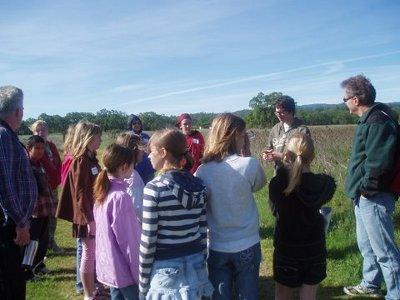
ANDERSON MARSH – Fifty-eight fourth to sixth graders from schools throughout Lake County participated in the art and science camp held at Anderson Marsh State Historic Park on Saturday, May 1.
During the morning, students rotated through four stations.
In the south barn, they looked at slides in a microscope and then compared the skulls, pelts and (plastic) scat of herbivores and carnivores.
In the north barn, they learned about American Indian history and culture and then made a tule doll.
At the ranch house, they took a tour and then joined a band to learn "Polly Wolly Doodle" (a pioneer song).
On a nature walk to Cache Creek, they saw turtles, deer, rabbits and lots of birds.
These free camps are always well-received by the students and adults who participate.
The camps highlight the importance of the Anderson Marsh site as a place to study Native American and European history, plant and animal life, and the ecology and geology of the area.
The camps would not be possible without the support of local volunteers and service groups.