 How to resolve AdBlock issue?
Education
- Details
- Written by: Caltrans
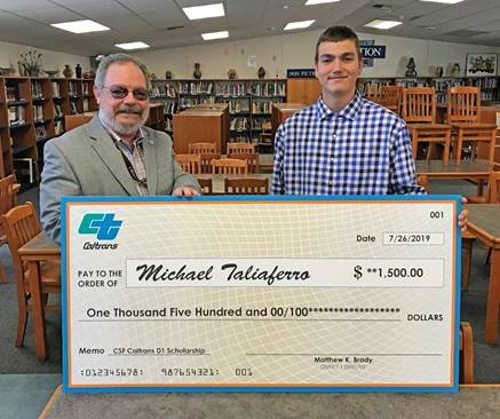
NORTH COAST, Calif. – Caltrans has awarded two $1,500 scholarships to local high school graduates as part of its 2019 Scholarship Program, thanks to the generosity of its district employees and support from the California Transportation Foundation.
This scholarship program supports college-bound high school seniors. Scholarships are competitive and based on applicant’s commitment to a career in transportation, attendance to a California University or State College, academic record, participation in extracurricular and/or community-related activities and, live within the four counties of the district – Del Norte, Humboldt, Lake and Mendocino counties.
The students receiving scholarships are Michael Taliaferro, a graduate of Lower Lake High School, and Dallas Daynara, a graduate of McKinleyville High School.
District 1 Caltrans employees have been raising money for this program for eight years with funds generated through proceeds from fundraising activities including candy and snack sales, bake sales, donut sales, Valentine’s Day gift sales and more.
This scholarship program is also supported by the California Transportation Foundation, which donates 25 percent of the funding.
Brad Mettam, Caltrans deputy for District 1 for planning and local assistance, spoke with pride of this tradition. “Caltrans District 1 employees work hard to raise these scholarship funds on their own. I’m just fortunate to have the opportunity to meet these students and show our support to their career goals.”

- Details
- Written by: Elizabeth Larson
“Food insecurity is a serious problem on California college campuses today and this is an important step to addressing it,” Sen. Dodd said. “My bill will ensure students of modest means don’t go hungry by making it easier for them to receive public assistance. Students shouldn’t have to starve in order to get an education.”
The inability to afford food – or food insecurity – is a top concern among college students. A recent Government Accountability Office report shows a third of all college student are struggling to afford food and basic nutrition. It recommends the U.S. Department of Agriculture’s Food and Nutrition Service take steps to enroll people in federal food assistance programs.
Senate Bill 173 removes barriers to students to get subsidies under Cal Fresh, in part by streamlining the application process.
More than 50,000 California college students could be enrolled in food assistance thanks to the senator’s legislation.
The California Welfare Directors Association, the County of Yolo, student groups and area food banks support the bill.
“Sadly, ‘starving students’ is more than a cliché for many food insecure California college students,” said Don Saylor, chair of the Yolo County Board of Supervisors. “We applaud Sen. Dodd for his leadership in combating student hunger on college campuses.”
Sen. Bill Dodd represents California’s Third Senate District, which includes all or portions of Napa, Solano, Sonoma, Yolo, Sacramento and Contra Costa counties. You can learn more about Senator Dodd at www.sen.ca.gov/dodd.
- Details
- Written by: California Attorney General's Office
CUSO provided private loans for students to attend the now-defunct, predatory ITT Technical Institute, or ITT Tech.
With substantial assistance from CUSO, ITT Tech conducted a coordinated scheme to misdirect student borrowers towards expensive student loans that borrowers struggled to repay.
The settlement will provide $168 million in relief to 22,000 borrowers – 4,000 of whom are in California. Many of these students were low-income and the targets of aggressive and misleading sales tactics by the school.
“ITT Tech, aided by CUSO, ripped off thousands of students in this illegal and coordinated scam,” said Attorney General Becerra. “In addition to grossly overcharging vulnerable students for a sham education, the companies guided students toward expensive and unwieldy loans that were nearly impossible to pay back. Students should by worrying about homework, not predators looking to exploit them for a quick buck.”
ITT Tech – one of the most expensive for-profit post-secondary institutions – received revenues from student tuition and fees.
As required by federal law known as the 90/10 Rule, private for-profit schools may receive no more than 90 percent of their revenue from federal public loans, with the remainder originating from other sources.
ITT Tech enlisted CUSO to provide ITT Tech students with private loans for this purpose. It then steered borrowers toward the lender. This scheme was designed for ITT Tech to enhance its financial statements, its appearance with investors, and to facilitate compliance with the 90/10 Rule.
The loan program issued $189 million in loans to ITT Tech students between 2009 and 2011. ITT Tech staff targeted students through aggressive tactics, including pulling students from class, withholding course material or transcripts, and rushing students through financial aid appointments.
The company projected that more than 60 percent of students would default on the loans, which carried interest rates as high as 16.25 percent.
These loans covered tuition gaps for which ITT Tech had previously offered short-term loans called “temporary credits.” Temporary credits were zero-interest loans payable in nine months, but were presented to students as loans payable upon graduation.
The credits had a high default rate, as students were unable to repay the full amount in such a short time. By extending loans through CUSO, ITT Tech could remove these unpaid credit balances from its financial reports.
Besides requirements that CUSO provide $168 million to student borrowers, the settlement includes restitution and borrower relief. CUSO will cease conducting business, including acquiring or issuing student loans, and cease all collection activities.
CUSO will also cancel all outstanding balances of consumer loan accounts and will direct credit reporting agencies to delete these balances from consumers’ credit reports. CUSO will implement a consumer redress plan to notify consumers of the settlement.
A copy of the final judgment can be found here.
- Details
- Written by: Elizabeth Larson
“As the primary higher education institution provider in the region, we are thrilled to offer this critical program to our communities,” said President/Superintendent Dr. Arturo Reyes.
The application period for the program will be open from Aug. 15 until Oct. 15, and 24 students will be admitted into the program.
Admission to the program will be based on the results of a random, computer generated lottery system. All qualified applicants will be included in the lottery.
Physical Therapist Assistants, or PTAs, provide physical therapy services under the direction and supervision of a licensed physical therapist.
Physical therapy is a dynamic profession full of variety, activity, and human interaction. Physical therapists and PTAs are movement experts who help to relieve pain, prevent disability and restore the basic movements that we take for granted every day by improving balance, posture, strength and flexibility.
PTAs are an integral part of the health care industry and work in a variety of settings including hospitals, private practices, outpatient clinics, home health, nursing homes, schools, sports facilities and more.
“Our goal is to develop and implement a Physical Therapist Assistant Program at Mendocino College which meets the urgent needs of our community and educates students with the best and most current practices in the Physical Therapy field,” said Dean of Applied Academics, Dennis Aseltyne.
The Mendocino College PTA Program is four semesters in length and includes both general education and program specific requirements.
The PTA Program has a hybrid format with courses taken both online and on the Mendocino College campus.
Students are required to be on campus for laboratory courses two days each week during the spring and fall semesters.
In addition to regular coursework, students are required to participate in three full time, six week clinical experiences.
According to Program Director Sara Bogner, “After 20 years as a physical therapist, I still think I hit the jackpot when I choose a career in physical therapy. As a physical therapist I have had the opportunity to work in many different settings with a wide variety of patients. I’ve been able to be a part of helping people recover from injury and regain their independence. I’ve seen physical therapy change people’s lives for the better. There is no greater feeling than receiving the heartfelt thanks of a patient after they have accomplished their goals. I love teaching and look forward to passing on what I have learned over my years as a physical therapist to the next generation of therapists.”
For more information about the Mendocino College Physical Therapist Assistant Program and accreditation status, visit www.mendocino.edu/PTA or contact Program Director Sara Bogner, PT, MS PT at: