How to resolve AdBlock issue?
News
- Details
- Written by: Elizabeth Larson
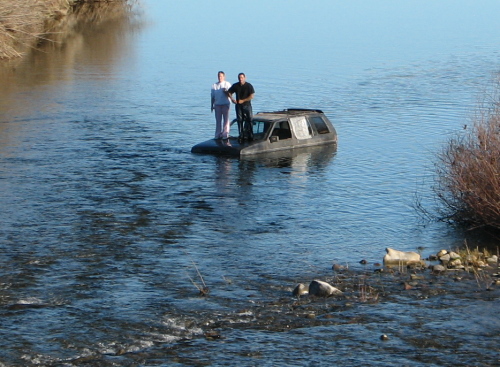
MIDDLETOWN – Some four-wheeling fun led to a dangerous predicament Wednesday, when a vehicle ended up stranded in the middle of Putah Creek.
Hidden Valley Lake resident Rick Hamilton said the vehicle was in the middle of the creek at Hartmann Road on the east side of Highway 29 at about 2:50 p.m. Wednesday.
Two people were standing on top of the hood and a third person was on one of the nearby banks.
Hamilton said he reported the situation, and two fire trucks showed up but left shortly thereafter.
A California Highway Patrol vehicle and the fire captain's pickup later were on scene, Hamilton said.
No information was available from the CHP late Wednesday.
Hamilton said four-wheeling takes place in the creekbed and the surrounding area.
E-mail Elizabeth Larson at
{mos_sb_discuss:2}
- Details
- Written by: Lake County News Reports
The survey, conducted Tuesday, indicates snow water content is 76 percent of normal for the date, statewide. This time last year, snow water content was 60 percent of normal statewide.
While this year’s water content is higher than last, winter storms arrived late. It is too early to tell whether improved figures will translate into a better water year than the state experienced last year, when winter storms ended early leading to California’s driest spring on record.
Electronic sensor readings show northern Sierra snow water equivalents at 54 percent of normal for this date, central Sierra at 76 percent, and southern Sierra at 99 percent. The sensor readings are posted at http://cdec.water.ca.gov/cgi-progs/snow/DLYSWEQ.
In Lake County, where water supply is largely dependent on rainfall and snowpack from the Mendocino National Forest, Clear Lake's level on Wednesday was 1.16 Rumsey – the measure specifically used for Clear Lake. That's 0.11 Rumsey below Dec. 31, 2007.
The Mendocino National Forest conducts snow surveys beginning in late February. This past year, the first forest snow survey noted levels 156 percent of average, while measurements at the same time in 2007 had showed 92 percent of normal. However, dry conditions in both years led to lower readings later in the spring.
Lake County's creeks also appear to be running low. US Geological Survey stream gage measurements noted the following readings on Wednesday:
Kelsey Creek was discharging at 14 cubic feet per second, well below the median of 32. The creek's minimum recorded reading is 3.9, recorded, in 1991, while its maximum is 3,500 cubic feet per second, recorded in 1997.
Cache Creek at Hough Springs near Clearlake Oaks was discharging at 18 cubic feet per second, with a median reading of 47. Its minimum is 1.7 (recorded in 1977) and maximum is 7,300 (recorded in 1997).
Cache Creek near Lower Lake, discharging at 4.7 cubic feet per second, with a median reading of 2.9. Its lowest reading, in 1991, was 0.19; its highest, in 1997, was 4,530.
Putah Creek near Guenoc, discharging at 41 cubic feet per second, with a median reading of 126. Minimum reading was 2.4, recorded in 1937, while its maximum, in 2006, was 4,650.
California's water picture remains uncertain, despite the fact that Tuesday's measurements indicate an improvement over last years initial snow survey figures.
DWR Director Lester Snow noted that “the strain on California’s water supply persists.”
“Recent regulatory actions that further limit pumping through the Delta and deficits from the previous two dry years will require a very wet year to relieve the drought,” said Snow. “We must take immediate steps to protect the Delta ecosystem, conserve more water and develop additional groundwater and surface storage facilities to meet our future needs.”
Storage in California’s major reservoirs is low. Lake Oroville, the principal storage reservoir for the State Water Project (SWP), is at 28 percent of capacity, and 44 percent of average storage for this time of year.
Continuing dry conditions and court-ordered restrictions on Delta water exports are limiting water deliveries to farms and urban areas. DWR’s early estimate is that it will only be able to deliver 15 percent of requested State Water Project water this year to the Bay Area, San Joaquin Valley, Central Coast and Southern California. Increased precipitation this winter could increase this figure.
In December 2008, the U.S. Fish and Wildlife Service released a Delta smelt Biological Opinion which could reduce Delta exports by 20-50 percent. In December 2007, Judge Oliver Wanger restricted pumping to protect the Delta smelt, resulting in a 25 percent reduction in water deliveries. In a November 2008 decision, the California Fish and Game Commission implemented take restrictions for the longfin smelt which also could reduce water delivery pumping.
A Biological Opinion from the National Marine Fisheries Service to protect salmon and steelhead is expected in March. These regulatory actions have and will continue to significantly decrease deliveries to homes, farms, cities and industry by both the State Water Project and the federal Central Valley Project.
Snow water content is important in determining the coming year's water supply. The measurements help hydrologists prepare water supply forecasts as well as provide others, such as hydroelectric power companies and the recreation industry, with needed data.
Monitoring is coordinated by the Department of Water Resources as part of the multi-agency California Cooperative Snow Surveys Program. Surveyors from more than 50 agencies and utilities visit hundreds of snow measurement courses in California’s mountains to gauge the amount of water in the snowpack.
{mos_sb_discuss:2}
- Details
- Written by: Lake County News Reports
“The Bush Administration is seeking to gut the Endangered Species Act on its way out the door,” Attorney General Brown said. “This is an audacious attempt to circumvent a time-tested statute that for 35 years has required scientific review of proposed federal agency decisions that affect wildlife.”
The new regulations, initially proposed by the Departments of the Interior and Commerce in August 2008 and made final on Dec. 16, largely eliminate a requirement in the Endangered Species Act that mandates scientific review of federal agency decisions that might affect endangered and threatened species and their habitats.
The changes allow federal agencies to undertake or permit mining, logging, and other commercial activities on federal land and other areas without obtaining review or comment from federal wildlife biologists on the environmental effects of such activities.
The new regulations are the most significant changes to the Endangered Species Act and its implementing regulations in 20 years.
Now that these regulations have been adopted, many decisions on whether to permit commercial activities on protected land will be made at the discretion of federal agency project proponents, according to Brown's office. These agencies generally lack adequate biological expertise and have incentives to conclude that their projects will not have adverse affects on endangered and threatened species and their habitat.
The changes also eliminate the requirement to consider the effects of greenhouse gas emissions on species and ecosystems from proposed federal projects. Federal agencies now no longer need to consider the possible adverse impacts on species like the polar bear from commercial projects that require federal approval or funding such as highway construction and coal-fired power plants.
The lawsuit, which was filed in the U.S. District Court for the Northern District of California, alleges that the Bush Administration:
• Violated the Endangered Species Act by adopting regulations that are inconsistent with that statute;
• Violated the National Environmental Policy Act by failing to consider the environmental ramifications of the proposed new regulations; and
• Violated the Administrative Procedures Act by not adequately considering public comments submitted by the Attorney General and numerous other organizations and concerned citizens.
The Attorney General’s lawsuit follows three similar lawsuits challenging the regulations filed earlier by environmental groups.
{mos_sb_discuss:2}
- Details
- Written by: Elizabeth Larson
The Denver-based MediaNews Group, which has owned the Record-Bee since 2001, made the announcement in a letter sent to employees' homes last week as well as a memorandum distributed on Monday.
The news comes as employees in Lakeport and around the company await a round of layoffs slated to happen any day, according to sources who have asked not to be identified due to fear of retribution.
Lake County News obtained a copy of the memo, sent Monday by Jim Janiga, senior vice president of human resources for MediaNews Group's California Newspaper Partnership, in which he informs employees that the company's matching contribution to the 401(k) plan will be suspended Jan. 1, 2009, “for an indefinite period of time.”
Janiga added that the suspension will run through all of 2009 but “could possibly be reinstated beginning in 2010.”
“The decision to suspend the matching contribution was not made lightly,” Janiga wrote. “This is an expense reduction needed to help offset still declining revenues, a trend we are all too familiar with and which continues to impact the newspaper industry and most all private and public sectors throughout our local, state and national economies.”
A summary annual report on MediaNews Group's retirement and savings plan, obtained by Lake County News, notes that 11,880 people were participants or plan beneficiaries as of Dec. 31, 2007.
The value of the plan's assets, after liabilities, was $238,414,653 on Dec. 31, 2007, up from $208,963,645 on Jan. 1, 2007, the report noted.
For the period of Jan. 1, 2007, through Dec. 31, 2007, the plan had total income of $51.5 million, which included MediaNews Group's $5.8 million in contributions, $21.1 million from employees, $4.6 million in other contributions and $19.9 million in investment earnings.
Earlier this month, William Dean Singleton, MediaNews' chief executive officer and its principal owner, asked unions at the Denver Post, another of his 53 daily newspapers, as well as the Denver Newspaper Agency to reopen labor contracts.
Singleton said he needed to cut $20 million in expenses immediately, according to a Rocky Mountain News report.
That request, made to the unions on Dec. 12, came a day after Moody's Investors Services downgraded nearly all of the company's $1 billion in debt further into junk status, reaching a non-investment grade rating of “Caa3,” which according to an Associated Press report is the third-lowest rating on Moody's scale.
Moody had previously downgraded MediaNews' debt in May. Three months later, the company sold its Connecticut newspaper holdings, including the Connecticut Post and seven non-daily newspapers, to Hearst Corp.
The rating downgrades are based on Moody's lowered opinion of the company's ability to meet its financial obligations after a 16-percent decline in revenue for the third quarter, and concerns over a revolving $175 million credit facility that comes due in December 2009, according to the Associated Press.
The Associated Press noted that the downgrade also has the impact of making it harder for MediaNews to find new financing because of default concerns.
In press reports Singleton has steadfastly maintained his company is financially sound and honoring its financial commitments.
The Record-Bee traditionally has been among MediaNews' strongest performers, outpacing advertising revenues of its larger, urban sister papers.
However, despite its stronger performance, the paper and its staff are facing cuts in staffing, which continues a trend in employee reductions at the newspaper.
Since 2001 the editorial staff of the Record-Bee and Clear Lake Observer-American combined has been reduced from 12 employees to eight, with at least another position on the line in the upcoming layoffs. Of those staff reductions, two have been reporter positions.
Those cuts in editorial are in addition to numerous other layoffs experienced throughout the paper's departments, including composing, press and accounting.
E-mail Elizabeth Larson at
{mos_sb_discuss:2}