 How to resolve AdBlock issue?
Education
- Details
- Written by: Editor
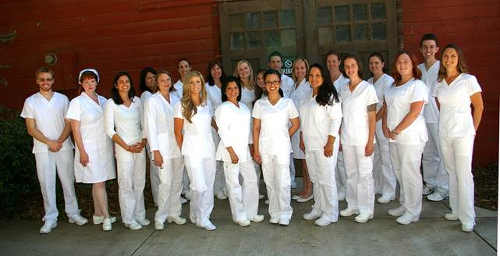
NORTH COAST, Calif. – At graduation on May 22, Mendocino College had 18 nurses who were excited about their graduation, but nervous to take the National Council Licensure Examination.
The NCLEX-RN test is a required exam that measures the competencies needed to perform safely and effectively as an entry level nurse and must be passed before a nurse receives their licensing.
Mendocino College is proud to announce that all of the testing 2014 Mendocino College Nursing Graduates passed the NCLEX exam on the first try.
“When we received the news that all of our students who graduated in May and took their NCLEX-RN had passed there was a joyous feeling of accomplishment and pride,” said Dr. Barbara French, director of nursing at Mendocino College.
“We know how very hard our students worked through the program and how hard we all work as instructors to prepare them,” French said. “This confirms the hard work for both students and instructors. When a student does not pass for any reason we all try and figure out how we could have presented information differently, addressed student learning needs differently, etc. We take it personally. Our pass rate has consistently been among the best, but finally hitting the 100-percent mark was a great feeling.”
French's statement speaks for the individualized attention, positive instruction and great care that the nursing faculty have for their students.
Through the hard work, determination and expertise of these faculty, Mendocino College has been able to boast a state board examination pass rate of 96 percent in the past, well above the statewide average of 86 percent.
Each fall the Mendocino College Nursing program admits eighteen new nursing students into the two-year program.
Each year when the graduating nursing students are surveyed, their overwhelming response is that their success is attributed to their instructors.
One past nursing student, Regina Santiago stated, “The nursing faculty have all been wonderful. They work at least as hard as we do. Our success really matters to them.”
Another graduate, Theresa Rohr, credited the nursing faculty at MC for inspiring her. “They were fabulous. We were all so close, and they were so important in getting me where I wanted and needed to be.”
Nursing students at Mendocino College receive a lot of specialized attention not only from the faculty, but also from the Mendocino College Foundation.
In consideration of the extra time required for schooling and the loss of income faced by many students, finding the funding for all of the necessary supplies for this degree can be exhausting. That’s where the foundation steps in.
In addition to providing nursing shoes, lab coats and emergency funding for student needs – to name a few – the foundation has a big surprise for each graduating class.
In 2012, the Mendocino College Foundation – through the generosity of Albert Beltrami – surprised each of the nursing graduates with a $400 check to fund their state board examination fees.
Since then, the foundation has tirelessly fundraised to provide the same opportunity for each of the graduating class of nurses.
“For every month a nursing candidate waits to take their state board examination, their ability to pass goes down 24 percent,” French said. “It is absolutely critical that our graduates take the examination immediately following graduation, and this annual gift guarantees that they will.”
On average, once students begin the nursing program their annual income drops by over 43 percent due to the intensity of the program.
With continued excellence in the classroom, the nursing faculty is striving toward matching its 100-percent pass rate again next year.
- Details
- Written by: Editor
LAKE COUNTY, Calif. – Under the careful tutelage of Connie Pagulayan, AA, business office manger of Rocky Point Center, 16 medical assistant students undertook the challenge of understanding the financial aspects of the ambulatory care setting.
Sept. 13 proved memorable for the wary but open-minded class.
For eight intense hours Pagulayan presented the basics and more in the complicated world of billing and medical insurance in the health care arena.
She emphasized the importance of accuracy, timeliness and understanding the procedures required.
Pagulayan reiterated the necessity to be able to explain the forms, reports and requirements to the patients involved in the process.
Her message was clear: be precise, be honest, be sensible and be sensitive.
The topic of managing money in a clinic or physician office is just one of approximately 50 areas of study the future medical assistants are undertaking as they prepare for the national certification exam next spring.
They agreed this subject presented a particularly difficult test of their abilities since finance in health care can defy even the experts.
The Lake County Office of Education is appreciative of Pagulayan and so many of the community guest speakers who are donating their time and talent to assist this class towards their efforts of achieving national certification.
The expertise of these citizens lends an added value to the rich educational program created for adult learners by the Lake County Office of Education Career & College Readiness Department.
- Details
- Written by: Editor
SACRAMENTO – In an historic first for public higher education in the state, Gov. Jerry Brown on Sunday signed legislation that allows California community colleges to award bachelor’s degrees in fields not currently served by the California State University (CSU) or University of California (UC).
The legislation, authored by Sen. Marty Block (D-San Diego), directs the California Community Colleges system to establish a pilot baccalaureate degree program in 15 college districts by no later than the 2017-18 academic year.
The state Chancellor’s Office, in consultation with UC and CSU, will decide which districts are chosen to host programs, subject to California Community Colleges Board of Governors approval.
Districts will be selected according to their ability and interest in establishing rigorous undergrad programs that confer degrees in high demand among regional employers.
Achieving a geographical balance of districts to maximize student enrollment will be another factor.
“Thanks to the governor, Legislature, and college educators who supported this bill, like Chancellor Constance Carroll of San Diego, the country’s largest system of higher education joins the ranks of community colleges in other states that offer four-year degrees,” said California Community Colleges Chancellor Brice W. Harris. “Employers in California seek candidates with advanced credentials and many struggle to fill positions in some of the fields that will be covered under the new program. This law will help us to meet California’s workforce needs, does not duplicate CSU or UC degree programs, and gives more Californians access to affordable higher education that can enable them to obtain well-paying jobs.”
The new four-year degree programs could be offered in vocational occupations where an Associate of Arts degree had been acceptable in the past for employment but now increasingly require a bachelor’s degree to be competitive.
These fields and occupations can include dental hygiene, industrial technology, allied health technology, emergency medical technicians, and data management for health care.
Under the new law, community colleges would charge only $84 more per unit for upper-division baccalaureate coursework than they currently charge for lower-division courses.
The Legislative Analyst’s Office will conduct an interim evaluation of the bachelor’s degree program in 2018, and a final evaluation by July 2022. The pilot program will end in the 2022-23 academic year, unless extended by the Legislature.
“California community colleges are well placed to educate students who may have been unable to earn a four-year degree due to our low tuition rates and numerous and easily accessible locations throughout the state,” Harris added.
The California Master Plan for Higher Education outlines the roles UC, CSU, and the community colleges play in educating the state’s population.
Under the original plan, enacted in the 1960s, UC awarded doctoral, master’s, and bachelor’s degrees, CSU awarded bachelor’s and master’s degrees, and the community colleges offered lower-division coursework and associate degrees or certificates. The plan has been adjusted to meet workforce needs in recent years.
For instance, CSU can now award doctoral degrees in education, nursing, and physical therapy.
Nationwide, more than 50 community colleges operate almost 500 baccalaureate programs in 21 states.
Gov. Brown also signed AB 2558 earlier this month. The legislation establishes the Community College Professional Development Program, which aims to increase professional development activities for all community college employees.
The California Community Colleges is the largest system of higher education in the nation composed of 72 districts and 112 colleges serving 2.1 million students per year.
Community colleges supply workforce training, basic skills education and prepare students for transfer to four-year institutions.
The Chancellor’s Office provides leadership, advocacy and support under the direction of the Board of Governors of the California Community Colleges.
For more information about the community colleges, please visit http://californiacommunitycolleges.cccco.edu/ .
- Details
- Written by: Charles Warren

Hello again readers, and this is the Carlé Chronicle, your primary news source for all things Carlé High School.
Carlé’s students of the week were Tyjonique “Ty Ty” Beasley and Ben Boyce. Both students are hard-working and talented individuals and Carlé appreciates having them around. We can’t wait to see what their future holds for them.
Our gold level students for the first grading period were just announced.
The hard-working students who maintained a 90-percent or higher attendance rate and received a minimum of 15 credits each were Jose Bendana, Devin Black, Ben Boyce, Angel Cordova, Dameon Dawson, Gage Fowler, Alyssa Goepfort, Chris Nuzzo, Isaiah Piazza and Dustin Wilson.
Autumn is finally here, and the sudden shift in weather has many people feeling, for lack of a better phrase, under the weather.
Our science teacher Angie Siegel would like to thank our gardener Dameon Dawson for all his hard work keeping our plants in the quad green, gorgeous and thriving throughout the school year.
When winter rolls around, Angie will be opening up a greenhouse where students will grow vegetables, and we hope to see many students interested in maintaining and growing our veggies this year.
Back To School night takes place Oct. 2 at 5:30 p.m. It will show students, guardians and staff alike our school’s progress and highlights throughout the year.
Students are encouraged to swing by with a parent or guardian and bring a fresh smile and a hot dish. All who attend and bring their guardian by will gain a small amount of credit in Elective credits.
Carlé’s U.S. History and Civics teacher Alan Siegel was invited to be on the State Teacher of the Year selection committee from Sept. 18 through 20 at the California Department of Education in Sacramento.
Siegel won the award in 2005 and he has been a member of the awards committee since 2007.
The committee helps select these special teachers of the year from every county winner including this year’s Lake County winner, Konocti’s own Kathy Perkins. Siegel must recuse himself when Perkins application comes up.
Regarding the event, Siegel said, “It’s been a special experience for me, because I get to read about the greatest schools and teachers every year and it’s been an honor to be part of this wonderful celebration. I’d also like to say it’s a pleasure to see the different ideas and programs from other teachers and look to adapt them to my own teaching style, and further help the pursuit of knowledge for my students here at Carlé.”
Our senior student Robert McGraw will be designing mugs for the 13 teachers who will be named as semifinalists and finalists. His efforts and artistic prowess are always appreciated.
We’d like to give a shout out our principal Matt Strahl’s mother Pat, who has continuously been following every article about our school. Thank you so much for all your support, Pat!
And thank you all for your own continued support. We hope that our articles have helped shed a light on our little school on the hill.
Charles Warren is a student at Carlé Continuation High School in Lower Lake, Calif.