
News

The California Department of Fish and Wildlife, or CDFW, has completed its 2025 waterfowl breeding population survey.
The results of the survey show both mallard and total duck species have increased this year.
The breeding population of mallards increased from 177,828 to 265,640 (a 49% increase), and total ducks (all species combined) increased from 373,864 to 474,495 (a 27% increase). Mallards remain below the long-term average by 16%.
“The survey indicated an increase in mallard abundance, and habitat conditions were good in northern California, so we expect average to above-average production for all waterfowl species,” said CDFW Waterfowl Program Biologist Melanie Weaver.
Since 1948, CDFW biologists and warden-pilots have conducted this survey annually using fixed-wing aircraft.
The population estimates are for those areas where the vast majority of waterfowl nesting occurs in California, including wetland and agricultural areas in northeastern California, throughout the Central Valley, the Suisun Marsh and some coastal valleys.
The complete 2025 California Waterfowl Breeding Population Survey Report is available at the CDFW website.
The majority of California’s wintering duck population originates from breeding areas surveyed by U.S. Fish and Wildlife Service, or USFWS, in Alaska and Canada, and these results should be available by late August.
CDFW survey information, along with similar data from other Pacific Flyway states, is used by the USFWS and the Pacific Flyway Council when setting hunting regulations for the Pacific Flyway states, including California.
- Details
- Written by: LAKE COUNTY NEWS REPORTS
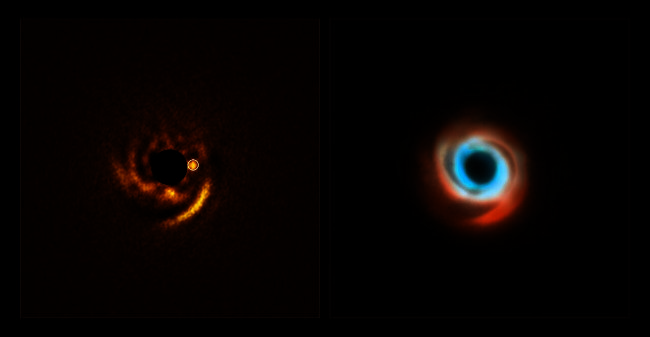
Astronomers may have caught a still-forming planet in action, carving out an intricate pattern in the gas and dust that surrounds its young host star.
Using ESO’s Very Large Telescope, or VLT, they observed a planetary disc with prominent spiral arms, finding clear signs of a planet nestled in its inner regions. This is the first time astronomers have detected a planet candidate embedded inside a disc spiral.
“We will never witness the formation of Earth, but here, around a young star 440 light-years away, we may be watching a planet come into existence in real time,” said Francesco Maio, a doctoral researcher at the University of Florence, Italy, and lead author of this study, published this month in Astronomy & Astrophysics.
The potential planet-in-the-making was detected around the star HD 135344B, within a disc of gas and dust around it called a protoplanetary disc.
The budding planet is estimated to be twice the size of Jupiter and as far from its host star as Neptune is from the Sun. It has been observed shaping its surroundings within the protoplanetary disc as it grows into a fully formed planet.
Protoplanetary discs have been observed around other young stars, and they often display intricate patterns, such as rings, gaps or spirals.
Astronomers have long predicted that these structures are caused by baby planets, which sweep up material as they orbit around their parent star. But, until now, they had not caught one of these planetary sculptors in the act.
In the case of HD 135344B’s disc, swirling spiral arms had previously been detected by another team of astronomers using Spectro-Polarimetric High-contrast Exoplanet REsearch, or SPHERE, an instrument on ESO’s VLT. However, none of the previous observations of this system found proof of a planet forming within the disc.
Now, with observations from the new VLT’s Enhanced Resolution Imager and Spectrograph, or ERIS, instrument, the researchers say they may have found their prime suspect.
The team spotted the planet candidate right at the base of one of the disc’s spiral arms, exactly where theory had predicted they might find the planet responsible for carving such a pattern.
“What makes this detection potentially a turning point is that, unlike many previous observations, we are able to directly detect the signal of the protoplanet, which is still highly embedded in the disc,” said Maio, who is based at the Arcetri Astrophysical Observatory, a centre of Italy’s National Institute for Astrophysics, or INAF. “This gives us a much higher level of confidence in the planet’s existence, as we’re observing the planet’s own light.”
A star’s companion is born
A different team of astronomers have also recently used the ERIS instrument to observe another star, V960 Mon, one that is still in the very early stages of its life. In a study published on 18 July in The Astrophysical Journal Letters, the team report that they have found a companion object to this young star. The exact nature of this object remains a mystery.
The new study, led by Anuroop Dasgupta, a doctoral researcher at ESO and at the Diego Portales University in Chile, follows up observations of V960 Mon made a couple of years ago.
Those observations, made with both SPHERE and the Atacama Large Millimeter/submillimeter Array, or ALMA, revealed that the material orbiting V960 Mon is shaped into a series of intricate spiral arms.
They also showed that the material is fragmenting, in a process known as “gravitational instability,” when large clumps of the material around a star contract and collapse, each with the potential to form a planet or a larger object.
“That work revealed unstable material but left open the question of what happens next. With ERIS, we set out to find any compact, luminous fragments signalling the presence of a companion in the disc — and we did,” said Dasgupta. The team found a potential companion object very near to one of the spiral arms observed with SPHERE and ALMA. The team say that this object could either be a planet in formation, or a ‘brown dwarf’ — an object bigger than a planet that didn’t gain enough mass to shine as a star.
If confirmed, this companion object may be the first clear detection of a planet or brown dwarf forming by gravitational instability.
The European Southern Observatory enables scientists worldwide to discover the secrets of the Universe for the benefit of all.
- Details
- Written by: European Southern Observatory





 How to resolve AdBlock issue?