 How to resolve AdBlock issue?
Health
- Details
- Written by: USC Schwarzenegger Institute
De León will lead the Institute’s statewide campaign to fight childhood asthma caused by tailpipe emissions and pollution by identifying barriers to transportation electrification.
Today, eight of the 10 most polluted cities in America are in California. That pollution is a public health crisis, particularly for communities of color, children and seniors.
Statewide, over five million people have asthma, and nearly 10% of kids in California have asthma. School aged children are between 20 percent and 40 percent more likely to suffer from asthma than adults. In fact, asthma is the leading cause of absenteeism in California public schools, resulting in over 14 million absences each year.
Building on the success of SB 100, De Leòn will bring together elected officials, regional transit operators, union officials, electric bus and truck manufacturers and others to find actionable solutions to childhood asthma.
“Kevin has guts and isn’t afraid to work across party lines to get the right thing done. His environmental leadership took AB 32 to the next level and created a new bar for the rest of the nation to meet,” said Gov. Schwarzenegger. “I’m excited to welcome him to the Institute and know we’ll accomplish great things together.”
“Tail-pipe pollution is a public health crisis threatening our environment and the health of millions of our children,” said de Leon. “Every California policymaker and planner needs to be asking themselves; how can we transform our transportation system, not years down the road, but right now. I’m looking forward to working with Arnold, the Schwarzenegger Institute and leaders across the state to accelerate the transition to a clean energy future.”
During his twelve-year tenure in the Legislature, de León authored some of the nation’s most far reaching climate and environmental justice policies. Senate Bill 350 requires buildings to double their energy efficiency and made the nation’s single largest investment in electric vehicle charging infrastructure.
SB 535 created the so-called “California Enviro Screen,” which requires a quarter of all Cap-and-Trade auction revenues be invested in communities most heavily impacted by air and water pollution and the adverse impacts of climate change.
SB 100 puts California on the path to 100% clean energy by 2045, and SB 32 expands the requirements of Gov. Schwarzenegger, Speaker Fabian Nunez, and Sen. Fran Pavley’s Global Warming Solutions Act.
Professor Antonio Bento and leading scholars from the University of Southern California and other major research universities will contribute to the initiative. Dan Jacobson with Environment California, an architect of the 100% clean energy law, and Dan Reeves, de León’s former Chief of Staff, will support the campaign and fundraising efforts.
The USC Schwarzenegger Institute for State and Global Policy is committed to advancing post-partisanship, where state and global leaders work together to establish best practices in policymaking regardless of political party. Through research, conferences, and advocacy the Institute seeks to inform public policy and debate to confront serious challenges to our society including climate change, political reform, and education.
- Details
- Written by: MCHC Health Centers
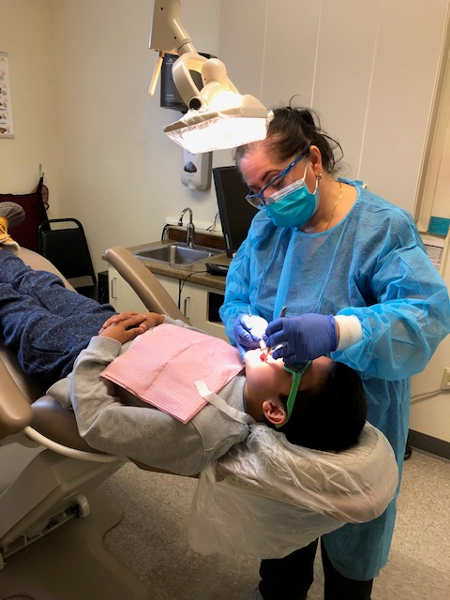
NORTH COAST, Calif. – To celebrate National Children’s Dental Health Month in February, MCHC Health Centers continued its annual tradition of participating in Give Kids a Smile Day.
On the first Saturday of February, dental employees volunteered to provide free dental care to 20 children who could not otherwise afford it.
“We had yet another successful year of giving back to our community,” said Dental Manager Margo Arellano. “Six dentists and 21 dental staff members came in on their day off to provide more than $10,000 worth of free care.” The team provided exams, x-rays, fillings, extractions, sealants, and more.
By visiting a dentist regularly starting at age 1, children are more likely to maintain good oral health, which helps ensure the ability communicate properly, to get good nutrition, and to avoid the embarrassment that can come from speech impediments or physical deformities.
Dental Director Dr. Doug Lewis thanked the dentists and other employees who supported the event, including the patient service representatives, dental assistants and sterile techs who scheduled the patients, prepared the equipment, set up the rooms, and then cleaned up after the event was finished.
Give Kids a Smile Day is a national event in which thousands of dentists and their teams provide free oral healthcare services to children from low-income families. In February and throughout the year, MCHC Health Centers provides dental care to children.
For more information, call 707-468-1010.
MCHC Health Centers is a local, non-profit, federally qualified health center offering medical, dental and behavioral health care to people in Lake and Mendocino counties.
- Details
- Written by: Elizabeth Larson
AB 824 would prohibit pharmaceutical agreements in which a drug company transfers anything of value to delay a competitor’s research, marketing, or sale of a competing version of its drug.
These agreements, known as “pay-for-delay” agreements, have significantly contributed to price increases for prescription drugs in California.
“Patients and consumers deserve to be free of unfair practices and price manipulation within the pharmaceutical industry,” said Attorney General Becerra. “This legislation is a crucial step in combating predatory pricing practices, like “pay-for-delay” schemes, by drug companies and in defending access to affordable care.”
“When drug companies use these quiet pay-for-delay agreements with generic drug manufacturers it hurts consumers twice – once by delaying the introduction of an equivalent generic drug that is almost always cheaper than the brand name and again by stifling additional competition when multiple generic companies begin producing even less expensive generic equivalents,” said Assemblymember Wood. “This is just wrong.”
Drug manufacturers employ pay-for-delay agreements to block competitors from marketing lower-cost versions of their drugs. Studies from the Federal Trade Commission and from experts have consistently shown that, as a result of these anticompetitive maneuvers, consumers are left to pay as much as 90 percent more for drugs shielded from competition.
Pay-for-delay agreements are the product of lawsuit settlements between a branded drug company and a generic drug company. In these cases, the branded company sues the generic company for alleged patent infringement. The companies then settle the case out of court in a confidential agreement.
As part of the agreement, the branded drug company pays the generic drug company to keep its generic drug off the market for a period of time. These pay-for-delay arrangements are kept secret from the public through out-of-court settlements.
AB 824 would presume these agreements are anticompetitive and that they delay entry of the generic drug into the marketplace. It would also prevent the parties from withholding relevant evidence regarding the agreements behind attorney-client and common-interest privileges.
This legislation is the first state legislation in the United States to tackle pay-for-delay agreements, providing California with the opportunity to continue to be a leader in pay-for-delay litigation.
- Details
- Written by: Elizabeth Larson
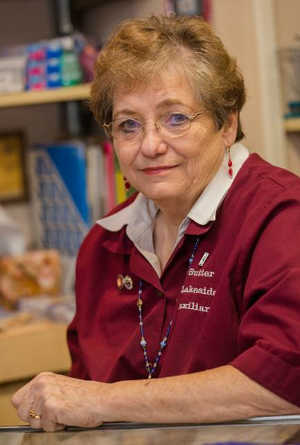
LAKEPORT, Calif. – Sutter Lakeside Hospital is recruiting volunteers to serve as the face of the front desk in the hospital lobby, as well as serve in other roles throughout the hospital.
Sutter Lakeside Hospital’s volunteer Auxiliary has been serving the community through their work with the organization since 1961.
Historically, volunteers have managed the hospital gift shop, helped check patients in for surgery, and helped with clerical work in the Emergency Department and Family Birth Center.
Volunteering at the front desk is a new opportunity for members of the Auxiliary.
“We’re excited to involve volunteers in serving as the face of the hospital when patients walk through our doors,” says Dan Peterson, chief administrative officer. “It’s fitting that community members would serve in this role, as we are such a community-oriented organization.”
Duties will include greeting patients, checking in visitors, helping patients navigate the building, answering questions and warmly welcoming all who enter.
No computer work is necessary and training will be provided.
Two four-hour shifts are available Monday through Friday from 8 a.m. to 12 p.m., and 12 p.m. to 4 p.m.
Applications are also accepted for work in the gift shop, at the surgery center and in the emergency department.
Applicants must be over the age of 18; a minimum one year commitment is required.
Interested applicants should contact Morgen Jarus at 707-262-5121 or