 How to resolve AdBlock issue?
Health
- Details
- Written by: Elizabeth Larson
Manaar Azreik and Christina Hamilton of Transformation by Fire.org will hold the workshops from 11 a.m. to 3 p.m. Saturday, Oct. 6, at the Middletown Activity Center (near the Library) and again Saturday, Oct. 20, at the Lower Lake Schoolhouse Museum on Main Street.
A light vegetarian lunch will be served. The event is offered by donation.
Since ancient times people have gathered together after disasters and tragedies to grieve, reconnect and heal.
In these events they create a safe space to join together, with time for reflection, discussion, drumming, movement, sound-healing and other emotional release practices.
To RSVP, please contact Azreik at 707-971-1226 or Hamilton at 707-921-9427.
To learn more about their work please visit www.transformationbyfire.org or email
- Details
- Written by: Earle Baum Center
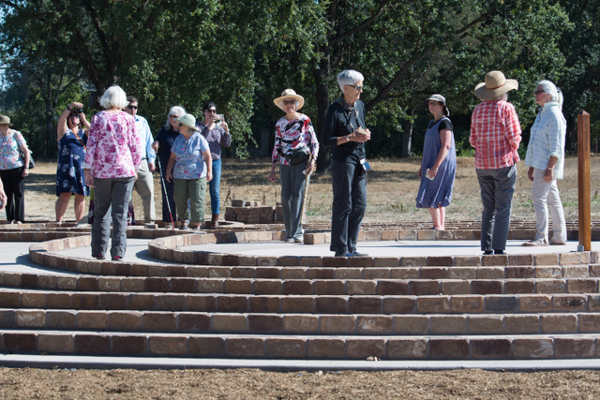
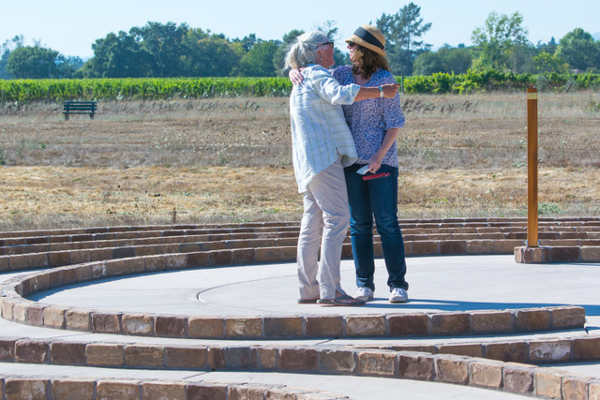
SANTA ROSA, Calif. – Featuring gentle looping spiral paths specially designed for people with vision loss and mobility challenges but fun for all ages, the new labyrinth at the Earle Baum Center celebrated its grand opening Sept. 7.
The labyrinth, which is located at 4539 Occidental Road, Santa Rosa, was made possible by a generous donation from an anonymous donor.
Labyrinths can be found in nearly every civilization in the world. The history of labyrinths goes back roughly 4,000 years.
They are an ancient archetypal symbol of transformation. It is used as a tool where one can have a direct experience, a relaxing walk for stress relief, celebrations of seasonal renewal or for some, as a walking meditation practice. They are currently popular in parks, churches and hospitals
“Our hope is to make this labyrinth accessible to those who use a white cane, guide dog, walker or wheelchair to travel,” said Patricia Jefferson, vision rehabilitation instructor at Earle Baum Center. “Its smooth concrete paths are 39 inches wide with 4 inches high brick curbs on each side of the path to help guide visitors safely.”
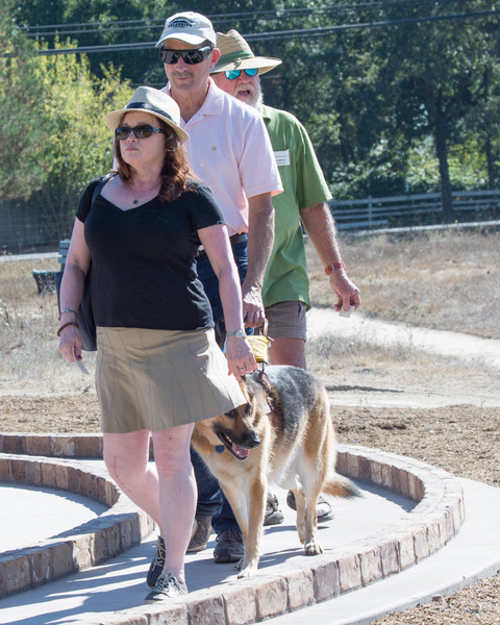
The labyrinth is open to the public as well. For those with mobility and orientation challenges, EBC offers ongoing training sessions on how to use the labyrinth for exercise and meditation.
A meditation space adjacent to the labyrinth includes a large seating area and is suitable for study groups or as a place for quiet contemplation. A stunning 60-foot redwood bench is curved to complement the landscape.
Future additions include an interpretive sign near the entrance and a description in Braille and via audio beacon.
The official opening of the labyrinth will include some brief remarks and a thank you to the talented labyrinth builders and the donor, a short history of labyrinths, presented by labyrinth facilitator Maia Scott and a chance to travel the path. Valerie Joi and Anne Strafford of Simple Praise will provide inspirational music and food and beverage will be provided.
If you have questions about the labyrinth, please call or email Patricia Jefferson at 707-636-2314 or
- Details
- Written by: Elizabeth Larson
The Infant Safe Sleep program is geared towards reducing infant deaths and injury related to suffocation and S.I.D.S.
Seminars are held from 5 to 6:30 p.m. on the first Wednesday of the month at Sutter Lakeside Hospital and the third Tuesday of the month at Adventist Health Clear Lake.
The Infant Safe Sleep Seminar is a countywide collaborative project between Sutter Lakeside Hospital and Adventist Health Clear Lake, and is supported by First 5 Lake County, Mother-Wise, Easter Seals, Lake County Tribal Health Consortium and Lake Family Resource Center. Special funding for the Adventist Health program is provided by Redbud Health Care District and Adventist Health Philanthropy.
“The information and resources shared are a lifeline to our Lake County mothers,” said Melissa Keller, AHCL Women’s Care RN. “It is a privilege to educate and support them during this precious time in their life. I am grateful the program is now offered at both ends of the lake.”
The centerpiece of the campaign is an hour long training led by registered nurses from the Sutter Lakeside Family Birth Center, Adventist Health Clear Lake Women’s Care Unit and volunteers from Mother-Wise, First 5 Lake County and Lake Family Resource Center.
Free and open to all Lake County residents expecting or with a new baby, each class covers why babies shouldn’t sleep in bed with a parent or caregiver; on their side or stomach; or in a crib cluttered with pillows, toys or blankets.
Mothers are encouraged to attend the seminar in their third trimester of pregnancy.
In addition to safe sleeping, partners offer resource information for post-delivery and child development.
Parents who attend the seminar go home with a bundle of child care products which includes a Pack ‘n Play, sleep sack, diapers, wipes, baby clothes, digital thermometer, and other baby essentials that support sale sleep strategies and infant care.
To sign up for an Infant Safe Sleep seminar at Adventist Health call the Bright Start Program at 707.995.4594; to sign up for an Infant Safe Sleep seminar at Sutter Lakeside Hospital call the Family Birth Center at 707-262-5085.
- Details
- Written by: Elizabeth Larson
In response to the unusually high numbers of suicides at state prisons, the state auditor investigated and released an audit report in August 2017 which noted that prisons failed to monitor at-risk inmates, complete behavioral risk evaluations and treatment plans, and did not have staff complete required trainings related to suicide prevention and response.
The auditor concluded that the California Department of Corrections and Rehabilitation, or CDCR, did not consistently follow their established procedures and practices.
“Once SB 960 is implemented, California state prisons will be more responsive to the needs of inmates and be able to prevent suicides behind prison walls,” Senator Leyva said. “This measure will address the suicide crisis in our state prisons by making sure that inmates are able to receive proper mental health care and other services to prevent injuries and deaths. SB 960 will also help improve the state prisons’ notification system to ensure that family members and loved ones are notified when an inmate dies or is seriously injured. I appreciate Governor Brown’s signature of SB 960, as it will promote greater transparency and affirm California’s commitment to reversing the troubling high rate of suicides in state prisons.”
Specifically, SB 960 would implement the State Auditor’s recommendation to require CDCR to report annually to the Legislature on its progress in meeting goals related to properly completing suicide risk evaluations and treatment plans, ensuring staff receive appropriate training, and implementing changes resulting from a special master or internal audits.
In addition, the report would include CDCR’s efforts and progress to expand their current notification system for instances of death, attempted suicide, serious injury, and serious illness.
This provision was included to address numerous troubling reports from advocates and other interested groups that have detailed instances where family members received delayed or no notification at all of their loved one’s death or serious harm.
Supported by California Catholic Conference, California Coalition for Women Prisoners, California Prison Focus, California Public Defenders Association, Californians United for a Responsible Budget, County Behavioral Health Directors Association of California, Depression and Bipolar Support Alliance, Ella Baker Center for Human Rights, Fair Chance Project, National Alliance on Mental Illness / California, National Association of Social Workers / California Chapter and the Steinberg Institute, SB 960 will take effect on Jan. 1, 2019.