 How to resolve AdBlock issue?
Health
- Details
- Written by: Mendocino College
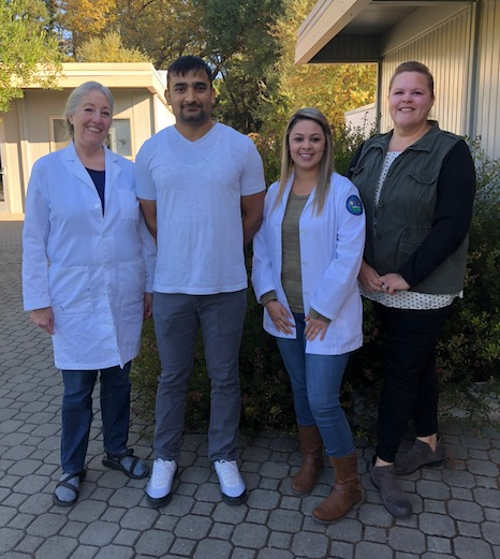
UKIAH, Calif. – First year nursing student Jessica Hernandez is a full-time student at Mendocino College enrolled in the college’s nursing program.
She is the fortunate recipient of a new scholarship from the American Legion’s Forty and Eight Society.
Forty and Eight representative Dennis Alexander contacted the nursing program because the club members wanted to provide a scholarship to a student enrolled in the nursing program who resides in Lake County, the home of the society.
According to staff in the nursing program, Hernandez immediately came to mind. She is a thoughtful, conscientious and hard-working student who lives in Lake County.
She is a graduate of Clear Lake High School and has been employed by Sutter Lakeside Hospital since 2011 as a certified nursing assistant.
Hernandez has always wanted to be a nurse and indicated that her role model is her mother. “My mother has always worked hard and supported and encouraged me to succeed,” she said.
She is following her mother’s example by encouraging her 5-year-old daughter Aleah, who also wants to be a nurse when she grows up.
Hernandez was excited to receive the scholarship and is on track to graduate from the nursing program in the spring of 2020, at which time she hopes to begin her nursing career at Sutter Lakeside.
The Forty and Eight Society is a veterans’ organization in Lake County that is actively involved in programs supporting child welfare, youth sports, training for nurses, Carville Star and other veterans affairs voluntary services.
Members of the Forty and Eight are also members of the American Legion. The American Legion was chartered and incorporated by Congress in 1919 as a patriotic veterans organization devoted to mutual helpfulness. It is the nation’s largest wartime veterans service organization, committed to mentoring youth and sponsorship of wholesome programs in our communities, advocating patriotism and honor, promoting strong national security, and continued devotion to our fellow service members and veterans.
For more information about the Mendocino College Foundation or to donate towards any of their programs, contact Katie Fairbairn, executive director, at
- Details
- Written by: Elizabeth Larson
Cigarette smoking is the leading cause of cancer death in the United States, accounting for 29 percent of all cancer deaths. In fact, smoking cigarettes kills more Americans than alcohol, car accidents, HIV, guns, and illegal drugs do combined.
Smoking not only causes cancer, but it also damages nearly every organ in the body, including the lungs, heart, blood vessels, reproductive organs, mouth, skin, eyes and bones.
Addiction to the nicotine in cigarettes is one of the strongest and most deadly addictions one
can have.
Each year, approximately 20 million American smokers try to quit, representing more than half of the 37.8 million smokers in the U.S. Only 7 percent succeed. An even greater percentage of smokers (68 percent) report being interested in quitting.
Quitting is hard. It takes commitment, and starts with a plan.
Getting help through counseling and/or prescription medications can triple your chances of quitting successfully.
Support is also essential. Smoking cessation programs, like the California Smokers Helpline (1-800-NOBUTTS), the American Cancer Society’s Freshstart program, Nicotine Anonymous meetings, self-help materials such as books and pamphlets, and smoking counselors or coaches can be of great help.
The American Cancer Society is available 24 hours a day, seven days a week, to provide support as you make your plan to quit. More information is available at www.cancer.org/Smokeout or by calling 1-800-227-2345.
- Details
- Written by: Upper Lake Seventh-day Adventist Church
Rizo and Merlie Etcobanez, experienced lifestyle educators, will be presenting this series beginning on Monday, Nov. 12, at 7 p.m. at the Upper Lake Seventh-day Adventist Church, 699 Second St.
It will continue every Monday evening for four sessions.
Come and learn how to implement lifestyle practices that will improve your health.
Watch plant-based cooking demonstrations and enjoy tasty food samples.
Admission is free.
For more information, call 707-275-8071.
- Details
- Written by: Mendocino College
Four fire engines, a Reach Air Ambulance, and dozens of Mendocino College students in the nursing and emergency medical services programs participated.
Several volunteer victims of the simulated two-car crash had a range of mock injuries for the students to diagnose and treat, including two deceased victims.
The objectives of the simulation were triage assessment, professional communications, and the use of the “jaws of life” extraction tool for trapped victims.
Prior to the actual simulation, a half day of workshops were held focusing on response to trauma events that included orthopedic and burn trauma, facial trauma, C-spinal immobilization skills, and mass casualty triage.
Students earned up to ten clinical hours of credit for participating in the simulation.
The result of five months of careful interagency planning, the event was designed to address the need for health care students to engage in inter-professional training – a need identified by the Institute of Medicine and the Robert Wood Johnson Foundation.
Coordinating the event were Mendocino College’s Nursing instructor Kimberly Swift, and EMS instructor Theresa Gowan.
Support from Amy Henry with Reach Air, and Chief Kirk Thomsen of Ukiah Valley Fire Authority also made the event possible.
Additional guidance and support came from Dr. Duncan Johnston and Dr. Gerry Lazzareschi from Adventist Health Ukiah Valley, who were present to assist students in their trauma assessments in the state-of-the-art simulation lab in the nursing program area at Mendocino College.
The event was rich with information and hands-on experience, benefiting students who will go on to serve those in need in their health services careers.
More information can be obtained at www.mendocino.edu/nursing or by calling 707-468-3099.
The Mendocino College Ukiah campus is located at 1000 Hensley Creek Road, Ukiah.