
Health
SACRAMENTO – The California Department of Public Health (CDPH) and the California Department of Pesticide Regulation (DPR) have warned people not to eat cactus pads, or nopales, imported from Mexico sold at specific retail and wholesale locations around the state due to the presence of unapproved pesticides.
Routine surveillance samples collected by DPR inspectors found various pesticides, including dimethoate, omethoate, monocrotophos and methidathion, at levels that pose a health risk to humans.
Both monocrotophos and methidathion have been banned for food use in the United States for several years.
“Anyone feeling ill after consuming cactus products should consult their health care provider,” said CDPH Director and State Health Officer Dr. Karen Smith. “The symptoms of acute poisoning may include sweating, headache, weakness, nausea, vomiting, hypersalivation, abdominal cramps, and diarrhea. Consumption of monocrotophos can lead to neurotoxicity and permanent nerve damage.”
DPR sampled contaminated cactus pads that were offered for sale to consumers and wholesale customers between January 23-29 at the following locations:
– Rancho San Miguel Markets, Madera;
– La Monarca Market, Lower Lake;
– FreshPoint Central California, Turlock;
– Arteaga’s Food Center, Sacramento;
– Stater Bros. Distribution Center, San Bernardino;
– S&L Wholesale Produce, San Francisco.
DPR immediately removed the cactus pads it could locate from store shelves and distribution centers. The items were quarantined or destroyed so that they do not pose a threat to consumers.
However, DPR believes it is possible that some of the cactus pads may have been sold to other stores in California, Nevada and Oregon.
The tainted produce was packaged with the brand names “Mexpogroup Fresh Produce,” “Aramburo,” or “Los Tres Huastecos”.
“Many Californians eat cactus as part of their diet, but the pesticide levels we have found at some specific locations are concerning,” said Brian Leahy, DPR director. “We are not aware of any illnesses that have been reported to date, but we suggest that anyone who bought this product from these locations recently, return it to the place of purchase or dispose of it in the garbage.”
Washing or peeling the cactus is not effective and people should not try to salvage any of this contaminated produce.
CDPH and CDPR have alerted the U.S. Food and Drug Administration about the issue.
Consumers who observe the product being offered for sale are encouraged to report the activity to the CDPH toll free complaint line at 800-495-3232.
Routine surveillance samples collected by DPR inspectors found various pesticides, including dimethoate, omethoate, monocrotophos and methidathion, at levels that pose a health risk to humans.
Both monocrotophos and methidathion have been banned for food use in the United States for several years.
“Anyone feeling ill after consuming cactus products should consult their health care provider,” said CDPH Director and State Health Officer Dr. Karen Smith. “The symptoms of acute poisoning may include sweating, headache, weakness, nausea, vomiting, hypersalivation, abdominal cramps, and diarrhea. Consumption of monocrotophos can lead to neurotoxicity and permanent nerve damage.”
DPR sampled contaminated cactus pads that were offered for sale to consumers and wholesale customers between January 23-29 at the following locations:
– Rancho San Miguel Markets, Madera;
– La Monarca Market, Lower Lake;
– FreshPoint Central California, Turlock;
– Arteaga’s Food Center, Sacramento;
– Stater Bros. Distribution Center, San Bernardino;
– S&L Wholesale Produce, San Francisco.
DPR immediately removed the cactus pads it could locate from store shelves and distribution centers. The items were quarantined or destroyed so that they do not pose a threat to consumers.
However, DPR believes it is possible that some of the cactus pads may have been sold to other stores in California, Nevada and Oregon.
The tainted produce was packaged with the brand names “Mexpogroup Fresh Produce,” “Aramburo,” or “Los Tres Huastecos”.
“Many Californians eat cactus as part of their diet, but the pesticide levels we have found at some specific locations are concerning,” said Brian Leahy, DPR director. “We are not aware of any illnesses that have been reported to date, but we suggest that anyone who bought this product from these locations recently, return it to the place of purchase or dispose of it in the garbage.”
Washing or peeling the cactus is not effective and people should not try to salvage any of this contaminated produce.
CDPH and CDPR have alerted the U.S. Food and Drug Administration about the issue.
Consumers who observe the product being offered for sale are encouraged to report the activity to the CDPH toll free complaint line at 800-495-3232.
- Details
- Written by: Editor
LAKEPORT, Calif. – When Kaiden Shuck was born four weeks early on July 30, 2007, doctors told his mother not to expect him to survive.
Edith Shuck, Kaiden’s mother, went to the hospital while pregnant for a stress test on July 29, a month before her due date. To her surprise, the doctor told her that she wouldn’t be leaving, but would deliver shortly.
“His heart rate kept dropping. I had a C-section that night, and he was having complications with his breathing,” said Edith.
The day after his birth, Kaiden was flown to the neonatal intensive care unit (NICU) at UCSF, where he would spend the next four months.
“I had to wait until they let me go to get to him,” said Edith. “Waiting was the worst. I kept asking, ‘Is he going to be okay?’ They really didn’t think he would survive.”
Kaiden was born legally blind. At four months old, he began suffering from near constant seizures. He was unable to walk until the age of eight. Between the ages of seven and ten he couldn’t gain weight, and he’s currently undergoing testing for Crohn’s disease. The root of Kaiden’s failure to thrive remains a mystery, however his mother expects him to continue to overcome the improbable.
“He’s fought everything they said he wouldn’t do,” said Edith. “I feel very lucky to have him as mine.”
Edith has overcome her own share of obstacles as well.
“I change his feeding tubes myself. At first I told them ‘I can’t take that tube out and see that hole in his stomach. I can’t do it.’ Then we had a spare at home and I thought, ‘You know what? I can do this and I’m going to.’ I’ve been doing it ever since.”
Access to care when needed most
Edith and Kaiden have weekly appointments at Sutter Lakeside Hospital to change his PICC line, a tube that aids in fulfilling Kaiden’s needs by supplying nutrition directly into his veins.
Before his PICC line, he hadn’t gained weight in years; since May, he’s gained 10 pounds. Edith doesn’t mind the hour and a half round trip for the fifteen minute procedure. Her son’s access to outpatient care at Sutter Lakeside Hospital saves her a weekly six hour trip to San Francisco.
“The nurses have been so amazing,” said Edith. “The two nurses we have all the time became like other moms. They see him coming and they’re ready to go. They’re just as good as we’ve ever had in San Francisco or Davis. It’s comfortable knowing we’re here and they’ll take care of him.”
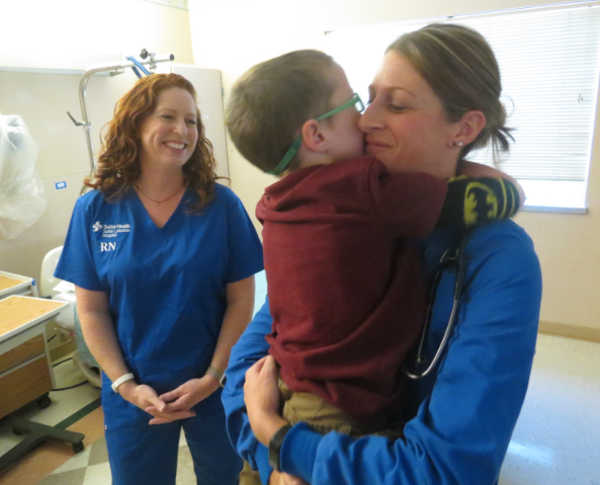
Edith considers Sabrina Bailey, RN, and Ali Conser, RN, Kaiden’s dream team. Sabrina and Ali, who met in nursing school, work together to change Kaiden’s PICC line and dressing as quickly as possible.
“That little boy – he is just so sweet,” said Ali. “He doesn’t say a lot but he always wants to give hugs and kisses. You can tell he has a warmth about him; it makes you comfortable.”
Outpatient care offers a variety of services from wound care to blood infusions. Pediatric patients aren’t common, but the staff is equipped to care for children as well.
“His smile when he walks in really does light up the room,” said Ali.
Though PICC line changes are uncomfortable, Kaiden doesn’t hold a grudge.
“He’s never mad when it’s done. He still wants to give you a hug and kiss,” said Ali.
Hope for the future
While Edith sometimes struggles with the loneliness of being a single mother to a special needs child, she gains strength from her son.
“He has such a beautiful soul; he just loves. I’ll go through anything just to have him with me, no matter what it is. My mother has been a huge support as well.”
As for Kaiden’s future, Edith trusts that her son will continue to persevere.
“A lot of the time we don’t have answers. We’re back and forth all the time to the city – not knowing what’s next is the hardest part. I wish we knew but at the same time, he’s amazing. I feel very lucky to have him as mine.”
Sutter Lakeside Hospital’s 10 bed adult and pediatric outpatient care unit is open 24/7. Services include infusions, wound care, blood transfusions, cardiac stress tests, PICC line insertions and more. For more information about Sutter Lakeside Hospital, visit www.sutterlakeside.org.

- Details
- Written by: Editor





 How to resolve AdBlock issue?