
Health
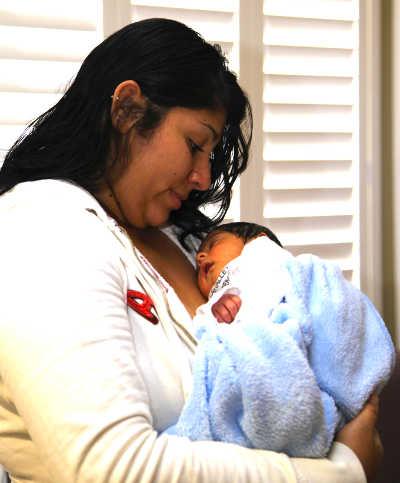
UKIAH, Calif. – The number 100 is significant in so many ways. On the Celsius scale, 100 degrees is the boiling temperature of water. 100 years is a century, considered a milestone today as during ancient times.
For Ukiah Valley Medical Center’s Family Birth Center staff, 100 has a different yet equally significant meaning.
Alex Anthony Galindo’s arrival at 6:45 p.m. on Wednesday, Oct. 31, marked a milestone at Ukiah Valley Medical Center’s Family Birth Center.
Little Alex is the 100th baby born in October, the most births in a single month since the Birth Center began delivering babies in April 1998.
Delivered by Karen Crabtree, M.D., local obstetrician and gynecologist at Mendocino Community Health Clinic, Alex Anthony weighed in at 6 pounds, 13 ounces and measured 18.5 inches long.
Proud mom Monica Marin of Ukiah, said she had a very good experience and she’s glad she chose UVMC. “The staff has been so helpful. And that means a lot to me being a first-time mom.”
The Family Birth Center has been averaging 70 deliveries per month leading up to this milestone.
“It is such a great accomplishment and truly a testament to the great staff we have here. And we’re hoping it gets even better as we are working hard to improve our facilities and equipment,” said Donna Bauer, director of perinatal services.
The department has also gone through recent renovations which make the rooms inviting and comfortable, for mom, baby and support persons. New bassinets and sofa beds make for a truly comforting experience.
“We want to make sure all moms and their families are able to bond and feel like they are in the comforts of their own homes,” said Bauer.
The department has also been hosting tours of the newly remodeled birthing suites to expectant families, boasting a private room large enough for the whole family with an on suite bathroom and Internet access.
Bauer also wanted expectant mothers to know, “We also provide birthing classes and breastfeeding consultation so that new families get support before and after the birth of their child.”
The Family Birth Center also has a special care nursery (Level II Neonatal ICU) which provides care for babies with special needs, a physician provider 24/7, a midwifery service, nurse educator and childbirth classes.
For a more intimate look at the Family Birth Center, expectant mothers can schedule a tour by calling 707-463-7550, or watch a virtual tour online at www.uvmc.org/birthcenter .
- Details
- Written by: Editor
A new study by researchers in Boston Children’s Hospital’s Division of Emergency Medicine indicates that a nationwide standard on booster seat laws for children 4 feet 9 inches and shorter, or up to 8 years old, would save lives.
The findings were published online Nov. 5 in the journal Pediatrics.
Boston Children’s researchers reviewed data from Fatality Analytic Reporting System, analyzing child deaths in motor vehicle accidents, looking specifically at whether the crash and resulting deaths or injuries took place in a state with or without a booster seat law. If the state did have a booster law, the team noted its age and height requirements.
The results varied from state to state, as many state’s booster seat laws have different age and height requirements, but overall findings were clear: states with booster seat laws had significantly fewer instances of death or injury from motor vehicle accidents, especially among children in the 6- to 7-year age group. Key findings include:
Out of 9,848 cases reviewed over a 10-year period, states with booster seat laws for children 4 to 6 had a roughly 20 percent lower rate of death and incapacitating injuries from motor vehicle crashes than states without booster seat laws.
States with booster seat laws that extended to 6- and 7-year-olds had a 35 percent decreased rate of death or incapacitating injury.
The AAP recommends that children be placed in belt-positioning booster seats after they grow too large for a car seat – around 4 years old – and until the child attains a height of about 4 feet 9 inches, usually around 8 to 12 years old.
Without boosters, many children shorter than 4 feet 9 inches run the risk of having the seat belt rest on their throat and abdomen, instead of their chest and lap. In the event of a crash, belts in that position may cause serious, even fatal, injuries to the intestines and spine.
Despite the effectiveness of booster seats in preventing this type of injury among children, usage remains low. According to reports, booster seats are used by only about half of children 4 to 5 years old and 35 percent of those 6 to 7 years old.
“Based on our findings, booster seat use for children under the age of 8 or 4 feet 9 inches really should go beyond causal suggestion,” said Rebekah Mannix, MD, MPH, of Boston Children’s Division of Emergency Medicine, lead author on the paper. “It’s clear that these laws save lives and we recommended all states adopt them.”
“At the end of the day we all want children to be safe,” added Lois Lee, MD, MPH, co-author on the study. “Data show booster seat laws help protect children, and we hope it can convince lawmakers to adopt laws that require kids to be in the proper child passenger restraint (car seat and booster seat) until the recommended age and height.”
- Details
- Written by: Editor





 How to resolve AdBlock issue?