 How to resolve AdBlock issue?
Recreation
- Details
- Written by: Carrie Wilson
Ingenious or illegal?
Question: I am going over abalone laws again for any details that I may have missed and I have one quick question.
Measuring devices: You must have a fixed-arm measuring gauge, capable of spanning an abalone’s shell. It is a violation to take an abalone when not in possession of a gauge, even if the abalone is legal-sized.
As you can see in this picture, the gauge is part of the ab iron. Since it has a fixed-arm that is capable of measuring abalone, I assume this gauge is legal. I just wanted to confirm since I am hearing that people are being approached for this type of gauge. Thanks. (Jerry)
Answer: In order for this combination abalone iron / measuring gauge to be legal, it must meet the requirements of both a legal abalone gauge and legal abalone iron.
According to California Department of Fish and Wildlife (CDFW) Lt. Dennis McKiver, the law says every person taking abalone “shall carry a fixed caliper measuring gauge capable of accurately measuring seven inches. The measuring device shall have fixed opposing arms of sufficient length to measure the abalone by placing the gauge over the shell” (California Code of Regulations Title 14, section 29.15(f)).
While the idea of carrying one device seems desirable, it is difficult to determine the absolute legality of this particular device from this photo alone.
The important thing to consider is that a legal gauge must be “capable of accurately measuring” and the fixed opposing arms must be “of sufficient length to measure the abalone by placing the gauge over the shell.”
If there is any question, the abalone fisherman should carry an additional legal abalone gauge with them.
All divers must carry an abalone gauge that measures seven inches and remember that any abalone removed from the rock that measures seven inches or more must be retained (CCR Title 14, section 29.15(d)). Wildlife officers frequently find people trophy hunting with only nine or 10 inch gauges in their possession and they end up citing many of these individuals for high grading because they are detaching and replacing abalone that are less than nine or 10 inches, but are otherwise legal to take.
Slingbow for game hunting
Question: Is it legal in California to hunt small and big game with a slingbow, provided it can cast an arrow legal for the game being hunted at least 130 yards? Referring to the California Code of Regulations Title 14, section 354, slingbows do have flexible material (the band), and a string connecting its two ends (of the band) as the nock, to satisfy the legal definition. (Jason L.)
Answer: These slingshot-style bows would not be legal because bows are defined only as longbow, recurve or compound bow (under CCR Title 14, section 354(a)).
The slingbow falls under the definition of a crossbow (CCR Title 14, section 354(b)) “or cured latex band” and could be used for hunting under crossbow regulations.
Trout fishing with 'dough balls'?
Question: While living back east, we used to use “dough balls” for trout. We made them out of corn meal, flour and water or fish meal, flour and water. Is this a legal bait for trout in California? (Mike)
Answer: Yes, processed foods may be used in California’s inland waters where bait is legal. Therefore, where bait is legal, dough balls would be legal.
Resident sport fishing license still legal after moving out of state?
Question: If I bought a California fishing license earlier in the year but then moved out of state, can I still legally fish with that resident license even if I now have an Idaho address?
I’ll be coming back and forth during the year to visit family and am hoping this license will be good at least through the end of the year. (James F., Boise, ID)
Answer: Yes, your resident California sport fishing license is valid through Dec. 31, 2014, even if you move out of state.
“Resident” is defined as: Any person who has resided continuously in the State of California for six months or more immediately prior to the date of his application for a license or permit, any person on active military duty with the Armed Forces of the United States or auxiliary branch thereof, or any person enrolled in the Job Corps established pursuant to Section 2883 of Title 29 of the United States Code (Fish and Game Code, section 70).
“Nonresident” is defined as: Any person who has not resided continuously in the State of California for six months immediately prior to the date of his application for a license or permit (FGC, section 57.)
Next year you will need to buy a nonresident sport fishing license to fish in California.
Carrie Wilson is a marine environmental scientist with the California Department of Fish and Wildlife. While she cannot personally answer everyone’s questions, she will select a few to answer each week in this column. Please contact her at
- Details
- Written by: Editor

CLEARLAKE OAKS, Calif. – Competitive runners, joggers and casual walkers seeking a vineyard setting as well as a mostly flat course will score on both counts at the Lake County Milers’ Vines to Wine run at Brassfield Estate Winery in Clearlake Oaks on Nov. 2 at 9:30 a.m.
The event, which features a chip-timed 5K run and walk along with a 10-mile run, is unique among runs in California in that it winds through vineyards and countryside on natural-terrain roads.
In addition to a traffic-free experience, the race offers all participants a technical long-sleeve T-shirt and a catered lunch (including Brassfield wine glass and four one-ounce tastings) with the opportunity to compete for first-, second- and third-place medals overall and in each age/gender division.
“Wine-loving runners who have visited Brassfield Estate Winery know what an amazing location this will be for the Vines to Wine Run. Newcomers to this area are going to be blown away by this venue,” said race director Jeanine Burnett of the picturesque locale.
The fee for this upscale event is $45 for the 5K walk or run and $55 for the 10-mile run through Aug. 15.
Register at https://runsignup.com/brassfield (small fee charged for online registration, or print registration form and mail in with check).
After Aug. 15, prices will increase by $5 for the 5K and $10 for the 10-mile, and will bump up again on Oct. 1 so register early.
Participants must be at least 12 years old; non-alcoholic beverages will be served to anyone under age 21 and to non-drinkers.
A limited number of tickets for the lunch and wine tasting will be available for spectators if purchased before event day.
Registration will be open until Oct. 30 or until the maximum of 400 participants is reached.
There will be no race day registration. The event will be held rain or shine.
Runners in the 10-mile race, covering much of the Brassfield Estate Winery’s vineyards in Lake County’s scenic High Valley appellation, must complete the course in a maximum of two hours and 20 minutes.
For this reason, casual walkers should sign up for the 5K distance. All finishers in the 10-mile race will receive a commemorative medal.
In keeping with their tradition, the Lake County Milers will donate a large portion of the proceeds from the event to benefit fitness programs at East Lake Elementary School in Clearlake Oaks as well as the Lower Lake High School cross-country team.
The Milers acknowledge the main sponsors for this event, including Brassfield Estate Winery, Bottle Rock Power and Shady Acres Campground.
The Lake County Milers is a running and walking club that promotes fitness and health in the Lake County region.
The Milers invite all runners and walkers throughout Lake County to join and receive club benefits, including information on upcoming race events and training opportunities. Whether you're a beginner or a veteran, the Milers have something for everyone.
For more details, see the group’s Web site at www.lakecountymilers.com .
- Details
- Written by: Editor
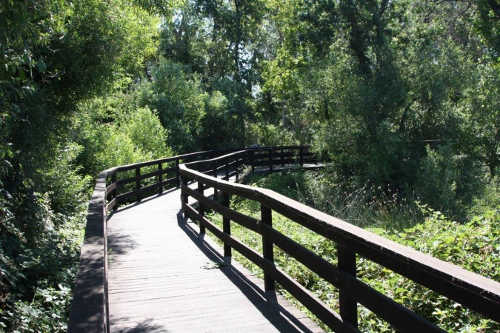
LOWER LAKE, Calif. – The last guided nature walk and ranch House tour of the summer will be held on Saturday morning, Aug. 9, at Anderson Marsh State Historic Park.
Saturday nature walks will resume in the fall on Oct. 12 and Nov. 9.
Led by park docents Gae Henry and Henry Bornstein, the August walk will explore the Cache Creek Nature Trail and Boardwalk ending at the deck on Cache Creek.
Come and view the birds, dragonflies, butterflies and other wildlife and wildflowers that can be found in the park this time of year.
Bring your binoculars and meet in front of the Ranch House at 8:15 a.m. for time to experience the early morning wildlife to be found in the Ranch House and Barn complex yard – walks begins at 8:30 a.m.
A tour of the historic Ranch House Museum will begin immediately after the walk. If rain cancels the walk, the ranch tour will begin at 8:30 a.m.
There is no charge for this event and parking is free for those attending.
For more information about nature walks or about how you can help support AMIA’s campaign to keep the park open and thriving, please visit www.andersonmarsh.org or contact them by telephone at 707-995-2658 or by email at
- Details
- Written by: Editor
The California Department of Fish and Wildlife’s (CDFW) Advanced Hunter Education Program and California Waterfowl Association are sponsoring a waterfowl hunting clinic in Redding on Saturday, Sept. 20.
The clinic is designed to teach waterfowl hunting techniques and will accommodate all skill levels.
The clinic will be taught by CDFW’s Chief of Enforcement Mike Carion and Warden Aaron Freitas both experienced hunters.
Topics to be covered are decoy placement, blind design, waterfowl calling, duck identification, hunting gear, game care, cooking tips and safety. Information will also be provided on hunting state wildlife areas and federal wildlife refuges.
If you want to learn how to hunt waterfowl successfully in Northern California, this is the clinic for you.
The clinic will run from 9 a.m. to 5 p.m. on Saturday, Sept. 20.
The cost is $45 and space is limited. Youth 16 years and younger are free but must be accompanied by adult.
Participants must register in advance at http://www.dfg.ca.gov/huntered/advanced/waterfowl_redding.aspx .
After registering, participants will receive an email with a map to the facility and a list of items to bring.