 How to resolve AdBlock issue?
Recreation
- Details
- Written by: Editor
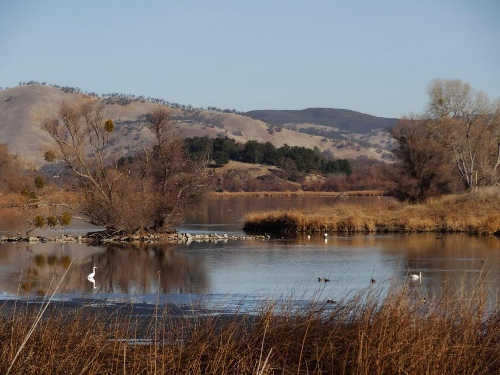
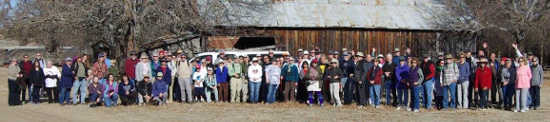
LOWER LAKE, Calif. – A record-breaking 140 Lake County residents and visitors from outside the county brought in the new year by participating in the Jan. 1 guided hike held on the newly-opened McVicar Trail at Anderson Marsh State Historic Park (AMSHP).
The hike was part of America's State Parks yearly “First Day Hikes” program.
AMSHP represented Lake County in the program, which includes State Parks in all 50 states.
Organizers said the park's hikes usually average between 15 and 25 people, with 40 people being the most they've had for previous hikes.
“This event exceeded all of our expectations and set a record for the number of people coming to the Park to enjoy a nature hike,” said park docent Gae Henry. “AMIA is pleased to have helped create this opportunity for the local community to start out the new year right. It was great seeing family groups and people of all ages coming out to enjoy beautiful Lake County.”
The First Day Hikes offer individuals and families an opportunity to begin the New Year rejuvenating and connecting with the outdoors by taking a healthy hike at a state park close to home.
The hike was led by Henry and fellow park docent Henry Bornstein, along with State Park Ranger Darin Connor and retired State Park Rangers Tom and Val Nixon.
Henry and Bornstein also are directors of the Anderson Marsh Interpretive Association (AMIA), the nonprofit, all volunteer association that cooperates with the state in operating and maintaining Anderson Marsh State Historic Park.
The work to reestablish the McVicar Trail at the park, which has been closed because of fallen trees and landslides, is the result of the partnership agreement between AMIA and the Department of Parks and Recreation.
The leisurely hike covered a distance of a little under fpur miles, beginning at the historic Ranch House complex and following the McVicar Trail through savannah grasslands, oak woodlands and riparian habitats, all the way out to the gravel beach across from Indian Island on Clear Lake itself.
Among the sights enjoyed by everyone who hiked the McVicar Trail that day was a good look at the rarely-seen Tundra Swan that has taken up residence in Anderson Marsh for the past couple of weeks.
Those who walked the entire trail and arrived at the beach in the early group also got a wonderful close-up look at a golden eagle having a territorial dispute with a red-tailed hawk.
The McVicar Trail is now open each day for the public to enjoy.
Anderson Marsh State Historic Park is located on Highway 53, between Lower Lake and Clearlake, and is open daily during daylight hours, with the vehicle parking lot open on weekends only.
For information about Anderson Marsh State Historic Park or AMIA, go to www.andersonmarsh.org or contact AMIA at either
- Details
- Written by: Carrie Wilson
Can friends pay for a friend to fish for them?
Question: What if four people got together and all paid the boat fare so that one person in the group could take a long range fishing trip?
Three of the people are not anglers. After the trip, all of the fish caught by the one angler would then be split evenly between the four people.
Would this be alright or somehow considered selling of fish? (Doug S., Montebello)
Answer: Fish caught under the authority of a sport fishing license may not be bought, sold, traded or bartered (Fish and Game Code, Section 7121).
This means if these people all helped pay the fare for another person to take a fishing trip with the expectation of receiving some of the fish caught back in return, that would be illegal.
Anglers who lawfully catch fish may always give fish away to whomever they wish, but it is not legal for non-anglers to pay for another person’s trip with the understanding or expectation of receiving fish in return for that money.
Why can’t California hunters deer hunt during the rut?
Question: While watching hunting shows on TV, I see that most of them are hunting during the rut. Why can’t deer and elk hunters in California also hunt during the rut? (Terry C.)
Answer: It’s all about providing more hunting opportunities to more people.
According to Game Species Conservation Program Manager Craig Stowers, seasons are set with certain harvest objectives in mind. Later in the season as the animals go into the rut (breeding period) they become more bold in their attempts to find a mate, and are thus easier to hunt.
If the season was held during the rut, the hunter harvest success rate would be higher, and fewer hunters would be able to hunt before the harvest objectives were reached.
Hunter survey data shows most hunters simply want an opportunity to hunt. The archery and gun seasons begin in different zones around the state in July and August, respectively.
By starting the season early and allowing it to run until late fall when the animals are just going into the rut, more hunters have more opportunities to participate.
In addition to regular season hunts, there are also several special late season hunts offered that are timed to take place during the rut.
These are highly sought-after tags, though, and they are distributed only through the big-game drawing.
Most of California’s deer hunting takes place well before the rut begins (general seasons are timed to close about a month before the rut gets started) for two reasons:
1) Hunting during the rut greatly reduces hunter opportunity (hunting success rate is higher and so fewer tags can be issued to achieve the harvest objectives).
2) To create the least amount of disturbance possible during this critical phase of their life cycle.
The bottom line is deer managers try to strike a balance between providing hunter opportunity and success while not exceeding harvest objectives.
Photo I.D. required when hunting or fishing?
Question: While hunting or fishing, besides carrying the appropriate license(s), do I also need to have photo identification in possession or can I leave it in my vehicle? (Gino A.)
Answer: You will need to verify you are the person holding your own fishing or hunting license. Though photo identification is not mandated by law, being able to identify yourself properly is.
If you cannot appropriately identify who you are, you may see yourself in an extended contact with the game warden.
If you’re getting cited for something, the game warden may have to take you to jail until you can be properly identified.
The bottom line is even though the law doesn’t state you must have photo identification in possession, it would benefit you greatly to carry photo identification, so you may properly identify who you are to the game warden.
Catching lobsters and crabs in crab traps?
Question: Is it legal to fish for both lobsters and crab at the same time using hoop nets for the lobster and a crab pot for the crabs?
My concern is that when we return to harbor, a game warden may question which method was used to take which species.
The crab pot is a Northern California type that is “soaked” for days and has escape ports. The hoop net is a basic hoop net. (Joel S.)
Answer: You may fish for lobsters and crabs at the same time but only with hoop nets or by hand. Crab traps are legal to use in the north but are illegal for sport fishermen to use south of Point Arguello (California Code Regulations Title 14, Section 29.80(e)).
While most lobsters occur in Southern California below Point Arguello, for any that do occur north of this point, crab traps may not be used.
Carrie Wilson is a marine environmental scientist with the California Department of Fish and Wildlife. While she cannot personally answer everyone’s questions, she will select a few to answer each week in this column. Please contact her at
- Details
- Written by: Editor
KELSEYVILLE, Calif. – The Kelseyville tennis group will meet on Monday, Jan. 13.
The group will meet beginning at 4 p.m. in the board room at the Kelseyville Unified School District office, 4410 Konocti Road.
A committee will report on plans for court repairs.
For more information call 707-279-9652.
- Details
- Written by: Editor
BOGGS MOUNTAIN, Calif. – The Friends of Boggs Mountain group will host a morning of trail work and maintenance on Saturday, Jan. 11.
Community members are invited to gather at Boggs Mountain State Demonstration Forest from 9 a.m. to 11 a.m.
Bring water, work gloves and a hand tool such as loppers or clippers. They also will have have tools available.
Meet in the Boggs parking lot, and carpool to the work sites, if necessary.
The forest entrance is located off Highway 175, just one and a half miles north of Cobb Village. Turn at the blue State Fire Station/Boggs Mountain Forest sign.
For more information call David at 707-928-0465.